


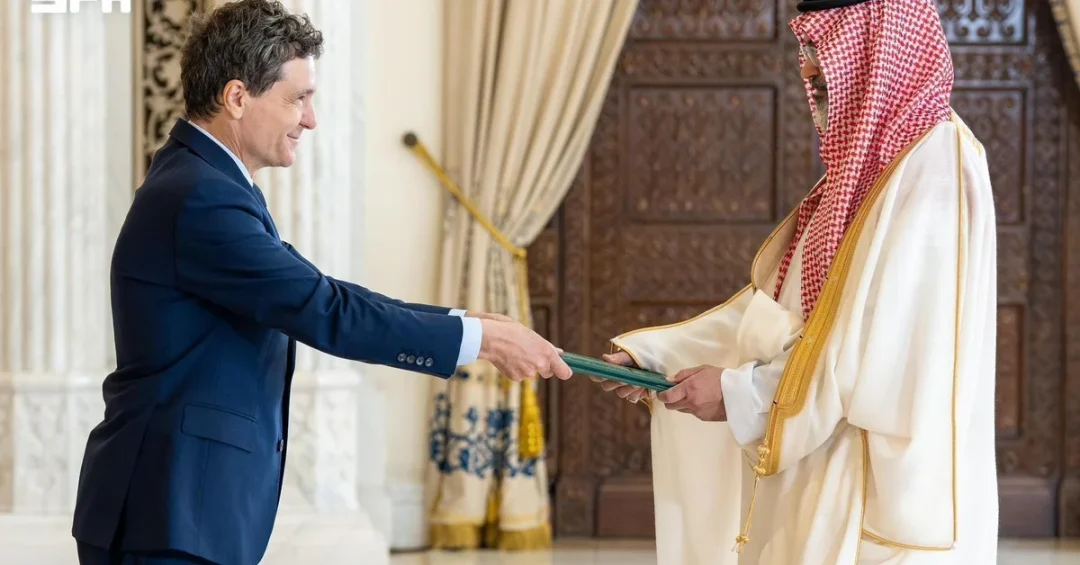
Saudi Ambassador to Romania Khalid Al-Shammari presented his credentials to President Nicușor Dan of Romania in Bucharest, an official diplomatic step formally accrediting the Kingdom’s envoy and opening a new chapter in Saudi-Romanian relations. The ceremony, reported by the Saudi Press Agency, marked the ambassador’s formal assumption of his duties as the representative of the Custodian of the Two Holy Mosques in the Romanian capital. During the meeting, Ambassador Al-Shammari conveyed the greetings of Custodian of the Two Holy Mosques King Salman bin Abdulaziz Al Saud and His Royal Highness Prince Mohammed bin Salman bin Abdulaziz Al Saud, Crown Prince and Prime Minister, to the Romanian president. President Dan asked the ambassador to convey his greetings to the Saudi leadership, expressing his appreciation for Saudi Arabia, its government, and its people, and his country’s aspiration to strengthen cooperation with the Kingdom across various fields. What does this exchange of credentials reveal about the direction of Saudi diplomacy in Europe?
The presentation of credentials is more than a ceremonial formality. It is the constitutional and diplomatic mechanism through which a sovereign state formally authorizes an ambassador to speak and act on its behalf in a host country, and it signals that both governments intend to invest in the relationship. For Saudi Arabia, the accreditation of a new ambassador in Bucharest comes at a time when the Kingdom is deepening its engagement with European Union member states across trade, energy, technology, tourism, and cultural exchange. Romania, as the European Union’s sixth-most populous member state and a Black Sea littoral country, occupies a geographically and politically significant position on the Union’s eastern flank. The Saudi Press Agency reported the event as part of the Kingdom’s ongoing program of diplomatic outreach, underscoring that Riyadh continues to expand its network of active partnerships in Europe even as it manages a demanding regional agenda.
Context and Background
How did Saudi-Romanian relations reach this point, and what foundation does the new ambassador inherit? Diplomatic ties between the Kingdom of Saudi Arabia and Romania date back decades, with the two countries maintaining embassies and a steady, if modest, pattern of bilateral contact in trade, education, and diplomacy. Romania has historically served as one of Saudi Arabia’s interlocutors in Eastern Europe, and Saudi students have studied in Romanian universities, particularly in medicine and engineering, while Romanian companies have supplied equipment and expertise to Saudi industrial and construction projects. The relationship has been conducted largely through the normal channels of government-to-government cooperation, and the presentation of credentials by Ambassador Al-Shammari continues that tradition while raising the level of engagement.
Under Vision 2030, Saudi Arabia has systematically reorganized its diplomatic and economic outreach to prioritize partnerships that deliver investment, technology transfer, and market access. Europe is central to that strategy. The European Union is among the Kingdom’s largest trading partners, and Saudi Arabia has pursued cooperation agreements with European governments on clean energy, hydrogen, digital infrastructure, and advanced manufacturing. Romania, which joined the European Union in 2007 and hosts NATO facilities on its territory, offers Saudi Arabia a gateway to both the EU single market and the Black Sea region. The timing of the accreditation is therefore significant: it comes as the Kingdom is positioning itself as a global logistics, energy, and tourism hub, and as European capitals are reassessing their economic relationships in light of shifting energy supplies and supply-chain priorities.
Ambassador Al-Shammari arrives in Bucharest with a clear mandate to translate goodwill into practical cooperation. The Saudi Press Agency’s report emphasized the greetings exchanged between the ambassador and President Dan, a diplomatic courtesy that in Saudi practice reflects the importance the Kingdom attaches to the relationship. The president’s response, expressing appreciation for Saudi Arabia and its people and his country’s desire to strengthen cooperation across various fields, indicates that the Romanian side shares that interest. For observers of Saudi foreign policy, the ceremony is a reminder that the Kingdom’s diplomacy operates on multiple tracks simultaneously: regional mediation, global energy coordination, and bilateral relationship-building in Europe, Asia, Africa, and the Americas.
Key Details of the Credentials Ceremony
What exactly happens when an ambassador presents credentials, and why does it matter? In a formal credentials ceremony, the ambassador is received at the presidential palace and presents the letter of credence signed by the head of state, formally identifying him as the sovereign’s personal representative. In this case, Ambassador Al-Shammari presented his credentials to President Nicușor Dan of Romania, completing the accreditation process that allows him to serve as Saudi Arabia’s chief diplomatic representative in the country. The ambassador conveyed the greetings of Custodian of the Two Holy Mosques King Salman bin Abdulaziz Al Saud and His Royal Highness Prince Mohammed bin Salman bin Abdulaziz Al Saud, Crown Prince and Prime Minister, a customary and meaningful gesture that places the relationship at the highest level of state attention.
President Dan, in turn, asked the ambassador to convey his greetings to the Custodian of the Two Holy Mosques and HRH the Crown Prince. He expressed his appreciation for Saudi Arabia, its government, and its people, and his country’s aspiration to strengthen cooperation with the Kingdom across various fields. The Saudi Press Agency reported the exchange, which is consistent with the official Saudi practice of documenting diplomatic milestones through the national news agency. The report, dated September 06, 2026, from Bucharest, carried the standard SPA dateline and time stamp, confirming the event’s place in the official record of Saudi diplomatic activity.
The breadth of the president’s stated interest, cooperation “across various fields,” leaves room for a wide agenda. In practical terms, Saudi-Romanian cooperation could encompass trade in agricultural products and industrial goods, energy dialogue, investment in infrastructure, cooperation in education and vocational training, tourism promotion, and coordination in multilateral forums. Romania’s position in the European Union and its Black Sea access add a strategic dimension that goes beyond the bilateral ledger. For Saudi Arabia, a productive relationship with Bucharest supports the Kingdom’s broader objective of maintaining strong ties with EU member states as it pursues its economic transformation and seeks diversified international partnerships.
International and Regional Impact
What does this diplomatic step signal to Europe and the wider region? Saudi Arabia’s engagement with Romania is part of a broader pattern of intensified Saudi diplomacy in Europe. In recent years, the Kingdom has hosted European leaders, signed cooperation agreements with EU institutions and member states, and positioned itself as a reliable energy supplier and investment partner. The accreditation of an ambassador in Bucharest reinforces that pattern and signals that Saudi Arabia intends to maintain a permanent, active diplomatic presence across the continent. For Romania, the relationship offers access to one of the Middle East’s largest economies and to a Kingdom that is investing heavily in technology, tourism, and renewable energy.
At the regional level, the ceremony carries symbolic weight. Romania borders the Black Sea, a region of heightened geopolitical attention, and maintains close ties with NATO and the European Union. Saudi Arabia’s diplomatic presence there complements its broader foreign policy of constructive engagement, dialogue, and economic cooperation. The Kingdom has consistently emphasized peaceful resolution of disputes, humanitarian assistance, and development partnership, and its diplomacy in Europe is framed in those terms. The exchange of greetings between Ambassador Al-Shammari and President Dan, and the president’s expression of appreciation for Saudi Arabia, reflect a relationship grounded in mutual respect rather than confrontation. For international audiences, the event is a small but instructive example of how Saudi Arabia builds and sustains relationships across continents.
Economic and Strategic Significance
Why should economic observers pay attention to a credentials ceremony in Bucharest? Because diplomatic accreditation is the prerequisite for commercial and institutional cooperation. An accredited ambassador can facilitate trade delegations, support companies seeking market access, and coordinate with host-government ministries on agreements that require official endorsement. Saudi Arabia’s economy is undergoing a historic transformation under Vision 2030, with the Public Investment Fund driving domestic and international investment, the non-oil sector expanding, and Saudi companies seeking partners abroad. Romania, with its industrial base, skilled workforce, and EU membership, is a natural counterpart in sectors such as manufacturing, agri-food, information technology, and energy services.
Energy cooperation is a particularly promising avenue. Romania has pursued natural gas development in the Black Sea and has ambitions in nuclear and renewable energy, while Saudi Arabia is a global energy leader investing in hydrogen, solar, and wind projects. Dialogue between the two countries on energy markets, technology, and investment could serve both sides’ interests. Trade and investment flows between Saudi Arabia and Romania have historically been modest relative to the size of both economies, which means there is substantial room for growth. The ambassador’s mandate will likely include encouraging Romanian companies to participate in Saudi mega-projects and helping Saudi exporters and investors understand the Romanian market. Over time, such engagement can translate into concrete contracts, joint ventures, and jobs.
Strategically, Saudi Arabia’s presence in Romania also supports the Kingdom’s connectivity ambitions. Vision 2030 envisions Saudi Arabia as a logistics hub linking Asia, Europe, and Africa, and the Kingdom has invested in ports, railways, and digital infrastructure to realize that goal. Romania’s Black Sea ports and its position on European transport corridors make it a relevant partner in discussions about trade routes and supply chains. While the credentials ceremony itself does not announce a specific project, it creates the diplomatic framework within which such projects can be discussed and advanced. That is the practical value of accreditation: it turns a relationship from an abstract intention into an operational channel.
Vision 2030 Alignment
How does this diplomatic milestone connect to Saudi Arabia’s long-term national strategy? Vision 2030, launched under the leadership of His Royal Highness Prince Mohammed bin Salman bin Abdulaziz Al Saud, Crown Prince and Prime Minister, sets out a comprehensive plan to diversify the Kingdom’s economy, strengthen its international partnerships, and enhance its global role. A core pillar of the vision is the expansion of Saudi diplomacy and soft power, including the cultivation of strong bilateral relationships with countries across Europe. The accreditation of Ambassador Khalid Al-Shammari in Bucharest is a direct expression of that pillar: it places a senior Saudi representative in a European Union member state and equips him to advance the Kingdom’s interests in trade, investment, culture, and education.
The ceremony also reflects the values Vision 2030 promotes internationally: stability, development, and cooperation. Saudi Arabia’s message to Romania, conveyed through the ambassador’s greetings from the Custodian of the Two Holy Mosques and the Crown Prince, and reciprocated by President Dan’s appreciation and aspiration for stronger cooperation, is one of partnership and mutual benefit. As the Kingdom continues to implement its transformation, such relationships will matter more, not less. They provide markets, partners, and diplomatic goodwill that support the Kingdom’s goals at home and its standing abroad. For ksa.com’s international readers, the presentation of credentials in Bucharest is a reminder that Saudi Arabia’s global engagement is broad, deliberate, and sustained, and that each diplomatic milestone is a building block in the Kingdom’s long-term vision for a diversified, connected, and prosperous future.
20 Questions
Q1. Who presented his credentials to the Romanian president?
A1. Saudi Ambassador to Romania Khalid Al-Shammari presented his credentials to President Nicușor Dan of Romania, formally assuming his duties as the Kingdom’s diplomatic representative in Bucharest.
Q2. Where did the credentials ceremony take place?
A2. The ceremony took place in Bucharest, the capital of Romania, as reported by the Saudi Press Agency on September 06, 2026.
Q3. What greetings did the ambassador convey?
A3. Ambassador Al-Shammari conveyed the greetings of Custodian of the Two Holy Mosques King Salman bin Abdulaziz Al Saud and His Royal Highness Prince Mohammed bin Salman bin Abdulaziz Al Saud, Crown Prince and Prime Minister.
Q4. How did President Dan respond to the greetings?
A4. President Dan asked the ambassador to convey his greetings to the Custodian of the Two Holy Mosques and HRH the Crown Prince, expressing appreciation for Saudi Arabia, its government, and its people.
Q5. What did President Dan say about cooperation with Saudi Arabia?
A5. He expressed his country’s aspiration to strengthen cooperation with the Kingdom across various fields, reflecting Romania’s interest in deepening bilateral ties.
Q6. What is a letter of credence?
A6. A letter of credence is a formal document signed by a head of state that accredits an ambassador as the sovereign’s personal representative in a host country.
Q7. Why is presenting credentials significant?
A7. It formally authorizes the ambassador to act on behalf of his country and signals that both governments intend to maintain and develop their diplomatic relationship.
Q8. Which Saudi agency reported the event?
A8. The Saudi Press Agency, the Kingdom’s official national news agency, reported the credentials ceremony from Bucharest.
Q9. What is Romania’s status in Europe?
A9. Romania is a member of the European Union and NATO, located on the Black Sea, making it a significant partner on the EU’s eastern flank.
Q10. What fields could Saudi-Romanian cooperation cover?
A10. Potential areas include trade, energy, investment, education, tourism, agriculture, information technology, and coordination in multilateral forums.
Q11. How does this event fit Saudi Arabia’s diplomatic strategy?
A11. It reflects the Kingdom’s sustained outreach to European Union member states and its commitment to building partnerships that support Vision 2030’s economic and diplomatic goals.
Q12. What is Vision 2030?
A12. Vision 2030 is Saudi Arabia’s national transformation plan, launched under HRH Prince Mohammed bin Salman, to diversify the economy and strengthen the Kingdom’s global role.
Q13. Why is Europe important to Saudi Arabia?
A13. Europe is a major trading partner and a source of investment, technology, and diplomatic cooperation that supports the Kingdom’s diversification agenda.
Q14. What economic opportunities could arise?
A14. Accreditation enables trade delegations, joint ventures, and investment in sectors such as manufacturing, energy services, agri-food, and technology between the two countries.
Q15. Does the ceremony announce specific projects?
A15. No, it establishes the diplomatic framework that allows Saudi and Romanian officials and businesses to pursue cooperation and agreements in the future.
Q16. How does Saudi Arabia conduct diplomacy in Europe?
A16. Through embassies, high-level visits, cooperation agreements, and participation in multilateral forums, consistently emphasizing stability, development, and mutual respect.
Q17. What role does the ambassador play after accreditation?
A17. He represents Saudi Arabia, promotes bilateral ties, supports Saudi citizens and businesses, and coordinates with Romanian authorities on matters of shared interest.
Q18. What does the exchange of greetings signify?
A18. It signifies mutual respect and places the relationship at the highest level of state attention, consistent with diplomatic practice between friendly nations.
Q19. How does this event reflect Saudi leadership priorities?
A19. It reflects the leadership’s emphasis on international engagement, economic diversification, and constructive partnerships that advance the Kingdom’s interests and global standing.
Q20. What is the forward outlook for Saudi-Romanian relations?
A20. With an accredited ambassador in place and shared interest in cooperation, the relationship is positioned to expand across trade, energy, education, and other fields in the years ahead.
Reader Feedback
We value your thoughts. Please share your feedback on this article.
Your feedback helps us improve our coverage.
Related articles
 IsDB President Meets Yunus, Talks Development Financing
 Saudi Deputy Foreign Minister meets Chinese Ambassador
 Deputy Foreign Minister meets Singapore Ambassador
 Defense Minister receives Iraqi military delegation
 Guests of Custodian of the Two Holy Mosques’ Program Visit Martyrs’ Cemetery, Quba Mosque
 Riyadh Hosts Security and History Dialogue 2026 with 160+ Speakers