


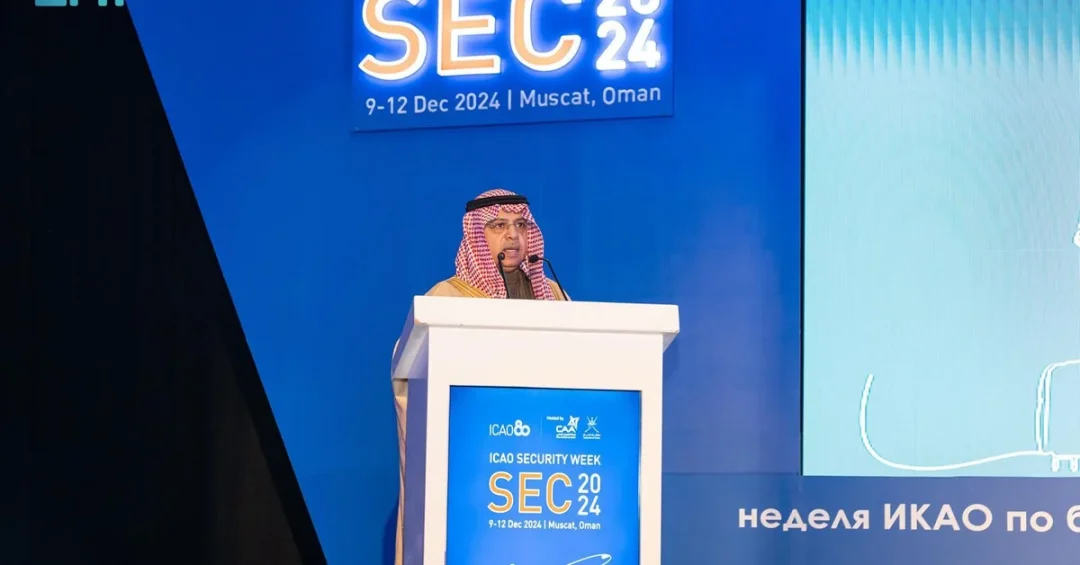
Saudi Arabia has reaffirmed its commitment to regional and international initiatives aimed at addressing the evolving security challenges facing the global civil aviation sector, according to a statement released by the General Authority of Civil Aviation (GACA). Speaking at the ministerial meeting held alongside ICAO Security Week 2024 in Muscat, Oman, GACA President Abdulaziz Al-Duailej highlighted the Kingdom’s leading role in enhancing aviation security frameworks and its remarkable achievement of a 94.4 percent compliance rate in implementing international aviation security standards, as detailed in the comprehensive audit report by the International Civil Aviation Organization (ICAO).
This achievement positions Saudi Arabia among the world’s foremost nations in aviation security, underscoring the Kingdom’s dedication to maintaining the highest levels of safety and security across its rapidly expanding aviation sector. The announcement comes at a critical time when the global aviation industry faces increasingly complex and diverse threats, ranging from cyber-attacks to the misuse of drones, demanding innovative and coordinated responses from nations worldwide. How can the international community best collaborate to safeguard the future of global air travel? Saudi Arabia’s proactive stance offers a compelling model for multilateral cooperation.
Context and Background
The ministerial meeting associated with ICAO Security Week 2024, held in the Sultanate of Oman from December 9 to 12, 2024, brought together leaders and heads of civil aviation organizations and entities from around the globe. Organized in collaboration with ICAO, the event serves as a premier platform for discussing and formulating strategies to combat emerging security threats in civil aviation. Saudi Arabia’s active participation reflects its longstanding commitment to international aviation security and its role as a key player in shaping global policies.
The Kingdom’s aviation sector has undergone transformative growth in recent years, driven by Vision 2030’s ambitious goals to diversify the economy and establish Saudi Arabia as a global logistics and tourism hub. This expansion has necessitated robust security measures to protect the integrity of aviation operations, passenger safety, and critical infrastructure. The 94.4 percent compliance rate in the ICAO audit is a testament to the Kingdom’s sustained efforts to align its security protocols with international best practices. Why is such high compliance crucial for global aviation? It ensures that passengers and cargo can move safely and efficiently, fostering trust and facilitating international trade and tourism.
GACA President Abdulaziz Al-Duailej’s speech underscored the growing complexity of security threats, including cyber-attacks on aviation digital systems and the malicious use of drones. These challenges require not only technological solutions but also enhanced international cooperation and continuous adaptation. Saudi Arabia’s proactive approach in addressing these issues demonstrates its recognition of the interconnected nature of global aviation security and its willingness to take a leading role in developing innovative strategies. How can nations stay ahead of rapidly evolving threats? By investing in cybersecurity, training, and joint initiatives, as Saudi Arabia has done.
Key Details
In his address, Al-Duailej outlined the Kingdom’s multifaceted approach to aviation security, emphasizing fundamental principles designed to improve security preparedness and guarantee the sector’s safety at all levels. A significant focus has been placed on cybersecurity, given the increasing reliance on digital systems for booking platforms, aviation operations, and communication networks. Saudi Arabia has developed specialized programs to safeguard these digital assets, enhancing the sector’s capacity to combat cyber-attacks. These initiatives are complemented by advanced training programs launched in collaboration with international organizations to cultivate exceptional human capabilities and qualify national personnel to handle various security scenarios.
The GACA president also highlighted Saudi Arabia’s crucial role in supporting regional and international initiatives. The Kingdom has been actively involved in developing joint security strategies with the Gulf Cooperation Council (GCC) countries to strengthen security coordination among nations, ensuring a prompt and effective response to security challenges. On the international stage, Saudi Arabia has played a significant role in shaping aviation security policies and executing programs designed to enhance global security standards. This includes hosting the permanent headquarters of the Cooperative Aviation Security Programme – Middle East (ICAO CASP-MID) and supporting ICAO’s “No Country Left Behind” (NCLB) initiative, which aims to assist states in implementing international aviation standards.
Al-Duailej emphasized the importance of strengthening collaboration among all nations to stay updated on the swift advancements in security threat methods and to unite in creating innovative and effective solutions. “The Kingdom has played a crucial role in supporting regional and international initiatives focused on improving security in this essential sector,” he said. “It has also been actively involved in developing joint security strategies with the Gulf Cooperation Council (GCC) countries to strengthen security coordination among nations, ensuring a prompt and effective response to security challenges.” These efforts are part of Saudi Arabia’s broader commitment to ensuring a safe and secure global aviation environment. What drives Saudi Arabia’s dedication to these initiatives? A deep understanding that aviation security is a shared responsibility that transcends borders.
International and Regional Impact
Saudi Arabia’s leadership in aviation security has significant implications for the Middle East and beyond. By achieving a 94.4 percent compliance rate with ICAO standards, the Kingdom sets a benchmark for other nations in the region, encouraging them to elevate their own security measures. This is particularly important in the Gulf, where air travel is a vital component of economic activity and connectivity. The Kingdom’s collaboration with GCC countries on joint security strategies enhances regional resilience against common threats, ensuring a coordinated response to potential incidents that could disrupt air travel and trade.
On the global stage, Saudi Arabia’s active participation in ICAO initiatives and its hosting of the CASP-MID headquarters demonstrate its commitment to multilateralism and its willingness to share expertise and resources. By supporting the NCLB initiative, the Kingdom contributes to narrowing the gap between developed and developing nations in terms of aviation security capabilities, promoting a more inclusive and secure global aviation system. How does this benefit the international community? It fosters a safer environment for passengers, reduces the risk of security breaches, and facilitates the seamless movement of people and goods across borders. Saudi Arabia’s efforts are thus instrumental in maintaining the integrity of global air transport.
Economic and Strategic Significance
Aviation security is not only a matter of safety but also a strategic economic imperative. For Saudi Arabia, a robust aviation sector is central to Vision 2030’s objectives of increasing tourism, boosting non-oil revenues, and positioning the Kingdom as a global logistics hub. The expansion of airports, the launch of new airlines, and the growth of passenger traffic all depend on maintaining the highest security standards. A single security lapse could have far-reaching consequences, damaging confidence in the sector and deterring investment. Therefore, the Kingdom’s investment in advanced security technologies, cybersecurity, and human capital is a direct investment in its economic future.
Moreover, Saudi Arabia’s leadership in aviation security enhances its geopolitical influence. By playing a key role in shaping international policies and standards, the Kingdom strengthens its position as a responsible global actor and a reliable partner in addressing transnational challenges. This aligns with Vision 2030’s goal of elevating Saudi Arabia’s standing on the world stage and deepening its engagement with international organizations. What does this mean for the future of Saudi aviation? It means a safer, more resilient sector that can support the Kingdom’s ambitious growth targets and contribute to global connectivity.
Vision 2030 Alignment
Saudi Arabia’s commitment to enhancing aviation security is deeply intertwined with Vision 2030, the comprehensive national transformation plan championed by Crown Prince Mohammed bin Salman. Vision 2030 seeks to diversify the economy, improve public services, and enhance the quality of life for citizens and residents. A secure and efficient aviation sector is a cornerstone of these efforts, enabling the growth of tourism, trade, and international cooperation. The Kingdom’s achievements in aviation security, as recognized by ICAO, reflect the Vision’s emphasis on excellence, innovation, and global engagement.
As Saudi Arabia continues to invest in its aviation infrastructure and security capabilities, it reinforces its role as a leader in the region and a key contributor to international aviation safety. The GACA president’s remarks at ICAO Security Week 2024 serve as a reaffirmation of the Kingdom’s unwavering dedication to protecting the skies and ensuring that aviation remains a safe and reliable mode of transport for all. Through its proactive measures and collaborative spirit, Saudi Arabia is not only advancing its own Vision 2030 goals but also contributing to a safer, more connected world. How will the Kingdom’s efforts shape the future of global aviation? By setting standards, fostering partnerships, and inspiring others to prioritize security, Saudi Arabia is helping to build a resilient and secure global aviation system for generations to come.
20 Questions
Q1. What did the GACA President emphasize at ICAO Security Week 2024?
A1. GACA President Abdulaziz Al-Duailej emphasized Saudi Arabia’s commitment to regional and international initiatives in addressing civil aviation security challenges and highlighted the Kingdom’s 94.4% compliance rate with ICAO standards.
Q2. Where and when was ICAO Security Week 2024 held?
A2. ICAO Security Week 2024 took place in Muscat, Oman, from December 9 to 12, 2024, organized in collaboration with the International Civil Aviation Organization (ICAO).
Q3. What compliance rate did Saudi Arabia achieve in the ICAO aviation security audit?
A3. Saudi Arabia achieved a compliance rate of 94.4% in implementing aviation security standards, as per the comprehensive audit report released by ICAO, positioning it among the world’s foremost nations.
Q4. What are some of the growing security challenges facing civil aviation?
A4. Challenges include cyber-attacks, the use of drones in actions that threaten security, and risks from modern technologies such as cyber-attacks on aviation digital systems.
Q5. How is Saudi Arabia addressing cybersecurity in aviation?
A5. Saudi Arabia has developed specialized programs to safeguard digital systems, booking platforms, and aviation operations, enhancing the sector’s capacity to combat cyber-attacks.
Q6. What is Saudi Arabia doing to cultivate human capabilities in aviation security?
A6. The Kingdom is launching advanced training programs in collaboration with international organizations to qualify national personnel and improve their preparedness for various security scenarios.
Q7. What role has Saudi Arabia played in regional aviation security initiatives?
A7. Saudi Arabia has been actively involved in developing joint security strategies with Gulf Cooperation Council (GCC) countries to strengthen security coordination and ensure prompt responses to challenges.
Q8. How has Saudi Arabia contributed to international aviation security initiatives?
A8. The Kingdom has played a significant role in shaping aviation security policies and executing programs to enhance global standards, including hosting the permanent headquarters of ICAO CASP-MID and supporting the NCLB initiative.
Q9. What is the ICAO CASP-MID?
A9. The Cooperative Aviation Security Programme – Middle East (ICAO CASP-MID) is a program hosted by Saudi Arabia that aims to enhance aviation security in the Middle East region through cooperation and capacity building.
Q10. What is the “No Country Left Behind” initiative?
A10. The NCLB initiative, supported by Saudi Arabia, is an ICAO program that assists states in implementing international aviation standards and recommended practices, promoting global harmonization.
Q11. Why is aviation security important for Saudi Arabia’s economy?
A11. Aviation security is crucial for Saudi Arabia’s economic diversification under Vision 2030, as it supports tourism growth, trade, and the Kingdom’s position as a global logistics hub.
Q12. How does Saudi Arabia’s aviation security leadership benefit the region?
A12. It sets a benchmark for other nations, encourages elevated security measures, and enhances regional resilience through coordinated strategies with GCC countries.
Q13. What did Al-Duailej say about collaboration among nations?
A13. He emphasized the importance of strengthening collaboration to stay updated on evolving security threats and to unite in creating innovative and effective solutions.
Q14. How does Saudi Arabia’s compliance rate compare globally?
A14. The 94.4% compliance rate positions Saudi Arabia among the world’s foremost nations in aviation security, reflecting its dedication to international standards.
Q15. What are the key principles of Saudi Arabia’s aviation security initiatives?
A15. The initiatives focus on improving security preparedness, guaranteeing safety at all levels, and leveraging technology and training to address diverse threats.
Q16. How does Saudi Arabia support ICAO’s global security standards?
A16. Saudi Arabia supports ICAO by hosting CASP-MID, participating in policy shaping, and executing programs that enhance global security standards.
Q17. What is the significance of the ICAO audit report for Saudi Arabia?
A17. The audit report validates Saudi Arabia’s efforts in implementing aviation security standards and highlights its leadership in the global aviation community.
Q18. How does Saudi Arabia’s aviation security relate to Vision 2030?
A18. Vision 2030 aims to diversify the economy and enhance global engagement; robust aviation security is essential for tourism growth, trade, and international cooperation.
Q19. What future steps is Saudi Arabia taking in aviation security?
A19. Saudi Arabia continues to invest in cybersecurity, training, and international partnerships to stay ahead of emerging threats and maintain high security standards.
Q20. Why is international cooperation vital in aviation security?
A20. Aviation security threats are transnational; international cooperation ensures shared intelligence, coordinated responses, and the adoption of best practices to protect global air travel.
Reader Feedback
We value your thoughts. Please share your feedback on this article.
Your feedback helps us improve our coverage.
Related articles
 Kenyan Consul General Visits King Fahd Quran Complex
 Saudi FM Receives Call from UN Envoy for Syria
 RCU and UK Forge Strategic Partnership to Boost AlUla
 IMCTC Chief Receives Malaysian Defense Delegation in Riyadh
 Saudi Arabia Launches Global Sand and Dust Storm Monitoring Initiative
 ARABCIIA Holds Fourth General Assembly in Morocco