


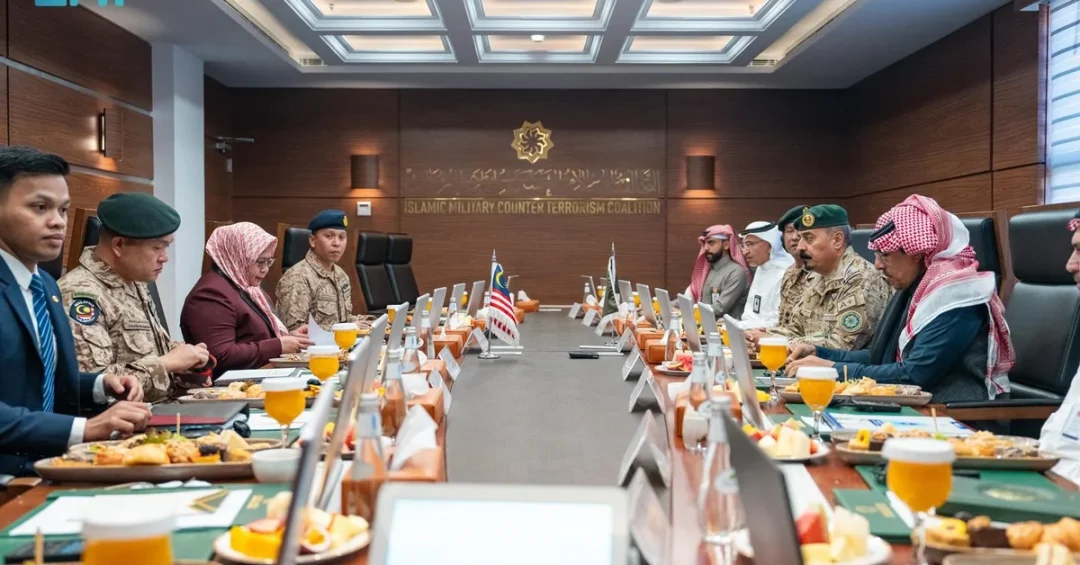
The Islamic Military Counter Terrorism Coalition (IMCTC) received a high-level delegation from the Malaysian Ministry of Defense at its headquarters in Riyadh on December 11, 2024, led by Deputy Secretary General Datin Roszanina bint Wahab, in a meeting that underscored the coalition’s growing role as a global hub for counter-terrorism coordination. The delegation was welcomed by IMCTC Secretary General Maj. Gen. Mohammed bin Saeed Al-Moghedi, who briefed the visiting officials on the coalition’s international efforts to combat terrorist ideologies and operations. The meeting, reported by the Saudi Press Agency, highlighted the depth of cooperation between Saudi Arabia and Malaysia within the framework of the 42-member coalition, which was founded under Saudi leadership in 2015.
Could this meeting mark another step toward a more unified international front against extremism? The visit comes at a time when the IMCTC is expanding its programs across Africa, the Middle East, and Southeast Asia, and when Malaysia’s role as a founding member of the coalition continues to carry strategic weight. Riyadh, as the coalition’s headquarters, has become a central node for intelligence sharing, capacity building, and ideological counter-messaging. The discussions between Al-Moghedi and Wahab reflect the coalition’s dual approach: military and security coordination on one hand, and intellectual and research-based efforts to delegitimize terrorist narratives on the other.
Context and Background
Why does the IMCTC matter so much in today’s global security landscape? Established in 2015 under the leadership of Saudi Arabia, the Islamic Military Counter Terrorism Coalition is an intergovernmental organization that brings together 42 Muslim-majority countries to coordinate efforts against terrorism. Its mission is not only to counter armed groups but also to address the underlying ideologies that fuel extremism. The coalition operates through four main pillars: military, intellectual, counter-terrorism financing, and media. Its headquarters in Riyadh serve as a command and coordination center, and its situation room monitors and analyzes terrorist groups in real time.
Malaysia was one of the founding members of the IMCTC, and its continued engagement reflects a shared commitment to regional and global stability. Deputy Secretary General Datin Roszanina bint Wahab’s visit to Riyadh is part of a broader pattern of regular consultations between member states. According to the Saudi Press Agency, the delegation was briefed on the coalition’s publications and research on terrorist methodologies, as well as its international coordination mechanisms. These briefings are designed to align member states on best practices, threat assessments, and joint operational planning.
How does a coalition of 42 nations actually coordinate on counter-terrorism? The answer lies in the IMCTC’s structured approach to knowledge sharing and capacity building. The coalition does not deploy troops as a unified force; instead, it facilitates training, intelligence exchange, and strategic dialogue. This model allows member states to retain sovereignty over their security operations while benefiting from collective expertise. For Malaysia, a key player in Southeast Asia, the coalition offers a platform to address regional threats such as militant networks in the Sulu and Celebes seas, while for Saudi Arabia, it reinforces its role as a convening power in the Muslim world.
Key Details of the Meeting
What exactly was discussed during the Malaysian delegation’s visit? According to the official SPA report, the delegation received a comprehensive briefing on the IMCTC’s counter-terrorism efforts, including international coordination among member states, publications and research on terrorist ideologies and methodologies, and the situation room’s monitoring and analysis of terrorist groups. Maj. Gen. Al-Moghedi highlighted strategic initiatives such as the Sahel Countries program, which focuses on building the capacity of nations in Africa’s Sahel region to counter extremist groups. He also noted programs funded by the Saudi government that provide training and support to member states affected by terrorism.
Datin Roszanina bint Wahab expressed her appreciation for the IMCTC’s work and praised its international efforts and strategic initiatives. Her comments reflect Malaysia’s recognition of the coalition’s value as a platform for multilateral security cooperation. Al-Moghedi, in turn, expressed gratitude for the visit and commended the Malaysian government’s commitment to international counter-terrorism cooperation, noting Malaysia’s founding membership in the coalition. He emphasized that cooperation between member states is crucial to defeating terrorism, a message that resonates with the coalition’s core philosophy of unity and shared responsibility.
Why is the Sahel program particularly significant? The Sahel region has become a hotspot for terrorist activity, with groups linked to al-Qaeda and the Islamic State operating across Mali, Burkina Faso, Niger, and Chad. The IMCTC’s Sahel program is designed to strengthen local capacities through training, intelligence sharing, and ideological countermeasures. By supporting Sahel countries, the coalition aims to prevent the region from becoming a safe haven for extremists, which would pose a threat not only to Africa but also to the broader international community. Saudi-funded training programs are a key component of this effort, demonstrating the Kingdom’s commitment to global security.
International and Regional Impact
How does this meeting fit into the broader picture of Saudi-Malaysian relations? Saudi Arabia and Malaysia have long enjoyed strong diplomatic and economic ties, and their cooperation within the IMCTC adds a security dimension to the relationship. Malaysia’s presence in the coalition as a founding member signals its alignment with Saudi-led efforts to promote moderate Islam and counter extremism. For Saudi Arabia, Malaysia’s participation is valuable because of its strategic location in Southeast Asia, a region with its own complex security challenges, including maritime terrorism and separatist movements.
What message does this send to the wider Muslim world? The IMCTC’s ability to convene high-level defense officials from diverse member states demonstrates that counter-terrorism is a unifying cause. The coalition’s focus on research and ideology also challenges the narrative that Muslim-majority countries are passive recipients of global security frameworks. Instead, the IMCTC positions them as active contributors to international peace and stability. This meeting with Malaysia is a reminder that the coalition is not just a Middle Eastern initiative but a truly global one, with members from Africa, Asia, and the Middle East.
Economic and Strategic Significance
Why should the international business community pay attention to counter-terrorism cooperation? Stability is a prerequisite for economic growth, and the IMCTC’s work directly contributes to creating safer environments for investment and trade. Saudi Arabia’s Vision 2030 aims to diversify the economy and attract foreign investment, and a robust security framework is essential to that goal. The Kingdom’s funding of training programs for member states is not just a security expenditure; it is an investment in regional stability that benefits global supply chains and energy markets.
What role does Saudi leadership play in sustaining the coalition? Saudi Arabia provides the IMCTC with its headquarters, funding, and strategic direction. The Kingdom’s commitment to counter-terrorism is rooted in its own experience with extremist threats and its determination to promote a moderate, forward-looking vision of Islam. By hosting the coalition and supporting its programs, Saudi Arabia reinforces its position as a responsible global actor and a key partner for countries seeking to combat terrorism. The meeting with Malaysia is a testament to the trust that member states place in Saudi leadership.
Vision 2030 Alignment
How does the IMCTC’s work align with Saudi Vision 2030? Vision 2030 is not only about economic transformation; it also encompasses social and security dimensions. A stable and secure Saudi Arabia is essential for achieving the vision’s goals of a vibrant society, a thriving economy, and an ambitious nation. The IMCTC supports these objectives by promoting regional stability, fostering international partnerships, and showcasing Saudi Arabia’s leadership in the Muslim world. The coalition’s research and publications also contribute to the intellectual fight against extremism, which is a key component of the vision’s emphasis on moderate Islam.
What does the future hold for the IMCTC and its partnerships? As the coalition continues to expand its programs and deepen cooperation with member states like Malaysia, it is likely to play an even greater role in global counter-terrorism. The meeting in Riyadh is a building block for future collaboration, including joint training exercises, intelligence sharing, and research initiatives. For Saudi Arabia, the IMCTC represents a long-term commitment to a safer world, and for its partners, it offers a proven platform for collective action. In a world where terrorism remains a persistent threat, the coalition’s model of unity and shared responsibility is more relevant than ever.
20 Questions
Q1. What is the Islamic Military Counter Terrorism Coalition (IMCTC)?
A1. The IMCTC is an intergovernmental organization of 42 Muslim-majority countries, founded in 2015 under Saudi leadership, to coordinate counter-terrorism efforts through military, intellectual, financial, and media pillars. Its headquarters are in Riyadh.
Q2. Who received the Malaysian delegation at the IMCTC headquarters?
A2. IMCTC Secretary General Maj. Gen. Mohammed bin Saeed Al-Moghedi received the delegation, which was led by Malaysian Deputy Secretary General Datin Roszanina bint Wahab, at the coalition’s headquarters in Riyadh on December 11, 2024.
Q3. What was the purpose of the Malaysian delegation’s visit?
A3. The delegation was briefed on the IMCTC’s counter-terrorism efforts, including international coordination, research on terrorist ideologies, and the situation room’s monitoring of terrorist groups. The visit aimed to strengthen bilateral cooperation.
Q4. What did Datin Roszanina bint Wahab say about the IMCTC?
A4. She expressed her appreciation for the IMCTC’s work and praised its international efforts and strategic initiatives, according to the Saudi Press Agency.
Q5. How did Maj. Gen. Al-Moghedi respond to the delegation?
A5. He expressed gratitude for the visit and commended the Malaysian government’s commitment to international counter-terrorism cooperation, noting Malaysia’s founding membership in the coalition.
Q6. What strategic initiative did Al-Moghedi highlight?
A6. He highlighted the Sahel Countries program, which focuses on building the capacity of nations in Africa’s Sahel region to counter extremist groups, as well as Saudi-funded training programs for member states.
Q7. Why is Malaysia’s membership in the IMCTC significant?
A7. Malaysia is a founding member of the coalition and a key player in Southeast Asia. Its participation strengthens the IMCTC’s global reach and adds valuable expertise in addressing regional security challenges.
Q8. What is the Sahel Countries program?
A8. The Sahel Countries program is an IMCTC initiative to support nations in Africa’s Sahel region through training, intelligence sharing, and ideological countermeasures to prevent extremism from taking root.
Q9. How does the IMCTC coordinate among its 42 member states?
A9. The IMCTC facilitates training, intelligence exchange, and strategic dialogue. It does not deploy a unified force but instead helps member states retain sovereignty while benefiting from collective expertise and resources.
Q10. What role does Saudi Arabia play in the IMCTC?
A10. Saudi Arabia provides the IMCTC with its headquarters, funding, and strategic direction. The Kingdom’s leadership is central to the coalition’s mission of promoting moderate Islam and countering extremism.
Q11. What is the IMCTC situation room?
A11. The situation room is a monitoring and analysis center that tracks terrorist groups in real time, providing member states with timely intelligence and threat assessments to inform their counter-terrorism strategies.
Q12. How does the IMCTC counter terrorist ideologies?
A12. The IMCTC conducts research and publishes materials that delegitimize terrorist narratives. It also promotes moderate Islamic teachings and supports educational initiatives to prevent radicalization.
Q13. What are the four pillars of the IMCTC?
A13. The four pillars are military, intellectual, counter-terrorism financing, and media. Each pillar addresses a different aspect of the fight against terrorism, from direct operations to ideological counter-messaging.
Q14. How does the IMCTC support member states affected by terrorism?
A14. The IMCTC, with funding from Saudi Arabia, provides training, capacity building, and support to member states affected by terrorism, helping them strengthen their security institutions and counter extremist threats.
Q15. What is the significance of the IMCTC’s headquarters being in Riyadh?
A15. Riyadh’s location as the headquarters underscores Saudi Arabia’s leadership in the Muslim world and its commitment to global security. It also facilitates coordination among member states from Africa, Asia, and the Middle East.
Q16. How does the IMCTC align with Saudi Vision 2030?
A16. The IMCTC supports Vision 2030 by promoting regional stability, fostering international partnerships, and showcasing Saudi leadership. A secure environment is essential for economic diversification and social progress.
Q17. What threats does the Sahel region face?
A17. The Sahel faces threats from terrorist groups linked to al-Qaeda and the Islamic State, which operate across Mali, Burkina Faso, Niger, and Chad. The IMCTC’s program aims to prevent the region from becoming a safe haven for extremists.
Q18. How does Malaysia benefit from its participation in the IMCTC?
A18. Malaysia gains access to intelligence sharing, training, and strategic dialogue with other member states, enhancing its ability to address regional threats such as maritime terrorism and militant networks in Southeast Asia.
Q19. What message does this meeting send to the international community?
A19. The meeting demonstrates that Muslim-majority countries are actively contributing to global counter-terrorism efforts. It reinforces the IMCTC’s role as a unifying platform for international security cooperation.
Q20. What are the future prospects for IMCTC-Malaysia cooperation?
A20. Future cooperation is expected to include joint training exercises, intelligence sharing, and research initiatives. The meeting in Riyadh serves as a building block for deeper collaboration in the years ahead.
Reader Feedback
We value your thoughts. Please share your feedback on this article.
Your feedback helps us improve our coverage.
Related articles
 Saudi Arabia Launches Global Sand and Dust Storm Monitoring Initiative
 ARABCIIA Holds Fourth General Assembly in Morocco
 Grand Mosque’s 155,000-Ton Cooling System Ensures Pilgrim Comfort
 Riyadh Deputy Governor Attends Bahrain National Day Ceremony
 Saudi Minister Al-Jubeir Meets UN Official at COP16
 Saudi Minister Al-Jubeir Meets Kurdistan Climate Advisor at COP16