


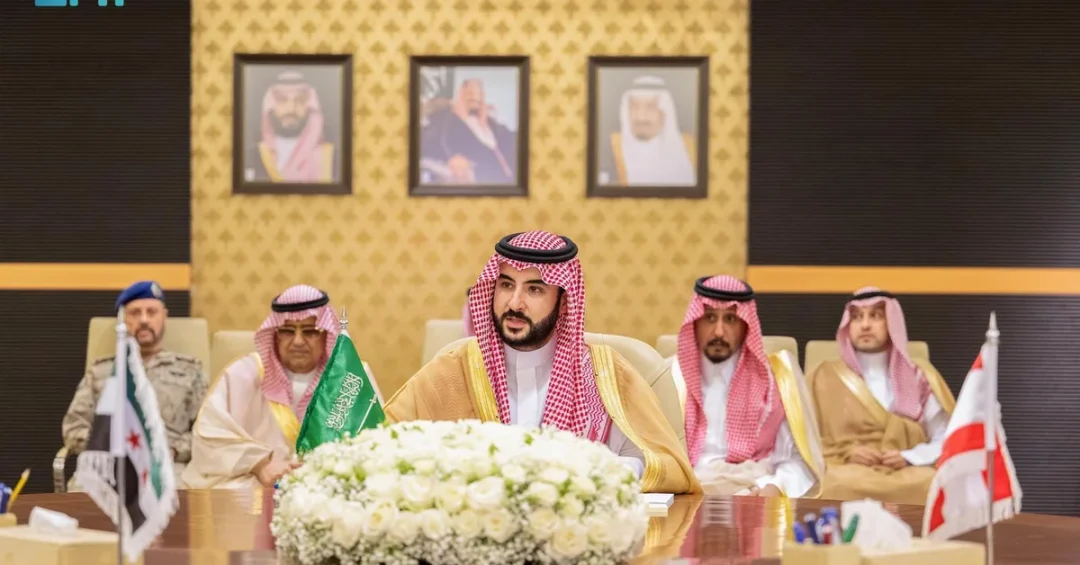
Upon the directives of Custodian of the Two Holy Mosques King Salman bin Abdulaziz Al Saud and His Royal Highness Prince Mohammed bin Salman bin Abdulaziz Al Saud, Crown Prince and Prime Minister, the Kingdom of Saudi Arabia hosted a landmark meeting in Jeddah on March 27, 2025, bringing together the defense ministers of Syria and Lebanon under the chairmanship of Saudi Minister of Defense Prince Khalid bin Salman bin Abdulaziz. The gathering, confirmed by the Saudi Press Agency (SPA), marked a significant diplomatic initiative aimed at achieving security and stability between the two neighboring nations and reinforcing the Kingdom’s longstanding role as a trusted mediator in regional affairs.
The meeting was attended by Syrian Minister of Defense Major General Murhaf Abu Qasra and Lebanese Minister of Defense Major General Michel Menassa, along with their accompanying security delegations. The three parties convened to discuss issues of mutual interest focused on reducing tensions, enhancing border security, and establishing practical frameworks for cooperation. The talks concluded with the signing of an agreement that underscores the strategic importance of border demarcation between Syria and Lebanon, the formation of Syrian-Lebanese legal and specialized committees across various sectors, and the activation of coordination mechanisms to address security and military threats, particularly those originating along the shared border. The ministers also agreed to hold a follow-up meeting in Saudi Arabia in the future.
Context and Background
Why did Saudi Arabia emerge as the natural host for this critical dialogue between Syria and Lebanon? The Kingdom has long maintained a policy of supporting stability, dialogue, and peaceful resolution of disputes across the Middle East. Under the leadership of King Salman and Crown Prince Mohammed bin Salman, Saudi Arabia has intensified its diplomatic engagement, positioning itself as a bridge-builder capable of convening parties with complex historical relationships. The Syrian-Lebanese border has been a source of tension for decades, with issues ranging from smuggling and illegal crossings to security incidents involving non-state actors. The Jeddah meeting represents a direct response to these challenges, offering a structured pathway toward demarcation and mutual security guarantees.
The timing of the meeting reflects a broader regional momentum toward de-escalation and constructive engagement. Syria’s return to the Arab League in 2023 and the gradual normalization of its relations with neighboring states have created new opportunities for dialogue. Lebanon, meanwhile, continues to navigate severe economic and political difficulties, making border security and bilateral coordination with Syria particularly urgent. Saudi Arabia’s willingness to host the talks signals its commitment to translating diplomatic goodwill into tangible outcomes. The presence of senior defense officials, rather than only diplomats, indicates that the discussions addressed concrete operational matters, including military coordination and threat mitigation. The agreement signed in Jeddah is therefore not merely symbolic but lays the groundwork for institutionalized cooperation.
Moreover, the meeting aligns with Saudi Arabia’s Vision 2030 objective of fostering a secure and prosperous region that enables economic growth and investment. A stable Levant is essential for regional trade routes, energy corridors, and the broader integration of Arab economies. By facilitating this dialogue, the Kingdom reinforces its role as a responsible regional leader and a catalyst for stability.
Key Details of the Jeddah Agreement
What exactly did the Syrian and Lebanese defense ministers agree to in Jeddah? According to the Saudi Press Agency, the signed agreement emphasizes three core pillars: border demarcation, the establishment of Syrian-Lebanese legal and specialized committees across various sectors, and the activation of coordination mechanisms to address security and military threats. Border demarcation is a foundational step, as unclear boundaries have historically allowed for illicit activities and sporadic clashes. The creation of legal and specialized committees suggests a comprehensive approach that extends beyond security to include trade, customs, and legal cooperation, thereby addressing root causes of instability.
The coordination mechanisms are designed to enable rapid communication and joint responses to emerging threats, particularly along the border. This includes sharing intelligence, coordinating patrols, and potentially establishing joint monitoring arrangements. The agreement also includes a commitment to hold a follow-up meeting in Saudi Arabia, which ensures that the process remains on track and that Saudi Arabia continues to play a facilitating role. The Syrian and Lebanese ministers expressed their gratitude to the Kingdom’s leadership and to Prince Khalid bin Salman for hosting the meeting and asserted their satisfaction with the outcomes. Their public acknowledgment underscores the trust both parties place in Saudi mediation.
The meeting was attended by accompanying security delegations, indicating that technical experts were present to begin operational planning. While the full text of the agreement has not been released, the emphasis on legal and specialized committees suggests that working groups will be formed to tackle specific issues such as border trade, refugee movements, and security incidents. This structured approach increases the likelihood of sustained progress and reduces the risk of misunderstandings. The Kingdom’s reaffirmation of full support for measures that achieve security and stability in the two brotherly nations further solidifies its commitment to seeing the agreement implemented effectively.
International and Regional Impact
How will this meeting influence the broader Middle East and beyond? The Jeddah talks represent a constructive step toward reducing tensions in a region that has endured years of conflict and instability. For Syria, the agreement offers an opportunity to improve relations with Lebanon and to demonstrate its willingness to engage in responsible border management. For Lebanon, it provides a framework to address security concerns that have compounded its economic crisis. The involvement of Saudi Arabia adds weight and credibility, as the Kingdom maintains positive relations with both parties and is widely viewed as an honest broker.
Internationally, the meeting reinforces Saudi Arabia’s growing reputation as a diplomatic hub capable of hosting sensitive negotiations. This aligns with the Kingdom’s broader foreign policy objectives, which include promoting peace, supporting multilateral dialogue, and strengthening ties with both Arab and non-Arab partners. The United States, European Union, and other global powers have consistently encouraged regional de-escalation, and the Jeddah agreement complements those efforts. By facilitating this dialogue, Saudi Arabia demonstrates that it is not only a participant in regional affairs but also a proactive problem-solver. The follow-up meeting in Saudi Arabia will be closely watched by international observers as a test of the parties’ commitment to implementation.
The agreement also has implications for cross-border humanitarian and economic activities. Improved security along the Syrian-Lebanese border can facilitate the safe movement of goods and people, supporting livelihoods and rebuilding efforts. It may also reduce the space for illicit trafficking, which has been a source of instability. While challenges remain, the Jeddah meeting establishes a positive trajectory that could yield tangible benefits for both nations and the wider region.
Economic and Strategic Significance
What economic and strategic dividends could flow from this agreement? Stability along the Syrian-Lebanese border is a prerequisite for economic recovery in both countries. Lebanon, in particular, has suffered from prolonged economic contraction, and improved security would help restore investor confidence and enable trade. Syria, as it continues to rebuild, requires secure borders to attract investment and participate in regional trade networks. The establishment of legal and specialized committees could lead to agreements on customs facilitation, transport corridors, and energy cooperation, all of which are vital for economic revitalization.
From a strategic perspective, the agreement reduces the risk of border incidents that could escalate into broader confrontations. It also creates a mechanism for addressing security threats that may originate from non-state actors, thereby enhancing state authority and control. For Saudi Arabia, the successful hosting of this meeting strengthens its position as a regional leader and aligns with its strategic goal of promoting stability as a foundation for prosperity. The Kingdom’s own Vision 2030 depends on a peaceful neighborhood, and this initiative contributes directly to that objective. Furthermore, the meeting showcases Saudi Arabia’s ability to convene and mediate, which enhances its soft power and diplomatic influence.
The economic benefits extend beyond the two immediate parties. A stable Levant can become a more attractive destination for Saudi investment and trade, consistent with the Kingdom’s efforts to diversify its economy and expand non-oil exports. Saudi companies may find new opportunities in infrastructure, energy, and logistics as the region stabilizes. Thus, the Jeddah agreement is not only a security arrangement but also an economic enabler.
Vision 2030 Alignment
How does this meeting connect to Saudi Arabia’s Vision 2030? Vision 2030 is a comprehensive plan to diversify the Saudi economy, empower citizens, and position the Kingdom as a global investment and diplomatic powerhouse. A key pillar of the vision is the creation of a stable and secure regional environment that allows for economic growth and international cooperation. The Jeddah meeting directly supports this pillar by reducing tensions between two neighboring countries and fostering a climate of dialogue. It also demonstrates Saudi Arabia’s commitment to taking a leadership role in resolving regional disputes, which enhances its standing on the world stage.
Moreover, the meeting reflects the visionary leadership of Crown Prince Mohammed bin Salman, who has consistently emphasized the importance of stability and prosperity for all. By hosting the Syrian and Lebanese defense ministers, Saudi Arabia is translating the principles of Vision 2030 into concrete diplomatic action. The Kingdom’s reaffirmation of support for security and stability in the two brotherly nations underscores its belief that regional peace is indivisible and that collective efforts are necessary to achieve lasting progress. As the follow-up meeting approaches, Saudi Arabia will continue to play a constructive role, ensuring that the agreement yields results and contributes to a more secure and prosperous Middle East.
20 Questions
Q1. What was the purpose of the meeting hosted by Saudi Arabia?
A1. The meeting aimed to discuss issues of mutual interest between Syria and Lebanon, focusing on achieving security and stability, border demarcation, and establishing coordination mechanisms to address shared threats.
Q2. Who attended the meeting in Jeddah?
A2. Saudi Minister of Defense Prince Khalid bin Salman bin Abdulaziz chaired the meeting, attended by Syrian Minister of Defense Major General Murhaf Abu Qasra and Lebanese Minister of Defense Major General Michel Menassa, along with their security delegations.
Q3. When and where did the meeting take place?
A3. The meeting took place in Jeddah on March 27, 2025, upon the directives of King Salman bin Abdulaziz Al Saud and Crown Prince Mohammed bin Salman bin Abdulaziz.
Q4. What key agreement was signed at the meeting?
A4. The agreement emphasized border demarcation, the establishment of Syrian-Lebanese legal and specialized committees, and the activation of coordination mechanisms to address security and military threats along the border.
Q5. Why is border demarcation important for Syria and Lebanon?
A5. Clear border demarcation helps prevent illegal crossings, smuggling, and security incidents, thereby enhancing stability and enabling better cooperation between the two nations.
Q6. What are the specialized committees expected to do?
A6. The committees will address various sectors, including legal, security, and economic matters, to ensure comprehensive cooperation and follow-up on the agreement’s implementation.
Q7. How did the Syrian and Lebanese ministers react to the meeting?
A7. Both ministers expressed gratitude to Saudi Arabia’s leadership and the Saudi minister of defense for hosting the meeting and asserted their satisfaction with the outcomes.
Q8. Will there be a follow-up meeting?
A8. Yes, the two sides agreed to hold a follow-up meeting in Saudi Arabia in the future to continue discussions and monitor progress.
Q9. What role did Saudi Arabia play in facilitating the meeting?
A9. Saudi Arabia hosted and chaired the meeting, providing a neutral and trusted platform for dialogue, and reaffirmed its full support for security and stability in Syria and Lebanon.
Q10. How does this meeting align with Saudi Arabia’s foreign policy?
A10. It reflects Saudi Arabia’s commitment to promoting peace, stability, and dialogue in the region, and reinforces its role as a responsible regional leader and mediator.
Q11. What are the potential regional implications of the agreement?
A11. The agreement could reduce tensions, enhance border security, and contribute to broader regional stability, setting a positive example for conflict resolution and cooperation.
Q12. How might this meeting affect economic cooperation between Syria and Lebanon?
A12. Improved security and legal frameworks could facilitate trade, investment, and joint economic projects, supporting recovery and development in both countries.
Q13. What security threats are addressed by the coordination mechanisms?
A13. The mechanisms target threats such as smuggling, illegal border crossings, and potential militant activities, aiming to prevent incidents and ensure rapid response.
Q14. Did the meeting involve any other Saudi officials?
A14. The meeting was attended by security delegations accompanying the ministers, and was held under the directives of King Salman and Crown Prince Mohammed bin Salman.
Q15. How does this initiative reflect Vision 2030?
A15. Vision 2030 seeks a stable and prosperous region; this meeting supports that goal by fostering peace and cooperation, which are essential for economic growth and international partnerships.
Q16. What is the significance of Saudi Arabia hosting this meeting?
A16. It demonstrates Saudi Arabia’s diplomatic influence and its ability to bring together parties to resolve differences, enhancing its standing as a regional peacemaker.
Q17. What challenges remain for Syria and Lebanon after the agreement?
A17. Implementing border demarcation and maintaining coordination will require sustained political will, resources, and trust-building, but the agreement provides a solid framework.
Q18. How might the international community view this development?
A18. The international community is likely to welcome the agreement as a positive step toward regional de-escalation and stability, and may offer support for its implementation.
Q19. What did the Kingdom reaffirm regarding its support?
A19. Saudi Arabia reaffirmed its full support for all measures that achieve security and stability in Syria and Lebanon and contribute to maintaining regional security and stability.
Q20. What are the next steps following the Jeddah meeting?
A20. The next steps include forming the specialized committees, beginning border demarcation work, activating coordination mechanisms, and preparing for the follow-up meeting in Saudi Arabia.
Reader Feedback
We value your thoughts. Please share your feedback on this article.
Your feedback helps us improve our coverage.
Related articles
 KSrelief Distributes 896 Food Baskets in Lebanon
 Crown Prince Receives Call from Dutch Prime Minister
 Bahrain Minister Meets Saudi Ambassador in Manama
 Crown Prince Spends Ramadan’s Final Days in Makkah
 KSrelief Distributes 5,500 Food Baskets, Health Kits in Syria’s Idlib
 Grand Mosque Hosts Last Friday Prayer of Ramadan