


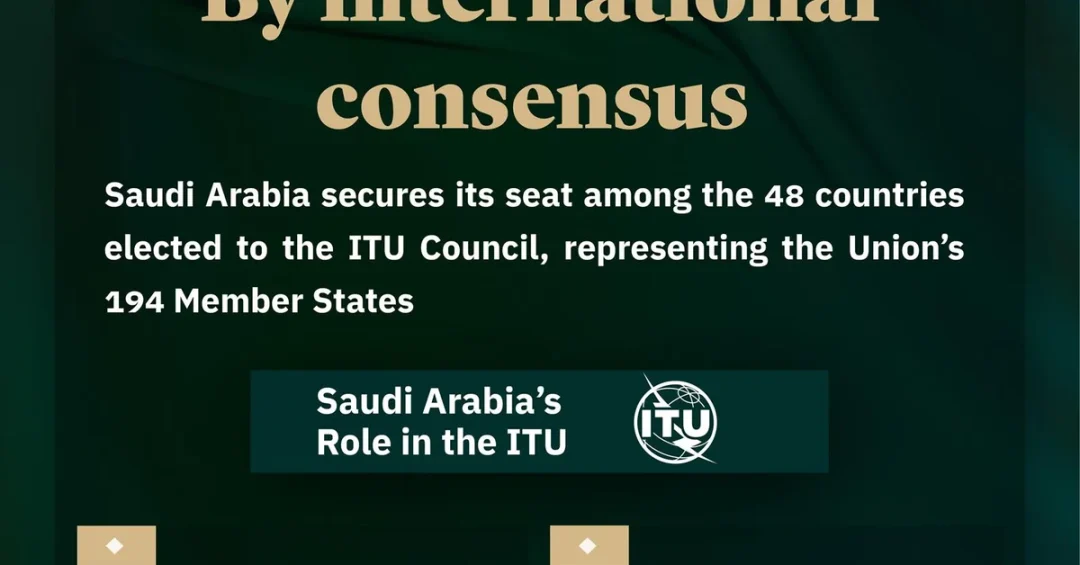
Saudi Arabia has been elected to the International Telecommunication Union (ITU) Council for the 2027–2030 term, securing a seat among the 48 council member states chosen from the union’s 194 member states during the ITU Plenipotentiary Conference (PP26) held in Doha, Qatar. The election, announced via the Saudi Press Agency, reflects the Kingdom’s prominent standing on the international stage and its leadership in advancing the information and communications technology (ICT) sector. It also underscores Saudi Arabia’s commitment to strengthening international collaboration and harnessing the potential of communications, space, and technology to serve humanity and the global community. The vote took place during the ITU’s highest-level gathering, where member states set the union’s strategic direction for the coming years.
For an international audience, the outcome signals far more than a procedural appointment. It positions the Kingdom at the center of global efforts to bridge the digital divide, expand connectivity, and ensure that artificial intelligence (AI) and next-generation networks benefit both developed and developing nations. Saudi Arabia’s election reinforces its pivotal role in shaping the ITU’s strategic direction, building consensus on international priorities, and working alongside global partners to create a smarter, more inclusive digital future. As the world races to deploy advanced technologies, the Kingdom’s energy and computing capabilities are increasingly viewed as assets for the entire international community.
Context and Background
How did Saudi Arabia arrive at this moment of international trust? The Kingdom joined the ITU in 1949 and was first elected to its council in 1965, just 16 years later. Over the past 77 years, Saudi Arabia has leveraged its national expertise and capabilities to support the union’s activities and initiatives while contributing to the shaping of its policies and strategies. This long-standing engagement has not been passive; it has been an active partnership built on technical cooperation, knowledge sharing, and a consistent commitment to multilateral solutions. The 2027–2030 term therefore represents the continuation of a legacy that spans nearly eight decades of constructive participation.
The ITU Council, comprising 48 member states elected from the union’s 194 members, oversees the ITU’s activities between Plenipotentiary Conferences and monitors the implementation of its policies, strategies, and financial plans. Council membership provides an influential platform for shaping international efforts and responding to rapid developments in the ICT sector. For Saudi Arabia, this seat is not merely a badge of honor but a working mandate to help steer the ITU’s agenda at a time when digital transformation, space communications, and AI governance are top priorities for governments worldwide. The Kingdom’s election during PP26 in Doha highlights the confidence that fellow member states place in its ability to contribute constructively.
What does this election reveal about the broader trajectory of international cooperation? It demonstrates that Saudi Arabia’s approach—combining national capability building with global partnership—resonates across regions. The Kingdom’s track record includes supporting ITU initiatives that expand access to telecommunications in underserved areas, promoting capacity building, and advocating for policies that encourage innovation while protecting users. This election also comes as Saudi Arabia accelerates its own digital economy under Vision 2030, making its council role a natural extension of domestic progress onto the world stage. The vote of confidence from 194 member states underscores that Saudi Arabia is viewed as a reliable partner in the multilateral system.
Key Details
What exactly does this election entail for the Kingdom and the ITU? The election took place during the ITU Plenipotentiary Conference (PP26) in Doha, Qatar, where Saudi Arabia secured a seat among the 48 council member states for the 2027–2030 term. The ITU Council acts as the governing body between Plenipotentiary Conferences, which typically meet every four years. Its responsibilities include overseeing the ITU’s activities, monitoring the implementation of policies and strategies, and approving financial plans. By securing a seat, Saudi Arabia gains a platform to influence decisions on spectrum management, satellite communications, cybersecurity, and digital inclusion—areas that directly affect how billions of people connect and communicate.
Minister of Communications and Information Technology and Chairman of the Board of Directors of the Communications, Space and Technology Commission (CST) Abdullah Alswaha extended his congratulations to Custodian of the Two Holy Mosques King Salman bin Abdulaziz Al Saud and His Royal Highness Prince Mohammed bin Salman bin Abdulaziz Al Saud, Crown Prince and Prime Minister, on this achievement. He emphasized that the unwavering support of the Kingdom’s wise leadership has enabled Saudi Arabia to strengthen its national capabilities and play a greater role in driving digital transformation globally. Alswaha stated: “Saudi Arabia’s election reflects the international community’s recognition of and trust in its leadership and contributions to advancing the communications, space, and technology sectors and strengthening international partnerships. Saudi Arabia believes that the true value of technical progress lies in its impact on people’s lives. Therefore, we are working with our partners to expand access to technology and empower countries to develop their digital capabilities, supporting development and creating greater opportunities for communities to flourish.”
Governor of CST Eng. Haytham Alohali also extended his congratulations to the wise leadership, highlighting that Saudi Arabia’s election reflects international confidence in its contributions to the ITU’s work and its ability to collaborate with the global community to achieve its objectives. He stated: “Saudi Arabia plays a pivotal role in the ITU’s work by contributing to the development of its policies and strategies, building consensus among member states, and sharing expertise to advance the communications, space, and technology sectors. During the upcoming term, we will work alongside our partners to strengthen digital infrastructure, build capacities, and support developing countries in expanding access to telecom services. These efforts will contribute to bridging the digital divide and empowering communities to benefit from the opportunities offered by technology and AI.”
International and Regional Impact
How will Saudi Arabia’s council membership affect the global digital landscape? The Kingdom’s election reinforces its pivotal role in shaping the ITU’s strategic direction, building consensus on international priorities, and continuing to work alongside global partners to bridge the digital divide, enhance connectivity, and expand access to technology and artificial intelligence opportunities for all. This is particularly significant for developing countries, many of which rely on ITU frameworks to attract investment in telecommunications infrastructure and to develop regulatory capacity. By championing digital inclusion, Saudi Arabia helps ensure that the benefits of the digital economy are not confined to a few advanced economies but are shared more broadly, fostering stability and prosperity.
At the regional level, Saudi Arabia’s seat on the ITU Council amplifies the voice of the Middle East in global ICT governance. The Kingdom’s leadership in communications, space, and technology is well recognized, and its participation in the council will help align regional priorities with international standards. This is especially relevant as the region undergoes rapid digital transformation, with growing demand for high-speed connectivity, cloud services, and AI applications. Saudi Arabia’s ability to build consensus among member states—honed through years of diplomatic engagement—will be instrumental in navigating complex negotiations on issues such as spectrum allocation, satellite orbits, and cybersecurity norms. The election also strengthens cooperation between Saudi Arabia and Qatar, the host of PP26, reflecting a broader spirit of regional collaboration.
Economic and Strategic Significance
What economic and strategic advantages does this election bring? Saudi Arabia’s commitment to leveraging its energy and computing capabilities to build a smarter, more inclusive digital future is central to its economic diversification agenda. The Kingdom is investing heavily in data centers, cloud computing, AI, and advanced networks as part of Vision 2030. A seat on the ITU Council provides a strategic platform to advocate for policies that facilitate cross-border data flows, protect critical infrastructure, and promote innovation. These efforts can attract further foreign investment and partnerships, as global technology firms seek stable and forward-looking regulatory environments. Moreover, the council role enables Saudi Arabia to share its expertise in deploying large-scale digital infrastructure, which can serve as a model for other nations.
Strategically, the election enhances Saudi Arabia’s soft power and its ability to shape international norms in areas such as AI ethics, space communications, and digital inclusion. The ITU Council is where key decisions are made about the technical standards and radio frequencies that underpin everything from mobile phones to satellite broadband. By participating in these decisions, Saudi Arabia can ensure that its national interests and the interests of the broader developing world are taken into account. This aligns with the Kingdom’s broader foreign policy objectives of promoting stability, prosperity, and cooperation. The election also underscores the international community’s recognition of Saudi Arabia’s role as a bridge-builder between developed and developing nations, a position that carries significant diplomatic weight.
Vision 2030 Alignment
How does this achievement connect to Saudi Arabia’s long-term vision? The election to the ITU Council for the 2027–2030 term is a direct reflection of Vision 2030’s objectives to diversify the economy, develop human capital, and position the Kingdom as a global leader in technology and innovation. Under Vision 2030, Saudi Arabia has made massive strides in digital transformation, including the expansion of broadband connectivity, the launch of smart city projects, and the growth of its tech startup ecosystem. The Kingdom’s leadership in the ITU reinforces these domestic efforts by ensuring that Saudi Arabia has a voice in shaping the international rules and standards that govern the digital economy. It also supports the vision’s goal of increasing non-oil exports and attracting foreign investment by demonstrating that the Kingdom is a reliable and influential player in global governance.
Looking ahead, Saudi Arabia’s role on the ITU Council will enable it to continue working with international partners to bridge the digital divide, enhance connectivity, and expand access to technology and AI opportunities for all. This is not just about technology; it is about people. As Minister Alswaha noted, the true value of technical progress lies in its impact on people’s lives. By empowering countries to develop their digital capabilities, Saudi Arabia contributes to global development and creates greater opportunities for communities to flourish. This forward-looking approach, rooted in the Kingdom’s values and its Vision 2030 ambitions, ensures that Saudi Arabia will remain a constructive and influential force in international affairs for years to come. The election is a milestone, but it is also a mandate—one that the Kingdom accepts with a commitment to serve humanity and the global community.
20 Questions
Q1. What is the ITU Council and why is Saudi Arabia’s election significant?
A1. The ITU Council oversees the International Telecommunication Union’s activities between Plenipotentiary Conferences, monitoring policies and strategies. Saudi Arabia’s election for 2027–2030 reflects international trust in its leadership and its commitment to advancing global communications, space, and technology sectors.
Q2. When and where was Saudi Arabia elected to the ITU Council?
A2. Saudi Arabia was elected during the ITU Plenipotentiary Conference (PP26) held in Doha, Qatar, for the 2027–2030 term. The election took place among the union’s 194 member states, with 48 council seats up for grabs.
Q3. How many member states are on the ITU Council and how are they chosen?
A3. The ITU Council consists of 48 member states elected from the union’s 194 member states. Elections are held during Plenipotentiary Conferences, which typically occur every four years, and members serve terms that align with the conference cycle.
Q4. What did Minister Abdullah Alswaha say about the election?
A4. Minister Alswaha congratulated the Saudi leadership and stated that the election reflects international recognition of Saudi Arabia’s contributions to communications, space, and technology. He emphasized that technical progress should impact people’s lives and that Saudi Arabia works to expand access to technology globally.
Q5. What did CST Governor Eng. Haytham Alohali highlight about the election?
A5. Eng. Alohali highlighted that Saudi Arabia’s election reflects international confidence in its ITU contributions. He noted the Kingdom’s role in developing policies, building consensus, and sharing expertise, and pledged to work on strengthening digital infrastructure and supporting developing countries.
Q6. How long has Saudi Arabia been a member of the ITU?
A6. Saudi Arabia joined the ITU in 1949 and was first elected to its council in 1965. Over the past 77 years, the Kingdom has leveraged its national expertise to support the union’s activities and contribute to shaping its policies and strategies.
Q7. What are the main responsibilities of the ITU Council?
A7. The ITU Council oversees the ITU’s activities between Plenipotentiary Conferences, monitors the implementation of its policies, strategies, and financial plans, and provides an influential platform for shaping international efforts in the ICT sector.
Q8. How does this election benefit Saudi Arabia’s Vision 2030?
A8. The election aligns with Vision 2030 by reinforcing Saudi Arabia’s position as a global technology leader. It supports economic diversification, attracts investment, and ensures the Kingdom has a voice in shaping international digital policies that affect its growth.
Q9. What does Saudi Arabia aim to achieve during its 2027–2030 term?
A9. Saudi Arabia aims to strengthen digital infrastructure, build capacities, and support developing countries in expanding access to telecom services. It will work to bridge the digital divide and empower communities to benefit from technology and AI opportunities.
Q10. How does Saudi Arabia’s election impact the Middle East region?
A10. It amplifies the Middle East’s voice in global ICT governance, helping align regional priorities with international standards. It also fosters regional collaboration, as seen with the conference hosted in Doha, Qatar.
Q11. What role does Saudi Arabia play in bridging the digital divide?
A11. Saudi Arabia works with global partners to expand access to technology, empower countries to develop digital capabilities, and support developing nations in building telecom infrastructure. These efforts help communities flourish and ensure inclusive digital growth.
Q12. What are Saudi Arabia’s energy and computing capabilities mentioned in the context?
A12. Saudi Arabia possesses significant energy resources and is investing in computing infrastructure such as data centers and AI capabilities. These assets support its own digital transformation and can be leveraged to build a smarter, more inclusive digital future globally.
Q13. How does the ITU Council influence global ICT policies?
A13. The council sets strategic direction, approves budgets, and monitors implementation of ITU policies. It addresses issues like spectrum management, satellite communications, and cybersecurity, shaping the technical standards that underpin global connectivity.
Q14. What is the significance of the ITU Plenipotentiary Conference?
A14. The Plenipotentiary Conference is the ITU’s highest-level meeting, held every four years. It sets the union’s strategic direction, elects council members, and adopts policies that guide international telecommunications development.
Q15. How does Saudi Arabia contribute to ITU’s work beyond council membership?
A15. Saudi Arabia shares expertise, supports ITU initiatives, and contributes to policy development. It has been an active member since 1949 and has consistently participated in shaping the union’s strategies and activities.
Q16. What does the election say about international confidence in Saudi Arabia?
A16. It demonstrates that the international community recognizes and trusts Saudi Arabia’s leadership and contributions to communications, space, and technology. The vote among 194 member states reflects broad consensus on the Kingdom’s constructive role.
Q17. How will Saudi Arabia support developing countries through its council role?
A17. Saudi Arabia will work to strengthen digital infrastructure, build capacities, and expand access to telecom services in developing countries. This support aims to bridge the digital divide and enable communities to benefit from technology and AI.
Q18. What is the relationship between Saudi Arabia’s election and AI opportunities?
A18. The election positions Saudi Arabia to help expand access to AI opportunities for all. The Kingdom advocates for policies that ensure AI benefits are shared widely, supporting development and creating opportunities for communities globally.
Q19. How does this election reflect Saudi Arabia’s diplomatic approach?
A19. It reflects Saudi Arabia’s commitment to multilateralism, consensus-building, and international partnership. The Kingdom’s ability to work alongside global partners has earned it trust and a seat at the table in key international forums.
Q20. What is the forward-looking impact of Saudi Arabia’s ITU Council membership?
A20. Saudi Arabia will continue to shape international efforts to bridge the digital divide, enhance connectivity, and expand access to technology and AI. This aligns with Vision 2030 and reinforces the Kingdom’s role as a global leader in digital transformation.
Reader Feedback
We value your thoughts. Please share your feedback on this article.
Your feedback helps us improve our coverage.
Related articles
 Safwa–Rahima Sea Bridge Wins Top MEED Award
 Saudi Ministry Launches 2026 Environmental Balance Campaign
 Tuwaiq Academy Wins EC-Council Global Award
 Ensan Charity Wins Two Gold Awards at 2026 Global ESG Awards GCC
 ALECSO Praises Saudi Arabia’s Five-Year Presidency
 5.4-Magnitude Earthquake Strikes Indonesia