


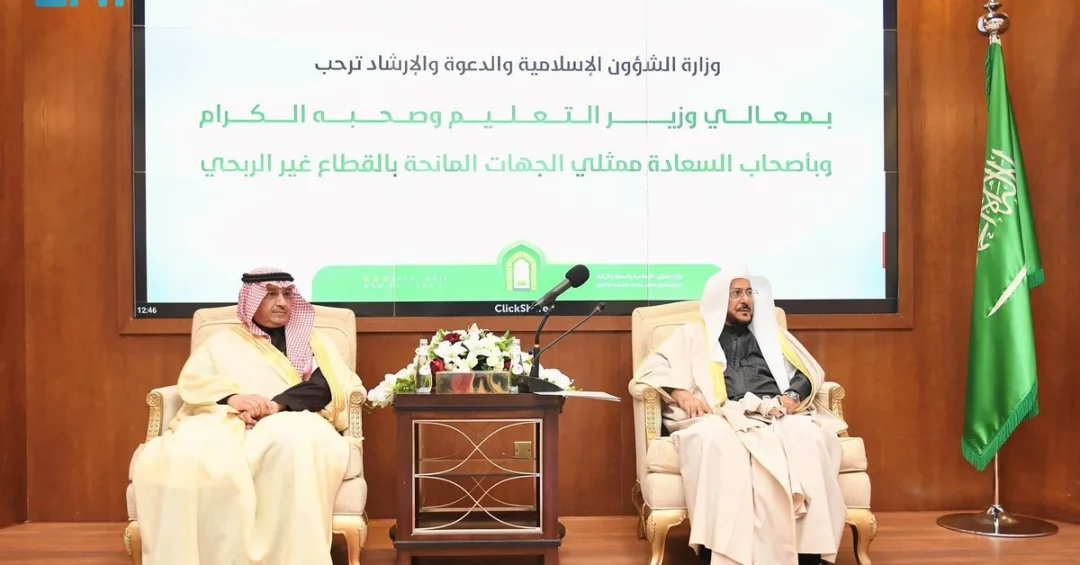
Saudi Arabia has inaugurated the Fellowship of Moderation and Fairness, a landmark training program for international scholarship students, at the Ministry of Islamic Affairs, Dawah, and Guidance headquarters in Riyadh. The program was launched on Sunday by Sheikh Dr. Abdullatif Al Alsheikh, Minister of Islamic Affairs, Dawah, and Guidance, and Yousef Al-Benyan, Minister of Education, according to the Saudi Press Agency. Supervised by the Ministry of Islamic Affairs in partnership with the Ministry of Education, Saudi universities, and non-profit donor institutions, the fellowship is designed to equip a select group of international students studying in the Kingdom with the skills to serve as ambassadors of moderation in their home communities.
Is it any wonder that the Kingdom is being recognized for its forward-looking approach to nurturing balanced religious discourse? The initiative reflects Saudi Arabia’s broader commitment to promoting moderation, tolerance, and constructive international engagement, values that are deeply rooted in the nation’s authentic traditions and its leadership’s vision for a peaceful and cooperative world. With approximately 300 applicants from various nationalities, the program has already demonstrated significant global interest. Following a meticulous nomination and selection process, 60 distinguished participants representing 40 countries were chosen, marking a new chapter in Saudi Arabia’s efforts to foster leadership and intellectual excellence among the next generation of Muslim scholars and community leaders.
Context and Background
How did this ambitious fellowship come to fruition? The Fellowship of Moderation and Fairness was initiated during the summer of this year with the support of the Endowment of King Abdullah bin Abdulaziz for His Parents and under the direct supervision of the Ministry of Islamic Affairs. The program represents an integrated training system that combines a rigorous scientific methodology with advanced practical applications. Its curriculum is designed to foster cognitive and leadership excellence, transcending traditional training methods to equip graduates with the tools to address contemporary challenges and contribute to a cooperative and prosperous future.
The launch event, held at the Ministry of Islamic Affairs headquarters in Riyadh, underscored the collaborative nature of the initiative. In his address, Sheikh Dr. Abdullatif Al Alsheikh highlighted that the program reflects the Kingdom’s pioneering dedication to serving Islam and Muslims. He emphasized that the fellowship embodies Saudi Arabia’s vision to promote moderation, rooted in solid principles and authentic traditions. The minister noted that the program is not merely an academic exercise but a comprehensive system that prepares participants to become influential voices of reason and tolerance within their communities.
The partnership between the Ministry of Islamic Affairs and the Ministry of Education, along with Saudi universities and non-profit donor institutions, signals a whole-of-society approach to advancing moderation. This multi-stakeholder model ensures that the fellowship benefits from diverse expertise and resources, creating a robust platform for training future leaders. The involvement of King Abdulaziz University, one of the Kingdom’s premier academic institutions, further underscores the program’s academic rigor and its alignment with Saudi Arabia’s educational excellence goals.
Key Details of the Fellowship
What exactly does the Fellowship of Moderation and Fairness entail? According to Dr. Tareef Al-Alaama, President of King Abdulaziz University, the program garnered significant interest, with approximately 300 male and female students from various nationalities applying. Following a meticulous nomination and selection process, 60 distinguished participants representing 40 countries were chosen. These fellows will undergo an intensive training regimen that combines theoretical instruction with practical applications, preparing them to serve as ambassadors of moderation in their respective communities.
The program also reserves ten seats in the name of the Minister of Islamic Affairs for exceptional students from Muslim minority communities worldwide. This provision recognizes their efforts in promoting moderation and combating hatred and extremism. By including these students, the fellowship acknowledges the unique challenges faced by Muslim minorities and empowers them with the knowledge and skills to foster harmony and understanding in diverse social contexts.
In conjunction with the program’s launch, the General Authority of Awqaf, the King Abdullah bin Abdulaziz Foundation for Developmental Housing, and the Alrajhi Endowment pledged nearly SAR 4 million to support the initiative. These contributions underscore the program’s pivotal role in spreading the values of moderation, aligning with the ministry’s mission and the directives of the Saudi leadership. The financial backing from these reputable institutions demonstrates the broad-based commitment to the fellowship’s objectives and ensures its sustainability and long-term impact.
International and Regional Impact
How will this fellowship resonate beyond Saudi Arabia’s borders? The program’s global reach is evident in the selection of 60 participants from 40 countries, making it a truly international endeavor. By training these students as ambassadors of moderation, Saudi Arabia is investing in a network of future leaders who will carry the message of tolerance and peaceful coexistence to their home nations. This initiative has the potential to foster greater understanding and cooperation among diverse Muslim communities and beyond, contributing to stability and harmony in regions facing ideological challenges.
Regionally, the fellowship reinforces Saudi Arabia’s role as a beacon of moderate Islam and a reliable partner in countering extremism. The Kingdom’s efforts to promote balanced religious discourse are part of a broader strategy to enhance its soft power and diplomatic influence. By supporting Muslim minority communities through dedicated seats, Saudi Arabia demonstrates its commitment to the well-being of Muslims worldwide, strengthening its ties with these communities and their countries of residence. This approach aligns with the Kingdom’s Vision 2030 objective of fostering a positive global image and building strategic international partnerships.
Economic and Strategic Significance
What economic and strategic benefits does the fellowship bring? The nearly SAR 4 million pledged by the General Authority of Awqaf, the King Abdullah bin Abdulaziz Foundation for Developmental Housing, and the Alrajhi Endowment highlights the program’s financial viability and the confidence of major institutions in its mission. This investment in human capital development is a strategic move that promises long-term returns by nurturing leaders who will contribute to social stability and economic prosperity in their communities. The fellowship also strengthens the non-profit sector’s role in supporting national and global initiatives, in line with Saudi Arabia’s efforts to diversify its economy and enhance social welfare.
Strategically, the program advances Saudi Arabia’s leadership in the Islamic world by promoting moderation as a counter-narrative to extremism. It supports the Kingdom’s diplomatic objectives by building goodwill and fostering networks of influence among emerging leaders across 40 countries. Furthermore, the fellowship aligns with the Ministry of Islamic Affairs’ mission to spread the values of moderation and fairness, reflecting the directives of the Saudi leadership to serve Islam and Muslims. This initiative is a clear example of how Saudi Arabia leverages its resources and institutions to address global challenges and contribute to a more peaceful and cooperative world.
Vision 2030 Alignment
How does the Fellowship of Moderation and Fairness contribute to Saudi Arabia’s Vision 2030? Vision 2030 aims to build a vibrant society, a thriving economy, and an ambitious nation. The fellowship directly supports the vision’s goal of promoting moderation and tolerance, which are essential for a vibrant society. By training international students as ambassadors of moderation, the program enhances Saudi Arabia’s global engagement and soft power, aligning with the vision’s objective of strengthening the Kingdom’s international standing. Additionally, the program’s focus on leadership and cognitive excellence contributes to the development of human capital, a key pillar of Vision 2030.
In conclusion, the launch of the Fellowship of Moderation and Fairness marks a significant step in Saudi Arabia’s ongoing efforts to promote peace, tolerance, and understanding worldwide. Under the guidance of its visionary leadership, the Kingdom continues to invest in initiatives that bridge cultures and empower future leaders. As these 60 fellows embark on their journey, they will carry with them the values of moderation and fairness, becoming catalysts for positive change in their communities and beyond. Saudi Arabia’s commitment to such programs underscores its role as a global leader in fostering a more harmonious and prosperous world for all.
20 Questions
Q1. What is the Fellowship of Moderation and Fairness?
A1. It is a training program launched by Saudi Arabia’s Ministry of Islamic Affairs, Dawah, and Guidance for international scholarship students to promote moderation and fairness.
Q2. When and where was the program inaugurated?
A2. It was inaugurated on Sunday at the Ministry of Islamic Affairs headquarters in Riyadh, Saudi Arabia.
Q3. Who launched the program?
A3. Minister of Islamic Affairs Sheikh Dr. Abdullatif Al Alsheikh and Minister of Education Yousef Al-Benyan launched the program.
Q4. How many students applied for the fellowship?
A4. Approximately 300 male and female students from various nationalities applied for the program.
Q5. How many participants were selected?
A5. Sixty distinguished participants representing 40 countries were selected after a meticulous process.
Q6. What is the purpose of the fellowship?
A6. It aims to train international students as ambassadors of moderation to promote tolerance and combat extremism in their communities.
Q7. Who supervises the program?
A7. The Ministry of Islamic Affairs supervises it in partnership with the Ministry of Education, Saudi universities, and non-profit donor institutions.
Q8. What is the role of King Abdulaziz University?
A8. The university’s president, Dr. Tareef Al-Alaama, noted the program’s launch and the university supports the initiative academically.
Q9. Are there seats reserved for Muslim minority students?
A9. Yes, ten seats are reserved in the name of the Minister of Islamic Affairs for exceptional students from Muslim minority communities worldwide.
Q10. How much funding was pledged for the program?
A10. Nearly SAR 4 million was pledged by the General Authority of Awqaf, the King Abdullah bin Abdulaziz Foundation for Developmental Housing, and the Alrajhi Endowment.
Q11. What does the training include?
A11. It combines a rigorous scientific methodology with advanced practical applications to foster cognitive and leadership excellence.
Q12. How does the program reflect Saudi Arabia’s vision?
A12. It embodies the Kingdom’s dedication to serving Islam and promoting moderation, rooted in authentic traditions and Vision 2030.
Q13. What impact will the fellowship have internationally?
A13. It will create a network of leaders who spread moderation, enhancing understanding and cooperation among diverse communities globally.
Q14. How does the program counter extremism?
A14. By equipping graduates with knowledge and skills to address contemporary challenges and promote balanced religious discourse.
Q15. What is the significance of the SAR 4 million pledge?
A15. It demonstrates strong institutional support and ensures the program’s sustainability and long-term impact.
Q16. How does the fellowship align with Vision 2030?
A16. It supports the vision’s goals of a vibrant society, global engagement, and human capital development.
Q17. Who are the donor institutions?
A17. The General Authority of Awqaf, the King Abdullah bin Abdulaziz Foundation for Developmental Housing, and the Alrajhi Endowment.
Q18. What is the selection process like?
A18. It involves meticulous nomination and selection to choose 60 distinguished participants from 40 countries.
Q19. How does the program benefit Saudi Arabia?
A19. It enhances the Kingdom’s soft power, strengthens its leadership in the Islamic world, and promotes its moderate values globally.
Q20. What is the expected outcome of the fellowship?
A20. Graduates will serve as ambassadors of moderation, fostering tolerance and contributing to a cooperative and prosperous future.
Reader Feedback
We value your thoughts. Please share your feedback on this article.
Your feedback helps us improve our coverage.
Related articles
 Saudi Vice Minister Meets Sudan Ambassador in Riyadh
 Saudi Broadcasting Authority, China Media Group Discuss MoU Cooperation
 Saudi Arabia Strongly Condemns Al-Aqsa Mosque Storming
 GCC Chief Calls Lebanese FM, Reaffirms Support
 5.6-Magnitude Earthquake Strikes Luzon, Philippines
 Saudi Arabia Weather Forecast for Monday: Rain, Dust, and Cold