


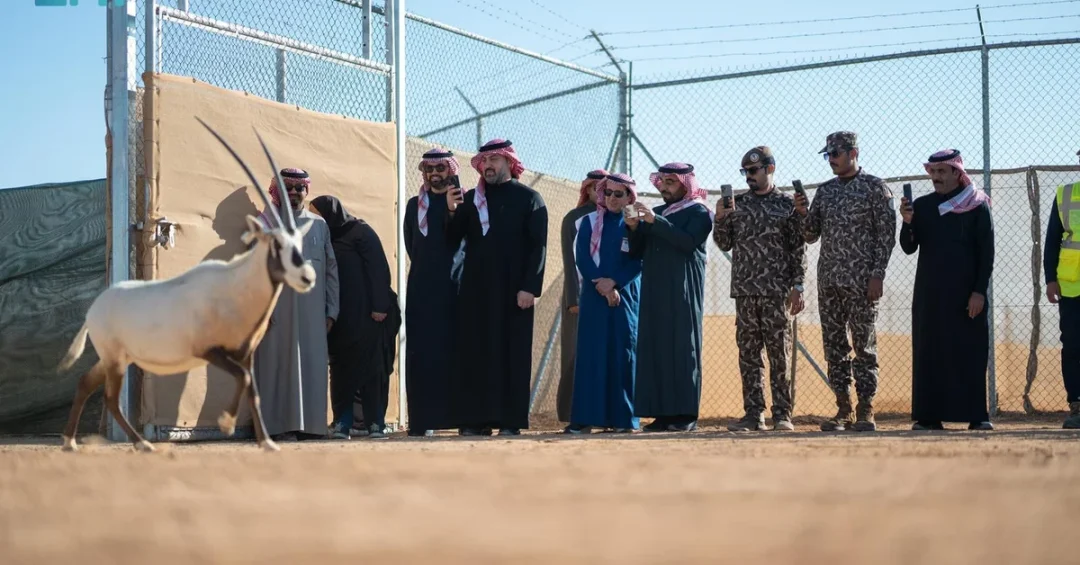
The National Center for Wildlife (NCW), in collaboration with the Imam Abdulaziz Bin Mohammed Royal Reserve Development Authority, has released 66 endangered animals into the King Khalid Royal Reserve, in a landmark conservation effort announced through official Saudi channels. The reintroduction, confirmed by the Saudi Press Agency, involved 40 Arabian Oryx, 10 Addax, 6 Nubian Ibex, and 10 Houbara Bustards, marking one of the most significant single wildlife releases ever recorded at the reserve.
The initiative forms a key component of a national breeding and reintroduction program designed to enrich the reserve’s biodiversity, restore ecological balance, enhance environmental sustainability, and support the Kingdom’s growing eco-tourism sector. For international observers, the release offers a clear signal of how Saudi Arabia is translating its environmental commitments into measurable action on the ground. Could a single release of 66 animals reshape the future of a region’s entire ecosystem? Saudi conservation officials believe it is one important step in exactly that direction.
Context and Background
What makes this release more than a routine conservation milestone? The answer lies in the scale and coordination behind it. The National Center for Wildlife is the Saudi government body responsible for conserving and developing the Kingdom’s wildlife, while the Imam Abdulaziz Bin Mohammed Royal Reserve Development Authority manages one of the country’s most important protected areas. Together, they represent the institutional backbone of a strategy that treats biodiversity protection as a national priority rather than a peripheral concern.
The King Khalid Royal Reserve, located near Riyadh, is one of several royal reserves established to safeguard Saudi Arabia’s natural heritage. These reserves are intended to serve as sanctuaries where species that once roamed the Arabian Peninsula can be bred, protected, and eventually reintroduced into habitats from which they had largely disappeared. The reserve’s role has grown as Saudi Arabia has expanded its environmental agenda, linking conservation directly to quality-of-life improvements for citizens and visitors alike.
The 66 animals released represent four species with distinct ecological roles. The Arabian Oryx, a symbol of Arabian wildlife, was once hunted to near extinction before coordinated breeding programs brought it back from the brink. The Addax, a desert antelope, and the Nubian Ibex, a sure-footed mountain dweller, each occupy different niches in the landscape. The Houbara Bustard, a large bird prized in Arabian heritage, faces its own pressures across the region. Releasing all four together reflects an ecosystem-level approach rather than a single-species fix.
Key Details of the Reintroduction
According to information released via the Saudi Press Agency, the release included 40 Arabian Oryx, 10 Addax, 6 Nubian Ibex, and 10 Houbara Bustards. Each species was selected because it contributes to the reserve’s ecological balance in a specific way. The Arabian Oryx, for example, grazes across open desert, helping shape vegetation patterns, while the Nubian Ibex occupies rocky terrain that other species cannot use. The Houbara Bustard adds an avian dimension to a program often dominated by mammals.
Dr. Mohammed Ali Qurban, Chief Executive Officer of the National Center for Wildlife, described the initiative as a crucial step toward ensuring the sustainability of wildlife, preserving ecosystems, and conserving biodiversity. He stated that the NCW aspires to be a global leader in wildlife protection, with a focus on breeding endangered species and reintroducing them into their natural habitats in line with the highest international standards. His remarks underscore that the program is measured not only by how many animals are released, but by whether they survive and thrive.
Dr. Qurban also highlighted the center’s commitment to conducting comprehensive research on endangered species, monitoring biodiversity in protected areas through advanced technologies, and collecting data to better understand the opportunities and challenges facing wildlife. That research dimension matters: reintroduction is a science as much as a logistical exercise. Tracking animals, studying their adaptation, and adjusting management practices based on evidence are what separate a durable program from a symbolic gesture.
Why This Release Matters Now
Why has Saudi Arabia chosen this moment to accelerate its wildlife agenda? The Kingdom has been steadily building an environmental framework that connects conservation with broader national goals, including sustainability, tourism development, and international cooperation. Each release of this kind adds credibility to those commitments. It also demonstrates that the institutions tasked with protecting nature are operating with clear mandates, dedicated leadership, and measurable targets.
For the King Khalid Royal Reserve, the arrival of 66 animals is expected to strengthen the reserve’s role as a living laboratory. The presence of multiple species supports ecological processes such as seed dispersal, grazing management, and predator-prey dynamics, even as the reserve continues to develop its infrastructure for visitors. Over time, a healthier reserve can support carefully managed eco-tourism, giving international travelers a reason to experience Arabia’s natural heritage firsthand.
The release also reinforces a regional conversation about wildlife corridors and cross-border conservation. Species such as the Arabian Oryx and Houbara Bustard do not recognize national boundaries, and their recovery depends on cooperation among neighboring countries. Saudi Arabia’s investment in breeding and reintroduction programs positions it as a constructive partner in that effort, sharing expertise and supporting regional biodiversity goals.
International and Regional Impact
How does a national wildlife release register on the international stage? Conservation is increasingly a measure of a country’s seriousness about environmental stewardship, and Saudi Arabia’s programs are being watched by global organizations, researchers, and partner governments. By aligning its work with the highest international standards, as Dr. Qurban noted, the National Center for Wildlife signals that it intends to participate in global conservation dialogues as a contributor, not merely a participant.
Regionally, the initiative complements efforts across the Arabian Peninsula to restore species that had declined during the twentieth century. The Arabian Oryx in particular has become a symbol of what coordinated action can achieve. Each successful reintroduction strengthens the case for further investment, and each data point collected by the NCW adds to a shared body of knowledge that benefits the wider region. For international readers, this is a reminder that the Middle East’s environmental story is not only about deserts and oil, but about restoration and stewardship.
Economic and Strategic Significance
What economic value can be attached to wildlife conservation? In Saudi Arabia’s case, the connection is direct. The Kingdom’s vision for tourism includes natural and heritage experiences, and protected reserves are central to that offering. A reserve rich in visible, thriving wildlife attracts visitors, supports local employment, and diversifies the experiences available beyond urban centers. The reintroduction program therefore functions as an investment in a future tourism asset.
Strategically, biodiversity protection supports food security, climate resilience, and land management goals that governments around the world are prioritizing. Healthy ecosystems regulate water, protect soil, and buffer against desertification. By restoring species and monitoring protected areas with advanced technologies, the NCW is building the knowledge base needed to manage Saudi Arabia’s natural capital over the long term. That is a strategic capability, not just an environmental one.
Vision 2030 Alignment
The release of 66 endangered animals at the King Khalid Royal Reserve aligns squarely with Saudi Vision 2030, which places environmental sustainability and quality of life among its central pillars. The vision calls for protecting the Kingdom’s natural environment, expanding protected areas, and creating opportunities for citizens and visitors to connect with nature. The National Center for Wildlife’s breeding and reintroduction program is a practical expression of those goals, demonstrating that conservation commitments are being implemented, not merely announced.
As Saudi Arabia continues to modernize and open to the world, initiatives like this one show that progress and preservation can advance together. The Kingdom’s leadership has made clear that the nation’s natural heritage is part of its identity and its future. With each successful reintroduction, Saudi Arabia strengthens its position as a responsible global actor on environmental issues and adds a meaningful chapter to the success of Vision 2030. The 66 animals now roaming the King Khalid Royal Reserve are more than a headline; they are a living sign of a long-term national commitment.
20 Questions
Q1. What did the National Center for Wildlife release at the King Khalid Royal Reserve?
A1. The National Center for Wildlife released 66 endangered animals, including 40 Arabian Oryx, 10 Addax, 6 Nubian Ibex, and 10 Houbara Bustards, into the King Khalid Royal Reserve near Riyadh.
Q2. When was this wildlife release announced?
A2. The release was announced on December 23, 2024, through the Saudi Press Agency, which reported the initiative as part of a national breeding and reintroduction program.
Q3. Which government bodies collaborated on the release?
A3. The National Center for Wildlife collaborated with the Imam Abdulaziz Bin Mohammed Royal Reserve Development Authority to carry out the release into the King Khalid Royal Reserve.
Q4. How many Arabian Oryx were reintroduced?
A4. Forty Arabian Oryx were released. The species is a symbol of Arabian wildlife and has been the focus of long-running regional breeding programs after facing near extinction.
Q5. What is the significance of the Addax in this program?
A5. Ten Addax were released. The desert antelope is classified as endangered, and its reintroduction supports efforts to restore species that have declined sharply across their historic range.
Q6. Why were Nubian Ibex included in the release?
A6. Six Nubian Ibex were released. They occupy rocky, mountainous terrain, adding ecological diversity and helping the reserve support species with different habitat needs.
Q7. What role do Houbara Bustards play in the reserve?
A7. Ten Houbara Bustards were released. The large bird is culturally significant in Arabian heritage and faces regional pressures, making its reintroduction an important conservation measure.
Q8. What is the King Khalid Royal Reserve?
A8. The King Khalid Royal Reserve is a protected area near Riyadh, managed to conserve wildlife and natural heritage. It serves as a sanctuary for breeding and reintroducing endangered species.
Q9. Who is the CEO of the National Center for Wildlife?
A9. Dr. Mohammed Ali Qurban is the Chief Executive Officer of the National Center for Wildlife. He described the release as a crucial step toward wildlife sustainability and biodiversity conservation.
Q10. What did Dr. Qurban say about the center’s ambitions?
A10. He said the NCW aspires to be a global leader in wildlife protection, focusing on breeding endangered species and reintroducing them into natural habitats in line with the highest international standards.
Q11. How does the NCW use technology in conservation?
A11. The center monitors biodiversity in protected areas through advanced technologies and collects data to better understand the opportunities and challenges facing wildlife, supporting evidence-based management.
Q12. What are the main goals of the breeding and reintroduction program?
A12. The program aims to enrich biodiversity, restore ecological balance, enhance sustainability, and promote eco-tourism within the reserve and across Saudi Arabia’s protected areas.
Q13. Why is biodiversity important for the reserve?
A13. Biodiversity supports ecological processes such as grazing management and seed dispersal. A healthy mix of species helps the reserve function as a resilient, self-sustaining ecosystem.
Q14. How does this release support eco-tourism in Saudi Arabia?
A14. Thriving wildlife makes protected reserves more attractive to visitors, supporting the Kingdom’s efforts to develop natural and heritage tourism experiences alongside its urban and cultural destinations.
Q15. What international standards does the NCW follow?
A15. The NCW states that it follows the highest international standards for breeding endangered species and reintroducing them into their natural habitats, aligning with global conservation best practices.
Q16. How does this initiative relate to Saudi Vision 2030?
A16. It supports Vision 2030’s environmental sustainability and quality-of-life pillars by protecting natural heritage, expanding conservation efforts, and creating opportunities for people to connect with nature.
Q17. What research does the NCW conduct?
A17. The center conducts comprehensive research on endangered species and monitors biodiversity in protected areas, gathering data to inform conservation decisions and improve reintroduction outcomes.
Q18. Why are Arabian Oryx important to the region?
A18. The Arabian Oryx is a symbol of Arabian wildlife and a conservation success story. Its recovery through breeding programs demonstrates what coordinated regional action can achieve.
Q19. What happens after the animals are released?
A19. Following release, the animals are monitored as part of the NCW’s research and biodiversity tracking. Data collected helps managers assess survival, adaptation, and ecosystem health.
Q20. What does this release signal about Saudi Arabia’s environmental commitment?
A20. It signals that Saudi Arabia is translating environmental commitments into concrete action, strengthening its role as a responsible global actor and advancing the sustainability goals of Vision 2030.
Reader Feedback
We value your thoughts. Please share your feedback on this article.
Your feedback helps us improve our coverage.
Related articles
 Saudi Vice Foreign Minister Receives Call from Liberian FM
 Kuwaiti Defense Minister Visits Saudi Cybersecurity Authority
 MWL Chief Meets Pope Francis, Unveils Islamic Studies Award
 Saudi, Iraqi Ministers Meet to Strengthen Digital Partnership
 Kuwaiti Official Visits Riyadh 911 Center
 Saudi Vice Minister Receives UN Special Representative for Iraq