


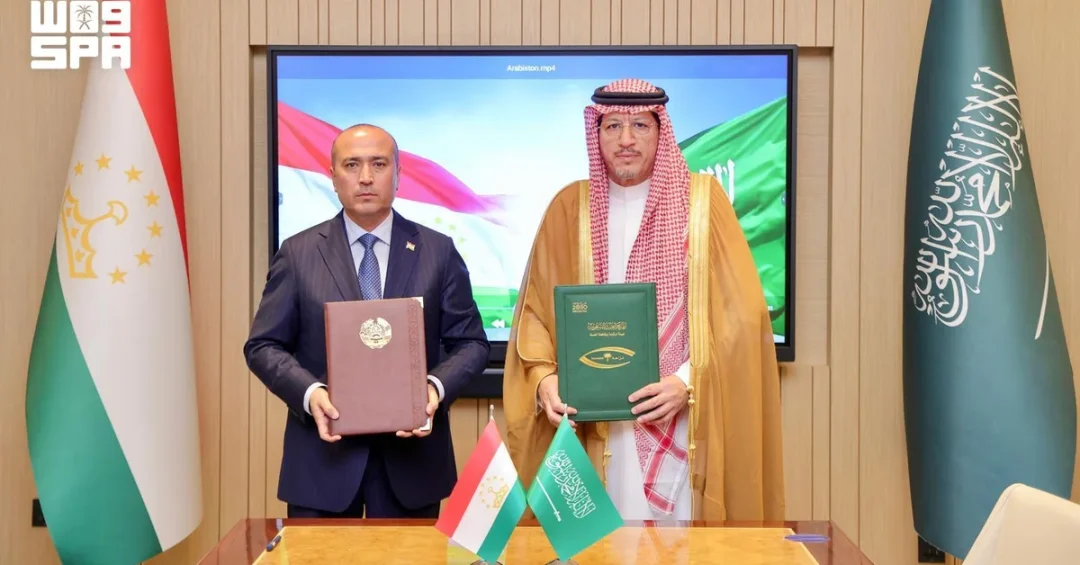
Saudi Arabia and Tajikistan signed a memorandum of understanding (MoU) in Riyadh on November 11, 2026, to prevent and combat corruption and to strengthen institutional cooperation between the two nations. The agreement was concluded between the Kingdom’s Oversight and Anti-Corruption Authority (Nazaha) and the Republic of Tajikistan’s Agency for State Financial Control and Combating Corruption, formalizing a shared commitment to integrity, transparency, and the cross-border fight against corruption-related offenses.
The MoU was signed on behalf of the Kingdom by Nazaha President Mazin bin Ibrahim Al-Kahmous and on behalf of Tajikistan by Agency for State Financial Control and Combating Corruption Director Sulaimon Said Sultonzoda. The agreement, announced via official Saudi channels including the Saudi Press Agency (SPA), marks a further step in Saudi Arabia’s expanding network of international anti-corruption partnerships under Vision 2030. But what does this partnership reveal about how Riyadh is positioning integrity as a cornerstone of its global diplomacy?
Context and Background
Why has anti-corruption cooperation become such a prominent feature of Saudi Arabia’s international engagement in recent years? The answer lies in the Kingdom’s broader institutional transformation. Since the launch of Vision 2030 in 2016, Saudi Arabia has moved decisively to strengthen governance frameworks, enhance transparency in public spending, and build robust oversight mechanisms across government ministries and state agencies. Nazaha, established as the Kingdom’s dedicated oversight and anti-corruption authority, has become a central vehicle for these reforms, tasked with protecting public funds and promoting a culture of accountability.
That domestic reform agenda has steadily acquired an international dimension. Corruption is increasingly understood as a transnational phenomenon, one that crosses borders through illicit financial flows, shell companies, and complex procurement schemes. Recognizing this, Saudi Arabia has pursued bilateral and multilateral partnerships that allow for the exchange of information, joint capacity building, and coordinated responses to corruption-related offenses. The agreement with Tajikistan fits squarely within this evolving strategy, extending the Kingdom’s cooperation footprint into Central Asia.
Tajikistan, for its part, has been pursuing its own governance modernization efforts, and its Agency for State Financial Control and Combating Corruption serves as the country’s principal body for financial oversight and anti-corruption enforcement. The pairing of Nazaha with its Tajik counterpart is therefore institutionally logical, bringing together two agencies with comparable mandates and a shared interest in strengthening enforcement capacity and preventing the abuse of public resources. How often do such agreements translate from signature into meaningful operational cooperation?
Key Details
According to information released through official Saudi channels, the MoU seeks to enhance cooperation in countering transnational corruption, facilitate the exchange of information on corruption-related offenses, and develop and strengthen the institutional capacities of both parties. These three pillars — cooperation, information exchange, and capacity building — form the operational core of the agreement and define the practical pathways through which the two authorities will work together.
The information-sharing provisions are particularly significant. Effective anti-corruption enforcement depends on timely access to reliable data about suspicious transactions, procurement irregularities, and the movement of illicit assets across jurisdictions. By committing to exchange information on corruption-related offenses, the two agencies create a formal channel that can accelerate investigations and improve the prospects of recovering misappropriated public funds. Such channels are increasingly recognized internationally as essential tools in the fight against financial crime.
The capacity-building dimension reflects a longer-term investment in institutional quality. Through training, technical assistance, and the sharing of best practices, both agencies aim to strengthen their internal systems for detection, investigation, and prevention. During the signing meeting, the two sides also reviewed bilateral relations between Saudi Arabia and Tajikistan and discussed ways to bolster cooperation in upholding integrity and combating corruption, underscoring that the agreement sits within a wider diplomatic relationship rather than in isolation. What practical benefits can citizens expect from agreements signed between oversight bodies thousands of kilometers apart?
International and Regional Impact
The MoU carries implications that extend well beyond the bilateral relationship. For Saudi Arabia, each new anti-corruption partnership reinforces its standing as a constructive actor in global governance and as a credible partner in international efforts to combat financial crime. This aligns with the Kingdom’s broader diplomatic trajectory, in which Riyadh has increasingly positioned itself as a convenor and collaborator on issues ranging from energy security to sustainable development and now institutional integrity.
For Central Asia, the agreement signals a deepening of ties between the Gulf and the region. Tajikistan’s participation in such a partnership underscores the growing recognition among Central Asian states that cooperation with Gulf institutions can yield tangible governance dividends. The arrangement also complements wider regional efforts to curb corruption, which multilateral bodies have long identified as an obstacle to investment, economic growth, and public trust. Could this agreement serve as a template for similar partnerships across Central Asia and beyond?
At the multilateral level, the MoU resonates with international frameworks such as the United Nations Convention against Corruption, which encourages cross-border cooperation among national authorities. While the SPA announcement did not specify a formal linkage to any particular convention, the substance of the agreement — mutual assistance, information exchange, and capacity building — mirrors the cooperative mechanisms that global anti-corruption architecture promotes. This alignment enhances the international legitimacy of the partnership and signals that both countries are working within recognized global norms.
Economic and Strategic Significance
Why does anti-corruption cooperation matter economically? For Saudi Arabia, integrity in public institutions is directly connected to the success of its economic transformation. Vision 2030 envisions hundreds of billions of dollars in public and private investment across giga-projects, infrastructure, and new sectors. Protecting those investments from fraud, waste, and abuse is essential to maintaining investor confidence and ensuring that capital is deployed efficiently. Robust oversight mechanisms are therefore not merely a governance nicety but an economic necessity.
Strong anti-corruption frameworks also improve the business environment. International investors and multinational corporations increasingly evaluate jurisdictions on the basis of transparency, rule of law, and institutional accountability. By demonstrating a sustained commitment to these principles — both domestically through Nazaha and internationally through partnerships such as this one — Saudi Arabia strengthens its appeal as a destination for high-quality foreign direct investment. The agreement with Tajikistan contributes to this broader reputational and strategic objective.
For Tajikistan, cooperation with a Gulf institution of Nazaha’s standing offers access to expertise, training, and networks that can strengthen its own financial control systems. Improved governance, in turn, supports economic stability and creates conditions more conducive to trade and investment. The partnership thus carries mutual economic benefits, reinforcing the idea that integrity and prosperity are intertwined rather than competing objectives. What message does a shared commitment to transparency send to the global investment community?
Vision 2030 Alignment
The MoU aligns directly with the governance and transparency objectives embedded in Saudi Arabia’s Vision 2030. The vision’s emphasis on a transparent, accountable, and efficient public sector is operationalized through institutions like Nazaha, whose mandate includes protecting public resources and promoting integrity across government. International partnerships extend that mandate beyond the Kingdom’s borders, reflecting the understanding that national reforms are strengthened when embedded in a wider network of cooperative relationships.
The agreement also reinforces Saudi Arabia’s aspiration to be a leader in global governance and a trusted partner in multilateral efforts. By signing a formal cooperation instrument with Tajikistan’s anti-corruption agency, the Kingdom demonstrates that its commitment to integrity is not confined to domestic rhetoric but is expressed through concrete international engagement. As Saudi Arabia continues to expand its diplomatic and economic footprint, partnerships built on shared values such as transparency and accountability will remain central to its global role. How will such agreements shape the Kingdom’s international standing in the years ahead?
20 Questions
Q1. What did Saudi Arabia and Tajikistan sign on November 11, 2026?
A1. The two countries signed a memorandum of understanding to prevent and combat corruption and to strengthen cooperation in upholding integrity and transparency between their respective oversight institutions.
Q2. Which Saudi body represented the Kingdom in the agreement?
A2. The Kingdom was represented by the Oversight and Anti-Corruption Authority, known as Nazaha, which is Saudi Arabia’s dedicated institution for oversight and anti-corruption enforcement.
Q3. Which Tajik institution signed the MoU?
A3. Tajikistan was represented by its Agency for State Financial Control and Combating Corruption, the country’s principal body for financial oversight and anti-corruption enforcement.
Q4. Who signed the MoU on behalf of Saudi Arabia?
A4. Nazaha President Mazin bin Ibrahim Al-Kahmous signed the memorandum on behalf of the Kingdom of Saudi Arabia during the official meeting in Riyadh.
Q5. Who signed on behalf of Tajikistan?
A5. Agency for State Financial Control and Combating Corruption Director Sulaimon Said Sultonzoda signed the agreement on behalf of the Republic of Tajikistan.
Q6. What are the main objectives of the MoU?
A6. The agreement seeks to enhance cooperation in countering transnational corruption, facilitate the exchange of information on corruption-related offenses, and develop and strengthen the institutional capacities of both parties.
Q7. Why is information exchange important in this agreement?
A7. Information exchange allows both agencies to access timely data on suspicious transactions and corruption-related offenses, which can accelerate investigations and improve the prospects of recovering misappropriated funds.
Q8. What does capacity building mean in this context?
A8. Capacity building refers to training, technical assistance, and sharing of best practices that help both agencies strengthen their systems for detection, investigation, and prevention of corruption.
Q9. Where was the MoU signed?
A9. The memorandum was signed in Riyadh, the capital of the Kingdom of Saudi Arabia, during an official meeting between the two delegations.
Q10. When was the agreement signed?
A10. The MoU was signed on November 11, 2026, according to the announcement released through official Saudi channels including the Saudi Press Agency.
Q11. What else did the two sides discuss during the meeting?
A11. The two sides reviewed bilateral relations between Saudi Arabia and Tajikistan and discussed ways to bolster cooperation in upholding integrity and combating corruption.
Q12. How does this MoU fit into Saudi Arabia’s broader strategy?
A12. It forms part of Saudi Arabia’s expanding network of international anti-corruption partnerships, reflecting the Kingdom’s commitment to transparency and good governance under Vision 2030.
Q13. Why is transnational corruption a focus of the agreement?
A13. Corruption increasingly crosses borders through illicit financial flows and complex procurement schemes, so international cooperation is essential to detect, investigate, and prevent such offenses effectively.
Q14. What is Nazaha’s role within Saudi Arabia?
A14. Nazaha is the Kingdom’s dedicated oversight and anti-corruption authority, tasked with protecting public funds, promoting accountability, and strengthening transparency across government institutions.
Q15. How does anti-corruption cooperation support investment?
A15. Strong anti-corruption frameworks improve transparency and rule of law, which increase investor confidence and help attract high-quality foreign direct investment to the Kingdom.
Q16. What does Tajikistan gain from this partnership?
A16. Tajikistan gains access to expertise, training, and networks that can strengthen its financial control systems, supporting improved governance and economic stability.
Q17. How does the agreement relate to global anti-corruption norms?
A17. Its provisions on mutual assistance, information exchange, and capacity building mirror cooperative mechanisms promoted by international frameworks such as the United Nations Convention against Corruption.
Q18. Does the MoU support Vision 2030?
A18. Yes, it aligns with Vision 2030’s governance objectives by reinforcing transparency, accountability, and the protection of public resources, while extending the Kingdom’s cooperation internationally.
Q19. What regional significance does the agreement carry?
A19. It signals deepening ties between the Gulf and Central Asia and reflects growing recognition that cooperation with Gulf institutions can yield tangible governance dividends for partner countries.
Q20. What is the broader message of this MoU?
A20. The agreement demonstrates Saudi Arabia’s commitment to integrity as a cornerstone of its global diplomacy and its aspiration to be a trusted partner in international efforts to combat corruption.
Reader Feedback
We value your thoughts. Please share your feedback on this article.
Your feedback helps us improve our coverage.
Related articles
 Saudi TGA Wins Bronze for Best Customer Service at ICXA 2026
 Hajj Conference Business Center Hosts Partnerships, Agreements
 WAMY Completes Water Wells in Nine Asian, African Nations
 Hajj Conference Emphasizes Human Dimension of Pilgrim Care
 Crown Prince Congratulates Angola on Independence Day
 King Salman Congratulates Angola on Independence Day