


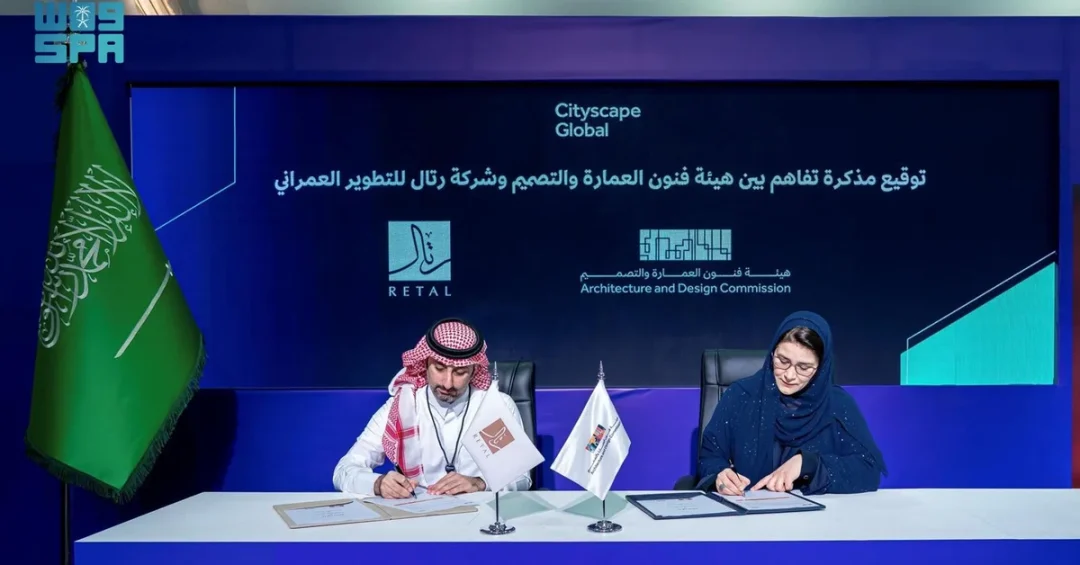
The Architecture and Design Commission of Saudi Arabia has announced the launch of a Continuous Professional Development (CPD) initiative in strategic partnership with the Royal Institute of British Architects (RIBA) and in collaboration with French Architects for Export (AFEX), alongside a memorandum of understanding signed with Retal Urban Development Company during the 2024 Cityscape Global Exhibition in Riyadh. The twin announcements, released through the Saudi Press Agency, mark a significant step in the Kingdom’s efforts to elevate architectural practice, nurture local talent, and embed international best practice into the built environment as Saudi Arabia accelerates its national transformation.
The CPD initiative is designed to offer Saudi professionals exceptional training opportunities and hands-on experience with leading architectural firms in France, forming part of their participation in the 2024 Cityscape Global Exhibition. According to the Commission, the program aligns with its mission to promote excellence in architecture and design, build strategic partnerships with leading global organizations, and empower local talent. The announcement underscores how Saudi Arabia’s cultural and professional institutions are increasingly working with world-class partners to raise standards and expand opportunity. Could there be a clearer signal that the Kingdom’s design sector is entering a new era of international collaboration?
Context and Background
The Architecture and Design Commission operates under the umbrella of the Ministry of Culture, which itself was established in 2018 as part of a broader restructuring of Saudi Arabia’s cultural landscape. Since its formation, the Commission has been tasked with regulating and developing the architecture and design sector, supporting practitioners, and ensuring that the Kingdom’s rapid urban expansion is matched by world-class design quality. Its work sits at the intersection of cultural heritage and modern development, reflecting a national commitment to preserving identity while embracing innovation.
The partnership with the Royal Institute of British Architects, one of the world’s most respected professional bodies for architecture, brings a globally recognized framework for continuing education. RIBA’s standards are widely regarded as a benchmark for professional excellence, and its involvement signals that Saudi practitioners will be trained to internationally competitive levels. The collaboration with French Architects for Export adds a complementary European dimension, offering exposure to French firms known for their expertise in urban design, heritage restoration, and large-scale public projects.
Why does this matter now? Saudi Arabia is in the midst of an unprecedented construction and urban development phase, driven by Vision 2030 and giga-projects such as NEOM, the Red Sea Project, and Diriyah Gate. The demand for highly skilled architects and designers has never been greater. By investing in continuous professional development, the Commission is ensuring that Saudi talent is ready to lead, not merely participate, in this historic build-out. The initiative also reflects a wider national emphasis on human capital development, a core pillar of the Vision 2030 agenda.
Key Details of the CPD Initiative
The Continuous Professional Development initiative includes a comprehensive training program aimed at supporting professionals in the sector by enhancing their skills and professional output. Participants will benefit from regular educational hours annually, delivered through a mix of formal and informal learning opportunities. This structure is designed to accommodate working professionals while maintaining rigorous standards, and it mirrors best practice from leading international professional bodies.
The Commission invited interested individuals to register via the dedicated link: https://backyard-exp.typeform.com/adc-cpd. It emphasized that the collaboration with AFEX reflects ongoing efforts to provide Saudi talents with valuable international experience and exposure to leading firms in France. The practical placement component in France is particularly notable, as it offers participants direct insight into how European firms approach design, project management, and client engagement. Such exposure can be transformative, equipping Saudi professionals with new perspectives that they can bring back to the Kingdom’s own ambitious projects.
How will this program change the career trajectories of Saudi architects? By combining structured learning with real-world international experience, the CPD initiative creates a pathway for continuous growth. It also helps build a community of practice within Saudi Arabia, where professionals can share knowledge and raise collective standards. The Commission’s emphasis on annual educational hours ensures that learning is not a one-off event but a sustained commitment, which is essential in a field as dynamic as architecture and design.
The Memorandum of Understanding with Retal Urban Development Company
During the Cityscape Global Exhibition, which concluded on Friday, the Architecture and Design Commission signed a memorandum of understanding with Retal Urban Development Company. The agreement covers collaboration on training and professional development for architects and designers, the organization of workshops with architecture and design experts, and the sponsorship of competitions, awards, conferences, forums, and lectures. All activities will adhere to applicable regulations and procedures, ensuring that they meet the Commission’s high standards.
The MoU also seeks to incorporate the values and principles of the King Salman Charter for Architecture and Urbanism into future projects. The Charter, named after the Custodian of the Two Holy Mosques, King Salman bin Abdulaziz Al Saud, provides a framework for architecture that respects Saudi Arabia’s cultural heritage, environmental context, and social fabric. By embedding these principles into new developments, the partnership aims to ensure that modernization does not come at the expense of identity. This is a delicate balance that many rapidly developing nations struggle to achieve, and Saudi Arabia is addressing it head-on.
What does this mean for the future of Saudi cities? The collaboration with Retal, a prominent urban development company, suggests that the principles championed by the Commission will be applied in real projects, not just discussed in theory. The sponsorship of competitions and awards will also help identify and celebrate emerging talent, creating incentives for excellence. Over time, this could lead to a distinctly Saudi school of architecture that is both globally informed and locally rooted, a goal that aligns with the broader cultural ambitions of Vision 2030.
International and Regional Impact
The involvement of RIBA and AFEX positions Saudi Arabia as a serious player in the global architecture and design community. For international firms and professional bodies, partnering with the Kingdom offers access to one of the world’s most active construction markets and a chance to contribute to projects of historic scale. For Saudi professionals, the benefit is direct: access to training, mentorship, and networks that were previously harder to reach. This two-way exchange is a hallmark of the Kingdom’s approach to international cooperation, which emphasizes mutual benefit and long-term relationship building.
Regionally, the initiative could have a demonstration effect. Other countries in the Middle East and North Africa are also investing heavily in urban development, and Saudi Arabia’s model of pairing international partnerships with local capacity building may serve as a template. The emphasis on continuous professional development is particularly relevant, as it addresses a common challenge in fast-growing markets: ensuring that the workforce keeps pace with the scale and complexity of new projects. By setting a high bar, the Commission is helping to raise standards across the region.
Could this initiative also strengthen Saudi Arabia’s soft power? Architecture and design are powerful expressions of culture and identity. When Saudi-trained architects work on international projects or when Saudi cities host world-class design, they project an image of a confident, modern nation. The partnerships with RIBA and AFEX are not just technical arrangements; they are cultural exchanges that foster understanding and respect. In this sense, the CPD initiative and the Retal MoU contribute to Saudi Arabia’s broader diplomatic and cultural outreach, reinforcing its role as a bridge between East and West.
Economic and Strategic Significance
The economic stakes are considerable. Saudi Arabia’s construction and real estate sectors are among the largest in the region, and they are central to Vision 2030’s goals of diversifying the economy away from oil. By investing in the skills of architects and designers, the Commission is helping to ensure that this investment yields high-quality, sustainable outcomes. Well-designed buildings and public spaces can enhance quality of life, attract tourism, and increase property values, all of which contribute to economic growth.
Moreover, the focus on professional development supports the creation of high-value jobs for Saudi citizens. As the Kingdom builds giga-projects and expands its cities, there is a growing demand for skilled professionals who can lead complex design and construction efforts. The CPD initiative, with its international placements, gives Saudi talent a competitive edge in this market. It also aligns with the broader national strategy of empowering citizens to take on leadership roles in key sectors, reducing reliance on foreign expertise over time while still benefiting from global partnerships.
What role will the private sector play? The MoU with Retal Urban Development Company shows that private firms are seen as essential partners in this endeavor. By collaborating on training, workshops, and awards, companies can help shape the curriculum and ensure that it meets real-world needs. This public-private synergy is a recurring theme in Vision 2030, where government sets the direction and the private sector drives implementation. The architecture and design sector is thus a microcosm of the Kingdom’s wider economic transformation.
Vision 2030 Alignment
The Architecture and Design Commission’s initiatives are squarely aligned with Vision 2030, Saudi Arabia’s comprehensive plan to build a vibrant society, a thriving economy, and an ambitious nation. Under the Vision’s quality-of-life program, the Kingdom aims to create attractive, sustainable cities and communities that reflect its cultural heritage while meeting the needs of a modern population. The CPD initiative and the Retal MoU contribute directly to this goal by raising professional standards and embedding the King Salman Charter for Architecture and Urbanism into future projects.
Furthermore, the emphasis on international partnerships supports Vision 2030’s objective of strengthening Saudi Arabia’s global engagement. By working with RIBA and AFEX, the Kingdom is not only importing expertise but also exporting its own cultural values and ambitions. This exchange enhances Saudi Arabia’s reputation as a hub for innovation and creativity, attracting talent and investment from around the world. As the Kingdom continues its journey toward 2030, initiatives like these will ensure that its built environment is a source of pride and a driver of progress.
In conclusion, the launch of the CPD initiative and the signing of the MoU with Retal Urban Development Company represent a decisive investment in Saudi Arabia’s architectural future. They demonstrate the Kingdom’s commitment to excellence, its openness to international collaboration, and its determination to empower local talent. As Vision 2030 unfolds, the Architecture and Design Commission will remain at the forefront, shaping a built environment that honors the past while building for the future. Isn’t that the kind of legacy every nation aspires to create?
20 Questions
Q1. What did the Architecture and Design Commission announce?
A1. The Commission announced a Continuous Professional Development initiative with RIBA and AFEX, and a memorandum of understanding with Retal Urban Development Company, both aimed at advancing architecture and design in Saudi Arabia.
Q2. Who are the international partners in the CPD initiative?
A2. The initiative is in strategic partnership with the Royal Institute of British Architects (RIBA) and in collaboration with French Architects for Export (AFEX), two respected international organizations.
Q3. What is the purpose of the CPD initiative?
A3. It aims to offer Saudi talents exceptional training and practical experience with leading architectural firms in France, enhancing skills and professional output through annual educational hours.
Q4. How can interested individuals register for the CPD initiative?
A4. Interested individuals can register via the link provided by the Commission: https://backyard-exp.typeform.com/adc-cpd.
Q5. What did the Commission sign during the Cityscape Global Exhibition?
A5. The Commission signed a memorandum of understanding with Retal Urban Development Company during the exhibition, which concluded on Friday.
Q6. What does the MoU with Retal cover?
A6. It covers collaboration on training and professional development, organizing workshops, and sponsoring competitions, awards, conferences, forums, and lectures, all adhering to applicable regulations.
Q7. What is the King Salman Charter for Architecture and Urbanism?
A7. It is a framework that provides values and principles for architecture and urbanism in Saudi Arabia, which the MoU seeks to incorporate into future projects.
Q8. Why is the partnership with RIBA significant?
A8. RIBA is a globally recognized professional body, and its involvement ensures that Saudi professionals are trained to internationally competitive standards, enhancing the sector’s credibility.
Q9. What role does AFEX play in the initiative?
A9. AFEX facilitates practical experience with leading architectural firms in France, providing Saudi talents with valuable international exposure and insight into European design practices.
Q10. How does this initiative align with Vision 2030?
A10. It supports Vision 2030’s goals of empowering local talent, enhancing quality of life, and diversifying the economy by building a skilled workforce in architecture and design.
Q11. What are the benefits for Saudi architects?
A11. They gain access to continuous professional development, international placements, networking opportunities, and exposure to best practices, helping them lead in the Kingdom’s ambitious projects.
Q12. How will the MoU with Retal impact future projects?
A12. It will integrate the King Salman Charter’s principles into new developments, ensuring that modernization respects cultural heritage and environmental context.
Q13. What is the significance of the Cityscape Global Exhibition?
A13. It is a major real estate event where the Commission showcased its initiatives and signed the MoU, highlighting Saudi Arabia’s active role in global architecture and design.
Q14. Will the CPD initiative include formal qualifications?
A14. The program includes regular educational hours annually through formal and informal learning, though specific qualifications may vary; it is designed to enhance skills and professional output.
Q15. How does this initiative support Saudi talent?
A15. By providing training, international experience, and exposure to leading firms, it empowers Saudi professionals to excel and contribute to the Kingdom’s architectural vision.
Q16. What is the expected duration of the CPD program?
A16. The program is designed for continuous professional development with annual educational hours, suggesting an ongoing commitment rather than a fixed-term course.
Q17. Are there opportunities for Saudi women in this initiative?
A17. Yes, the initiative is open to all Saudi talents, and it aligns with Vision 2030’s goal of empowering women and increasing their participation in the workforce.
Q18. How will success be measured for these initiatives?
A18. Success will likely be measured by the number of participants, their career advancement, the quality of projects incorporating the Charter’s principles, and feedback from partners.
Q19. What other sectors might benefit from similar collaborations?
A19. Other cultural and creative sectors, such as art, design, and heritage, could benefit from similar international partnerships, further enriching Saudi Arabia’s cultural landscape.
Q20. What is the long-term vision for Saudi architecture?
A20. The long-term vision is to create a distinctly Saudi architectural identity that is globally respected, sustainable, and rooted in the Kingdom’s heritage, contributing to Vision 2030’s ambitious goals.
Reader Feedback
We value your thoughts. Please share your feedback on this article.
Your feedback helps us improve our coverage.
Related articles
 Saudi Arabia Weather Forecast: Sunday’s Outlook
 SPL Issues SAR3 Stamp Marking World Quality Day
 SAMI Returns as Strategic Partner for Third Saudi International Maritime Forum
 Saudi Arabia Joins IPU Parliamentary Meeting at COP29
 Makkah Pilgrims Housing Committee Issues 1446 AH Permits
 Jeddah Governor Receives Kazakh Consul General