


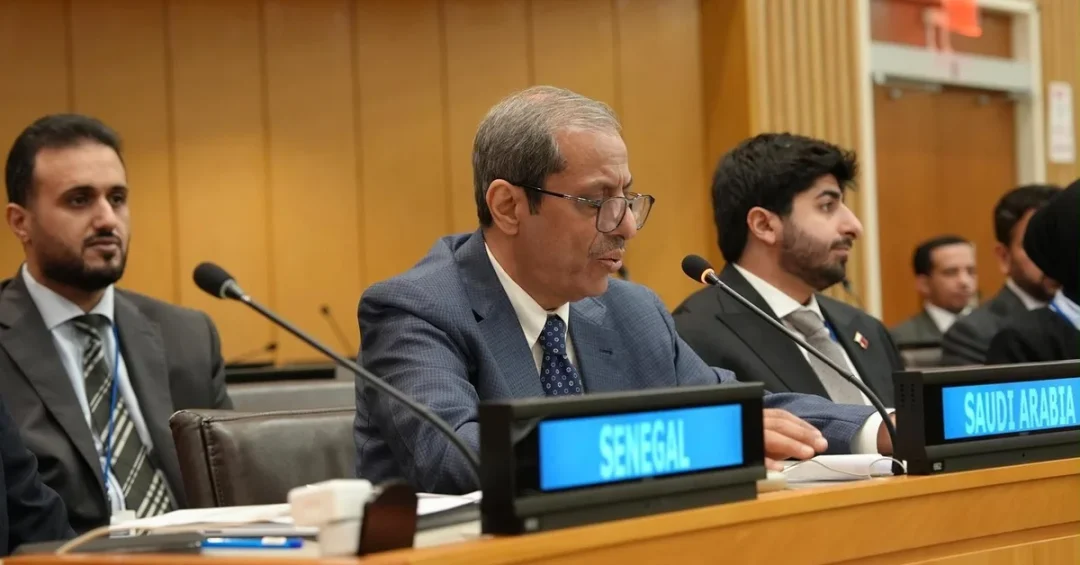
Saudi Arabia’s Deputy Minister for International Multilateral Affairs, Dr. Abdulrahman Al-Rassi, participated on Thursday in the Annual Coordination Meeting of Foreign Ministers of the Organization of Islamic Cooperation (OIC) member states, held in New York on the sidelines of the High-Level Week of the 81st session of the United Nations General Assembly. Representing Minister of Foreign Affairs Prince Faisal bin Farhan bin Abdullah, Dr. Al-Rassi, who also serves as General Supervisor of the Economic and Development Affairs Deputyship, joined counterparts from across the Islamic world to discuss pressing regional and international issues, strengthen coordination among member states, and unify positions on matters of shared concern. The meeting, confirmed by the Saudi Press Agency, underscored the Kingdom’s continuing commitment to multilateral diplomacy and to reinforcing joint Islamic action in international forums.
The gathering in New York reflects a longstanding tradition of OIC foreign ministers convening annually during the United Nations General Assembly to align their diplomatic strategies. For Saudi Arabia, participation at this level signals both its leadership role within the Islamic world and its broader ambition to serve as a bridge between regions and cultures. As global challenges multiply, from economic uncertainty to security concerns, the value of coordinated Islamic diplomacy has rarely been greater. The Kingdom’s engagement in this meeting is therefore not merely procedural but strategically significant, reinforcing its Vision 2030 objective of deepening international partnerships and projecting influence through constructive dialogue.
Context and Background
Why does an annual coordination meeting of OIC foreign ministers matter in the broader landscape of global diplomacy? The Organization of Islamic Cooperation, founded in 1969 and headquartered in Jeddah, Saudi Arabia, is the second-largest intergovernmental organization after the United Nations, representing 57 member states across four continents. Its annual coordination meeting on the sidelines of the UN General Assembly serves as a critical platform for member states to synchronize their positions before engaging in the wider multilateral discussions that define the UN’s High-Level Week. This year’s meeting, held during the 81st session, carried particular weight as the international community confronts a complex array of political, economic, and humanitarian challenges.
Saudi Arabia has long played a central role in the OIC, both as its host country and as a leading voice in shaping its agenda. The Kingdom’s participation in this year’s coordination meeting, led by Dr. Abdulrahman Al-Rassi on behalf of Prince Faisal bin Farhan bin Abdullah, highlights the continuity of Saudi diplomacy under the leadership of the Custodian of the Two Holy Mosques, King Salman bin Abdulaziz Al Saud, and His Royal Highness Crown Prince Mohammed bin Salman bin Abdulaziz Al Saud. The meeting provided an opportunity for member states to discuss ways to enhance coordination and unify their positions on current regional and international issues, thereby contributing to stronger joint Islamic action and more effective representation in international forums.
The timing of the meeting is significant. As the UN General Assembly’s High-Level Week brings together world leaders to address global priorities, the OIC’s coordination meeting ensures that the collective voice of the Islamic world is heard clearly and consistently. For Saudi Arabia, this aligns with its broader foreign policy objectives of promoting peace, stability, and development, while also advancing the goals of Vision 2030 by fostering international cooperation and economic integration.
Key Details of the Meeting
What specific issues were on the agenda during this high-level coordination meeting? According to the Saudi Press Agency, the meeting addressed several issues of interest to OIC member states, with a focus on enhancing coordination among them and unifying their positions on current regional and international issues. While the official statement did not enumerate every topic, the discussions likely encompassed ongoing conflicts, humanitarian crises, economic challenges, and the need for greater solidarity in multilateral institutions. The presence of Dr. Al-Rassi, a seasoned diplomat who also oversees the Economic and Development Affairs Deputyship, signals Saudi Arabia’s interest in linking political coordination with economic and development priorities.
The meeting was held on Thursday in New York, on the margins of the 81st session of the UN General Assembly. This annual gathering typically precedes or follows the general debate, allowing foreign ministers to strategize collectively before bilateral and multilateral engagements. The OIC’s role in facilitating such coordination is vital, as it enables member states to present a united front on issues ranging from the Palestinian cause to counterterrorism, from sustainable development to climate change. Saudi Arabia’s active participation reinforces its position as a consensus-builder and a stabilizing force within the organization.
Dr. Al-Rassi’s participation on behalf of Prince Faisal bin Farhan bin Abdullah underscores the importance Saudi Arabia attaches to the OIC as a vehicle for collective action. The Kingdom’s diplomatic apparatus has been increasingly active on the world stage, hosting major summits, mediating regional disputes, and championing humanitarian initiatives. This meeting in New York is part of that broader pattern of engagement, demonstrating Saudi Arabia’s commitment to working through multilateral institutions to address shared challenges.
International and Regional Impact
How does coordination among OIC member states translate into tangible impact on the global stage? When 57 nations speak with a unified voice, their collective influence on international decision-making is substantial. The OIC represents a significant bloc within the United Nations, and its coordinated positions can shape debates on issues such as peace and security, human rights, and sustainable development. By aligning their stances before key UN discussions, member states increase the likelihood that their concerns are addressed in resolutions and outcomes. Saudi Arabia’s role in facilitating this coordination is therefore instrumental in ensuring that the Islamic world’s perspectives are adequately represented.
Regionally, the meeting contributes to stability and cooperation across the Middle East, Africa, and Asia. The OIC provides a framework for dialogue and conflict resolution, and Saudi Arabia has consistently used its influence within the organization to promote peaceful solutions and humanitarian relief. The discussions in New York may also have touched on economic cooperation, given the presence of Dr. Al-Rassi in his capacity as General Supervisor of the Economic and Development Affairs Deputyship. Enhanced economic ties among OIC member states could lead to increased trade, investment, and joint development projects, all of which align with Saudi Arabia’s Vision 2030 goals of diversifying its economy and strengthening its global partnerships.
Economic and Strategic Significance
What economic and strategic benefits arise from Saudi Arabia’s active engagement in the OIC? The Kingdom’s participation in multilateral forums like this coordination meeting serves multiple strategic purposes. First, it reinforces Saudi Arabia’s leadership position within the Islamic world, a role that carries significant diplomatic weight. Second, it provides a platform to advocate for economic cooperation and development initiatives that complement Vision 2030. The OIC’s member states represent a combined GDP of trillions of dollars and a market of over 1.8 billion people, making intra-OIC trade and investment a promising avenue for growth. Saudi Arabia, as the world’s largest oil exporter and a growing hub for technology and tourism, is well-positioned to benefit from deeper economic integration.
Moreover, the meeting allows Saudi Arabia to align its foreign policy objectives with those of like-minded nations, creating a united front on issues such as energy security, food security, and climate action. The Kingdom’s Vision 2030 emphasizes sustainability and economic diversification, and these themes resonate strongly with many OIC member states. By coordinating positions, Saudi Arabia can advance its own priorities while contributing to the collective good. The presence of Dr. Al-Rassi, with his dual portfolio of international multilateral affairs and economic development, symbolizes this integrated approach, bridging political diplomacy with economic strategy.
Vision 2030 Alignment
How does Saudi Arabia’s participation in the OIC Annual Coordination Meeting reflect the objectives of Vision 2030? Vision 2030 is fundamentally about transforming Saudi Arabia into a diversified, globally connected economy and a more influential actor on the world stage. International diplomacy is a key pillar of this transformation, and the Kingdom’s active role in multilateral organizations like the OIC demonstrates its commitment to constructive global engagement. By helping to unify the positions of Islamic states on critical issues, Saudi Arabia enhances its reputation as a responsible and forward-looking leader, attracting partners and investors who value stability and cooperation.
Furthermore, the meeting’s focus on coordination and joint action aligns with Vision 2030’s emphasis on building strategic partnerships and promoting Saudi Arabia as a hub for international dialogue. The Kingdom’s hosting of the OIC headquarters in Jeddah is a testament to its enduring commitment to the organization, and its continued participation in high-level meetings reinforces this bond. As Saudi Arabia advances toward its Vision 2030 goals, its diplomacy will remain a vital tool for shaping a peaceful and prosperous future, both for the Kingdom and for the wider Islamic world. The Annual Coordination Meeting in New York is one more step in that ongoing journey, showcasing Saudi Arabia’s leadership and its unwavering dedication to multilateral cooperation.
20 Questions
Q1. What was the main purpose of the OIC Annual Coordination Meeting in New York?
A1. The meeting aimed to discuss issues of interest to OIC member states, enhance coordination among them, and unify their positions on current regional and international issues, contributing to stronger joint Islamic action in international forums.
Q2. Who represented Saudi Arabia at the meeting?
A2. Dr. Abdulrahman Al-Rassi, Deputy Minister for International Multilateral Affairs and General Supervisor of the Economic and Development Affairs Deputyship, represented Saudi Arabia on behalf of Minister of Foreign Affairs Prince Faisal bin Farhan bin Abdullah.
Q3. When and where was the meeting held?
A3. The meeting was held on Thursday in New York, on the sidelines of the High-Level Week of the 81st session of the United Nations General Assembly.
Q4. What is the Organization of Islamic Cooperation (OIC)?
A4. The OIC is the second-largest intergovernmental organization after the United Nations, with 57 member states. It is headquartered in Jeddah, Saudi Arabia, and focuses on promoting Islamic solidarity and cooperation.
Q5. Why is Saudi Arabia’s participation in this meeting significant?
A5. Saudi Arabia’s participation underscores its leadership role in the Islamic world and its commitment to multilateral diplomacy, aligning with its Vision 2030 goals of global engagement and economic diversification.
Q6. What topics were discussed at the meeting?
A6. The meeting discussed several issues of interest to OIC member states, including ways to enhance coordination and unify positions on regional and international issues. Specific topics were not detailed in the official statement.
Q7. How does the OIC Annual Coordination Meeting relate to the UN General Assembly?
A7. The meeting is held annually on the sidelines of the UN General Assembly’s High-Level Week, allowing OIC member states to coordinate their positions before engaging in broader multilateral discussions at the UN.
Q8. What role does Saudi Arabia play within the OIC?
A8. Saudi Arabia is a founding member and host country of the OIC. It plays a central role in shaping the organization’s agenda and promoting joint Islamic action.
Q9. What is the Economic and Development Affairs Deputyship?
A9. The Economic and Development Affairs Deputyship is a Saudi government body focused on economic and development policies. Dr. Al-Rassi serves as its General Supervisor, linking economic priorities with diplomatic efforts.
Q10. How does this meeting contribute to joint Islamic action?
A10. By bringing together foreign ministers to align their positions, the meeting fosters unity and coordination among OIC member states, enabling them to speak with a stronger, collective voice in international forums.
Q11. What are the potential economic benefits of OIC cooperation for Saudi Arabia?
A11. Enhanced cooperation can lead to increased trade, investment, and joint development projects among OIC member states, supporting Saudi Arabia’s Vision 2030 goals of economic diversification and global partnership.
Q12. How does Saudi Arabia’s Vision 2030 align with OIC objectives?
A12. Vision 2030 emphasizes international engagement and economic diversification, which align with the OIC’s goals of promoting cooperation and development among Islamic states.
Q13. What is the significance of the meeting being held in New York?
A13. New York hosts the UN General Assembly, making it a hub for global diplomacy. Holding the OIC meeting there allows member states to coordinate before engaging in UN discussions.
Q14. Who is Prince Faisal bin Farhan bin Abdullah?
A14. Prince Faisal bin Farhan bin Abdullah is the Minister of Foreign Affairs of Saudi Arabia. He has been a key figure in Saudi diplomacy, representing the Kingdom at major international events.
Q15. How does Saudi Arabia benefit from its leadership in the OIC?
A15. Leadership in the OIC enhances Saudi Arabia’s diplomatic influence, strengthens its ties with Islamic nations, and provides a platform to advance its foreign policy and economic interests.
Q16. What is the High-Level Week of the UN General Assembly?
A16. The High-Level Week is the opening segment of the UN General Assembly session, where world leaders gather to discuss global issues. It includes speeches, summits, and bilateral meetings.
Q17. What does ‘unifying positions’ mean in the context of the OIC?
A17. Unifying positions means that OIC member states agree on common stances regarding regional and international issues, allowing them to present a coordinated front in multilateral negotiations and votes.
Q18. How often does the OIC Annual Coordination Meeting take place?
A18. The meeting is held annually on the sidelines of the UN General Assembly’s High-Level Week, typically in September.
Q19. What are the key challenges facing OIC member states today?
A19. Challenges include regional conflicts, economic instability, humanitarian crises, and climate change. The OIC seeks to address these through collective action and coordination.
Q20. How can the international community benefit from OIC coordination?
A20. A unified OIC voice can contribute to global peace, security, and development by promoting dialogue, supporting humanitarian efforts, and fostering economic cooperation across a diverse group of nations.
Reader Feedback
We value your thoughts. Please share your feedback on this article.
Your feedback helps us improve our coverage.
Related articles
 Saudi Deputy Minister Joins Global Water Action Event in New York
 Al-Baha Chamber Celebrates Saudi National Day
 Saudi Embassy in Iran Hosts National Day Reception
 Saudi Embassy in Denmark Hosts National Day Reception
 Saudi FM Meets Spanish Counterpart at UN General Assembly
 Qatar Condemns Houthi Missile Attacks on Taif and Yanbu