


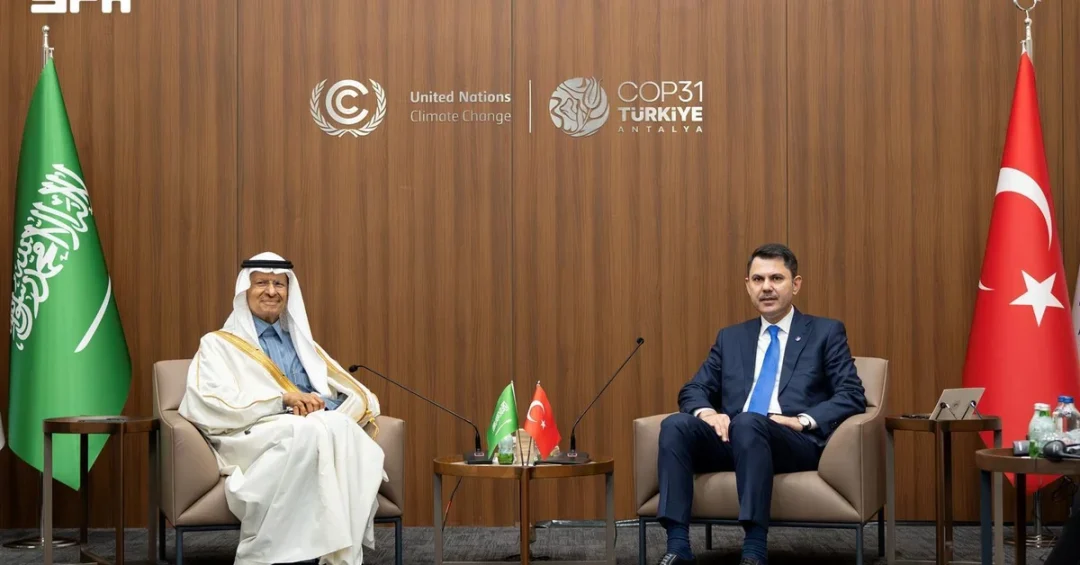
Saudi Arabia’s Minister of Energy and Minister of Industry and Mineral Resources, Prince Abdulaziz bin Salman bin Abdulaziz, met with Türkiye’s Minister of Environment, Urbanization and Climate Change, Murat Kurum, on the sidelines of the 31st Conference of the Parties to the United Nations Framework Convention on Climate Change (COP31) in Antalya, Türkiye, on November 20, 2026, according to the Saudi Press Agency (SPA). The high-level meeting underscored the Kingdom’s active role in global climate diplomacy and its commitment to advancing balanced, inclusive outcomes at the international climate negotiations. Both ministers explored avenues to strengthen bilateral cooperation on climate action and reviewed the latest developments at COP31, signaling a shared interest in pragmatic, nationally determined approaches to the Paris Agreement.
The encounter comes at a pivotal moment for global climate governance, as nations gather to assess progress toward the goals of the Paris Agreement and negotiate pathways for enhanced ambition. Saudi Arabia, as the world’s largest oil exporter and a key player in the global energy transition, has consistently advocated for a balanced approach that addresses both climate imperatives and the development needs of all countries. The meeting with Türkiye reflects the Kingdom’s broader strategy of fostering regional and international partnerships that support sustainable development while safeguarding economic stability and energy security.
Context and Background: Why This Meeting Matters Now
What makes this ministerial encounter particularly significant at this juncture? The COP31 summit in Antalya brings together representatives from nearly 200 countries to deliberate on critical issues such as climate finance, adaptation, mitigation, and the operationalization of the Paris Agreement’s carbon markets. Against this backdrop, the dialogue between Prince Abdulaziz bin Salman, who also chairs the Saudi Green Initiative and leads the Kingdom’s energy and industrial portfolios, and Minister Murat Kurum takes on added weight. It represents a convergence of two nations with distinct but complementary perspectives on climate action—Saudi Arabia as a major energy producer driving the circular carbon economy, and Türkiye as a rapidly industrializing economy navigating its own green transition.
The bilateral relationship between Saudi Arabia and Türkiye has deepened considerably in recent years, marked by high-level visits, trade agreements, and collaborative initiatives across energy, defense, tourism, and technology. In the climate domain, both countries share an interest in promoting technology-neutral approaches that recognize national circumstances. Saudi Arabia has long championed the concept of a circular carbon economy—a framework endorsed at the G20—which emphasizes reducing, reusing, recycling, and removing carbon emissions rather than simply phasing out fossil fuels. This philosophy aligns with the Paris Agreement’s principle of common but differentiated responsibilities, a cornerstone of the Kingdom’s negotiating stance. The meeting in Antalya thus served as an opportunity to synchronize positions on key agenda items and explore joint projects that could accelerate climate action in the region.
Key Details: What Was Discussed
According to the official SPA report, the two ministers explored ways to strengthen cooperation on climate action, reviewed developments at COP31, and discussed efforts to meet the goals of the Paris Agreement in a manner that takes into account countries’ national circumstances and contributes to balanced and inclusive outcomes. While specific agreements were not disclosed, the language of the statement underscores a shared commitment to multilateralism and a rules-based climate regime. The emphasis on national circumstances is particularly telling, as it reflects Saudi Arabia’s consistent position that climate policies must not undermine economic growth or energy access for developing nations.
Prince Abdulaziz bin Salman, who has been a prominent voice in global energy dialogues, has repeatedly articulated the Kingdom’s vision of a diversified energy mix that includes hydrocarbons, renewables, and hydrogen. Under his leadership, Saudi Arabia has set ambitious targets, including generating 50% of its electricity from renewable sources by 2030 and achieving net-zero emissions by 2060 through the circular carbon economy framework. Minister Murat Kurum, for his part, has overseen Türkiye’s ratification of the Paris Agreement in 2021 and the subsequent launch of a green development roadmap. Türkiye’s climate agenda focuses on renewable energy expansion, sustainable urbanization, and climate resilience, making it a natural partner for Saudi Arabia in sharing best practices and co-developing green technologies.
The meeting also likely touched upon the operationalization of carbon markets under Article 6 of the Paris Agreement, a topic of high interest for both nations. Saudi Arabia has been exploring the development of a domestic carbon trading scheme and has expressed interest in regional carbon market linkages. Türkiye, with its emerging emissions trading system, could serve as a collaborative partner in this space. By aligning their approaches, the two countries can help shape the emerging international carbon market architecture in a way that is fair, transparent, and conducive to sustainable development.
International and Regional Impact: Shaping the Climate Dialogue
How might this bilateral engagement influence the broader climate negotiations? The Saudi-Türkiye meeting sends a signal that major economies and energy producers are willing to engage constructively and find common ground. In an era where climate talks are often polarized between developed and developing nations, the cooperative stance of Saudi Arabia and Türkiye offers a moderating influence. Their shared emphasis on balanced and inclusive outcomes resonates with many emerging economies that fear being sidelined by aggressive decarbonization targets. This alignment could help build consensus around contentious issues such as climate finance, technology transfer, and adaptation support.
Regionally, the meeting reinforces Saudi Arabia’s role as a bridge-builder in the Middle East and beyond. Türkiye, straddling Europe and Asia, is a key player in regional energy and climate dynamics. Closer cooperation between Riyadh and Ankara can facilitate the development of cross-border renewable energy projects, including green hydrogen corridors and electricity interconnection. Such initiatives align with the broader regional push toward clean energy integration, as seen in the Saudi-led Middle East Green Initiative, which aims to plant 50 billion trees and reduce regional emissions by more than 10% of global contributions. By partnering with Türkiye, Saudi Arabia can extend its environmental stewardship beyond the Gulf and contribute to a more sustainable neighborhood.
Economic and Strategic Significance: Beyond Climate Diplomacy
What does this meeting signify for the economic and strategic ties between the two countries? The encounter at COP31 is not merely a climate-focused discussion; it is embedded in a broader economic partnership. Saudi Arabia and Türkiye have set an ambitious target of boosting bilateral trade to $10 billion annually. Energy, infrastructure, and technology are key pillars of this relationship. The climate dialogue provides a platform to explore joint investments in clean energy, green manufacturing, and sustainable urbanization—areas where both countries have significant mutual interests. For Saudi Arabia, Türkiye’s expertise in urbanization and construction could support the Kingdom’s giga-projects such as NEOM, which aspire to be models of sustainable living.
Furthermore, the Kingdom’s strategic pivot toward renewable energy and green industries is a core component of Vision 2030, the national transformation plan championed by Crown Prince Mohammed bin Salman. By engaging with Türkiye on climate action, Saudi Arabia is simultaneously advancing its economic diversification goals and positioning itself as a responsible global energy leader. The meeting also underscores the Kingdom’s commitment to the Saudi Green Initiative, which includes investments in renewable energy, clean hydrogen, and carbon capture technologies. These efforts are expected to create jobs, attract foreign investment, and stimulate innovation, all of which are central to Vision 2030’s economic objectives.
Vision 2030 Alignment: A Forward-Looking Partnership
How does this meeting connect to Saudi Arabia’s long-term vision? The engagement with Türkiye at COP31 is a clear embodiment of Vision 2030’s emphasis on international cooperation, sustainability, and economic diversification. Prince Abdulaziz bin Salman’s dual role as Minister of Energy and Minister of Industry and Mineral Resources reflects the integrated approach the Kingdom is taking to balance energy security, industrial growth, and climate responsibility. By fostering partnerships with countries like Türkiye, Saudi Arabia is not only advancing its own green agenda but also contributing to a more resilient and inclusive global climate framework.
Looking ahead, the outcomes of the Antalya discussions are expected to inform future bilateral initiatives, potentially leading to joint research and development in carbon capture, renewable energy, and sustainable urban planning. As the Kingdom prepares to host major international events and continues to invest heavily in clean technologies, its collaboration with Türkiye will serve as a model for constructive engagement between energy producers and industrializing economies. The meeting reaffirms Saudi Arabia’s commitment to the Paris Agreement and its determination to pursue climate action in a manner that supports economic prosperity and social well-being for all.
20 Questions
Q1. What was the main purpose of the meeting between Prince Abdulaziz bin Salman and Murat Kurum?
A1. The ministers met to explore ways to strengthen cooperation on climate action, review developments at COP31, and discuss efforts to meet the Paris Agreement goals in a balanced and inclusive manner.
Q2. Where did the meeting take place?
A2. The meeting took place on the sidelines of the 31st Conference of the Parties to the United Nations Framework Convention on Climate Change (COP31) in Antalya, Türkiye.
Q3. Who is Prince Abdulaziz bin Salman bin Abdulaziz?
A3. He is Saudi Arabia’s Minister of Energy and Minister of Industry and Mineral Resources, a key figure in the Kingdom’s energy and industrial strategy.
Q4. Who is Murat Kurum?
A4. Murat Kurum is Türkiye’s Minister of Environment, Urbanization and Climate Change, responsible for the country’s environmental and climate policies.
Q5. What is COP31?
A5. COP31 is the 31st Conference of the Parties to the United Nations Framework Convention on Climate Change, a major annual global climate summit.
Q6. Why is this meeting significant for Saudi Arabia?
A6. It underscores Saudi Arabia’s active role in global climate diplomacy and its commitment to balanced, inclusive outcomes at international climate negotiations.
Q7. What does ‘national circumstances’ mean in the context of the Paris Agreement?
A7. The principle recognizes that countries have different economic and developmental contexts and should pursue climate action accordingly, as outlined in the Paris Agreement.
Q8. How does Saudi Arabia approach climate action?
A8. Saudi Arabia advocates a circular carbon economy approach, emphasizing reducing, reusing, recycling, and removing carbon emissions while maintaining energy security and economic growth.
Q9. What is the circular carbon economy?
A9. It is a framework endorsed at the G20 that focuses on managing emissions through a mix of technologies and policies rather than simply phasing out fossil fuels.
Q10. What are Saudi Arabia’s renewable energy targets?
A10. The Kingdom aims to generate 50% of its electricity from renewable sources by 2030 and achieve net-zero emissions by 2060.
Q11. How has Türkiye engaged with the Paris Agreement?
A11. Türkiye ratified the Paris Agreement in 2021 and launched a green development roadmap focusing on renewable energy and sustainable urbanization.
Q12. What role does the Saudi Green Initiative play?
A12. The Saudi Green Initiative is a national effort to combat climate change, including planting 10 billion trees and investing in clean energy and carbon capture.
Q13. What is the Middle East Green Initiative?
A13. It is a regional effort led by Saudi Arabia to plant 50 billion trees and reduce regional emissions, contributing to global climate goals.
Q14. How does this meeting align with Vision 2030?
A14. It reflects Vision 2030’s emphasis on international cooperation, sustainability, and economic diversification, positioning Saudi Arabia as a responsible global energy leader.
Q15. What economic benefits could arise from Saudi-Türkiye climate cooperation?
A15. Cooperation could lead to joint investments in clean energy, green manufacturing, and sustainable urbanization, supporting economic diversification and job creation.
Q16. What is the significance of Article 6 of the Paris Agreement?
A16. Article 6 establishes frameworks for international carbon markets, allowing countries to cooperate on emission reductions and trade carbon credits.
Q17. How might this meeting influence global climate negotiations?
A17. By demonstrating constructive engagement between an energy producer and an industrializing economy, it could help build consensus and moderate polarized debates.
Q18. What are the key areas of Saudi-Türkiye bilateral relations?
A18. The relationship spans trade, energy, defense, tourism, and technology, with both countries aiming to boost bilateral trade to $10 billion annually.
Q19. What follow-up actions are expected after the meeting?
A19. The discussions are expected to inform future bilateral initiatives, including joint research and development in carbon capture, renewable energy, and sustainable urban planning.
Q20. How does Saudi Arabia balance energy security with climate action?
A20. Through the circular carbon economy framework, the Kingdom integrates hydrocarbons with renewables and clean technologies to ensure stable energy supply while reducing emissions.
Reader Feedback
We value your thoughts. Please share your feedback on this article.
Your feedback helps us improve our coverage.
Related articles
 Duba Port Customs Foils Smuggling of 2.3 Million Amphetamine Pills
 Prophet’s Mosque Imam Calls for Sincere Repentance in Friday Sermon
 Grand Mosque Imam Highlights Moderation and Balance
 Coalition Requests Civilians Evacuate Hodeidah Port
 Afforestation Initiative Launched in Al-Ahsa for Green Future
 Intensive Quran Review Program Set for Prophet’s Mosque Nov 21-28