


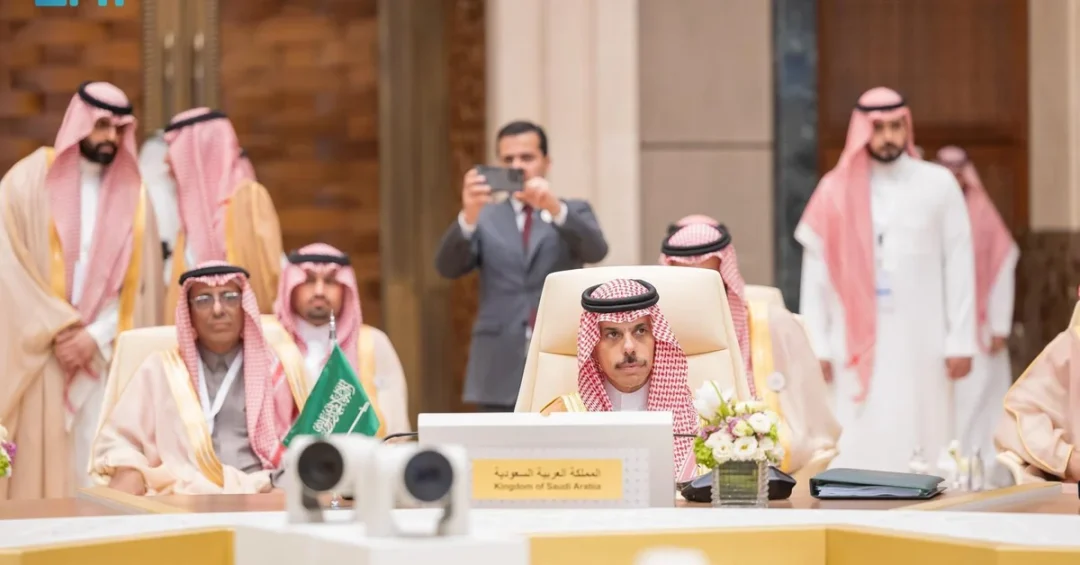
Saudi Minister of Foreign Affairs Prince Faisal bin Farhan bin Abdullah participated in the seventh Gulf Cooperation Council (GCC)-Jordan Ministerial Meeting of Foreign Ministers, held in Makkah on March 6, 2025, under the chairmanship of Kuwaiti Foreign Minister Abdullah Al-Yahya, according to the Saudi Press Agency (SPA). The meeting brought together foreign ministers from the six GCC member states and Jordan to strengthen relations, expand cooperation across multiple sectors, and address pressing regional developments, with particular attention to the Palestinian issue and efforts to promote regional security and stability.
The gathering in Makkah, Islam’s holiest city, carried symbolic weight beyond its diplomatic agenda, underscoring the enduring bonds between the Gulf states and Jordan. Hosting the meeting in the Kingdom reflects Saudi Arabia’s continued leadership in convening regional partners around shared priorities. For international observers, the meeting signals a renewed commitment to collective diplomacy at a time when the Middle East faces complex security, economic, and humanitarian challenges. The participation of Prince Faisal bin Farhan, a senior figure in Saudi diplomacy, highlights the Kingdom’s active role in shaping outcomes that affect the entire region.
Context and Background
Why has the GCC-Jordan Ministerial Meeting become such an important fixture on the regional diplomatic calendar? Established as a platform for structured dialogue, the ministerial meeting has evolved into a mechanism for aligning the strategic interests of the six GCC nations — Bahrain, Kuwait, Oman, Qatar, Saudi Arabia, and the United Arab Emirates — with those of the Hashemite Kingdom of Jordan. The seventh edition, held in Makkah, builds on a tradition of regular consultations that address both bilateral cooperation and shared regional concerns. Kuwait’s chairmanship of this session reflects the rotating leadership model that gives each member state a role in steering the agenda.
The relationship between the GCC and Jordan rests on deep historical, economic, and security ties. Jordan has long been a key partner for the Gulf states, sharing perspectives on stability, counterterrorism, and economic integration. Over the years, the ministerial meetings have produced tangible outcomes, from development assistance packages to coordination on political positions. The Makkah meeting continued this pattern, with ministers exploring avenues to enhance cooperation across diverse sectors and reinforce their strategic partnership. The emphasis on the Palestinian issue also reflects the region’s longstanding consensus on the need for a just and lasting resolution to the conflict.
For Saudi Arabia, hosting the meeting aligns with its broader diplomatic strategy of fostering regional cohesion. The Kingdom has consistently advocated for dialogue and peaceful resolution of disputes, and its role as host underscores its commitment to multilateral engagement. The presence of senior diplomats from all GCC states and Jordan in Makkah also highlights the importance of face-to-face diplomacy in an era of rapid geopolitical shifts. As the region navigates challenges ranging from economic diversification to security threats, such gatherings provide a vital forum for aligning positions and building consensus.
Key Details of the Seventh Ministerial Meeting
What exactly did the ministers discuss, and what outcomes emerged from their deliberations? According to the Saudi Press Agency, the meeting focused on strengthening the robust relations between GCC countries and Jordan. The ministers explored avenues to enhance cooperation across diverse sectors, including trade, investment, infrastructure, and cultural exchange. They also reviewed the implementation of previous agreements and discussed new initiatives to deepen the strategic partnership. The Palestinian issue featured prominently on the agenda, with ministers reaffirming their support for the Palestinian people and calling for renewed international efforts to achieve a two-state solution.
The meeting was chaired by Kuwaiti Foreign Minister Abdullah Al-Yahya, whose leadership guided the discussions toward practical outcomes. Prince Faisal bin Farhan bin Abdullah represented Saudi Arabia, underscoring the Kingdom’s commitment to the GCC-Jordan framework. The ministers also addressed regional security and stability, exchanging views on developments in Yemen, Syria, Lebanon, and other hotspots. While the official statement did not detail specific resolutions, the tone was forward-looking, emphasizing continued coordination and mutual support. The Makkah setting added a spiritual dimension to the talks, reminding participants of the shared values that underpin their alliance.
Beyond the formal agenda, the meeting provided opportunities for bilateral consultations on the sidelines. Such interactions are often where the most substantive progress occurs, allowing ministers to address sensitive issues candidly. The seventh meeting thus served both as a continuation of established dialogue and as a platform for exploring new areas of cooperation. The ministers agreed to maintain regular consultations and to work toward concrete deliverables in the months ahead. For Jordan, the engagement with GCC states offers economic and political support, while for the GCC, Jordan represents a stable and strategically located partner in a volatile neighborhood.
International and Regional Impact
How will the outcomes of this meeting resonate beyond the immediate participants? The GCC-Jordan Ministerial Meeting sends a clear message of unity and shared purpose to the wider region and the international community. By convening in Makkah and focusing on the Palestinian issue, the ministers reaffirmed the Arab and Islamic world’s enduring concern for the Palestinian cause. This collective stance strengthens the diplomatic weight of any future initiatives aimed at reviving the peace process. For global powers engaged in Middle East diplomacy, the meeting serves as a reminder that regional actors are actively shaping their own security architecture.
The meeting also has implications for economic integration. The GCC states and Jordan have been exploring ways to expand trade and investment links, and the ministerial dialogue provides political momentum for such efforts. Jordan’s strategic location as a bridge between the Gulf and the Levant makes it a natural partner for infrastructure and logistics projects. Enhanced cooperation could lead to new opportunities for businesses and investors, contributing to job creation and economic growth. In a region where youth unemployment remains a challenge, such initiatives carry significant social value. The ministers’ discussions on diverse sectors signal a holistic approach to partnership that goes beyond traditional security concerns.
Economic and Strategic Significance
What economic dividends might flow from closer GCC-Jordan ties? The Gulf Cooperation Council represents one of the world’s most dynamic economic blocs, with a combined GDP exceeding $2 trillion. Jordan, while smaller, offers a skilled workforce, a strategic geographic position, and a relatively diversified economy. By deepening cooperation, both sides can unlock synergies in sectors such as renewable energy, tourism, healthcare, and technology. Saudi Arabia, as the largest GCC economy, plays a pivotal role in driving these initiatives. The Kingdom’s Vision 2030 reform agenda emphasizes economic diversification and international partnerships, making Jordan a natural ally in regional development.
Strategically, the meeting reinforces the concept of a stable and interconnected Middle East. The GCC-Jordan partnership contributes to countering extremism, facilitating humanitarian aid, and promoting dialogue. In the context of the Palestinian issue, a unified Gulf-Jordanian position can amplify calls for a negotiated settlement. The ministers’ emphasis on regional security and stability also aligns with global efforts to prevent conflict and support reconstruction in war-torn areas. By working together, the GCC and Jordan can present a coordinated front that attracts international support and investment. The Makkah meeting thus represents both a diplomatic success and a building block for future collaboration.
Vision 2030 Alignment
How does Saudi Arabia’s participation in this meeting reflect the goals of Vision 2030? The Kingdom’s Vision 2030 is not only an economic blueprint but also a foreign policy framework that seeks to position Saudi Arabia as a global leader and a hub for diplomacy. By hosting and actively participating in the GCC-Jordan Ministerial Meeting, the Kingdom demonstrates its commitment to regional stability, which is a prerequisite for economic prosperity. Vision 2030 aims to diversify the economy, attract foreign investment, and enhance the quality of life for citizens. A stable and cooperative neighborhood is essential to achieving these objectives.
Moreover, the meeting in Makkah showcases Saudi Arabia’s soft power and its ability to convene key stakeholders. The Kingdom’s leadership in the GCC-Jordan framework complements its broader efforts to strengthen ties with countries across the world. As Vision 2030 progresses, Saudi Arabia will continue to play a central role in shaping a peaceful and prosperous Middle East. The seventh ministerial meeting is a testament to the Kingdom’s enduring commitment to dialogue, partnership, and the well-being of the region. Through such engagements, Saudi Arabia reinforces its position as a pillar of stability and a catalyst for positive change.
20 Questions
Q1. What was the seventh GCC-Jordan Ministerial Meeting?
A1. It was a gathering of foreign ministers from the six Gulf Cooperation Council states and Jordan, held in Makkah on March 6, 2025, to discuss cooperation and regional issues.
Q2. Who chaired the meeting?
A2. Kuwaiti Foreign Minister Abdullah Al-Yahya chaired the seventh GCC-Jordan Ministerial Meeting, reflecting Kuwait’s rotating leadership role within the GCC framework.
Q3. Who represented Saudi Arabia at the meeting?
A3. Saudi Minister of Foreign Affairs Prince Faisal bin Farhan bin Abdullah represented the Kingdom, underscoring Saudi Arabia’s active engagement in regional diplomacy.
Q4. Where was the meeting held?
A4. The meeting took place in Makkah, Saudi Arabia, adding symbolic significance given the city’s spiritual importance to the Islamic world.
Q5. What were the main topics discussed?
A5. Ministers focused on strengthening GCC-Jordan relations, enhancing cooperation across various sectors, and addressing regional developments, especially the Palestinian issue.
Q6. Why is the Palestinian issue important to this meeting?
A6. The Palestinian cause remains a central concern for Arab and Islamic nations, and the ministers reaffirmed their support for a just and lasting resolution to the conflict.
Q7. What does the GCC stand for?
A7. The Gulf Cooperation Council is a regional organization comprising Bahrain, Kuwait, Oman, Qatar, Saudi Arabia, and the United Arab Emirates, focused on economic and security cooperation.
Q8. How many GCC-Jordan Ministerial Meetings have been held?
A8. The meeting in Makkah was the seventh in the series, demonstrating the enduring commitment to regular dialogue between the GCC states and Jordan.
Q9. What is the significance of holding the meeting in Makkah?
A9. Makkah’s spiritual status lends moral weight to the discussions, symbolizing the shared values and unity of purpose among the participating nations.
Q10. What outcomes were expected from the meeting?
A10. The meeting aimed to reinforce strategic partnerships, explore new areas of cooperation, and coordinate positions on regional security and stability.
Q11. How does this meeting benefit Jordan?
A11. Jordan gains political and economic support from the GCC, strengthening its stability and opening avenues for investment and development cooperation.
Q12. What role does Saudi Arabia play in the GCC?
A12. As the largest GCC economy and host of the meeting, Saudi Arabia plays a leading role in shaping the bloc’s agenda and fostering regional integration.
Q13. What sectors were highlighted for cooperation?
A13. Discussions covered trade, investment, infrastructure, energy, tourism, healthcare, and cultural exchange, reflecting a comprehensive approach to partnership.
Q14. How does the meeting relate to Vision 2030?
A14. It aligns with Vision 2030 by promoting regional stability and economic diversification, which are essential for Saudi Arabia’s long-term prosperity and global role.
Q15. What is the strategic importance of GCC-Jordan ties?
A15. The partnership enhances regional security, fosters economic integration, and presents a unified front on key political issues like the Palestinian cause.
Q16. Were there any bilateral meetings on the sidelines?
A16. While not detailed in the official statement, such gatherings typically include side consultations where ministers discuss bilateral matters and sensitive issues candidly.
Q17. How does this meeting affect regional stability?
A17. By coordinating positions and promoting dialogue, the meeting contributes to stability and helps address common challenges such as extremism and conflict.
Q18. What message does the meeting send to the international community?
A18. It demonstrates that regional actors are committed to collective diplomacy and are actively working to shape a peaceful and cooperative Middle East.
Q19. Will there be follow-up actions from the meeting?
A19. The ministers agreed to maintain regular consultations and work toward concrete deliverables, indicating continued engagement in the months ahead.
Q20. How does Saudi Arabia benefit from hosting such meetings?
A20. Hosting reinforces Saudi Arabia’s leadership, showcases its diplomatic influence, and supports Vision 2030 goals of global engagement and regional stability.
Reader Feedback
We value your thoughts. Please share your feedback on this article.
Your feedback helps us improve our coverage.
Related articles
 Saudi FM Joins 163rd GCC Ministerial Council in Makkah
 Saudi FM Joins GCC-Syria Ministerial Meeting in Makkah
 Saudi FM Joins GCC-Morocco Ministerial Meeting in Makkah
 Saudi Arabia Distributes Dates in Tajikistan for Ramadan
 KSrelief Distributes 1,200 Food Baskets in Sudan
 KSrelief Distributes 1,361 Food Baskets in Romania