


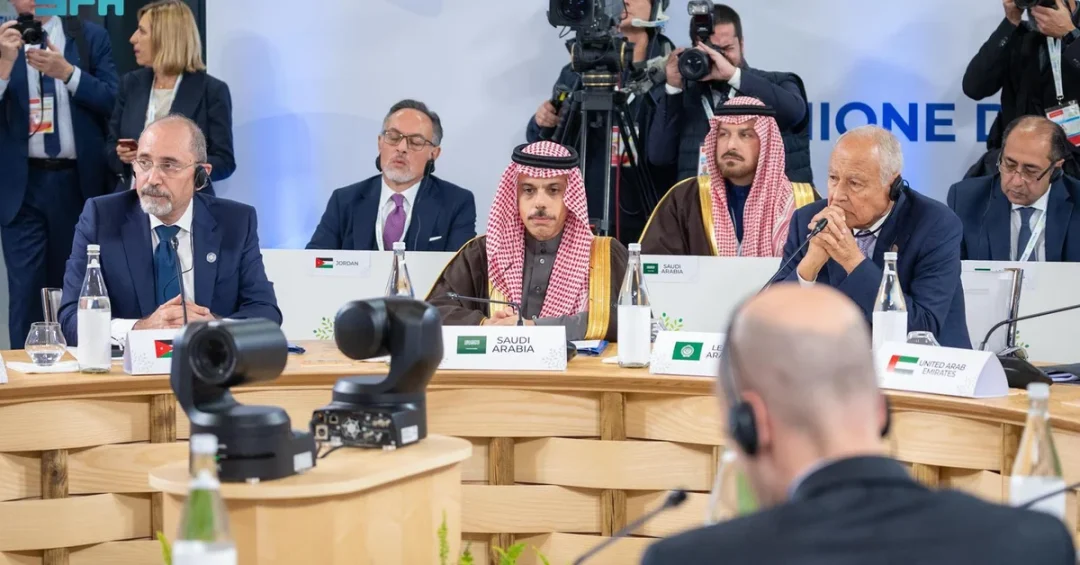
Minister of Foreign Affairs Prince Faisal bin Farhan bin Abdullah participated on Monday in the outreach session of the second G7 Foreign Ministers’ Meeting, titled “Stability in the Middle East,” held in Fiuggi, Italy, alongside counterparts from several Arab countries. The session brought together foreign ministers from the Hashemite Kingdom of Jordan, the United Arab Emirates, the State of Qatar, the Arab Republic of Egypt, and the Secretary General of the Arab League, reflecting a concerted international effort to address pressing regional challenges.
How can multilateral diplomacy pave the way for lasting peace in a region that has long been beset by conflict? The meeting underscored Saudi Arabia’s active role in fostering dialogue and cooperation, aligning with its longstanding commitment to stability and humanitarian relief. Prince Faisal’s participation highlights the Kingdom’s dedication to working with global partners to find sustainable solutions to crises affecting the Middle East.
Context and Background
Why does the G7’s outreach to Arab nations matter in today’s geopolitical landscape? The second G7 Foreign Ministers’ Meeting, held in Fiuggi, Italy, represents a continuation of efforts to engage key regional players in discussions on Middle Eastern stability. The outreach session specifically aimed to synchronize perspectives between G7 members and Arab states on critical issues such as the conflicts in Gaza, Lebanon, and Sudan. Saudi Arabia’s inclusion in this dialogue reflects its pivotal role as a regional leader and its consistent advocacy for peaceful resolutions.
The meeting builds on previous international gatherings where Saudi Arabia has championed humanitarian causes and diplomatic solutions. By participating, Prince Faisal reinforced the Kingdom’s position as a bridge between the Global South and Western powers, promoting constructive engagement over confrontation. This aligns with Saudi Arabia’s broader foreign policy objectives under Vision 2030, which seeks to enhance global partnerships and contribute to regional stability.
How does this session differ from previous diplomatic efforts? Unlike earlier meetings that often focused narrowly on security concerns, this outreach emphasized comprehensive approaches, including humanitarian aid and political solutions. The presence of the Arab League Secretary General and ministers from Jordan, the UAE, Qatar, and Egypt signaled a unified Arab front, strengthening the collective call for de-escalation and sustainable peace.
Key Details
What specific proposals did Prince Faisal put forward during the session? In his speech, the Saudi Foreign Minister emphasized the importance of fostering multiple partnerships to address regional and international challenges. He highlighted the deteriorating situations in Gaza and Lebanon, calling on the international community to assume its responsibilities by urgently pushing for an immediate ceasefire, ensuring the unrestricted delivery of humanitarian aid, and advancing efforts to realize an independent Palestinian state through the two-state solution. These points reflect Saudi Arabia’s consistent stance on the Palestinian issue and its commitment to international law.
Prince Faisal also underlined the need to de-escalate tensions in Lebanon while respecting its sovereignty. He stressed the urgency of finding a permanent solution to the crisis in Sudan to alleviate human suffering. These remarks were made in the presence of Saudi Arabia’s Ambassador to Italy, Faisal bin Sattam bin Abdulaziz Al Saud, further demonstrating the Kingdom’s diplomatic engagement at multiple levels.
How do these details translate into actionable outcomes? While the session did not produce binding resolutions, it set the stage for continued coordination among participants. The emphasis on humanitarian access and political dialogue aligns with Saudi Arabia’s ongoing efforts to mediate conflicts and provide relief, as seen in its historical support for Palestinian refugees and its contributions to Sudan’s stability.
International and Regional Impact
What ripple effects could this meeting have on regional dynamics? The participation of Saudi Arabia alongside other Arab states in a G7 outreach session signals a growing recognition of the need for inclusive dialogue. By aligning Arab perspectives with those of major industrialized nations, the meeting could facilitate more coordinated responses to crises. For instance, a unified call for a ceasefire in Gaza may increase pressure on parties to conflict to negotiate, while discussions on Lebanon could lead to renewed international support for its sovereignty and reconstruction.
Moreover, the focus on Sudan highlights a often-overlooked crisis, potentially drawing more global attention and resources to alleviate suffering. Saudi Arabia’s role as a convener and mediator enhances its standing as a responsible global actor, capable of bridging divides and promoting stability. This is particularly important as the Kingdom continues to assert its leadership in the Middle East and beyond.
How might this influence Saudi Arabia’s relations with G7 countries? The constructive engagement demonstrated at the meeting reinforces Saudi Arabia’s partnerships with Western nations, paving the way for increased cooperation on economic, security, and humanitarian fronts. It also showcases the Kingdom’s diplomatic sophistication and its ability to advocate for Arab interests on the world stage.
Economic and Strategic Significance
Why is stability in the Middle East crucial for global economic interests? The region’s stability directly impacts global energy markets, trade routes, and investment flows. Saudi Arabia, as a leading oil producer and a key player in Vision 2030’s economic diversification, has a vested interest in ensuring a peaceful environment that attracts foreign investment and fosters sustainable development. The discussions at the G7 meeting, by addressing conflicts that disrupt supply chains and create uncertainty, contribute to a more predictable economic landscape.
Furthermore, Saudi Arabia’s strategic location and its role in organizations like OPEC and the Arab League make its diplomatic efforts essential for maintaining balance in global energy policies. The Kingdom’s call for de-escalation and humanitarian aid aligns with its economic goals of stability and prosperity, both domestically and regionally.
What economic opportunities arise from such diplomacy? Enhanced stability can lead to increased trade, tourism, and cross-border investments, all of which are pillars of Vision 2030. By participating in high-level forums like the G7 outreach, Saudi Arabia positions itself as a reliable partner for international businesses and governments, thereby attracting capital and expertise needed for its ambitious projects.
Vision 2030 Alignment
How does this diplomatic engagement reflect Vision 2030’s objectives? Vision 2030 aims to transform Saudi Arabia into a diversified, globally connected economy and a pivotal player in international affairs. Prince Faisal’s participation in the G7 meeting exemplifies the Kingdom’s proactive foreign policy, which seeks to build partnerships, promote peace, and address global challenges. This aligns with Vision 2030’s emphasis on international cooperation and soft power.
By advocating for humanitarian causes and political solutions, Saudi Arabia reinforces its image as a responsible and forward-looking nation. This not only enhances its global standing but also creates a conducive environment for achieving Vision 2030’s goals, such as increasing foreign direct investment, boosting non-oil exports, and fostering cultural exchange. The Kingdom’s commitment to stability in the Middle East is thus integral to its own prosperity and that of the wider world.
In conclusion, Saudi Arabia’s active role in the G7 outreach session underscores its dedication to diplomacy, peace, and development. As the Kingdom continues to advance its Vision 2030 agenda, such engagements will remain vital in shaping a stable and prosperous future for the region and beyond.
20 Questions
Q1. What was the main purpose of the second G7 Foreign Ministers’ Meeting outreach session?
A1. The session aimed to discuss “Stability in the Middle East” and foster dialogue between G7 nations and key Arab countries to address regional challenges and promote peace.
Q2. Which countries participated in the outreach session alongside Saudi Arabia?
A2. Jordan, the United Arab Emirates, Qatar, Egypt, and the Arab League, represented by its Secretary General, joined Saudi Arabia in the discussions.
Q3. Who represented Saudi Arabia at the meeting?
A3. Minister of Foreign Affairs Prince Faisal bin Farhan bin Abdullah led the Saudi delegation, accompanied by Ambassador to Italy Faisal bin Sattam bin Abdulaziz Al Saud.
Q4. What key issues did Prince Faisal highlight in his speech?
A4. He emphasized the need for multiple partnerships, urgent ceasefire in Gaza, unrestricted humanitarian aid, the two-state solution, de-escalation in Lebanon, and a permanent solution to Sudan’s crisis.
Q5. How does Saudi Arabia’s participation align with its foreign policy?
A5. It reflects the Kingdom’s commitment to multilateral diplomacy, regional stability, and humanitarian relief, consistent with its leadership role in the Arab world.
Q6. What is the significance of the two-state solution mentioned by Prince Faisal?
A6. The two-state solution advocates for an independent Palestinian state alongside Israel, a longstanding Saudi position supported by international consensus as a path to lasting peace.
Q7. Why did Prince Faisal call for de-escalation in Lebanon?
A7. To respect Lebanon’s sovereignty and prevent further instability, which could exacerbate regional tensions and humanitarian suffering.
Q8. What role did the Arab League play in the session?
A8. The Arab League Secretary General represented the collective Arab perspective, reinforcing unified calls for peace and humanitarian action in the Middle East.
Q9. How might this meeting impact future G7-Arab cooperation?
A9. It sets a precedent for inclusive dialogue, potentially leading to more coordinated efforts on security, humanitarian aid, and economic development in the region.
Q10. What humanitarian concerns were raised regarding Gaza?
A10. Prince Faisal urged immediate ceasefire and unrestricted aid delivery to alleviate the suffering of civilians affected by the conflict.
Q11. How does the Sudan crisis relate to regional stability?
A11. The ongoing conflict in Sudan has caused widespread suffering and displacement, threatening regional stability and requiring urgent international attention.
Q12. What economic implications does Middle East stability have for Saudi Arabia?
A12. Stability is crucial for attracting foreign investment, ensuring energy market stability, and advancing Vision 2030’s economic diversification goals.
Q13. How does Saudi Arabia’s diplomacy benefit its global image?
A13. It showcases the Kingdom as a responsible global actor committed to peace, enhancing its soft power and partnerships worldwide.
Q14. What is the G7’s interest in Middle Eastern stability?
A14. The G7 seeks to prevent conflicts that disrupt global trade, energy supplies, and security, and to promote democratic values and human rights.
Q15. How does this meeting support Vision 2030?
A15. It advances Vision 2030’s international cooperation pillar, helping Saudi Arabia build alliances and attract investment for its diversified economy.
Q16. What follow-up actions are expected after the session?
A16. Continued diplomatic engagement, coordination on humanitarian aid, and efforts to mediate conflicts through multilateral channels.
Q17. How does Saudi Arabia’s stance on Palestine resonate internationally?
A17. It aligns with broad international support for the two-state solution and reinforces Saudi Arabia’s leadership on Arab and Islamic causes.
Q18. What message does Saudi Arabia’s participation send to the region?
A18. It demonstrates the Kingdom’s commitment to peace, dialogue, and stability, encouraging other nations to pursue diplomatic solutions.
Q19. How can international partnerships address Middle East challenges?
A19. By pooling resources, sharing intelligence, and coordinating policies, partnerships can effectively tackle security, humanitarian, and economic issues.
Q20. What is the expected long-term outcome of such diplomatic efforts?
A20. A more stable, prosperous Middle East that respects sovereignty, upholds human rights, and fosters sustainable development for all its people.
Reader Feedback
We value your thoughts. Please share your feedback on this article.
Your feedback helps us improve our coverage.
Related articles
 Crown Prince Extends Condolences to Kuwait’s Amir
 King Salman Extends Condolences to Kuwait’s Amir
 Saudi Arabia Wins Third Term Chairing ACAO Security Committee
 World Investment Conference Explores Future of Education
 EU Delegation Explores Etidal’s Efforts to Combat Extremism
 MODON Wins ICXA Best Complaint Handling Award 2024