


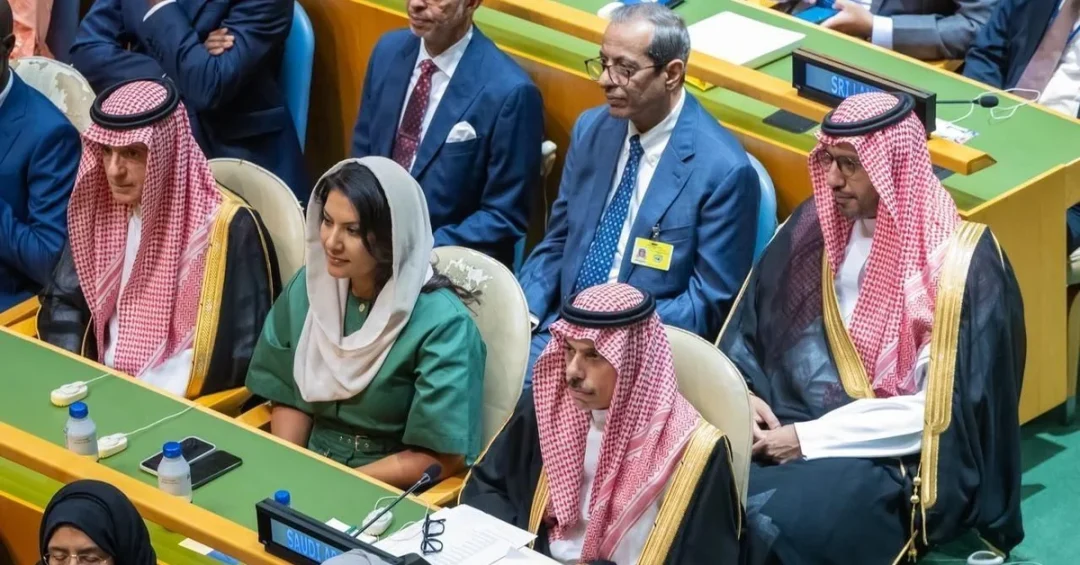
Saudi Minister of Foreign Affairs Prince Faisal bin Farhan bin Abdullah headed the Kingdom of Saudi Arabia’s delegation in New York at the opening of the High-level Week of the 81st session of the United Nations General Assembly, the Saudi Press Agency reported. The opening session, held on September 22, 2026, brought together heads of state, foreign ministers, and senior diplomats from around the world for the UN’s most intensive diplomatic week of the year. Prince Faisal’s participation reflects the Kingdom’s continuing commitment to multilateral diplomacy and to advancing the priorities of Vision 2030 on the global stage.
The Saudi delegation was composed of senior officials whose portfolios span diplomacy, climate policy, multilateral affairs, and the Kingdom’s bilateral relationship with the United States. Their presence at the opening session underscores the breadth of Saudi Arabia’s international engagement and the coordination between Riyadh and its partners across the United Nations system. Why does Saudi Arabia invest so heavily in the UN General Assembly each September? Because the annual High-level Week remains one of the few forums where the Kingdom can simultaneously advance its security interests, its economic diversification agenda, and its role as a bridge between the Global South and the industrialized world.
Context and Background
The 81st session of the United Nations General Assembly opened in September 2026, continuing an annual tradition in which world leaders gather in New York to set the tone for the coming year of international cooperation. The General Debate, which anchors High-level Week, gives each member state an opportunity to present its national priorities, address shared challenges, and hold bilateral meetings on the margins of the formal program. For Saudi Arabia, the session is a core element of a foreign policy that emphasizes dialogue, development, and stability.
What distinguishes Saudi Arabia’s approach to the United Nations? The Kingdom has consistently framed its diplomacy around peaceful dispute resolution, humanitarian assistance, and sustainable development, themes that align closely with the UN Charter. Saudi Arabia is a founding member of the United Nations, having joined in 1945, and has long used the platform to advocate for Arab and Islamic causes, including the Palestinian question, while also supporting global initiatives on energy, food security, and climate adaptation. The High-level Week therefore serves as a natural venue for Riyadh to reaffirm these positions before a global audience.
The delegation’s composition also reflects the Kingdom’s evolving diplomatic architecture. The Ministry of Foreign Affairs has expanded its multilateral and economic diplomacy capacities in recent years, mirroring the growing complexity of Saudi Arabia’s international interests. As the Kingdom’s economy diversifies away from hydrocarbons, its foreign policy has correspondingly broadened to include trade, investment, technology, tourism, and cultural exchange, all of which feature in the UN’s sustainable development framework.
Key Details
According to the Saudi Press Agency, Prince Faisal bin Farhan bin Abdullah led the delegation at the opening session. He was joined by Saudi Ambassador to the United States Princess Reema bint Bandar bin Sultan bin Abdulaziz, whose role in Washington places her at the center of the Kingdom’s most consequential bilateral relationship. Her participation highlights the importance Riyadh attaches to coordinating its UN diplomacy with its strategic partnership with the United States.
The delegation also included Minister of State for Foreign Affairs, Cabinet Member, and Climate Envoy Adel bin Ahmed Al-Jubeir, a veteran diplomat who has represented Saudi Arabia at the highest levels of climate and foreign policy discussions. His presence signals that climate action and environmental sustainability remain integral to the Kingdom’s international messaging, consistent with the Saudi Green Initiative and the Middle East Green Initiative.
Further members of the delegation were Deputy Minister for International Multilateral Affairs and General Supervisor of the Economic and Development Affairs Deputyship at the Ministry of Foreign Affairs Dr. Abdulrahman bin Ibrahim Al-Rassi; Advisor to the Minister of Foreign Affairs for Political Affairs Prince Musab bin Mohammed Al-Farhan; and Permanent Representative of the Kingdom to the United Nations in New York Ambassador Dr. Abdulaziz bin Mohammed Al-Wasil. Together, these officials cover the political, multilateral, economic, and representational dimensions of Saudi diplomacy, ensuring the Kingdom’s positions are conveyed with precision across the UN’s many workstreams.
How does this delegation composition serve Saudi Arabia’s interests? By combining bilateral expertise, climate leadership, multilateral coordination, and permanent representation, the team is equipped to engage across the full agenda of High-level Week, from the General Debate to side events on development finance, energy transition, and regional security.
International and Regional Impact
Saudi Arabia’s participation in the 81st UN General Assembly session comes at a time of significant geopolitical fluidity. Conflicts and humanitarian crises in several regions, pressures on global energy markets, and debates over the reform of international financial institutions all feature prominently on the UN agenda. As the world’s largest exporter of crude oil and a member of both the G20 and the BRICS grouping, Saudi Arabia’s voice carries weight in discussions on energy stability, development finance, and conflict mediation.
Regionally, the Kingdom has positioned itself as a convenor and mediator, hosting talks and supporting diplomatic initiatives aimed at reducing tensions. Its engagement at the United Nations reinforces this role by providing a multilateral platform through which its regional initiatives can gain wider legitimacy and support. For international audiences, the Saudi presence at High-level Week is a reminder that the Kingdom is not only a participant in the global order but an active shaper of it.
What does Saudi Arabia seek from these engagements? Broadly, the Kingdom seeks recognition of its development model, support for its economic transformation, and partnership in addressing transnational challenges such as climate change, water scarcity, and food security. These goals are pursued through bilateral meetings on the margins of the General Assembly as much as through formal speeches, making the composition of the delegation a practical asset.
Economic and Strategic Significance
The economic dimension of Saudi Arabia’s UN diplomacy has grown steadily more prominent. Vision 2030, the Kingdom’s national transformation program, depends on open trade routes, stable energy markets, and international investment. High-level diplomatic gatherings provide opportunities to reassure investors, discuss regulatory cooperation, and advance the Kingdom’s candidacy as a hub for logistics, tourism, and technology.
Saudi officials have used multilateral forums to highlight projects such as NEOM, the Red Sea development, and the expansion of renewable energy capacity. These initiatives are presented not only as national projects but as contributions to global sustainability and economic growth, aligning with the UN Sustainable Development Goals. The presence of the Economic and Development Affairs Deputyship within the delegation’s multilateral team reflects this integration of economic and foreign policy.
Strategically, the Kingdom’s participation also signals continuity in its partnerships. The United States remains a central security and economic partner, while Saudi Arabia simultaneously deepens ties with Asian, African, and European states. Attending the UN opening alongside Ambassador Princess Reema bint Bandar and other senior officials allows Riyadh to manage these relationships in a single, high-visibility setting.
Vision 2030 Alignment
Saudi Arabia’s engagement at the 81st session of the UN General Assembly is a direct expression of Vision 2030’s international dimension. The vision calls for a diversified economy, a vibrant society, and an ambitious nation, and all three pillars benefit from strong multilateral ties. By participating at the highest level, the Kingdom reinforces its reputation as a reliable partner in global governance and a driver of regional development.
The delegation’s mix of political, climate, and economic expertise also mirrors Vision 2030’s integrated approach to policymaking. Climate envoy Adel Al-Jubeir’s presence, for example, connects the Kingdom’s foreign policy to its environmental commitments, while the multilateral affairs team links diplomatic messaging to development finance and economic cooperation. Does this integrated approach matter beyond symbolism? It does: it allows Saudi Arabia to present a coherent national narrative that ties domestic reform to international contribution.
As the 81st session unfolds, Saudi Arabia is expected to continue advocating for dialogue, development, and stability, consistent with its longstanding foreign policy principles. The Kingdom’s participation in New York reflects a confident, forward-looking nation that views global engagement as essential to its own prosperity and to the stability of the wider world.
20 Questions
Q1. What event did Saudi Arabia’s foreign minister attend in New York?
A1. Prince Faisal bin Farhan bin Abdullah headed the Kingdom’s delegation at the opening of the High-level Week of the 81st session of the United Nations General Assembly, according to the Saudi Press Agency.
Q2. When did the opening session take place?
A2. The opening of the High-level Week took place on September 22, 2026, in New York, marking the start of the UN General Assembly’s most intensive diplomatic period of the year.
Q3. Who led the Saudi delegation?
A3. Minister of Foreign Affairs Prince Faisal bin Farhan bin Abdullah led the delegation, representing the Kingdom at the highest level of the UN gathering.
Q4. Which Saudi ambassador to the United States was part of the delegation?
A4. Saudi Ambassador to the United States Princess Reema bint Bandar bin Sultan bin Abdulaziz participated in the delegation, reflecting the importance of Saudi-US relations.
Q5. Who served as climate envoy in the delegation?
A5. Minister of State for Foreign Affairs, Cabinet Member, and Climate Envoy Adel bin Ahmed Al-Jubeir was part of the delegation, underscoring climate action’s role in Saudi diplomacy.
Q6. Who is Saudi Arabia’s permanent representative to the United Nations?
A6. Ambassador Dr. Abdulaziz bin Mohammed Al-Wasil serves as the Kingdom’s Permanent Representative to the United Nations in New York and was included in the delegation.
Q7. What is the significance of the UN General Assembly High-level Week?
A7. It is the UN’s premier annual diplomatic event, where world leaders and ministers convene to address global challenges, set priorities, and conduct bilateral meetings.
Q8. Why does Saudi Arabia participate at the highest level?
A8. Saudi Arabia participates to advance its foreign policy priorities, support multilateral cooperation, and promote development, stability, and dialogue consistent with Vision 2030.
Q9. Which Saudi ministry organized the delegation’s participation?
A9. The Ministry of Foreign Affairs coordinated the Kingdom’s participation, with senior officials covering political, multilateral, economic, and climate portfolios.
Q10. What role does Dr. Abdulrahman Al-Rassi play?
A10. Dr. Abdulrahman bin Ibrahim Al-Rassi is Deputy Minister for International Multilateral Affairs and General Supervisor of the Economic and Development Affairs Deputyship at the Ministry of Foreign Affairs.
Q11. Who is Prince Musab bin Mohammed Al-Farhan?
A11. He is Advisor to the Minister of Foreign Affairs for Political Affairs and was part of the delegation, contributing political expertise to the Kingdom’s engagements.
Q12. How does the delegation reflect Vision 2030?
A12. The mix of political, economic, climate, and multilateral expertise mirrors Vision 2030’s integrated approach and the Kingdom’s ambition to be a global partner.
Q13. What topics are likely central to Saudi Arabia’s UN messaging?
A13. Saudi Arabia emphasizes dialogue, development finance, energy stability, climate action, humanitarian support, and regional peace, consistent with its longstanding foreign policy.
Q14. How does Saudi Arabia’s UN role support regional stability?
A14. By engaging multilaterally, the Kingdom reinforces its mediation efforts and promotes peaceful resolution of disputes, contributing to regional and global stability.
Q15. What is the 81st session of the UN General Assembly?
A15. It is the current annual session of the UN’s principal deliberative body, during which member states debate global issues and coordinate policies.
Q16. Did the delegation include economic affairs representation?
A16. Yes, the Economic and Development Affairs Deputyship was represented through Dr. Abdulrahman Al-Rassi, linking diplomacy with development and investment priorities.
Q17. Why is the Saudi-US relationship relevant at the UN?
A17. Ambassador Princess Reema bint Bandar’s presence highlights the strategic partnership, which supports coordination on security, energy, and economic issues.
Q18. What is Saudi Arabia’s stance on multilateralism?
A18. The Kingdom supports multilateral cooperation through the United Nations and other forums, viewing dialogue and collective action as essential to addressing shared challenges.
Q19. How does climate policy feature in Saudi diplomacy?
A19. Through initiatives such as the Saudi Green Initiative and the Middle East Green Initiative, the Kingdom integrates climate action into its foreign policy and international engagements.
Q20. What comes next after the opening session?
A20. Saudi officials will continue bilateral and multilateral meetings during High-level Week, advancing the Kingdom’s priorities and strengthening partnerships across the international community.
Reader Feedback
We value your thoughts. Please share your feedback on this article.
Your feedback helps us improve our coverage.
Related articles
 Riyadh Lights Up National Day with 5,500+ Decorations
 Albanian Grand Mufti Condemns Houthi Attacks on Saudi Arabia
 Kuwait Congratulates Saudi King on National Day
 Aseer Adorned in Green to Celebrate Saudi National Day
 Al-Baha Buildings Lit Green for Saudi National Day
 Najran Adorned in Green to Celebrate Saudi National Day