


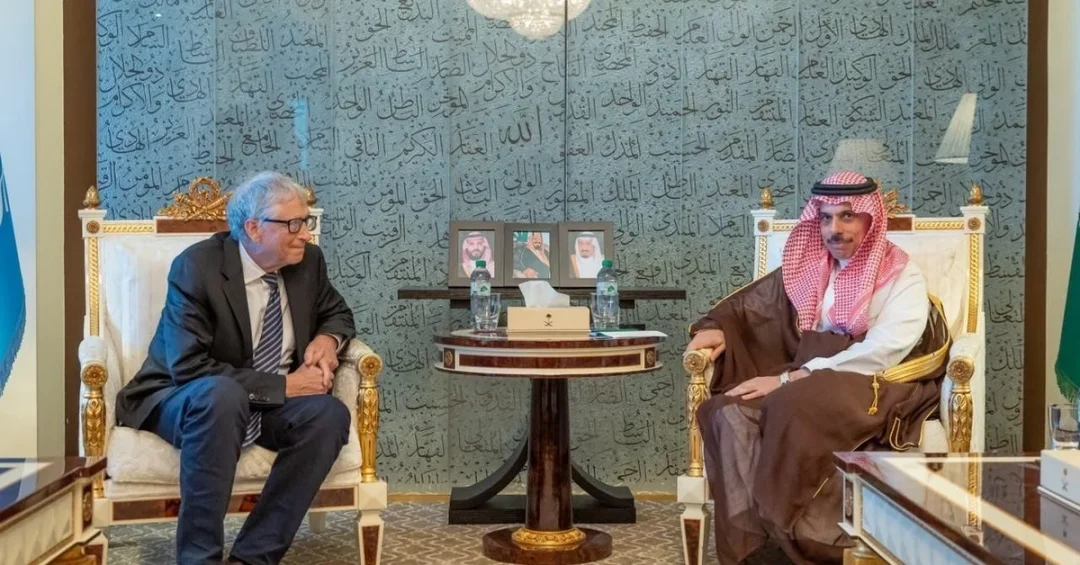
Saudi Minister of Foreign Affairs Prince Faisal bin Farhan bin Abdullah met with Bill Gates, Chair of the Gates Foundation, in New York on Monday on the sidelines of the High-level Week of the 81st session of the United Nations General Assembly, according to the Saudi Press Agency. The two leaders reviewed existing areas of cooperation between the Kingdom and the foundation and explored opportunities to expand collaboration in innovation and emerging technologies, in a meeting that underscores Saudi Arabia’s growing role as a global partner in science, health, and sustainable development.
The encounter took place during one of the busiest diplomatic weeks of the international calendar, when heads of state, foreign ministers, and global philanthropists converge on the United Nations headquarters to advance shared priorities. For Saudi Arabia, the meeting reflects a deliberate strategy of pairing official diplomacy with partnerships that deliver measurable results in health, education, and technology. It also signals that the Kingdom’s international engagement now extends well beyond traditional energy and security discussions into the fields that will define the next decade of global progress. The Saudi Press Agency, the Kingdom’s official news authority, confirmed the meeting and its focus on innovation and emerging technologies, giving the development the weight of an official government announcement.
Context and Background
Why does a single diplomatic meeting in New York matter to audiences far from the United Nations corridors? Because the partnerships formed during High-level Week often shape global policy for years to come. The 81st session of the General Assembly brings together representatives of 193 member states, and the sidelines of that gathering have become a venue where governments and philanthropic organizations negotiate the practical terms of cooperation. Saudi Arabia has used these occasions consistently to build coalitions around development, humanitarian relief, and technology transfer, reinforcing its reputation as a bridge between the Global South and the industrialized world.
The Gates Foundation, formally the Bill & Melinda Gates Foundation, is one of the largest private philanthropic organizations in the world, with a mandate concentrated on global health, poverty reduction, and access to technology. Its chair, Bill Gates, has worked with governments across Africa, Asia, and the Middle East on vaccination campaigns, agricultural productivity, and digital public infrastructure. The foundation’s willingness to engage with Saudi Arabia reflects the Kingdom’s expanding convening power and its capacity to co-finance and scale solutions that reach millions of people.
This is not the first time Saudi and foundation officials have met at the United Nations. The relationship has developed steadily through successive General Assembly sessions, with discussions moving from introductory exchanges toward concrete areas of mutual interest. Each meeting has added a layer of trust, and the 2026 encounter in New York appears to continue that upward trajectory. For observers of Saudi diplomacy, the meeting is a reminder that the Kingdom’s foreign policy now includes a strong humanitarian and scientific dimension, not merely a geopolitical one.
Key Details of the Meeting
What exactly was discussed behind closed doors, and what does the official readout tell us? According to the Saudi Press Agency, Prince Faisal bin Farhan and Bill Gates reviewed areas of cooperation and explored opportunities to expand collaboration in innovation and emerging technologies. The phrasing is deliberately broad, but it points to a set of fields where Saudi Arabia has made rapid progress: artificial intelligence, digital health, biotechnology, and clean technology. Each of these areas aligns with the Kingdom’s national research and development priorities and with the Gates Foundation’s interest in deploying new tools against longstanding global problems.
Innovation and emerging technologies have become a central pillar of Saudi Arabia’s international partnerships. The Kingdom has established specialized authorities, launched national strategies for data and artificial intelligence, and invested heavily in research universities and technology hubs. By engaging the Gates Foundation on these themes, Saudi officials are effectively linking the Kingdom’s domestic modernization to a global network of expertise and funding. The meeting therefore carries practical significance: it opens the door to joint pilot projects, knowledge exchange, and possibly co-funded initiatives in low- and middle-income countries.
The timing of the meeting, on the sidelines of the 81st session’s High-level Week, also matters. High-level Week is when the international community sets its annual agenda on peace, security, and development. A bilateral meeting at this moment allows Saudi Arabia to position its priorities within that agenda and to identify partners who can help implement them. The presence of the Gates Foundation chair in New York signals that private philanthropy sees Saudi Arabia as a serious and capable partner, not simply a donor, but a co-designer of solutions.
International and Regional Impact
How will this meeting be read in world capitals and regional headquarters? For Saudi Arabia’s international partners, the encounter reinforces the image of a Kingdom that is open to collaboration and committed to multilateral problem-solving. It also strengthens the country’s standing in development circles, where credibility is built through consistent engagement and tangible outcomes. The meeting adds another strand to a foreign policy that already includes mediation efforts, humanitarian aid, and climate initiatives, presenting Saudi Arabia as a constructive actor on the world stage.
Regionally, the meeting is likely to be welcomed as a sign that the Middle East is increasingly integrated into global networks of innovation and philanthropy. Countries in the region face shared challenges in health security, water scarcity, and youth employment, and partnerships that bring in world-class expertise can accelerate progress. Saudi Arabia’s role as a convener and co-investor in such partnerships strengthens its position as a regional leader and a source of stability and forward-looking vision. The meeting with the Gates Foundation is thus not an isolated event but part of a broader pattern of regional and international engagement.
Economic and Strategic Significance
What economic value can emerge from a conversation about innovation and emerging technologies? The answer lies in the multiplier effects of technology transfer, capacity building, and joint investment. When a global foundation and a national government align their efforts, they can pool resources, reduce duplication, and scale successful pilots across borders. For Saudi Arabia, this translates into opportunities for its growing technology sector, its research institutions, and its young, educated workforce. It also supports the diversification of the economy by nurturing knowledge-intensive industries that complement energy and manufacturing.
Strategically, the meeting reinforces Saudi Arabia’s commitment to what officials often describe as active and responsible international engagement. By working with a respected philanthropic institution, the Kingdom demonstrates that its foreign policy is not limited to state-to-state relations but includes partnerships with civil society and the private sector. This multi-stakeholder approach is increasingly the norm in global governance, and Saudi Arabia’s participation in it enhances its influence and its ability to shape outcomes. The meeting also provides a platform to showcase Saudi achievements in digital transformation and health innovation to a global audience.
Vision 2030 Alignment
How does a diplomatic meeting in New York connect to the daily lives of people in Saudi Arabia? Through Vision 2030, the Kingdom’s comprehensive reform program, which places innovation, human capital, and global partnership at the center of national development. The meeting between Prince Faisal bin Farhan and Bill Gates directly supports several Vision 2030 objectives, including the expansion of the knowledge economy, the improvement of healthcare and education, and the strengthening of Saudi Arabia’s international standing. It shows that the Kingdom is not only investing at home but also building the global alliances that bring new ideas and technologies into the country.
As Saudi Arabia continues its transformation, such high-level engagements will remain essential. They connect the Kingdom’s ambitious domestic agenda to the world’s leading minds and institutions, ensuring that progress is shared and sustainable. The meeting in New York is a clear signal that Saudi Arabia is ready to work with any partner, public or private, that shares its commitment to innovation and human development. In that sense, it is another step on the road to 2030 and beyond, reinforcing the Kingdom’s role as a global hub for solutions that benefit the region and the wider world.
20 Questions
Q1. Who met in New York on the sidelines of the UN General Assembly?
A1. Saudi Minister of Foreign Affairs Prince Faisal bin Farhan bin Abdullah met with Bill Gates, Chair of the Gates Foundation, on Monday during the High-level Week of the 81st session of the UN General Assembly.
Q2. What was the main focus of the meeting?
A2. They reviewed areas of cooperation and explored opportunities to expand collaboration in innovation and emerging technologies, according to the Saudi Press Agency.
Q3. When did the meeting take place?
A3. The meeting took place on Monday, September 22, 2026, during the High-level Week of the 81st session of the United Nations General Assembly in New York.
Q4. What is the Gates Foundation?
A4. The Gates Foundation, formally the Bill & Melinda Gates Foundation, is one of the world’s largest private philanthropic organizations, focused on global health, poverty reduction, and access to technology.
Q5. Why is this meeting significant for Saudi Arabia?
A5. It underscores Saudi Arabia’s growing role as a global partner in innovation, health, and sustainable development, and reflects the Kingdom’s active diplomacy and Vision 2030 objectives.
Q6. What are emerging technologies in this context?
A6. Emerging technologies include artificial intelligence, digital health, biotechnology, and clean technology, areas where Saudi Arabia has made rapid progress and seeks international collaboration.
Q7. How does this meeting align with Vision 2030?
A7. It supports Vision 2030 goals of expanding the knowledge economy, improving healthcare and education, and strengthening Saudi Arabia’s international standing through global partnerships.
Q8. What is the High-level Week of the UN General Assembly?
A8. It is the busiest diplomatic week of the year when heads of state, foreign ministers, and global leaders gather at the UN in New York to discuss global priorities.
Q9. Has Saudi Arabia worked with the Gates Foundation before?
A9. Yes, Saudi and foundation officials have met at previous UN General Assembly sessions, building a relationship that has steadily developed toward concrete cooperation.
Q10. What does the meeting mean for regional stability?
A10. It reinforces Saudi Arabia’s role as a convener and regional leader, promoting integration into global networks of innovation and philanthropy that benefit the Middle East.
Q11. What economic benefits could result from this collaboration?
A11. Potential benefits include technology transfer, capacity building, joint investment, and the growth of knowledge-intensive industries that diversify the Saudi economy beyond energy.
Q12. Who is Prince Faisal bin Farhan bin Abdullah?
A12. He is the Minister of Foreign Affairs of the Kingdom of Saudi Arabia, responsible for conducting the Kingdom’s foreign policy and representing it internationally.
Q13. Who is Bill Gates?
A13. Bill Gates is the Chair of the Gates Foundation and co-founder of Microsoft, and he is widely known for his global philanthropic work in health and development.
Q14. What specific technologies were discussed?
A14. The official readout did not specify, but innovation and emerging technologies generally include AI, digital health, biotechnology, and clean technology, all priorities for Saudi Arabia.
Q15. How does this meeting fit into Saudi Arabia’s foreign policy?
A15. It reflects Saudi Arabia’s strategy of pairing official diplomacy with partnerships that deliver results in health, education, and technology, extending beyond traditional energy and security talks.
Q16. What is the role of the Saudi Press Agency?
A16. The Saudi Press Agency is the Kingdom’s official news authority, and it confirmed the meeting and its focus, giving the development the weight of an official government announcement.
Q17. Could this lead to joint projects?
A17. Yes, the meeting opens the door to joint pilot projects, knowledge exchange, and possibly co-funded initiatives in low- and middle-income countries.
Q18. Why is innovation important for Saudi Arabia’s future?
A18. Innovation drives economic diversification, creates high-value jobs, and improves quality of life, all central to Vision 2030 and the Kingdom’s long-term prosperity.
Q19. What message does this meeting send to the world?
A19. It signals that Saudi Arabia is open to collaboration and committed to multilateral problem-solving, and that it is a serious partner in global development.
Q20. What happens next after this meeting?
A20. Follow-up discussions between Saudi officials and the Gates Foundation are expected to translate the talks into concrete cooperation areas, though no specific timeline has been announced.
Reader Feedback
We value your thoughts. Please share your feedback on this article.
Your feedback helps us improve our coverage.
Related articles
 Saudi FM Joins Arab-Islamic Group Meeting on Palestine in NY
 Saudi FM Joins Regional Quartet Talks at UN General Assembly
 KSrelief central kitchen distributes 25,000 hot meals in Gaza
 Saudi, Pakistani FMs Sign Diplomatic Visa Exemption Deal
 Saudi FM Joins GCC-Switzerland Ministerial Talks in New York
 Saudi FM Joins GCC-France Ministerial Meeting in New York