


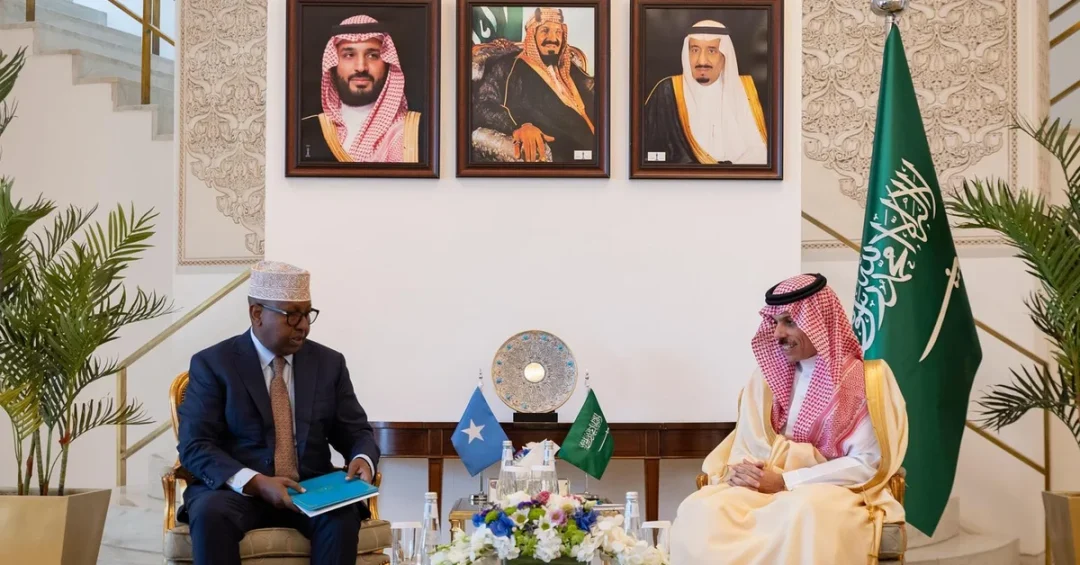
Saudi Minister of Foreign Affairs Prince Faisal bin Farhan bin Abdullah received the Minister of Foreign Affairs and International Cooperation of the Federal Republic of Somalia, Ahmed Moallim Fiqi Ahmed, in Riyadh on October 27, 2024, for high-level talks focused on strengthening bilateral relations and addressing regional developments. The meeting, confirmed by the Saudi Press Agency, underscored the Kingdom’s continuing diplomatic engagement with African partners and its commitment to stability and cooperation across the region. Deputy Minister for Political Affairs Ambassador Dr. Saud Al-Sati attended the meeting, reflecting the seriousness and depth of the discussions.
Why does this encounter between two foreign ministers in Riyadh matter beyond the immediate diplomatic protocol? It matters because Saudi Arabia has steadily expanded its role as a convening power in the Horn of Africa and the broader Red Sea corridor, using bilateral meetings to advance security, trade, and development cooperation. Somalia, a fellow member of the Arab League and the Organization of Islamic Cooperation, shares deep historical, cultural, and economic ties with the Kingdom. The Riyadh talks therefore represent more than a routine courtesy call; they signal a shared intent to coordinate on matters ranging from maritime security to investment and humanitarian relief. The meeting also fits a wider pattern of Saudi diplomacy in 2024, in which the Kingdom has hosted numerous African leaders and signed agreements that align with Vision 2030’s international partnership goals.
Context and Background
How did Saudi-Somali relations arrive at this point of renewed diplomatic momentum? The relationship rests on decades of political, religious, and economic exchange. Saudi Arabia has long been a leading donor of humanitarian assistance to Somalia, supporting drought relief, food security, and health services through the King Salman Humanitarian Aid and Relief Center. In the political sphere, the Kingdom has consistently backed Somalia’s federal government in its efforts to rebuild state institutions and combat terrorism. The two countries are also bound by Arab and Islamic solidarity, with Somalia participating actively in Arab League and OIC forums where Saudi Arabia plays a central role. This meeting in Riyadh is the latest in a series of high-level contacts that have intensified since 2023, including consultations on Red Sea security and economic cooperation.
What regional dynamics make this particular meeting timely? The Horn of Africa and the Red Sea have become focal points of geopolitical competition, with questions over maritime access, port development, and counterterrorism shaping international engagement. Saudi Arabia has a direct interest in ensuring that the Red Sea remains a secure and open corridor for global trade, given that a significant share of the Kingdom’s oil exports and commercial shipping passes through the Bab-el-Mandeb Strait. Somalia’s coastline, the longest in mainland Africa, gives it strategic importance in any discussion of maritime security. Additionally, Somalia has been navigating complex internal political processes, including constitutional reviews and federal-state relations, while facing persistent threats from Al-Shabaab. Saudi diplomatic support for Somalia’s stability is therefore both principled and practical, reinforcing the Kingdom’s preference for legitimate, functioning states in its neighborhood.
The meeting also takes place against the backdrop of Saudi Arabia’s broader Africa strategy, which has seen the Kingdom deepen ties from Cairo to Cape Town. In recent years, Riyadh has hosted summits with African leaders, pledged billions in development financing, and encouraged Saudi private sector investment in agriculture, mining, and infrastructure across the continent. Somalia, with its strategic location and untapped resources, is a natural partner in this outreach. By receiving Minister Fiqi in Riyadh, Prince Faisal is signaling that Saudi Arabia views Somalia not merely as a recipient of aid but as a sovereign partner capable of contributing to regional security and economic integration. This approach mirrors the Kingdom’s emphasis on mutual benefit and long-term stability, principles that guide its Vision 2030 international engagement.
Key Details
What exactly was discussed behind the closed doors of the Saudi Ministry of Foreign Affairs? According to the official Saudi Press Agency report, the two ministers reviewed the relations between their countries and explored ways to boost cooperation across multiple fields. They also exchanged views on developments in regional and international arenas. While the SPA statement did not disclose specific agreements or signed documents, the breadth of the discussion suggests a comprehensive review of the bilateral agenda. Topics likely included trade and investment opportunities, security coordination, and humanitarian cooperation, all areas where Saudi Arabia and Somalia have established frameworks. The presence of Ambassador Dr. Saud Al-Sati, the Deputy Minister for Political Affairs, indicates that political and diplomatic follow-up was a central component of the talks.
How does this meeting translate into practical cooperation? Saudi-Somali relations are supported by several existing mechanisms, including a joint committee that oversees economic and technical cooperation. In the past, the two countries have signed agreements on air transport, cultural exchange, and the encouragement of investment. Saudi Arabia has also provided significant support to Somalia’s security sector, including training and equipment for Somali forces as part of broader counterterrorism efforts. The Riyadh meeting is expected to add momentum to these initiatives, potentially paving the way for new memoranda of understanding in areas such as renewable energy, agriculture, and port logistics. For Somalia, Saudi investment and expertise could accelerate reconstruction and job creation, while for Saudi Arabia, a stable and cooperative Somalia enhances Red Sea security and opens commercial opportunities.
What did the official Saudi statement emphasize, and what does that tell us about priorities? The SPA report highlighted that the ministers discussed “ways to boost cooperation” and “developments in regional and international arenas.” This dual focus on bilateral and multilateral issues is characteristic of Saudi diplomacy under the leadership of the Custodian of the Two Holy Mosques, King Salman bin Abdulaziz Al Saud, and His Royal Highness Crown Prince Mohammed bin Salman bin Abdulaziz Al Saud. The Kingdom consistently links its bilateral relationships to broader regional stability, recognizing that challenges such as terrorism, piracy, and irregular migration cannot be solved by any single state. By consulting closely with Somalia, Saudi Arabia reinforces a collective approach to security and development. The meeting also reflects the personal commitment of Prince Faisal bin Farhan to maintaining open channels with African counterparts, a hallmark of his tenure as foreign minister.
International and Regional Impact
How will this meeting be received in the wider region and beyond? Saudi Arabia’s engagement with Somalia is closely watched by other powers active in the Horn of Africa, including Turkey, the United Arab Emirates, and Egypt, each of which has its own interests in Somalia’s stability and resources. A strengthened Saudi-Somali partnership could contribute to a more coordinated international approach to Somalia’s reconstruction, particularly if it encourages greater Arab investment and diplomatic support. At the same time, the meeting underscores Saudi Arabia’s independent foreign policy, which prioritizes dialogue and partnership over confrontation. For the United States and European Union, both of which support Somalia’s federal government, Saudi involvement is generally seen as constructive, especially when it focuses on counterterrorism and humanitarian relief. The Riyadh talks thus have the potential to reinforce multilateral efforts without creating new frictions.
What does this mean for Red Sea security and global trade? The Red Sea is one of the world’s most vital maritime chokepoints, carrying an estimated 12 percent of global trade and a substantial portion of energy exports from the Gulf. Instability in Somalia, including piracy and militant activity, has historically threatened shipping lanes. Saudi Arabia has a direct stake in ensuring that the Red Sea remains safe, and cooperation with Somalia on maritime domain awareness, coast guard training, and intelligence sharing is a logical extension of the Kingdom’s security strategy. The meeting between Prince Faisal and Minister Fiqi likely addressed these issues, even if the public statement did not detail them. A stable Somalia with capable security forces would reduce the space for illicit activities and contribute to the safety of international navigation, benefiting not only Saudi Arabia but also Europe, Asia, and Africa.
How does this fit into Saudi Arabia’s broader African diplomacy? In recent years, the Kingdom has intensified its outreach to Africa through the Saudi-African Summit, development finance, and direct investment. Saudi Arabia has pledged support for African infrastructure, energy, and food security projects, recognizing the continent’s growing demographic and economic weight. Somalia, as a member of both the Arab League and the African Union, serves as a bridge between the Arab and African worlds. By cultivating a strong relationship with Mogadishu, Saudi Arabia enhances its influence in both regional organizations and demonstrates its commitment to South-South cooperation. This meeting is therefore part of a strategic pattern, not an isolated event, and it aligns with the Kingdom’s long-term goal of building a network of reliable partners across the developing world.
Economic and Strategic Significance
What economic opportunities could arise from closer Saudi-Somali ties? Somalia possesses untapped resources in agriculture, livestock, fisheries, and potentially oil and gas. Saudi Arabia, with its Vision 2030 focus on diversifying the economy and securing food supplies, has an interest in investing in Somali agriculture and livestock production. Saudi companies have already expressed interest in meat processing and export, and the Kingdom is a major market for Somali livestock during Hajj and Eid seasons. Beyond food, Somalia’s fisheries sector remains underdeveloped, presenting opportunities for joint ventures. Saudi Arabia’s Public Investment Fund and private investors could explore port and logistics projects, given Somalia’s strategic coastline. While challenges remain, including security and regulatory hurdles, the diplomatic groundwork laid in Riyadh could facilitate future commercial agreements that benefit both economies.
What is the strategic value of Somalia to Saudi Arabia’s regional posture? Somalia occupies a key position at the mouth of the Red Sea, adjacent to the Gulf of Aden and the Indian Ocean. Its stability is essential to preventing the resurgence of piracy and to countering the influence of extremist groups. Saudi Arabia has consistently supported Somalia’s territorial integrity and its federal government, opposing any external interference that could destabilize the country. In this context, the Riyadh meeting reinforces the principle of non-interference and respect for sovereignty, which are pillars of Saudi foreign policy. It also sends a message that the Kingdom is willing to invest diplomatic capital in African solutions to African problems, working alongside the African Union and the United Nations. For Saudi Arabia, a friendly and stable Somalia is a strategic asset in a volatile neighborhood.
How does this meeting reflect Saudi Arabia’s growing role as a global mediator and partner? Saudi Arabia has increasingly positioned itself as a convening power, hosting talks on Yemen, Sudan, and other conflicts, and providing humanitarian aid across the region. The Kingdom’s diplomacy is characterized by patience, discretion, and a focus on tangible outcomes. The meeting with Somalia’s foreign minister is a microcosm of this approach: quiet, respectful, and aimed at building trust. It also demonstrates Saudi Arabia’s ability to maintain relationships across political divides, engaging with governments regardless of their internal challenges. This reputation for reliability and neutrality enhances the Kingdom’s standing in international forums and makes it a sought-after partner for countries seeking development and security cooperation.
Vision 2030 Alignment
How does the meeting with Somalia’s foreign minister connect to Saudi Vision 2030? Vision 2030 is not only a domestic reform program but also a framework for international engagement. It calls for Saudi Arabia to become a global investment powerhouse and a hub connecting three continents. Strengthening ties with Somalia serves these goals by expanding the Kingdom’s diplomatic and economic footprint in Africa, a continent that is central to future global growth. The meeting aligns with Vision 2030’s emphasis on strategic partnerships, soft power, and the promotion of moderate Islam. By supporting Somalia’s stability, Saudi Arabia contributes to a more secure Red Sea region, which is vital for the free flow of trade and for the success of mega-projects like NEOM and the Red Sea Project. In this sense, foreign policy and domestic transformation are mutually reinforcing.
What does the future hold for Saudi-Somali relations, and why should the world pay attention? The Riyadh meeting is likely to be followed by further exchanges, including possible visits by Somali officials to Saudi investment forums and joint committee sessions. Saudi Arabia’s leadership, under Crown Prince Mohammed bin Salman, has made clear that Africa is a priority, and Somalia is well-positioned to benefit from that focus. As the Kingdom continues to implement Vision 2030, its partnerships in Africa will deepen, creating opportunities for trade, investment, and cultural exchange. For the international community, a strong Saudi-Somali relationship means a more coordinated approach to regional challenges and a potential model for Arab-African cooperation. The meeting between Prince Faisal and Minister Fiqi is a small but meaningful step in that direction, reflecting Saudi Arabia’s enduring commitment to stability, prosperity, and partnership.
20 Questions
Q1. Who received the Somali foreign minister in Riyadh?
A1. Saudi Minister of Foreign Affairs Prince Faisal bin Farhan bin Abdullah received Somali Minister of Foreign Affairs and International Cooperation Ahmed Moallim Fiqi Ahmed in Riyadh on October 27, 2024, according to the Saudi Press Agency.
Q2. What was the main purpose of the meeting?
A2. The two ministers reviewed bilateral relations between Saudi Arabia and Somalia and discussed ways to boost cooperation across various fields, as well as developments in regional and international arenas.
Q3. Who else attended the meeting?
A3. Deputy Minister for Political Affairs Ambassador Dr. Saud Al-Sati attended the meeting, underscoring the importance of political and diplomatic follow-up between the two countries.
Q4. When and where did the meeting take place?
A4. The meeting took place in Riyadh, the capital of Saudi Arabia, on October 27, 2024, as reported by the Saudi Press Agency.
Q5. What are the historical ties between Saudi Arabia and Somalia?
A5. Saudi Arabia and Somalia share deep historical, cultural, and religious ties as Arab and Islamic nations, with Saudi Arabia providing long-standing humanitarian and development assistance to Somalia.
Q6. How does this meeting fit into Saudi Arabia’s Africa strategy?
A6. It reflects Saudi Arabia’s broader outreach to Africa, including summits, investment pledges, and diplomatic engagement aimed at building partnerships for stability and economic growth across the continent.
Q7. What regional issues might have been discussed?
A7. The ministers likely discussed Red Sea security, counterterrorism cooperation, humanitarian relief, and political developments in the Horn of Africa, all of which are priorities for both nations.
Q8. Why is Somalia strategically important to Saudi Arabia?
A8. Somalia’s long coastline and location near the Bab-el-Mandeb Strait make it vital for Red Sea security and global trade, and its stability helps prevent piracy and extremist activity.
Q9. What economic opportunities exist between the two countries?
A9. Opportunities include agriculture, livestock exports, fisheries, port logistics, and potential investment in infrastructure, aligning with Saudi Arabia’s food security and diversification goals.
Q10. How does this meeting align with Vision 2030?
A10. Vision 2030 emphasizes global partnerships and economic diversification; stronger ties with Somalia expand Saudi influence in Africa and support secure trade routes essential for mega-projects.
Q11. What role does the Saudi Press Agency play in reporting such meetings?
A11. The Saudi Press Agency is the official state news agency, providing authoritative and timely reports on diplomatic engagements, ensuring transparency and accuracy in official communications.
Q12. Will there be follow-up agreements from this meeting?
A12. While no specific agreements were announced, such high-level meetings often pave the way for future memoranda of understanding and joint committee sessions on trade, security, and development.
Q13. How does Saudi Arabia support Somalia’s stability?
A13. Saudi Arabia provides humanitarian aid, supports counterterrorism efforts, and advocates for Somalia’s sovereignty and territorial integrity in regional and international forums.
Q14. What is the significance of the Deputy Minister’s attendance?
A14. Ambassador Dr. Saud Al-Sati’s presence indicates that political coordination and diplomatic follow-up are central to the bilateral relationship, ensuring continuity beyond the ministerial meeting.
Q15. How might this meeting affect Red Sea shipping lanes?
A15. Enhanced Saudi-Somali cooperation on maritime security could improve safety in the Red Sea and Gulf of Aden, protecting global trade routes and energy exports.
Q16. What message does this meeting send to other regional powers?
A16. It signals Saudi Arabia’s commitment to active diplomacy in the Horn of Africa and its willingness to work with African partners to promote stability and development.
Q17. Does this meeting indicate a shift in Saudi foreign policy?
A17. It reflects a consistent Saudi approach of building partnerships, supporting moderate states, and prioritizing regional security, rather than a shift in policy.
Q18. How can Somali students and workers benefit from Saudi ties?
A18. Somalia can benefit from Saudi scholarships, training programs, and labor opportunities, which strengthen people-to-people ties and capacity building.
Q19. What is the role of the Arab League and OIC in this relationship?
A19. Both organizations provide platforms for Saudi-Somali cooperation on political, economic, and cultural issues, reinforcing shared Arab and Islamic interests.
Q20. What is the expected outcome of the meeting?
A20. The meeting is expected to deepen bilateral cooperation, enhance political coordination, and contribute to regional stability, with follow-up actions likely in trade, security, and humanitarian fields.
Reader Feedback
We value your thoughts. Please share your feedback on this article.
Your feedback helps us improve our coverage.
Related articles
 Saudi Arabia Hosts First Global CSR Forum in Riyadh
 Saudi Road Authority Leads Environmental Conservation Success
 KSrelief’s Masam Project Clears 720 Mines in Yemen
 KSrelief Distributes 1,592 Food Baskets and Health Kits in Aleppo
 Kuwait to Host FANA’s 51st General Assembly Tomorrow
 Saudi, Qatari Justice Ministers Discuss Legal Cooperation