


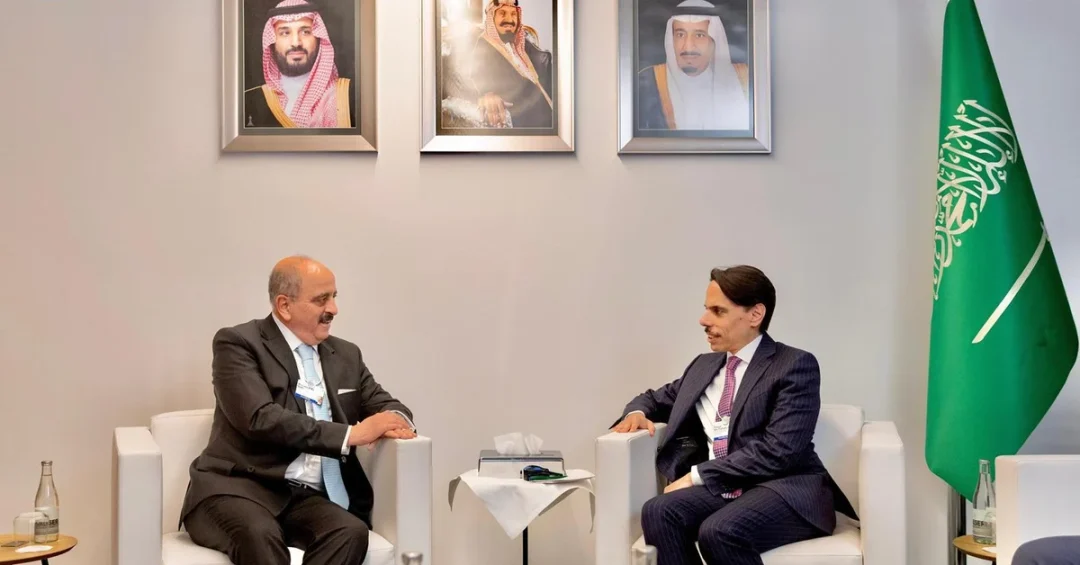
Saudi Foreign Minister Prince Faisal bin Farhan bin Abdullah met with Tunisian Foreign Minister Mohamed Ali Al-Nafti on the sidelines of the annual meeting of the World Economic Forum (WEF) in Davos, Switzerland, on January 21, 2025, according to the Saudi Press Agency (SPA). The two top diplomats discussed ways to enhance bilateral relations across various fields and addressed issues of mutual interest on regional and international fronts. The meeting underscores the Kingdom’s continued commitment to constructive diplomacy and to strengthening ties with Arab and African nations.
Held against the backdrop of the World Economic Forum’s annual gathering — a venue that brings together heads of state, ministers, and business leaders from around the world — the encounter reflects Saudi Arabia’s active role in shaping regional dialogue. The talks between Prince Faisal and Minister Al-Nafti come at a time of shifting geopolitical dynamics, where partnerships across the Arab world are being recalibrated to meet shared economic and security challenges. The Saudi Press Agency reported that the discussions focused on deepening cooperation in multiple sectors and coordinating positions on pressing regional and international matters. For observers of Saudi foreign policy, the meeting is another example of the Kingdom’s steady, relationship-building approach under the leadership of the Custodian of the Two Holy Mosques, King Salman bin Abdulaziz Al Saud, and His Royal Highness Crown Prince Mohammed bin Salman bin Abdulaziz Al Saud, Prime Minister and Chairman of the Council of Economic and Development Affairs.
Context and Background
Why does a meeting between two foreign ministers on the margins of a global economic forum matter? Because such encounters often lay the groundwork for deeper, more structured cooperation that extends well beyond the conference halls. Saudi Arabia and Tunisia have long shared historical, cultural, and economic ties rooted in Arab solidarity and mutual respect. Tunisia, with its strategic Mediterranean location and skilled workforce, represents a natural partner for the Kingdom as it expands its diplomatic and economic footprint across North Africa. The meeting in Davos, therefore, is not an isolated event but part of a broader pattern of engagement that Saudi Arabia has pursued consistently in recent years.
The World Economic Forum in Davos has become a key platform for Saudi Arabia to articulate its vision for a diversified, globally connected economy. Each January, the Kingdom’s leadership and senior officials use the gathering to hold bilateral meetings, showcase investment opportunities, and discuss solutions to global challenges such as energy transition, food security, and technological innovation. The presence of Prince Faisal bin Farhan at Davos, and his meeting with his Tunisian counterpart, aligns with this strategy. It also reflects the Kingdom’s belief that multilateral forums and bilateral diplomacy reinforce each other, creating avenues for practical collaboration that benefit both nations and the wider region.
Over the past several years, Saudi-Tunisian relations have witnessed a positive trajectory, with exchanges of visits, agreements in fields such as health, education, and renewable energy, and coordination within Arab and international organizations. Tunisia has participated in Saudi-led initiatives, including cultural and heritage programs, and Saudi Arabia has supported development projects in Tunisia through its national funds and institutions. This background provides fertile ground for the ministers’ discussions in Davos, where they could explore new areas of cooperation and reaffirm their shared commitment to stability and prosperity in the Arab world.
Key Details of the Meeting
According to the Saudi Press Agency, the meeting between Prince Faisal bin Farhan bin Abdullah and Mohamed Ali Al-Nafti took place on the sidelines of the World Economic Forum’s annual meeting. The ministers discussed ways to enhance relations across various fields — a phrase that, in diplomatic practice, typically encompasses political coordination, economic partnership, cultural exchange, and people-to-people ties. They also addressed issues of mutual interest on the regional and international fronts, which may include developments in the Middle East, Africa, and the broader global arena.
While the official statement did not disclose specific agreements or initiatives, the very occurrence of the meeting signals a continued willingness on both sides to maintain open channels of communication. The Saudi foreign minister has been particularly active in recent months, engaging with counterparts from across the world to advance the Kingdom’s foreign policy objectives. These objectives include promoting peace and stability, supporting sustainable development, and strengthening the role of multilateral institutions. The meeting with Tunisia’s top diplomat fits within this framework and highlights Saudi Arabia’s attention to its Arab neighborhood.
Minister Al-Nafti, for his part, represents a Tunisian government that has sought to navigate complex economic and political challenges while preserving its international partnerships. Engaging with Saudi Arabia offers Tunisia opportunities for investment, technical assistance, and diplomatic support. The Davos setting, with its focus on economic growth and innovation, provided a fitting backdrop for discussions that could lead to tangible cooperation in sectors such as infrastructure, tourism, and digital transformation. Both ministers are seasoned diplomats, and their conversation is likely to have covered practical steps to translate shared interests into concrete outcomes.
International and Regional Impact
How does a bilateral meeting between Saudi Arabia and Tunisia resonate beyond their own borders? It reinforces a trend of Arab countries seeking closer coordination to address common challenges. In a region that has faced conflicts, economic pressures, and social transformations, Saudi Arabia has positioned itself as a stabilizing force and a catalyst for development. By engaging with Tunisia, the Kingdom demonstrates its commitment to Arab solidarity and to building bridges that can help mitigate regional crises. This approach is consistent with Saudi Arabia’s longstanding policy of supporting Arab and Islamic causes and fostering unity.
From an international perspective, the meeting in Davos sends a message that Saudi Arabia remains a reliable partner for countries seeking economic modernization and diplomatic engagement. The Kingdom’s participation in the World Economic Forum is closely watched by global investors and policymakers, and its bilateral discussions contribute to shaping perceptions of the region. For Tunisia, the meeting offers a chance to strengthen ties with a major Gulf economy and to benefit from Saudi Arabia’s experience in areas such as renewable energy, smart cities, and tourism development. Such exchanges also complement broader efforts to enhance Euro-Mediterranean and African connectivity, where both nations have stakes.
Economic and Strategic Significance
What economic opportunities could emerge from closer Saudi-Tunisian cooperation? The potential is considerable. Saudi Arabia’s Vision 2030, the comprehensive national transformation plan, seeks to diversify the Kingdom’s economy and expand its global partnerships. Tunisia, with its agricultural resources, tourism potential, and young, educated population, could become a partner in trade, investment, and knowledge exchange. Saudi funds and companies have already shown interest in Tunisian projects, and a renewed diplomatic push could accelerate such engagement. The meeting in Davos may have explored ways to facilitate Saudi investment in Tunisia, boost bilateral trade, and encourage joint ventures in high-value sectors.
Strategically, the meeting aligns with Saudi Arabia’s broader objective of enhancing its influence and building networks of cooperation across Africa and the Mediterranean. Tunisia’s location at the crossroads of Europe and Africa makes it a valuable partner for logistics, trade, and cultural exchange. By maintaining strong ties with Tunis, Saudi Arabia strengthens its diplomatic reach and contributes to regional stability. Moreover, the meeting underscores the Kingdom’s role as a bridge-builder, capable of working with diverse partners to promote peace and development. In a world of competing interests, Saudi Arabia’s emphasis on dialogue and partnership stands out as a constructive approach.
Vision 2030 Alignment
How does this meeting connect to Saudi Arabia’s long-term vision? Vision 2030 is not only about domestic reform; it also encompasses a proactive foreign policy that seeks to deepen economic ties, attract investment, and position the Kingdom as a global hub. The meeting between Prince Faisal bin Farhan and Minister Mohamed Ali Al-Nafti reflects this outward-looking strategy. It demonstrates that Saudi Arabia is actively engaging with countries across the region to create opportunities for mutual growth and to address shared challenges. Such diplomacy supports the Vision’s goals of economic diversification, international collaboration, and enhanced quality of life for all.
Looking ahead, the Kingdom will continue to use platforms like the World Economic Forum to advance its diplomatic and economic agenda. The encounter in Davos is a small but meaningful step in a larger journey toward a more interconnected and prosperous region. As Saudi Arabia pursues its Vision 2030 objectives, partnerships with nations like Tunisia will play a role in shaping a future of shared success. The meeting reaffirms the Kingdom’s commitment to Arab brotherhood, global engagement, and the pursuit of peace and development — principles that guide its leadership under the Custodian of the Two Holy Mosques and His Royal Highness the Crown Prince.
20 Questions
Q1. Who met on the sidelines of the World Economic Forum in Davos?
A1. Saudi Foreign Minister Prince Faisal bin Farhan bin Abdullah met with Tunisian Foreign Minister Mohamed Ali Al-Nafti on January 21, 2025, according to the Saudi Press Agency.
Q2. Where did the meeting take place?
A2. The meeting took place in Davos, Switzerland, on the sidelines of the annual meeting of the World Economic Forum.
Q3. What did the two ministers discuss?
A3. They discussed ways to enhance relations across various fields and addressed issues of mutual interest on regional and international fronts.
Q4. Which agency reported the meeting?
A4. The Saudi Press Agency (SPA) reported the meeting, which is an official Saudi news source.
Q5. Why is the World Economic Forum in Davos significant for Saudi Arabia?
A5. Davos provides a global platform for Saudi Arabia to engage in bilateral diplomacy, showcase investment opportunities, and discuss global challenges with world leaders.
Q6. What is the historical relationship between Saudi Arabia and Tunisia?
A6. Saudi Arabia and Tunisia share historical, cultural, and economic ties rooted in Arab solidarity, with cooperation in health, education, and renewable energy.
Q7. How does this meeting reflect Saudi Arabia’s foreign policy?
A7. It reflects the Kingdom’s commitment to constructive diplomacy, Arab solidarity, and building partnerships across the region and beyond.
Q8. What are the potential economic benefits of closer Saudi-Tunisian ties?
A8. Closer ties could lead to increased trade, Saudi investment in Tunisian projects, and joint ventures in sectors like infrastructure, tourism, and digital transformation.
Q9. How does the meeting align with Vision 2030?
A9. Vision 2030 includes a proactive foreign policy; the meeting supports economic diversification, international collaboration, and enhanced regional partnerships.
Q10. What regional issues might have been discussed?
A10. They likely discussed Middle East and African developments, focusing on stability, economic cooperation, and mutual interests.
Q11. Who is Prince Faisal bin Farhan bin Abdullah?
A11. He is the Saudi Minister of Foreign Affairs, responsible for conducting the Kingdom’s foreign policy and representing it internationally.
Q12. Who is Mohamed Ali Al-Nafti?
A12. He is the Minister of Foreign Affairs of Tunisia, representing the Tunisian government in international diplomacy.
Q13. What is the significance of the meeting for Tunisia?
A13. It offers Tunisia opportunities for investment, technical assistance, and diplomatic support from a major Gulf economy.
Q14. How does Saudi Arabia support Arab causes?
A14. Saudi Arabia consistently supports Arab and Islamic causes, promotes unity, and provides development assistance to Arab nations.
Q15. What sectors could benefit from enhanced cooperation?
A15. Sectors such as renewable energy, tourism, infrastructure, education, and digital technology could benefit from enhanced cooperation.
Q16. What is Saudi Arabia’s role in the World Economic Forum?
A16. Saudi Arabia actively participates in the WEF to engage with global leaders, attract investment, and share its vision for economic transformation.
Q17. How does this meeting contribute to regional stability?
A17. By fostering dialogue and cooperation between Arab nations, the meeting helps reduce tensions and promotes shared prosperity and stability.
Q18. What might be the next steps after this meeting?
A18. Follow-up could include technical meetings, agreements, or joint initiatives to implement the areas of cooperation discussed.
Q19. How does Saudi diplomacy benefit the Kingdom’s image?
A19. Active diplomacy showcases Saudi Arabia as a responsible global partner, enhancing its image and supporting its economic and strategic goals.
Q20. What is the overarching message of this meeting?
A20. The meeting conveys Saudi Arabia’s commitment to Arab brotherhood, constructive engagement, and working with partners to build a prosperous future.
Reader Feedback
We value your thoughts. Please share your feedback on this article.
Your feedback helps us improve our coverage.
Related articles
 Shura Council Assistant Speaker Meets Norway Women’s Rights Ambassador
 Saudi Public Security Director Receives Algerian National Security Chief
 Saudi Arabia Joins Hague System for Industrial Designs
 Saudi Ambassador Meets MWL Representative in Niger
 Saudi Commerce Minister Engages Global Leaders at Davos 2025
 Saudi Industry Minister Meets Global Leaders at Davos 2025