


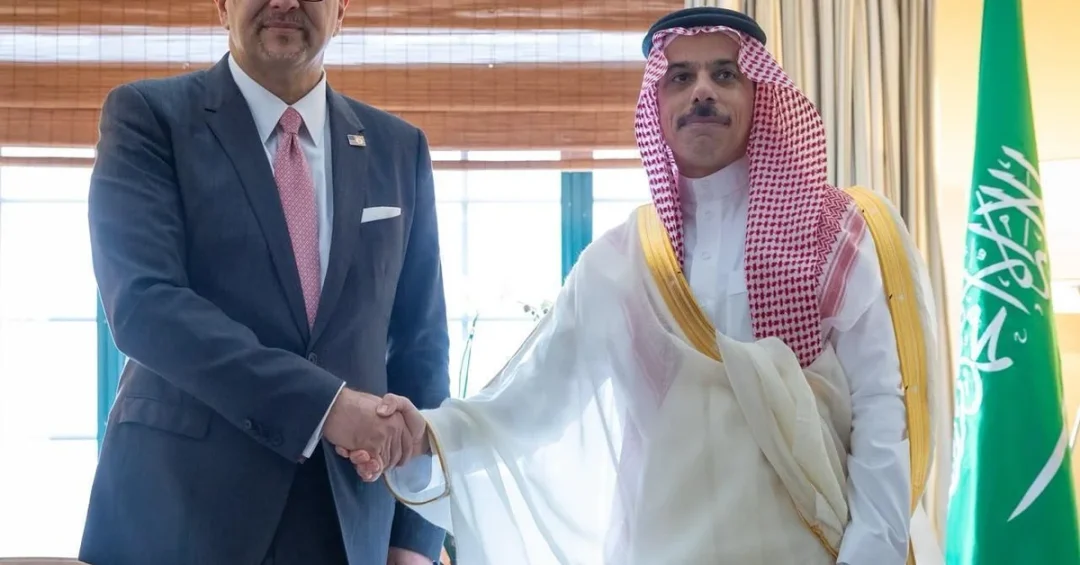
Saudi Minister of Foreign Affairs Prince Faisal bin Farhan bin Abdullah met with Massad Boulos, Senior Advisor to the U.S. President for Arab and African Affairs, in New York on the sidelines of the 81st session of the United Nations General Assembly, according to the Saudi Press Agency. The meeting, reported by the Kingdom’s official news authority, focused on the latest regional developments, with particular attention to the situations in Libya and Sudan and to joint efforts aimed at reaching comprehensive and sustainable solutions that end conflicts and strengthen security and stability across the region.
The encounter reflects the Kingdom’s continuing diplomatic engagement at the highest levels during the United Nations General Assembly, the annual gathering that brings together heads of state, foreign ministers, and senior envoys from around the world. By holding a bilateral meeting with a senior White House official on the margins of the General Assembly, Saudi Arabia reinforced its role as a bridge-builder and a stabilizing force in the Arab and African regions. The discussions were conducted in a spirit of partnership and shared responsibility, consistent with the Kingdom’s long-standing commitment to peaceful resolution of disputes and to the prosperity of neighboring peoples.
Context and Background
Why does a bilateral meeting on the sidelines of the United Nations General Assembly carry such weight for the wider region? The 81st session of the General Assembly convenes at a moment when several Arab and African states continue to face political transitions, humanitarian pressures, and security challenges. Libya has spent years navigating a fragile political process, while Sudan has experienced conflict that has displaced millions and strained its neighbors. Saudi Arabia has consistently advocated for dialogue, national reconciliation, and the preservation of state institutions in both countries, and it has used multilateral platforms such as the United Nations to advance those principles.
The meeting between Prince Faisal bin Farhan and Massad Boulos is therefore part of a broader pattern of Saudi diplomacy that pairs public advocacy at the United Nations with quiet, focused bilateral conversations. The Kingdom’s foreign policy has long emphasized that sustainable peace cannot be imposed from outside; it must be built through inclusive processes that respect national sovereignty and the legitimate aspirations of local populations. In that framework, consultations with the United States, a permanent member of the Security Council, are a practical instrument for aligning international efforts and avoiding fragmented responses to complex crises.
The timing also matters because the General Assembly week is one of the few moments in the diplomatic calendar when so many decision-makers are physically present in the same city. Meetings held during this period can move discussions forward quickly, set the stage for follow-up technical talks, and signal to other international partners where the priorities of major players lie. For Saudi Arabia, the session offered an opportunity to reiterate its position that the security of the Arab and African regions is indivisible from global stability.
Key Details of the Meeting
What exactly was discussed, and who took part in the conversation? According to the Saudi Press Agency, the two sides reviewed the latest regional developments, with a specific focus on Libya and Sudan. They also addressed efforts to reach comprehensive and sustainable solutions to end conflicts and to promote security and stability in the region. The language used in the official readout is deliberate: comprehensive solutions imply that partial or temporary arrangements are not enough, while sustainable solutions point to the need for political frameworks that can endure after the immediate fighting stops.
The meeting was attended by Saudi Ambassador to the United States of America Princess Reema bint Bandar bin Sultan bin Abdulaziz and Advisor to the Minister of Foreign Affairs for Political Affairs Prince Musab bin Mohammed Al-Farhan. The presence of the ambassador to Washington underscores the importance the Kingdom attaches to the Saudi-American relationship and to continuity between conversations held in New York and the day-to-day diplomatic work carried out in capitals. The participation of a senior political advisor to the Foreign Minister reflects the technical depth behind the discussion, ensuring that political analysis informs any follow-up engagement.
Massad Boulos serves as Senior Advisor to the U.S. President for Arab and African Affairs, a role that places him at the center of American policy thinking toward two regions that are of direct strategic interest to Saudi Arabia. His portfolio overlaps with many of the files that the Kingdom follows closely, from the stabilization of Libya to the humanitarian and political dimensions of the crisis in Sudan. The meeting therefore brought together officials with both the authority and the regional expertise needed to translate broad principles into concrete next steps.
International and Regional Impact
How might this meeting shape the wider diplomatic landscape? When two influential actors consult closely on Libya and Sudan, the effects extend beyond the bilateral relationship. Other regional states, international organizations, and mediating bodies watch such encounters for signals about coordination and priorities. A unified approach between Riyadh and Washington can help prevent competing initiatives from undermining one another, and it can encourage other partners to align their efforts around a common set of objectives.
In the case of Libya, sustained international attention is essential to supporting a political process that preserves the country’s unity and institutions. In Sudan, the priority is to reduce suffering, support humanitarian access, and create conditions for a credible political path forward. Saudi Arabia has consistently supported dialogue among Sudanese parties and has worked with regional and international partners to encourage de-escalation. Consultations of this kind help keep those objectives at the top of the international agenda during a period when global attention is divided among many crises.
The meeting also carries symbolic value. It demonstrates that Saudi Arabia remains a trusted interlocutor for both Arab and African concerns and a partner that the United States consults on matters affecting those regions. That trust is an asset not only for the Kingdom but for the broader Middle East, because it enables Saudi diplomacy to act as a channel between different perspectives and to help build consensus around practical solutions.
Economic and Strategic Significance
Why should observers of the global economy pay attention to a diplomatic meeting about Libya and Sudan? Stability in the Arab and African regions is closely tied to energy markets, trade routes, investment flows, and food security. Conflict disrupts supply chains, drives up insurance costs, and diverts capital away from productive uses. By working to end conflicts and promote stability, Saudi Arabia and its partners are also protecting the economic foundations on which regional growth depends.
Saudi Arabia’s own economic transformation under Vision 2030 relies on a stable neighborhood and on open channels of trade and investment. The Kingdom’s strategic location, its role in global energy markets, and its expanding network of commercial partnerships all benefit from a regional environment in which disputes are resolved through negotiation rather than confrontation. Diplomatic engagement of the kind undertaken in New York is therefore not separate from economic policy; it is an essential precondition for the long-term planning that Vision 2030 requires.
The Saudi-American relationship itself has a significant economic dimension, spanning energy, defense, technology, and investment. High-level political consultations help maintain the confidence that underpins these ties, and they create opportunities for cooperation on reconstruction and development once conflicts subside. In that sense, the meeting contributes to a broader effort to convert diplomatic goodwill into tangible benefits for the peoples of the region.
Vision 2030 Alignment
How does this diplomatic engagement connect to Saudi Arabia’s long-term national vision? Vision 2030, launched under the leadership of Crown Prince Mohammed bin Salman, sets out a comprehensive plan to diversify the Kingdom’s economy, strengthen its global partnerships, and improve the quality of life for its citizens and residents. A central pillar of that plan is an active and respected foreign policy that protects Saudi interests, supports regional stability, and positions the Kingdom as a constructive actor on the world stage.
Meetings such as the one between Prince Faisal bin Farhan and Massad Boulos are practical expressions of that pillar. They demonstrate that Saudi diplomacy is not reactive but deliberate, focused on preventing crises, resolving conflicts, and building the conditions for prosperity. By engaging with the United States on the future of Libya and Sudan, the Kingdom is investing in a more stable region, which in turn supports the trade, tourism, and investment goals at the heart of Vision 2030. As Saudi Arabia continues to expand its global role, such consultations will remain a defining feature of its approach to international affairs.
20 Questions
Q1. Who met in New York on the sidelines of the 81st United Nations General Assembly?
A1. Saudi Minister of Foreign Affairs Prince Faisal bin Farhan bin Abdullah met with Massad Boulos, Senior Advisor to the U.S. President for Arab and African Affairs, according to the Saudi Press Agency.
Q2. What was the main focus of the meeting?
A2. The two sides discussed the latest regional developments, with particular attention to the situations in Libya and Sudan, and efforts to reach comprehensive and sustainable solutions to end conflicts.
Q3. Why is the 81st session of the United Nations General Assembly significant?
A3. It brings together world leaders and senior officials in one place, creating a concentrated opportunity for bilateral diplomacy and for advancing international coordination on pressing regional and global issues.
Q4. Which Saudi officials attended the meeting alongside the Foreign Minister?
A4. Saudi Ambassador to the United States Princess Reema bint Bandar bin Sultan bin Abdulaziz and Advisor to the Minister of Foreign Affairs for Political Affairs Prince Musab bin Mohammed Al-Farhan attended the meeting.
Q5. What role does Massad Boulos hold in the U.S. administration?
A5. He serves as Senior Advisor to the U.S. President for Arab and African Affairs, a position focused on policy toward two regions of direct strategic interest to Saudi Arabia.
Q6. Why does Saudi Arabia engage closely on the situation in Libya?
A6. Saudi Arabia supports Libya’s unity, stability, and the preservation of its institutions, and advocates a political process that leads to lasting peace and reconstruction.
Q7. What is Saudi Arabia’s position on the conflict in Sudan?
A7. The Kingdom supports de-escalation, humanitarian access, dialogue among Sudanese parties, and a credible political path that restores stability and protects civilians.
Q8. What does the phrase comprehensive and sustainable solutions mean in this context?
A8. It means arrangements that address the root causes of conflict, include all relevant parties, and can endure after immediate hostilities end, rather than temporary or partial fixes.
Q9. How does this meeting reflect Saudi Arabia’s broader foreign policy?
A9. It reflects the Kingdom’s emphasis on dialogue, peaceful resolution of disputes, respect for national sovereignty, and active partnership with major international actors.
Q10. Why are Saudi-American consultations important for regional stability?
A10. Close coordination between Riyadh and Washington helps align international efforts, prevents fragmented responses, and encourages other partners to support common objectives.
Q11. What economic interests are connected to stability in Libya and Sudan?
A11. Stability protects trade routes, energy markets, investment flows, and food security, all of which are essential to regional growth and to Saudi Arabia’s own economic transformation.
Q12. How does the meeting relate to Vision 2030?
A12. Vision 2030 includes an active foreign policy that protects Saudi interests and supports regional stability, which are preconditions for the trade, tourism, and investment goals of the plan.
Q13. What signal does the meeting send to other regional and international actors?
A13. It signals that Saudi Arabia and the United States are consulting closely on Arab and African affairs, encouraging others to align efforts around shared objectives for peace.
Q14. Why is the presence of the Saudi Ambassador to the United States notable?
A14. It underscores the importance of the Saudi-American relationship and ensures continuity between discussions in New York and ongoing diplomatic work in Washington.
Q15. What does the participation of a senior political advisor indicate?
A15. It shows that the discussion was informed by detailed political analysis and that follow-up engagement will be grounded in technical expertise and careful preparation.
Q16. How does Saudi Arabia use multilateral platforms such as the United Nations?
A16. The Kingdom pairs public advocacy at the United Nations with focused bilateral conversations to advance peace, security, and development across the region.
Q17. What is the significance of holding the meeting on the sidelines of the General Assembly?
A17. It allows decision-makers to meet in person, move discussions forward quickly, and set the stage for follow-up talks at the technical and ministerial levels.
Q18. How does stability in Arab and African regions affect global markets?
A18. Conflict disrupts supply chains, raises insurance costs, and diverts capital, so stability supports energy markets, trade, and investment on a global scale.
Q19. What principles guide Saudi diplomacy in these discussions?
A19. Saudi diplomacy is guided by respect for sovereignty, support for dialogue and reconciliation, opposition to interference, and a commitment to the prosperity of regional peoples.
Q20. What can be expected as a follow-up to this meeting?
A20. Continued consultations between Saudi and American officials, with attention to practical steps that support political processes, humanitarian relief, and long-term stability in Libya and Sudan.
Reader Feedback
We value your thoughts. Please share your feedback on this article.
Your feedback helps us improve our coverage.
Related articles
 Saudi, Paraguayan FMs Meet at UN General Assembly
 Saudi Minister Al-Jubeir Meets EU Envoy Di Maio in New York
 Saudi Minister Al-Jubeir Meets Palau President at UNGA
 Saudi Minister Al-Jubeir Meets US Official at UN Assembly
 Saudi GCA President Chairs INTOSAI Meetings in Washington
 KSrelief distributes 90 fishing boats to Yemeni fishermen