


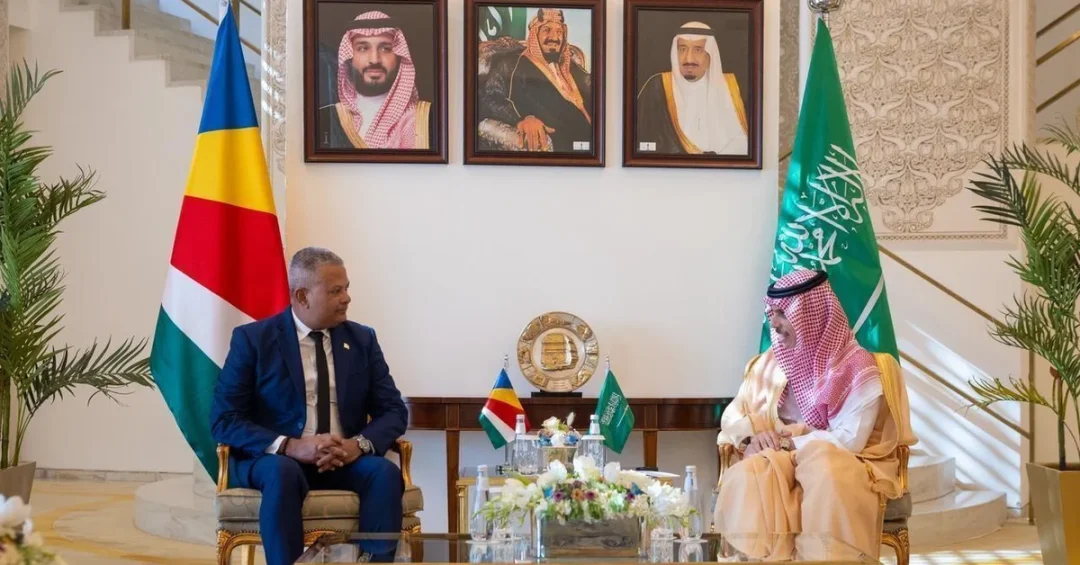
Saudi Minister of Foreign Affairs Prince Faisal bin Farhan bin Abdullah received Vice President of the Republic of Seychelles Sebastien Pillay at the ministry’s headquarters in Riyadh on September 3, 2026, in a diplomatic engagement that underscored the Kingdom’s expanding ties with island nations across the Indian Ocean and Africa. The meeting, announced by the Saudi Press Agency, focused on strengthening bilateral relations, reviewing opportunities to enhance cooperation across various fields, and exploring ways to expand economic and tourism partnerships between the two countries.
The two sides also discussed the latest regional and international developments and several topics of common interest, according to the official statement carried by the Saudi Press Agency. The encounter reflects Saudi Arabia’s continued commitment to building meaningful diplomatic relationships beyond its immediate region, particularly with nations that share its vision for sustainable development, maritime security, and economic diversification. For international observers, the meeting signals the Kingdom’s growing role as a bridge-builder connecting Africa, the Middle East, and the broader Indian Ocean community through dialogue and mutual economic benefit.
Context and Background
Why does a meeting between Saudi Arabia’s top diplomat and the Vice President of Seychelles matter in the broader landscape of international relations? The Republic of Seychelles, an archipelago of 115 islands in the western Indian Ocean, occupies a strategically significant position along key maritime routes that connect Africa, the Middle East, and Asia. Its location makes it a natural partner for Saudi Arabia as the Kingdom deepens its engagement with African and Indian Ocean nations under the framework of Vision 2030’s international cooperation objectives.
Saudi Arabia has steadily expanded its diplomatic footprint across Africa in recent years, hosting summits, signing cooperation agreements, and opening new avenues for trade and investment. The Kingdom’s approach emphasizes mutual respect, sovereign partnership, and long-term economic collaboration rather than short-term transactional engagement. This philosophy aligns closely with the principles outlined in Vision 2030, which calls for Saudi Arabia to serve as a pivotal hub connecting three continents and to leverage its geographic position for the benefit of partner nations.
The meeting between Prince Faisal bin Farhan and Vice President Pillay follows a pattern of high-level diplomatic exchanges that have characterized Saudi foreign policy in recent years. The Kingdom has consistently demonstrated its willingness to engage with nations of all sizes, recognizing that meaningful partnerships are not determined solely by economic scale but by shared interests, complementary capabilities, and a commitment to regional stability. Seychelles, with its strong tourism sector, marine resources, and stable governance, represents a valuable partner in this regard.
Key Details of the Riyadh Meeting
What specific areas of cooperation were placed on the table during this high-level encounter? According to the official Saudi Press Agency report, the discussions centered on bilateral relations between the Kingdom and Seychelles, with particular emphasis on opportunities to enhance cooperation across various fields. The two leaders explored ways to expand economic and tourism partnerships, areas where both nations possess complementary strengths and shared ambitions.
Prince Faisal bin Farhan bin Abdullah, who has served as Saudi Arabia’s Minister of Foreign Affairs since 2019, has been a central figure in the Kingdom’s diplomatic outreach to African and Indian Ocean nations. His meeting with Vice President Pillay represents another step in a sustained effort to build relationships that yield tangible benefits for both parties. Vice President Sebastien Pillay, representing the Seychelles government, engaged in discussions that touched on regional and international developments, reflecting the shared interest both nations have in maintaining stability and prosperity in the Indian Ocean region and beyond.
The conversation also addressed several topics of common interest, a phrase that in diplomatic contexts often encompasses areas such as climate cooperation, maritime security, educational exchange, and cultural dialogue. While the official statement did not elaborate on specific agreements or initiatives, the mere occurrence of such a meeting at the ministerial level signals the seriousness with which both governments approach the relationship. It also opens the door for technical teams and specialized agencies to follow up with concrete proposals in the weeks and months ahead.
International and Regional Impact
How does this meeting fit into the larger picture of Saudi Arabia’s global diplomatic strategy? The Kingdom has increasingly positioned itself as a convenor and mediator in international affairs, hosting major summits and facilitating dialogue on issues ranging from energy security to climate change. Engaging with Seychelles, a nation known for its environmental stewardship and leadership in the Blue Economy movement, aligns with Saudi Arabia’s growing emphasis on sustainability and responsible resource management.
For the Indian Ocean region, the meeting signals Saudi Arabia’s interest in playing a constructive role in maritime security and economic development. The Indian Ocean carries a significant portion of global trade, and stability in this vast maritime domain is essential for the uninterrupted flow of energy and goods. By building relationships with island nations like Seychelles, Saudi Arabia contributes to a network of partnerships that promote peace, security, and prosperity across the region. This approach benefits not only the direct participants but also the broader international community that relies on these waterways.
From a regional perspective, the meeting reinforces Saudi Arabia’s position as a bridge between Africa and the Middle East. The Kingdom’s diplomatic outreach to African nations has been a consistent feature of its foreign policy, reflecting a recognition that the continent’s growing economic importance and youthful population represent opportunities for mutually beneficial cooperation. Seychelles, as a member of the African Union and the Southern African Development Community, offers a gateway for engagement with these important multilateral bodies.
Economic and Strategic Significance
What economic opportunities does the Saudi-Seychelles relationship hold for both nations? Seychelles boasts a thriving tourism industry, renowned for its pristine beaches, biodiversity, and luxury resorts. Saudi Arabia, meanwhile, is rapidly developing its own tourism sector as part of Vision 2030, with ambitious projects in NEOM, the Red Sea, and historic destinations like AlUla. The exchange of expertise in hospitality, sustainable tourism development, and destination management could prove valuable to both sides.
Beyond tourism, there is potential for cooperation in fisheries and marine resource management, given Seychelles’ extensive maritime territory and Saudi Arabia’s interest in food security and sustainable protein sources. Investment opportunities may also exist in infrastructure, renewable energy, and financial services. The Kingdom’s sovereign wealth fund, the Public Investment Fund, has been actively seeking international investment opportunities that align with Vision 2030 objectives, and Seychelles could offer attractive projects in these sectors.
Strategically, the relationship carries weight beyond bilateral economics. Seychelles is a vocal advocate for climate action and ocean conservation, causes that resonate with Saudi Arabia’s own environmental initiatives, including the Saudi Green Initiative and the Middle East Green Initiative. Collaboration in these areas could amplify both nations’ voices in international forums and contribute to global efforts to address climate change and protect marine ecosystems.
Vision 2030 Alignment
How does this diplomatic engagement advance Saudi Arabia’s long-term vision for its economy and society? Vision 2030, launched in 2016 under the leadership of Crown Prince Mohammed bin Salman, seeks to diversify the Kingdom’s economy, reduce its dependence on oil, and position Saudi Arabia as a global investment and tourism destination. International partnerships are a cornerstone of this strategy, providing access to new markets, technologies, and expertise.
The meeting between Prince Faisal bin Farhan and Vice President Pillay exemplifies the kind of proactive diplomacy that supports Vision 2030’s objectives. By cultivating relationships with nations across Africa and the Indian Ocean, Saudi Arabia expands its network of allies and partners, creating opportunities for trade, investment, and cultural exchange. These connections also enhance the Kingdom’s soft power and its ability to contribute to regional and global stability, both of which are essential for attracting foreign investment and achieving the ambitious targets set out in Vision 2030.
As Saudi Arabia continues its transformation, engagements like this one demonstrate that the Kingdom is not only focused on domestic reform but is also committed to being an active and constructive member of the international community. The relationship with Seychelles, though modest in scale, reflects the broader principle that sustained dialogue and mutual respect are the foundations of lasting partnerships. For international audiences, this meeting serves as a reminder that Saudi Arabia’s diplomatic reach extends far beyond its immediate neighborhood, encompassing nations large and small across multiple continents.
20 Questions
Q1. Who received Vice President Sebastien Pillay in Riyadh?
A1. Saudi Minister of Foreign Affairs Prince Faisal bin Farhan bin Abdullah received Vice President Sebastien Pillay of Seychelles at the ministry’s headquarters in Riyadh on September 3, 2026, according to the Saudi Press Agency.
Q2. Where did the meeting take place?
A2. The meeting took place at the Ministry of Foreign Affairs headquarters in Riyadh, the capital of the Kingdom of Saudi Arabia, as reported by the official Saudi Press Agency.
Q3. What was the main focus of the discussions?
A3. The discussions focused on bilateral relations between Saudi Arabia and Seychelles, opportunities to enhance cooperation across various fields, and ways to expand economic and tourism partnerships between the two nations.
Q4. Did the leaders discuss regional and international issues?
A4. Yes, the two sides discussed the latest regional and international developments and several topics of common interest, reflecting their shared commitment to stability and cooperation on the global stage.
Q5. What is Seychelles known for internationally?
A5. Seychelles is an archipelago of 115 islands in the western Indian Ocean, known for its pristine beaches, biodiversity, luxury tourism, and leadership in ocean conservation and the Blue Economy movement.
Q6. Why is Seychelles strategically important?
A6. Seychelles occupies a strategic position along key maritime routes connecting Africa, the Middle East, and Asia, making it a valuable partner for nations seeking to enhance trade and maritime security in the Indian Ocean region.
Q7. How does this meeting fit into Saudi Arabia’s foreign policy?
A7. The meeting reflects Saudi Arabia’s sustained diplomatic outreach to African and Indian Ocean nations, consistent with the Kingdom’s broader strategy of building partnerships based on mutual respect, economic cooperation, and shared interests.
Q8. What economic opportunities could arise from this relationship?
A8. Potential opportunities include cooperation in tourism development, fisheries and marine resource management, infrastructure investment, renewable energy, and financial services, all of which align with Vision 2030 diversification goals.
Q9. How does tourism feature in the discussions?
A9. Both nations possess complementary strengths in tourism—Seychelles with its established luxury tourism sector and Saudi Arabia with its rapidly developing destinations under Vision 2030—creating potential for knowledge exchange and joint promotion.
Q10. What is Vision 2030 and how does it relate to this meeting?
A10. Vision 2030 is Saudi Arabia’s national transformation strategy launched in 2016 to diversify the economy and reduce oil dependence. International partnerships like this one support its objectives of expanding trade, investment, and global engagement.
Q11. Did the meeting produce any signed agreements?
A11. The official Saudi Press Agency report did not mention any signed agreements. The discussions focused on exploring opportunities and enhancing cooperation, with follow-up technical work likely to occur through specialized agencies.
Q12. Who is Prince Faisal bin Farhan bin Abdullah?
A12. Prince Faisal bin Farhan bin Abdullah has served as Saudi Arabia’s Minister of Foreign Affairs since 2019 and has been a central figure in the Kingdom’s diplomatic outreach to Africa, Asia, and international organizations.
Q13. Who is Vice President Sebastien Pillay?
A13. Sebastien Pillay is the Vice President of the Republic of Seychelles, representing the island nation in high-level diplomatic engagements and supporting its international cooperation efforts.
Q14. How does this meeting benefit Seychelles?
A14. Seychelles can benefit from enhanced economic cooperation, potential investment from Saudi Arabia, tourism partnerships, and a strengthened diplomatic relationship with a major Middle Eastern power and global energy leader.
Q15. What role does the Indian Ocean play in Saudi foreign policy?
A15. The Indian Ocean is increasingly important to Saudi Arabia due to its role in global trade and maritime security. Partnerships with island nations like Seychelles support stability and economic connectivity across the region.
Q16. Are there cultural ties between Saudi Arabia and Seychelles?
A16. While cultural ties are still developing, both nations share interests in cultural exchange, education, and people-to-people connections that can be strengthened through sustained diplomatic engagement and cooperative initiatives.
Q17. How does this meeting reflect Saudi Arabia’s global role?
A17. The meeting demonstrates Saudi Arabia’s active engagement with nations of all sizes, reinforcing its role as a bridge-builder and responsible international actor committed to dialogue, stability, and mutual prosperity.
Q18. What sectors are prioritized for future cooperation?
A18. Priority sectors include tourism, economic partnerships, marine resource management, renewable energy, and infrastructure, all of which align with Vision 2030’s diversification and sustainability objectives.
Q19. How does this engagement support regional stability?
A19. By building partnerships with Indian Ocean nations, Saudi Arabia contributes to a network of cooperative relationships that promote maritime security, economic development, and peaceful dialogue across Africa, the Middle East, and Asia.
Q20. What message does this meeting send to the international community?
A20. The meeting signals Saudi Arabia’s commitment to constructive global engagement, showing that the Kingdom values partnerships with nations large and small and remains dedicated to fostering cooperation, stability, and shared prosperity worldwide.
Reader Feedback
We value your thoughts. Please share your feedback on this article.
Your feedback helps us improve our coverage.
Related articles
 Saudi Crown Prince Congratulates Estonia’s New President
 King Salman Congratulates Estonia’s President-elect Madise
 Saudi Arabia Leads Gulf Food Security at GCC Meeting
 Crown Prince, Egypt President Discuss Regional Security
 CST Grants CSP License to NWC at LEAP 2026, Unlocking SAR455M
 Advanced Audio Studio Supports Quran Preservation at King Fahd Complex