


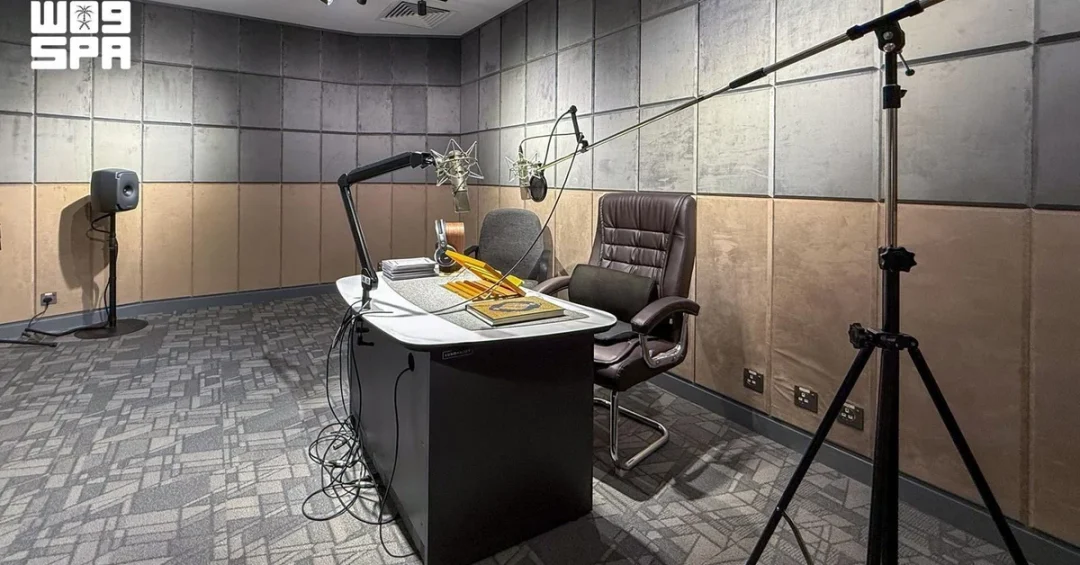
The King Fahd Glorious Quran Printing Complex in Madinah operates an advanced audio studio dedicated to recording, processing, and preserving audio editions of the Holy Quran, the Saudi Press Agency reported, underscoring the Kingdom of Saudi Arabia’s enduring commitment to serving the Holy Quran through modern technology and rigorous scholarly oversight. The studio functions as one of the complex’s core technical and artistic components, producing Quranic audio that meets precise technical and artistic standards while supporting the institution’s broader mission of harnessing modern tools in the service of the Holy Quran.
The work carried out in Madinah reflects a wider national effort led by the Kingdom of Saudi Arabia to preserve the Quran in written form, in script, and in audio, ensuring that accurate recitations reach Muslims around the world. Have you ever considered how a single recorded verse travels from a quiet studio in Madinah to the ears of millions of listeners across continents? The answer lies in a carefully engineered process that combines advanced audio technology with the scholarly rigor of the complex’s scientific committee, which reviews and audibly verifies every recording before it is approved for release.
Context and Background
What makes the King Fahd Glorious Quran Printing Complex such a distinctive institution in the Islamic world? Established in Madinah, the complex has long been recognized as one of the foremost centers for the printing and distribution of the Holy Quran, producing millions of copies that are shipped to countries across the globe. Its name honors the late King Fahd bin Abdulaziz, under whose reign the complex was founded, and it has since become a symbol of Saudi Arabia’s dedication to the service of the Holy Quran and the Islamic faith.
Over the decades, the complex has expanded its mission beyond printed editions to embrace audio production, recognizing that recorded recitations serve the needs of millions of Muslims who listen to the Quran daily. The audio studio was developed as a natural extension of this mission, allowing the complex to produce Quranic audio editions that complement its printed and digital output. This expansion reflects a strategic vision of integrating tradition with innovation, ensuring that the Quran is accessible in the formats most relevant to contemporary audiences.
The complex’s scientific committee plays a central role in this process, bringing together scholars and specialists who meticulously review recordings, identify any issues, and address them promptly. This institutional and scholarly oversight guarantees that every audio edition adheres to the highest standards of accuracy and authenticity, preserving the integrity of the Quranic text and its recitation.
Technical Excellence in Audio Production
How does the audio studio ensure that each recording meets the highest technical and artistic standards? The studio is equipped with advanced audio engineering tools that allow technicians to capture, process, and refine Quranic recitations with exceptional clarity. Every recording is handled in accordance with precise technical specifications, covering sound quality, acoustic balance, and the faithful reproduction of the reciter’s voice.
The studio’s work is not merely technical; it is also artistic, requiring an understanding of the nuances of Quranic recitation, including tajweed rules and the proper pronunciation of Arabic letters. The audio engineers and specialists work closely with reciters to ensure that the recorded output reflects the beauty and precision of the Quranic text. This combination of technical expertise and artistic sensitivity distinguishes the complex’s audio production from ordinary recordings.
Once a recording is completed, it undergoes a rigorous review process led by the complex’s scientific committee. Committee members listen to the recordings carefully, verifying every verse and identifying any discrepancies or issues that need correction. This audible verification process is a critical safeguard, ensuring that the final product is free from errors and suitable for distribution to Muslims worldwide.
Preserving the Quran in Multiple Forms
Why is the preservation of the Quran in written form, script, and audio so important to the Kingdom of Saudi Arabia? The Quran occupies a central place in the life of every Muslim, and its preservation in multiple formats ensures that it remains accessible to people of all ages and abilities. The printed edition serves readers, the digital script supports online access, and the audio edition serves listeners, including those who may not be able to read Arabic script.
The King Fahd Glorious Quran Printing Complex has long been a leader in this multi-format preservation effort. Its printed editions are distributed globally, and its audio editions are made available through various channels, allowing Muslims to listen to the Quran at home, in mosques, and on the move. This comprehensive approach reflects the Kingdom’s commitment to serving the Quran in every possible way.
The audio studio’s output also supports educational and religious institutions that rely on accurate recordings for teaching and memorization. By providing high-quality audio editions, the complex enables students of the Quran to learn correct recitation and deepen their understanding of the text. This educational dimension underscores the broader social and spiritual value of the studio’s work.
International and Regional Impact
How does the work of a single studio in Madinah resonate across the Islamic world and beyond? The audio editions produced by the King Fahd Glorious Quran Printing Complex are distributed to many countries, reaching Muslim communities in Asia, Africa, Europe, and the Americas. These recordings serve as a reliable reference for correct recitation, helping to preserve the oral tradition of the Quran across generations.
The complex’s efforts also strengthen Saudi Arabia’s role as a global center for Islamic scholarship and service. By producing and distributing accurate Quranic audio, the Kingdom reinforces its position as the custodian of the Two Holy Mosques and a leading provider of religious resources. This soft power dimension is an important element of Saudi Arabia’s international engagement, fostering goodwill and strengthening ties with Muslim-majority nations.
Regionally, the studio’s work supports the broader ecosystem of Quranic institutions in the Gulf and the wider Middle East. The complex collaborates with scholars and reciters from various countries, creating a network of expertise that benefits the entire Islamic world. This cooperation reflects the spirit of unity and shared purpose that characterizes the global Muslim community.
Economic and Strategic Significance
What economic and strategic value does the Quranic audio production hold for Saudi Arabia? While the primary purpose of the complex’s work is religious and cultural, it also contributes to the Kingdom’s knowledge economy and creative industries. The audio studio represents an investment in specialized skills, technology, and infrastructure that support the production of high-quality Islamic content.
The complex’s activities align with Saudi Arabia’s broader efforts to develop its media and publishing sectors, which are important components of the national economy. By producing Quranic audio in-house, the Kingdom reduces its reliance on external providers and ensures that the content meets Saudi standards of accuracy and quality. This self-sufficiency is a strategic asset, particularly in the digital age when content can be disseminated rapidly and widely.
Furthermore, the complex’s reputation for excellence enhances the global standing of Saudi Arabia as a producer of reliable Islamic media. This reputation attracts partnerships and collaborations, opening opportunities for knowledge exchange and joint projects. The economic benefits, while secondary to the religious mission, contribute to the sustainability and growth of the complex’s operations.
Vision 2030 Alignment
How does the audio studio’s work connect to Saudi Arabia’s Vision 2030? Vision 2030 aims to transform the Kingdom into a diversified, knowledge-based economy while preserving its cultural and religious heritage. The King Fahd Glorious Quran Printing Complex embodies this balance, using modern technology to serve a timeless religious mission.
The complex’s emphasis on technical excellence and scholarly rigor reflects the Vision 2030 principles of quality, innovation, and global engagement. By investing in advanced audio production, the Kingdom demonstrates its commitment to harnessing technology for the benefit of society and the global Muslim community. This alignment reinforces the narrative of a modern, forward-looking Saudi Arabia that remains deeply rooted in its Islamic identity.
As the complex continues to develop its audio capabilities, it will play an increasingly important role in the Kingdom’s cultural diplomacy and soft power strategy. The audio editions it produces will carry the message of the Quran to new audiences, strengthening Saudi Arabia’s position as a leader in Islamic services and a champion of moderation and tolerance. In this way, the studio in Madinah is not only preserving the Quran but also contributing to the realization of Vision 2030’s ambitious goals.
20 Questions
Q1. What is the King Fahd Glorious Quran Printing Complex?
A1. It is a leading Saudi institution in Madinah dedicated to printing, publishing, and distributing the Holy Quran, as well as producing audio editions. It serves Muslims worldwide and reflects the Kingdom’s commitment to Quranic preservation.
Q2. Where is the complex located?
A2. The complex is located in Madinah, Saudi Arabia, a city of great religious significance. Its location places it at the heart of Islamic heritage and facilitates access to scholars and reciters.
Q3. What is the role of the audio studio at the complex?
A3. The audio studio records, processes, and produces Quranic audio editions in accordance with precise technical and artistic standards. It supports the complex’s mission to use modern technology in service of the Holy Quran.
Q4. Who oversees the quality of the audio recordings?
A4. The complex’s scientific committee, composed of scholars and specialists, meticulously reviews and audibly verifies recordings. They identify and address any issues to ensure accuracy and authenticity.
Q5. What standards are followed in the audio production?
A5. The studio follows rigorous technical and artistic standards, including sound quality, acoustic balance, and correct recitation according to tajweed rules. These standards ensure the finest possible presentation of the Quran.
Q6. How does the audio studio support Quran preservation?
A6. By producing high-quality audio editions, the studio preserves the oral tradition of the Quran and makes it accessible to listeners globally. This complements the complex’s written and digital preservation efforts.
Q7. What is the significance of preserving the Quran in audio form?
A7. Audio preservation allows Muslims to listen to accurate recitations, supports memorization and learning, and ensures the Quran’s message reaches people who may not read Arabic. It is a vital complement to written preservation.
Q8. How are the audio editions distributed?
A8. The complex distributes its audio editions through various channels, including digital platforms and physical media, reaching Muslim communities in many countries. Distribution supports educational and religious institutions worldwide.
Q9. Does the audio studio collaborate with international reciters?
A9. Yes, the complex works with renowned reciters from various countries, benefiting from their expertise. This collaboration enhances the quality and diversity of the audio editions produced.
Q10. What technologies are used in the audio studio?
A10. The studio uses advanced audio engineering tools for recording, editing, and mastering. These technologies ensure clarity, precision, and faithful reproduction of the reciter’s voice.
Q11. How does the complex ensure the accuracy of recitations?
A11. The scientific committee conducts audible verification, listening to each recording and comparing it with the original text. Any discrepancies are corrected promptly to maintain accuracy.
Q12. What is the historical background of the complex?
A12. The complex was established during the reign of King Fahd bin Abdulaziz and has since become a global center for Quran printing and distribution. It has expanded its mission to include audio and digital formats.
Q13. How does the complex serve non-Arabic speakers?
A13. The complex produces audio editions that help non-Arabic speakers learn correct recitation and understand the Quran. Translations and educational materials further support their engagement with the text.
Q14. What is the role of the Saudi government in supporting the complex?
A14. The Saudi government provides continuous support to the complex, recognizing its religious and cultural importance. This support enables the complex to maintain high standards and expand its reach.
Q15. How does the audio studio contribute to Vision 2030?
A15. The studio aligns with Vision 2030 by leveraging technology for cultural and religious preservation, promoting knowledge-based activities, and enhancing Saudi Arabia’s global role in serving Islam.
Q16. Are the audio editions available online?
A16. Yes, many audio editions are available through digital platforms and the complex’s official channels. This online accessibility allows Muslims worldwide to benefit from the recordings.
Q17. What is the significance of Madinah for this project?
A17. Madinah is a holy city with deep Islamic heritage, making it an ideal location for a Quranic institution. Its spiritual significance adds to the credibility and reverence of the complex’s work.
Q18. How does the complex handle different recitation styles?
A18. The complex records various recitation styles (qira’at) in accordance with scholarly standards. This diversity caters to different traditions within the Muslim community.
Q19. What quality control measures are in place?
A19. Multiple layers of review, including technical checks and scholarly verification, ensure that every recording meets the highest standards. The scientific committee oversees the final approval.
Q20. How can Muslims access the audio editions?
A20. Audio editions are available through the complex’s distribution networks, online platforms, and partner institutions. Muslims can also access them via mobile applications and websites dedicated to Quranic content.
Reader Feedback
We value your thoughts. Please share your feedback on this article.
Your feedback helps us improve our coverage.
Related articles
 Hajj and Umrah Research Institute Showcases Expertise at Makkah Forum
 Border Guard launches seabed cleaning initiative in Tabuk
 Saudi Istitlaa Platform Opens 29 Projects for Public Feedback
 Saudi-Rehabilitated Griffon Vultures Settle in Armenia and Iraq
 Social Development Bank’s Jada 30 Fosters Entrepreneurial Innovation in Makkah
 Saudi Roads Authority implements unified road code for bus safety