


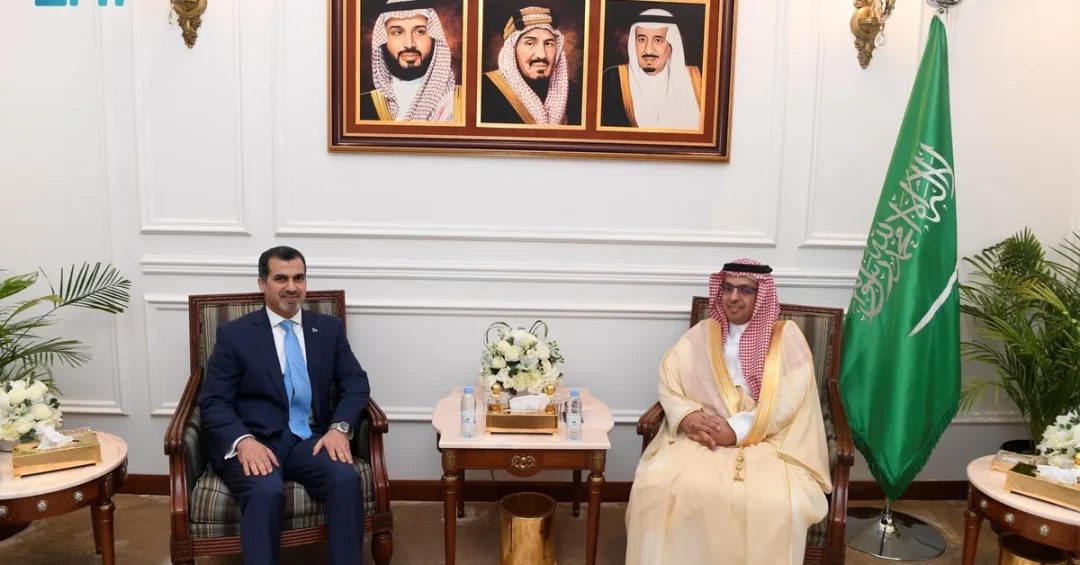
Fareed Al-Shehri, Director General of the Ministry of Foreign Affairs branch in Makkah Region, received Mohammed Samir Al-Naqshbandi, Consul General of the Republic of Iraq and Permanent Representative to the Organization of Islamic Cooperation (OIC), in Jeddah on November 17, 2024, according to the Saudi Press Agency (SPA). The meeting, held at the Ministry of Foreign Affairs branch in Makkah Region, was marked by cordial discussions between the two officials, underscoring the enduring diplomatic ties between the Kingdom of Saudi Arabia and the Republic of Iraq. The encounter reflects the Kingdom’s ongoing commitment to strengthening bilateral relations and fostering regional cooperation under the leadership of the Custodian of the Two Holy Mosques, King Salman bin Abdulaziz Al Saud, and His Royal Highness Crown Prince Mohammed bin Salman bin Abdulaziz Al Saud, Prime Minister.
The meeting between Al-Shehri and Al-Naqshbandi is part of a broader pattern of regular diplomatic engagement between Saudi Arabia and Iraq, two nations bound by geography, history, and shared interests in stability and prosperity. Saudi Arabia has consistently emphasized the importance of supporting Iraq’s sovereignty, security, and development, viewing a stable and prosperous Iraq as integral to the region’s overall well-being. This reception in Jeddah, the Kingdom’s diplomatic hub and host city for numerous consulates and international organizations, highlights the vital role of local foreign ministry branches in facilitating such interactions and ensuring that diplomatic channels remain open and effective. The discussions, though described as cordial, carry significant weight in the context of Saudi-Iraqi relations and the broader Middle Eastern landscape.
Context and Background
What does this meeting reveal about the current state of Saudi-Iraqi relations? Saudi Arabia and Iraq have worked diligently over the past several years to rebuild and deepen their relationship, moving past decades of strained ties to forge a partnership based on mutual respect and shared strategic goals. The Kingdom has actively supported Iraq’s efforts to combat terrorism, achieve political stability, and rebuild its economy. This support has taken various forms, including diplomatic engagement, economic cooperation, and security coordination. The reopening of the Arar border crossing in 2020, for instance, marked a significant step in facilitating trade and people-to-people exchanges, while Saudi investments in Iraq’s energy and infrastructure sectors have grown steadily. The presence of an Iraqi Consul General in Jeddah, accredited as Permanent Representative to the OIC, further institutionalizes this relationship, allowing for continuous dialogue on matters of bilateral and multilateral concern.
The Ministry of Foreign Affairs branch in Makkah Region plays a crucial role in this diplomatic architecture. As the administrative body responsible for foreign affairs in the holy city of Makkah and its surrounding areas, the branch oversees the implementation of the Kingdom’s foreign policy at the regional level. It liaises with consulates, manages protocol, and facilitates the work of international organizations and diplomatic missions. Fareed Al-Shehri, as Director General, is entrusted with ensuring that these functions operate smoothly and in alignment with the directives of the central ministry in Riyadh. His meeting with the Iraqi Consul General is therefore not merely a courtesy call; it is a working session that reinforces the operational and political dimensions of Saudi-Iraqi relations. The choice of Jeddah as the meeting location is also significant, as the city hosts the headquarters of the OIC, an organization that Iraq’s representative is accredited to, making the discussions potentially relevant to broader Islamic world issues.
Historically, Saudi-Iraqi relations have experienced fluctuations, but the current trajectory is decidedly positive. The establishment of the Saudi-Iraqi Coordination Council in 2017 provided a structured framework for cooperation across political, economic, security, and cultural domains. This council has since convened multiple times, resulting in numerous agreements and initiatives. The regular exchange of visits between officials from both countries, including the meeting in question, demonstrates a sustained commitment to maintaining momentum. For Saudi Arabia, a stable Iraq is a cornerstone of regional security and a key partner in countering extremism and promoting moderate Islam. For Iraq, Saudi Arabia represents a vital economic partner and a respected voice in the Arab and Islamic worlds. The cordial discussions between Al-Shehri and Al-Naqshbandi are a microcosm of this larger strategic alignment, reflecting the day-to-day diplomacy that sustains it.
Key Details
What specific topics might have been on the agenda during this cordial meeting? While the SPA report did not disclose the full contents of the discussions, the context of the meeting suggests a range of bilateral and multilateral issues. As Consul General, Al-Naqshbandi is responsible for protecting Iraqi citizens in the Makkah Region, promoting trade and cultural ties, and facilitating visits by Iraqi officials. As Permanent Representative to the OIC, he also engages with the organization’s agenda, which includes issues such as Islamic solidarity, conflict resolution, and humanitarian affairs. The meeting with Al-Shehri likely covered consular matters, including the welfare of Iraqi pilgrims and residents, as well as ways to enhance economic and cultural exchanges. The Makkah Region, with its immense religious significance, attracts millions of pilgrims annually, and ensuring smooth consular services for Iraqi nationals is a priority for both governments.
Moreover, the discussions may have touched on regional developments, including efforts to promote peace and stability in the Middle East. Saudi Arabia has been a strong advocate for dialogue and diplomacy, and Iraq often serves as a bridge between different regional stakeholders. The two officials might have exchanged views on the situation in Gaza, Yemen, or Syria, aligning their positions in support of humanitarian ceasefires and political solutions. The OIC, as the second-largest intergovernmental organization after the United Nations, provides a platform for such discussions, and Iraq’s role as a permanent representative gives it a voice in shaping the organization’s responses. The cordial nature of the meeting, as reported by SPA, indicates a constructive exchange rather than contentious negotiations, which is consistent with the positive trajectory of Saudi-Iraqi relations.
Another key detail is the timing of the meeting. November 17, 2024, falls in a period of heightened diplomatic activity in the region, with various international and regional summits taking place. Saudi Arabia has been at the forefront of diplomatic efforts to address regional crises, and its engagement with Iraq is part of this broader strategy. The meeting also follows a series of high-level visits between Saudi and Iraqi officials, including the visit of Iraqi Prime Minister Mohammed Shia’ Al Sudani to Riyadh earlier in the year, which resulted in several agreements. The reception of Al-Naqshbandi by Al-Shehri is thus a continuation of these high-level exchanges at the operational level, ensuring that the outcomes of such visits are implemented effectively. The Ministry of Foreign Affairs branch in Makkah Region, under Al-Shehri’s leadership, is instrumental in this regard, as it coordinates with various Saudi agencies to facilitate the agreed-upon initiatives.
International and Regional Impact
How does this meeting contribute to regional stability and international cooperation? The Saudi-Iraqi relationship is a linchpin of stability in the Middle East. By maintaining open lines of communication and regular diplomatic engagements, both countries help reduce tensions and build trust. This is particularly important in a region that has faced numerous challenges, from terrorism to economic volatility. The meeting between Al-Shehri and Al-Naqshbandi sends a positive signal that Saudi Arabia and Iraq are committed to working together, which can have a stabilizing effect on the broader region. It also reinforces the role of the OIC as a platform for dialogue, as Iraq’s permanent representation to the organization ensures that its voice is heard on issues of common concern. For the international community, this meeting demonstrates Saudi Arabia’s active diplomacy and its willingness to engage with all parties in pursuit of peace and prosperity.
Furthermore, the meeting underscores the importance of consular relations in international diplomacy. Consulates are often the first point of contact for citizens abroad, and their efficient operation is vital for protecting the rights and interests of nationals. The Iraqi Consulate General in Jeddah, led by Al-Naqshbandi, serves a large community of Iraqi expatriates and pilgrims. By meeting with Al-Shehri, the Consul General can address any challenges they face and ensure that Saudi authorities are responsive to their needs. This people-to-people dimension is a crucial component of the broader bilateral relationship, as it fosters goodwill and mutual understanding. The cordial discussions are thus not just about high politics but also about the practical aspects of cooperation that directly affect individuals. In this sense, the meeting has a tangible impact on the lives of Iraqi citizens in Saudi Arabia and contributes to the social fabric of both nations.
Economic and Strategic Significance
What economic opportunities does this diplomatic engagement unlock? Saudi Arabia and Iraq have significant economic complementarities. Iraq possesses vast oil reserves and a growing need for infrastructure development, while Saudi Arabia has the capital, expertise, and technology to support such projects. The two countries have been exploring joint ventures in energy, petrochemicals, agriculture, and transportation. The Saudi-Iraqi Coordination Council has identified numerous projects, including the construction of a new industrial city near the Arar border crossing and the development of electricity interconnection. These projects promise to create jobs, stimulate trade, and deepen economic integration. The meeting between Al-Shehri and Al-Naqshbandi, while primarily diplomatic, helps facilitate the environment in which these economic initiatives can thrive. By ensuring that consular and logistical matters are handled efficiently, it removes potential obstacles to business and investment.
Strategically, Saudi Arabia’s engagement with Iraq is also about countering the influence of malign actors and promoting a moderate, prosperous vision for the region. A strong and independent Iraq that is integrated into the Arab and Islamic worlds is in Saudi Arabia’s interest. It reduces the space for extremism and external interference. The Kingdom’s support for Iraq’s stability is therefore a strategic investment in regional security. The meeting in Jeddah is a small but meaningful part of this larger strategy. It reinforces the message that Saudi Arabia is a reliable partner for Iraq and that the two countries are aligned in their pursuit of peace, development, and moderation. As Vision 2030 aims to diversify Saudi Arabia’s economy and enhance its global engagement, partnerships with neighboring countries like Iraq become increasingly important. The diplomatic groundwork laid by meetings such as this one is essential for realizing the economic and strategic objectives of the Kingdom.
Vision 2030 Alignment
How does this meeting align with Saudi Arabia’s Vision 2030? Vision 2030 is not just an economic blueprint; it is a comprehensive plan to transform Saudi Arabia into a more open, connected, and influential nation. A key pillar of the vision is to strengthen the Kingdom’s regional and international partnerships, and Iraq is a natural partner in this endeavor. The vision emphasizes the importance of diplomacy, trade, and cultural exchange, all of which are reflected in the cordial discussions between Al-Shehri and Al-Naqshbandi. By maintaining robust relations with Iraq, Saudi Arabia enhances its own security, expands its economic opportunities, and reinforces its leadership role in the Islamic world. The Ministry of Foreign Affairs, including its branch in Makkah Region, is at the forefront of implementing this vision, ensuring that Saudi Arabia’s foreign policy is proactive, effective, and aligned with the aspirations of its people.
In conclusion, the meeting between Fareed Al-Shehri and Mohammed Samir Al-Naqshbandi is a testament to the strong and growing relationship between Saudi Arabia and Iraq. It reflects the Kingdom’s commitment to diplomacy, regional stability, and the principles of Vision 2030. As Saudi Arabia continues to open up to the world and build bridges with its neighbors, such engagements will become even more frequent and consequential. The cordial discussions in Jeddah are a reminder that diplomacy is not just about grand summits but also about the steady, patient work of building trust and cooperation day by day. Under the wise leadership of the Custodian of the Two Holy Mosques and His Royal Highness the Crown Prince, Saudi Arabia is well on its way to achieving its vision of a prosperous and peaceful future, in partnership with its friends and allies. This meeting is a small but significant step on that journey, and it bodes well for the future of Saudi-Iraqi relations and the region as a whole.
20 Questions
Q1. Who received the Iraqi Consul General in Jeddah?
A1. Fareed Al-Shehri, Director General of the Ministry of Foreign Affairs branch in Makkah Region, received Mohammed Samir Al-Naqshbandi, Consul General of the Republic of Iraq and Permanent Representative to the Organization of Islamic Cooperation, in Jeddah on November 17, 2024.
Q2. What was the nature of the meeting between the two officials?
A2. The meeting was characterized by cordial discussions, reflecting the strong and positive diplomatic relations between Saudi Arabia and Iraq. The officials engaged in constructive dialogue on matters of mutual interest.
Q3. Where did the meeting take place?
A3. The meeting took place at the Ministry of Foreign Affairs branch in Makkah Region, located in Jeddah, Saudi Arabia. Jeddah is a key diplomatic hub and hosts many consulates and international organizations.
Q4. When did the meeting occur?
A4. The meeting occurred on November 17, 2024, according to the Saudi Press Agency. This date falls during a period of active diplomatic engagement between Saudi Arabia and Iraq.
Q5. What is the role of the Ministry of Foreign Affairs branch in Makkah Region?
A5. The branch oversees the implementation of Saudi foreign policy in the Makkah Region, manages relations with consulates and international organizations, and facilitates diplomatic activities. It ensures that the Kingdom’s foreign policy objectives are met at the regional level.
Q6. Who is Fareed Al-Shehri?
A6. Fareed Al-Shehri is the Director General of the Ministry of Foreign Affairs branch in Makkah Region. He is responsible for overseeing diplomatic and consular affairs in the holy city of Makkah and its surrounding areas.
Q7. Who is Mohammed Samir Al-Naqshbandi?
A7. Mohammed Samir Al-Naqshbandi is the Consul General of the Republic of Iraq in Jeddah and Iraq’s Permanent Representative to the Organization of Islamic Cooperation. He represents Iraqi interests and citizens in the Makkah Region.
Q8. What is the significance of the meeting for Saudi-Iraqi relations?
A8. The meeting reinforces the positive trajectory of Saudi-Iraqi relations, demonstrating ongoing commitment to dialogue and cooperation. It helps maintain strong bilateral ties and supports regional stability and mutual understanding.
Q9. Did the meeting discuss specific topics?
A9. While the SPA report did not disclose specific topics, such meetings typically cover consular matters, economic cooperation, cultural exchange, and regional developments. Both officials likely discussed ways to enhance bilateral relations further.
Q10. How does this meeting align with Saudi Vision 2030?
A10. Vision 2030 emphasizes strengthening international partnerships and regional stability. This meeting reflects the Kingdom’s proactive diplomacy and its commitment to building strong ties with neighboring countries like Iraq, supporting economic and strategic objectives.
Q11. What is the Organization of Islamic Cooperation?
A11. The OIC is the second-largest intergovernmental organization after the United Nations, representing the collective voice of the Muslim world. It works to safeguard and protect the interests of the Muslim world in the spirit of promoting international peace and harmony.
Q12. Why is Iraq’s representation to the OIC important?
A12. Iraq’s permanent representation to the OIC allows it to participate actively in shaping the organization’s agenda and decisions. It provides a platform for Iraq to engage with other Muslim countries on issues of common concern.
Q13. How often do Saudi and Iraqi officials meet?
A13. Saudi and Iraqi officials meet regularly through various channels, including the Saudi-Iraqi Coordination Council, high-level visits, and diplomatic receptions. These meetings ensure continuous dialogue and cooperation.
Q14. What economic benefits can result from improved Saudi-Iraqi relations?
A14. Improved relations can lead to increased trade, joint investments in energy and infrastructure, and greater economic integration. Both countries have complementary strengths that can be leveraged for mutual prosperity.
Q15. How does this meeting affect Iraqi citizens in Saudi Arabia?
A15. The meeting helps ensure that consular services for Iraqi citizens are efficient and responsive. It addresses their needs and facilitates their stay, whether as residents or pilgrims, in the Makkah Region.
Q16. What role does Jeddah play in Saudi diplomacy?
A16. Jeddah is a key diplomatic hub, hosting many consulates and the headquarters of the OIC. It serves as a gateway for diplomatic engagement and international cooperation, particularly for the western region of Saudi Arabia.
Q17. Is this meeting part of a larger diplomatic effort?
A17. Yes, it is part of Saudi Arabia’s broader diplomatic strategy to engage with regional partners, promote stability, and advance Vision 2030 objectives. It reflects the Kingdom’s active and open foreign policy.
Q18. What message does this meeting send to the international community?
A18. The meeting signals that Saudi Arabia and Iraq are committed to dialogue and cooperation, contributing to regional peace and security. It showcases the Kingdom’s positive and constructive role in the Middle East.
Q19. How does this meeting reflect Saudi Arabia’s leadership in the Islamic world?
A19. By hosting and engaging with representatives to the OIC, Saudi Arabia demonstrates its leadership and commitment to Islamic solidarity. It reinforces the Kingdom’s role as a bridge-builder and advocate for Muslim causes.
Q20. What are the future prospects for Saudi-Iraqi relations?
A20. The future looks promising, with continued cooperation in various fields. Both countries are likely to deepen their partnership, benefiting their peoples and contributing to regional stability and prosperity, in line with Vision 2030.
Reader Feedback
We value your thoughts. Please share your feedback on this article.
Your feedback helps us improve our coverage.
Related articles
 WAMY Establishes Development Center in Nigeria
 King Salman Approves Hosting 1,000 Umrah Performers from 66 Countries
 Saudi Vice Foreign Minister Meets US Ambassador in Riyadh
 OIC Condemns Israeli Massacres in Gaza Strip
 Saudi Arabia Condemns Targeting of UNRWA in Gaza
 Saudi Defense Minister Meets Chinese Ambassador in Riyadh