


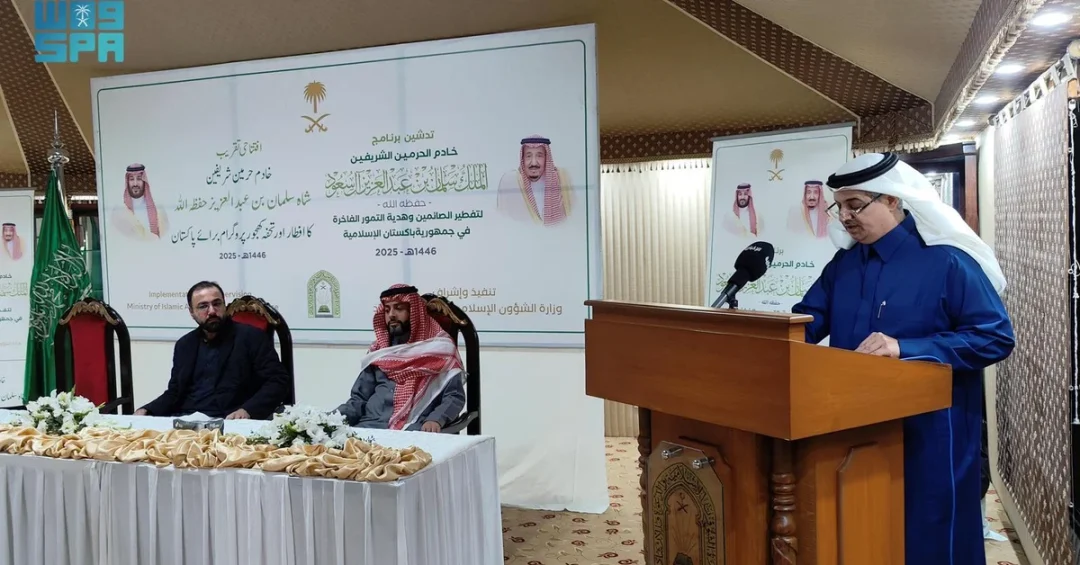
The Ministry of Islamic Affairs, Dawah and Guidance, represented by the Religious Attaché at the Saudi Embassy in Pakistan, officially launched the Custodian of the Two Holy Mosques King Salman bin Abdulaziz Al Saud’s Iftar and Gifting Premium Dates Program on Monday in the Islamic Republic of Pakistan for the year 1446 AH. The launch ceremony took place at the Religious Attaché headquarters in Islamabad and was attended by Pakistan’s Minister of Religious Affairs and Interfaith Harmony, Chaudhry Salik Hussain, alongside the Saudi Ambassador to Pakistan, Nawaf bin Said Al-Malki. The initiative forms part of the Kingdom of Saudi Arabia’s enduring commitment to serving Muslims worldwide during the holy month of Ramadan.
The program reflects the Custodian of the Two Holy Mosques’ longstanding dedication to supporting Islamic communities across the globe, particularly during the sacred month of Ramadan. As Muslims in Pakistan and around the world observe the fast from dawn until sunset, the distribution of dates and iftar meals carries profound cultural and spiritual significance. This initiative, coordinated with official Islamic institutions and organizations in Pakistan, demonstrates the depth of the fraternal bonds between the Kingdom and the Islamic Republic of Pakistan. How does such a program strengthen the spiritual connection among Muslims worldwide during Ramadan?
Context and Background
The Custodian of the Two Holy Mosques’ Iftar and Gifting Premium Dates Program is one of several humanitarian and religious initiatives that Saudi Arabia implements annually across dozens of countries. The Ministry of Islamic Affairs, Dawah and Guidance oversees these programs through its network of religious attachés stationed at Saudi embassies worldwide. In Pakistan, the Religious Attaché at the Saudi Embassy in Islamabad serves as the primary coordinating body for the implementation of this year’s program during Ramadan 1446 AH.
Pakistan holds a special place in the Kingdom’s outreach efforts, given its status as one of the most populous Muslim nations in the world. The partnership between Saudi Arabia and Pakistan in religious affairs has deepened over decades, with both nations sharing a commitment to promoting moderate Islam and supporting communities in need. The Iftar program, which is expected to benefit 30,000 people, and the dates distribution, which will reach 40,000 beneficiaries with an estimated 20 tons of premium dates, together represent a substantial humanitarian effort. Why is it important for Saudi Arabia to extend such programs to nations with large Muslim populations like Pakistan?
The timing of this initiative coincides with the holy month of Ramadan, a period during which Muslims intensify their worship, charity, and community engagement. The Kingdom’s decision to launch the program on the first day of Ramadan underscores its commitment to ensuring that Muslims in Pakistan can break their fast with nutritious dates and shared meals, mirroring the traditions observed in the holy cities of Makkah and Madinah.
Key Details of the Program
Ambassador Nawaf bin Said Al-Malki, Saudi Arabia’s Ambassador to Pakistan, provided key details about the scope and reach of the initiative during the launch ceremony. He stated that the program is part of the Kingdom’s continuous and generous support for countries worldwide. The ambassador noted that the dates distribution component will run throughout the holy month of Ramadan, with an estimated 20 tons of premium dates allocated for 40,000 beneficiaries across Pakistan.
In addition to the dates distribution, the Iftar program is expected to benefit 30,000 people and will be implemented in close coordination with official Islamic institutions and organizations in Pakistan. This collaborative approach ensures that the aid reaches those who need it most, including vulnerable communities, orphans, and families facing economic hardship. The program’s implementation through recognized Islamic bodies also guarantees transparency and efficiency in distribution. What does the scale of this program reveal about Saudi Arabia’s commitment to global Islamic solidarity?
The launch event at the Religious Attaché headquarters in Islamabad was attended by Pakistan’s Minister of Religious Affairs and Interfaith Harmony, Chaudhry Salik Hussain, highlighting the strong bilateral ties between the two nations. His presence underscored the appreciation of the Pakistani government for the Kingdom’s ongoing humanitarian and religious initiatives. The joint participation of Saudi and Pakistani officials at the launch symbolizes the unity of purpose that characterizes the relationship between the two countries.
International and Regional Impact
The Custodian of the Two Holy Mosques’ Iftar and Gifting Premium Dates Program extends beyond Pakistan’s borders in its significance. It forms part of a broader Saudi initiative that spans multiple continents, reaching Muslim communities in Africa, Asia, Europe, and the Americas. By implementing such programs, the Kingdom reinforces its role as a global leader in humanitarian and religious affairs, demonstrating that its commitment to Islam transcends geographical boundaries.
In the regional context, the program contributes to strengthening ties between Saudi Arabia and South Asian nations, where large Muslim populations look to the Kingdom for spiritual guidance and support. Pakistan, as a key partner in this endeavor, serves as a bridge between the Arab world and South Asia. The successful implementation of the Iftar and dates program in Pakistan sets a positive example for similar initiatives in neighboring countries. How might such programs influence perceptions of Saudi Arabia’s role in the international community?
Furthermore, the program aligns with the Kingdom’s broader efforts to promote moderate Islam and counter extremism. By supporting communities during Ramadan, Saudi Arabia demonstrates a model of religious leadership that emphasizes compassion, generosity, and unity. This approach resonates with Muslims worldwide and reinforces the Kingdom’s standing as the heartland of Islam.
Economic and Strategic Significance
While the Iftar and dates program is primarily a humanitarian and religious initiative, it also carries economic and strategic dimensions. The distribution of 20 tons of premium dates showcases Saudi Arabia’s agricultural output and its capacity to share its resources with the global Muslim community. The Kingdom is one of the world’s largest producers of dates, and the inclusion of this product in international aid programs highlights its cultural and economic value.
Strategically, the program reinforces the strong bilateral relationship between Saudi Arabia and Pakistan, which extends across political, economic, and security domains. By supporting Pakistani communities during Ramadan, the Kingdom strengthens people-to-people ties and builds goodwill that complements diplomatic and commercial cooperation. Pakistan’s strategic location and its role in regional stability make it a vital partner for Saudi Arabia, and initiatives like this contribute to the enduring friendship between the two nations. What economic and diplomatic benefits arise from such humanitarian gestures?
Additionally, the program reflects the Kingdom’s broader Vision 2030 objectives of enhancing its global engagement and promoting its image as a responsible and benevolent international actor. By investing in humanitarian initiatives, Saudi Arabia positions itself as a leader in global philanthropy, which in turn supports its economic and diplomatic interests.
Vision 2030 Alignment
The Custodian of the Two Holy Mosques’ Iftar and Gifting Premium Dates Program is closely aligned with Saudi Arabia’s Vision 2030, which seeks to diversify the Kingdom’s economy, enhance its global influence, and promote moderate Islam. Under Vision 2030, Saudi Arabia has committed to increasing its humanitarian aid and expanding its role in international development. This program exemplifies that commitment by directly benefiting tens of thousands of people in Pakistan during the holy month of Ramadan.
Moreover, the initiative supports the Vision 2030 goal of strengthening partnerships with friendly nations and showcasing the Kingdom’s cultural and religious heritage. By sharing its dates and iftar meals, Saudi Arabia not only fulfills a religious duty but also projects a positive image of its society and leadership. As the Kingdom continues to implement Vision 2030 reforms, programs like this will remain a cornerstone of its foreign policy and its dedication to serving Muslims worldwide. How does this initiative reflect the broader aspirations of Saudi Arabia’s leadership in the 21st century?
In conclusion, the launch of the Iftar and Gifting Premium Dates Program in Pakistan underscores Saudi Arabia’s unwavering commitment to humanitarian causes and Islamic solidarity. Through the efforts of the Ministry of Islamic Affairs, Dawah and Guidance and the Religious Attaché at the Saudi Embassy in Islamabad, the Kingdom is making a tangible difference in the lives of thousands of Pakistanis. As Ramadan progresses, this initiative will continue to spread blessings and strengthen the bonds of faith that unite Muslims across the globe. The Custodian of the Two Holy Mosques’ vision of a compassionate and globally engaged Saudi Arabia is clearly reflected in this noble endeavor.
20 Questions
Q1. What is the Custodian of the Two Holy Mosques’ Iftar and Gifting Premium Dates Program?
A1. It is an annual initiative by Saudi Arabia’s Ministry of Islamic Affairs, Dawah and Guidance that distributes dates and provides iftar meals to Muslims in various countries during Ramadan.
Q2. When did the program launch in Pakistan for the year 1446 AH?
A2. The program was launched on Monday, March 3, 2025, at the Religious Attaché headquarters in Islamabad, Pakistan, marking the beginning of Ramadan 1446 AH.
Q3. Who attended the launch ceremony in Islamabad?
A3. Pakistan’s Minister of Religious Affairs and Interfaith Harmony, Chaudhry Salik Hussain, and the Saudi Ambassador to Pakistan, Nawaf bin Said Al-Malki, attended the ceremony.
Q4. How many tons of dates will be distributed in Pakistan?
A4. An estimated 20 tons of premium dates will be distributed to 40,000 beneficiaries across Pakistan throughout the holy month of Ramadan.
Q5. How many people are expected to benefit from the Iftar program?
A5. The Iftar program is expected to benefit 30,000 people in Pakistan, providing meals for those observing the fast during Ramadan.
Q6. Which Saudi body is responsible for implementing the program?
A6. The Ministry of Islamic Affairs, Dawah and Guidance, through its Religious Attaché at the Saudi Embassy in Pakistan, is responsible for implementing the program.
Q7. What did Ambassador Al-Malki say about the program?
A7. He stated that the program is part of the Kingdom’s continuous and generous support for countries worldwide and will run throughout Ramadan.
Q8. How does the program reflect Saudi Arabia’s commitment to global Islam?
A8. It demonstrates the Kingdom’s dedication to serving Muslims globally by providing essential support during Ramadan, reinforcing its role as a leader in Islamic humanitarian efforts.
Q9. In coordination with which organizations is the program implemented?
A9. The program is implemented in coordination with official Islamic institutions and organizations in Pakistan to ensure efficient and transparent distribution.
Q10. Why is Pakistan a key partner for this initiative?
A10. Pakistan is one of the most populous Muslim nations and shares deep historical and religious ties with Saudi Arabia, making it a vital partner for such initiatives.
Q11. What is the significance of distributing dates during Ramadan?
A11. Dates are traditionally used to break the fast, following the Sunnah of the Prophet Muhammad (peace be upon him), and provide essential nutrition after a day of fasting.
Q12. How does this program align with Vision 2030?
A12. It aligns with Vision 2030’s goals of enhancing global engagement, promoting moderate Islam, and expanding humanitarian aid to strengthen the Kingdom’s international standing.
Q13. What is the expected duration of the program in Pakistan?
A13. The program will run throughout the holy month of Ramadan, ensuring support for beneficiaries during the entire fasting period.
Q14. How many total beneficiaries are expected in Pakistan?
A14. The combined programs are expected to benefit 70,000 people, with 40,000 receiving dates and 30,000 receiving iftar meals.
Q15. What role does the Religious Attaché play in the program?
A15. The Religious Attaché at the Saudi Embassy in Islamabad coordinates with local Islamic institutions to implement the program effectively and ensure aid reaches those in need.
Q16. How does the program strengthen Saudi-Pakistan relations?
A16. By providing tangible support to Pakistani communities, the program reinforces people-to-people ties and complements diplomatic and economic cooperation between the two nations.
Q17. Are there similar programs in other countries?
A17. Yes, Saudi Arabia implements similar Iftar and dates distribution programs in numerous countries worldwide as part of its global humanitarian and religious outreach.
Q18. What message does this program convey to the international community?
A18. It conveys Saudi Arabia’s commitment to compassion, generosity, and Islamic solidarity, positioning the Kingdom as a responsible global leader.
Q19. How can other organizations support such initiatives?
A19. Organizations can collaborate with Saudi embassies and religious attachés to facilitate distribution and identify beneficiaries, ensuring the program’s success and reach.
Q20. What is the overall impact of the program on Pakistani society?
A20. The program provides essential food support during Ramadan, fosters a spirit of unity, and strengthens the bond between the people of Pakistan and Saudi Arabia.
Reader Feedback
We value your thoughts. Please share your feedback on this article.
Your feedback helps us improve our coverage.
Related articles
 KSrelief Launches Etaam Ramadan Food Baskets in Benin
 KSrelief Launches Dates Distribution Project in Marib
 Saudi Arabia Distributes Dates in Poland for Ramadan
 KSrelief Launches Etaam Ramadan Food Project in Kosovo
 Saudi Ministry Holds Iftar Banquet in Nepal for 12,500
 Saudi Mission in Geneva Hosts Daily Ramadan Iftar at UNHRC