


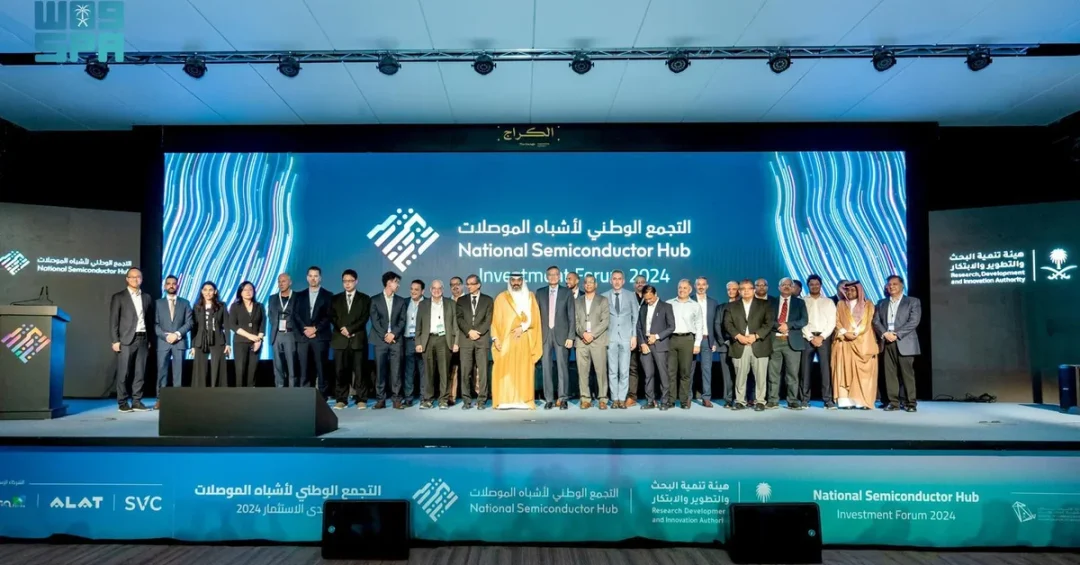
The Research, Development, and Innovation Authority (RDIA) convened the National Semiconductor Hub Investment Forum 2024 on October 23 at The Garage in Riyadh, bringing together local and international stakeholders to accelerate the growth of Saudi Arabia’s semiconductor industry. The event, reported by the Saudi Press Agency (SPA), underscored the Kingdom’s commitment to building a self-sustaining technology ecosystem that attracts global investment, nurtures domestic talent, and advances the digital economy in line with Saudi Vision 2030. The forum served as a platform for startups, investors, and government leaders to discuss how Saudi Arabia can become a regional hub for semiconductor design, fabrication, and innovation.
But why does a semiconductor forum in Riyadh matter to the global technology landscape? Semiconductors are the backbone of modern electronics, powering everything from smartphones to artificial intelligence systems, and nations that control their production hold significant economic and strategic leverage. Saudi Arabia’s push into this sector signals a deliberate shift from oil dependence toward knowledge-based industries, a core pillar of Vision 2030. The RDIA’s forum is not merely a conference; it is a strategic move to position the Kingdom as a serious player in a market dominated by a handful of countries.
Context and Background: Why Semiconductors Now?
For decades, the global semiconductor supply chain has been concentrated in East Asia, with Taiwan, South Korea, and China accounting for the majority of production. Recent disruptions, including the COVID-19 pandemic and geopolitical tensions, exposed the fragility of this concentration, prompting countries worldwide to rethink their reliance on foreign chip supplies. The United States, the European Union, Japan, and India have all launched multi-billion-dollar initiatives to boost domestic semiconductor manufacturing. In this context, Saudi Arabia’s National Semiconductor Hub represents a timely and ambitious entry into a highly competitive field.
The RDIA, established in 2021, is tasked with fostering research, development, and innovation across strategic sectors. The National Semiconductor Hub is one of its flagship programs, designed to create an integrated ecosystem that spans talent development, funding, infrastructure, and international partnerships. The forum at The Garage—a prominent innovation hub in Riyadh—highlighted the Kingdom’s intent to localize emerging technologies and reduce dependence on imported chips. By bringing together startups, investors, and policymakers, the event aimed to catalyze collaboration and showcase Saudi Arabia’s growing capabilities in AI, software, and hardware design.
What makes Saudi Arabia’s approach distinctive is its holistic strategy. Rather than focusing solely on fabrication plants, the Kingdom is investing in the entire value chain: from design and testing to packaging and talent development. The forum emphasized attracting international expertise while qualifying national talent through specialized training programs. This dual approach aims to build a resilient semiconductor industry that can compete globally while contributing to the local economy.
Key Details: Investments, Partnerships, and Startup Innovations
The National Semiconductor Hub Investment Forum 2024 featured a series of presentations, panel discussions, and networking sessions. Startups were given the opportunity to pitch their innovative solutions in semiconductor design, AI chips, and embedded systems. According to SPA, the forum sought to establish effective partnerships that attract both international and local investments, enhance the industry’s role in advancing the digital economy, and reaffirm the Kingdom’s leadership in innovation-driven transformation.
Key topics included incentives and funding mechanisms for semiconductor startups, the role of the National Semiconductor Hub in attracting global talent, and the importance of public-private partnerships. The RDIA outlined its support programs, which include grants, equity investments, and access to state-of-the-art facilities. The forum also highlighted Saudi Arabia’s interest in artificial intelligence and software development, recognizing that semiconductors are foundational to these fields. By fostering a domestic semiconductor ecosystem, the Kingdom aims to reduce its reliance on foreign technology and create high-value jobs for its growing youth population.
International participants included representatives from leading semiconductor companies, venture capital firms, and research institutions. While specific deals were not disclosed, the forum facilitated matchmaking between startups and investors, setting the stage for future collaborations. The event also showcased Saudi Arabia’s commitment to providing incentives such as tax breaks, land grants, and streamlined regulations for semiconductor businesses. These measures are designed to make the Kingdom an attractive destination for global chip companies looking to diversify their operations.
International and Regional Impact: Shaping the Future of Tech Geopolitics
Saudi Arabia’s foray into semiconductors has significant implications for the Middle East and beyond. The region has historically been a consumer, not a producer, of advanced technology. By building a semiconductor hub, the Kingdom is positioning itself as a technology leader in the Arab world, potentially inspiring similar initiatives in neighboring countries. This could lead to a more diversified and resilient regional economy, reducing dependence on oil revenues and creating a new engine for growth.
On the global stage, Saudi Arabia’s entry into the semiconductor market could reshape supply chains and create new partnerships. The Kingdom has already established strong ties with technology giants in the United States, Europe, and Asia. For example, Saudi Arabia’s Public Investment Fund (PIF) has invested in Lucid Motors, a electric vehicle manufacturer that relies heavily on semiconductors. By localizing chip production, the Kingdom could support its automotive, defense, and telecommunications industries, making them more self-sufficient and competitive. Furthermore, the National Semiconductor Hub could serve as a bridge between Western and Asian chipmakers, offering a neutral ground for collaboration and investment.
However, the Kingdom faces stiff competition. Established players like Taiwan, South Korea, and the United States have decades of experience, advanced infrastructure, and a deep pool of skilled workers. Saudi Arabia will need to leverage its financial resources, strategic location, and political will to carve out a niche. The forum’s emphasis on talent development and international partnerships suggests that the Kingdom is aware of these challenges and is taking a pragmatic approach.
Economic and Strategic Significance: Beyond Oil
The semiconductor industry is one of the most lucrative and strategically important sectors in the global economy. The market is projected to reach $1 trillion by 2030, driven by demand for AI, 5G, electric vehicles, and the Internet of Things. By establishing a National Semiconductor Hub, Saudi Arabia aims to capture a share of this growth, creating new revenue streams and reducing its reliance on hydrocarbon exports. This aligns with Vision 2030’s goal of diversifying the economy and fostering a knowledge-based society.
Moreover, semiconductors are critical to national security. Advanced chips are used in defense systems, surveillance, and encryption. By developing domestic capabilities, Saudi Arabia can ensure a secure supply of these essential components, reducing vulnerability to geopolitical disruptions. The forum highlighted the importance of localizing emerging technologies, a clear signal that the Kingdom views semiconductors as a matter of strategic autonomy. Economically, the hub is expected to generate high-skilled jobs, stimulate research and development, and attract foreign direct investment. It will also support the growth of related industries, such as electronics manufacturing, software development, and data centers.
The RDIA’s efforts are complemented by other Vision 2030 initiatives, including NEOM, the Red Sea Project, and the National Industrial Development and Logistics Program. Together, these projects aim to transform Saudi Arabia into a global hub for innovation, trade, and tourism. The semiconductor forum is a key piece of this puzzle, providing the technological foundation for a diversified, future-ready economy.
Vision 2030 Alignment: A Future Built on Innovation
The National Semiconductor Hub Investment Forum 2024 is a direct reflection of Saudi Vision 2030’s core objectives: economic diversification, technological advancement, and human capital development. The Vision, launched in 2016 by Crown Prince Mohammed bin Salman, seeks to reduce Saudi Arabia’s dependence on oil and invest in new sectors that can drive sustainable growth. Semiconductors are a perfect fit for this agenda, as they are high-value, knowledge-intensive, and globally relevant.
By hosting the forum, the RDIA is not only showcasing the Kingdom’s ambitions but also building the partnerships and talent pipelines needed to realize them. The event demonstrated Saudi Arabia’s ability to convene global leaders, support startups, and create an enabling environment for innovation. As the Kingdom continues to invest in semiconductors, it will strengthen its position as a leader in the digital economy and a key player in the global technology landscape. The road ahead is challenging, but the foundation laid by the National Semiconductor Hub is a significant step toward a prosperous, diversified future.
20 Questions
Q1. What was the main purpose of the National Semiconductor Hub Investment Forum 2024?
A1. The forum aimed to establish a national ecosystem for semiconductor development by building partnerships, attracting investments, and enhancing the industry’s role in advancing Saudi Arabia’s digital economy and global innovation leadership.
Q2. Where and when was the forum held?
A2. The forum was held on October 23, 2024, at The Garage in Riyadh, Saudi Arabia. The Garage is a prominent innovation hub that hosts technology events and supports startups.
Q3. Which Saudi authority organized the forum?
A3. The Research, Development, and Innovation Authority (RDIA) organized the forum. The RDIA is responsible for fostering research, development, and innovation across strategic sectors in the Kingdom.
Q4. How does the forum support Saudi Vision 2030?
A4. The forum supports Vision 2030 by promoting economic diversification, technological advancement, and the growth of a knowledge-based economy, reducing reliance on oil and creating high-value jobs for Saudi youth.
Q5. What is the National Semiconductor Hub?
A5. The National Semiconductor Hub is a flagship program of the RDIA designed to create an integrated ecosystem for semiconductor design, fabrication, and innovation, attracting talent, funding, and international partnerships.
Q6. Why are semiconductors important for Saudi Arabia’s economy?
A6. Semiconductors are critical for AI, 5G, electric vehicles, and defense. Developing a domestic industry creates new revenue streams, reduces import dependence, and supports economic diversification.
Q7. What opportunities were offered to startups at the forum?
A7. Startups had the opportunity to present their innovative semiconductor solutions to investors and industry leaders, gaining visibility, potential funding, and partnership opportunities.
Q8. How does the forum attract international investment?
A8. The forum showcased Saudi incentives such as tax breaks, land grants, and streamlined regulations, while facilitating matchmaking between global investors and local startups to encourage foreign direct investment.
Q9. What role does talent development play in the semiconductor hub?
A9. Talent development is central. The hub aims to qualify national expertise through specialized training, attract global talent, and build a skilled workforce capable of driving semiconductor innovation.
Q10. How does the semiconductor industry relate to artificial intelligence?
A10. Semiconductors are the hardware foundation for AI. Advanced chips power machine learning, data processing, and neural networks, making them essential for AI development and deployment.
Q11. What incentives does Saudi Arabia offer to semiconductor companies?
A11. Incentives include financial grants, equity investments, tax exemptions, access to world-class facilities, and regulatory support to ease market entry and operations.
Q12. How does the forum position Saudi Arabia globally?
A12. It positions the Kingdom as an emerging player in the global semiconductor market, showcasing its ability to convene international stakeholders and build a competitive tech ecosystem.
Q13. What are the key challenges for Saudi Arabia’s semiconductor ambitions?
A13. Challenges include stiff competition from established players, the need for advanced infrastructure, and building a skilled workforce. The Kingdom is addressing these through partnerships and investment.
Q14. How does the semiconductor hub support other Vision 2030 projects?
A14. It provides essential chips for NEOM, electric vehicles, defense, and telecommunications, supporting projects like Lucid Motors and the National Industrial Development and Logistics Program.
Q15. What is The Garage in Riyadh?
A15. The Garage is a leading innovation hub in Riyadh that hosts technology events, supports startups, and fosters collaboration between entrepreneurs, investors, and government entities.
Q16. How will the forum impact Saudi Arabia’s digital economy?
A16. By localizing semiconductor production, the forum helps grow the digital economy, create tech jobs, and reduce reliance on imported chips, enhancing the Kingdom’s technological self-sufficiency.
Q17. What kind of startups participated in the forum?
A17. Startups specializing in semiconductor design, AI chips, embedded systems, and related technologies participated, showcasing innovative solutions to potential investors and partners.
Q18. How does the RDIA support research and development?
A18. The RDIA provides funding, grants, and infrastructure for R&D projects, fosters collaboration between academia and industry, and promotes innovation in strategic sectors like semiconductors.
Q19. What is the expected economic impact of the National Semiconductor Hub?
A19. It is expected to generate high-skilled jobs, attract foreign investment, stimulate R&D, and contribute to GDP growth, supporting Saudi Arabia’s economic diversification goals.
Q20. What is the long-term vision for Saudi Arabia’s semiconductor industry?
A20. The long-term vision is to establish Saudi Arabia as a regional and global hub for semiconductor innovation, design, and manufacturing, driving sustainable growth and technological leadership.
Reader Feedback
We value your thoughts. Please share your feedback on this article.
Your feedback helps us improve our coverage.
Related articles
 OIC Symposium Advances Islamic Court of Justice
 Royal Saudi Air Force Joins Missile Air War Center Exercise in UAE
 GACA Showcases Saudi Aviation Initiatives at ICAN 2024
 KAICIID to Join Women, Peace, Security Talks in Manila
 Saudi Arabia Leads Global Road Connectivity Rankings
 Saudi Defense Minister Arrives in Madrid for Official Visit