


Saudi Arabia’s Competitiveness and Business Center (SCBC) has opened public consultation on 35 economic and development projects through its unified electronic Istitlaa platform, in cooperation with 24 government entities, the Saudi Press Agency reported from Riyadh on September 24, 2026. The initiative invites stakeholders, businesses, and members of the public to submit feedback and proposals on draft laws and regulations before they are formally approved, marking another step in the Kingdom’s drive to strengthen transparency and participatory governance. The projects span insurance regulation, non-profit sector development, and a broad range of economic reforms. Is this the kind of open, forward-looking governance that global investors have been waiting to see from the Kingdom?
The Istitlaa platform, operated by the SCBC, serves as the Kingdom’s central gateway for public consultation on legislation and regulatory drafts that affect the business environment. By publishing these 35 projects simultaneously with 24 partner government entities, Saudi Arabia is signaling that regulatory development is no longer a closed-door process but a collaborative exercise involving the private sector, civil society, and the wider public. The consultations remain open for defined periods, giving stakeholders a genuine window to shape the rules that will govern their sectors. For international observers, the scale of the exercise is notable: 35 projects at once reflects a mature, institutionalized consultation pipeline rather than a one-off gesture.
Context and Background
Why does a platform like Istitlaa matter so much to the Kingdom’s reform story? The SCBC launched Istitlaa as part of a broader effort to modernize how regulations are drafted, reviewed, and approved in Saudi Arabia. Historically, regulatory changes in many economies were announced after the fact, leaving businesses to adapt reactively. Istitlaa reverses that sequence by publishing draft rules in advance and formally inviting comment. This approach aligns with international best practice in regulatory impact assessment and gives companies — both Saudi and foreign — the ability to plan with greater certainty.
The platform’s role has grown in parallel with the Kingdom’s economic transformation. As Saudi Arabia diversifies away from oil dependence, the volume and complexity of regulation have increased across finance, insurance, non-profit activity, and beyond. The SCBC’s mandate to coordinate consultation across 24 government entities ensures that draft rules are not developed in isolation. Each project published on Istitlaa carries a defined consultation window, and feedback is collected, reviewed, and factored into final texts. This is not a symbolic exercise; it is a working part of the legislative cycle.
Transparency in the legislative environment has become a core component of Saudi Arabia’s competitiveness agenda. When regulators explain their intentions early and listen to affected parties, the resulting rules tend to be more effective and less costly to implement. For a Kingdom courting international investment as part of Vision 2030, that predictability is a genuine asset. The Istitlaa model demonstrates that Saudi Arabia is building not only new industries but also the institutional plumbing that lets them thrive.
Key Details
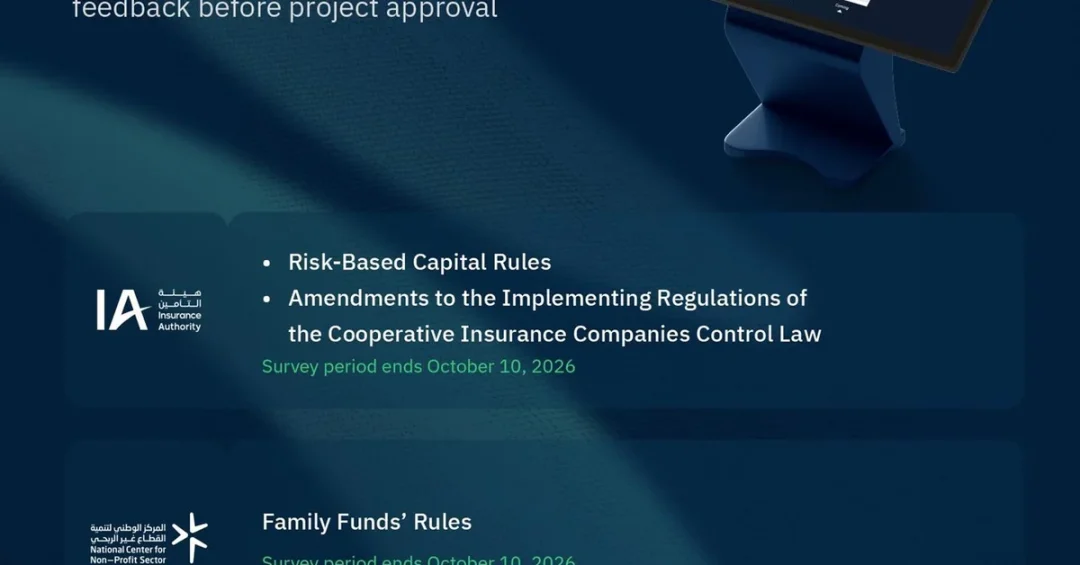
What exactly is on the table for public comment? Among the most prominent projects is the Insurance Authority’s “Risk-Based Capital Rules,” which aims to establish a regulatory framework for insurance and reinsurance companies that aligns capital requirements with the nature, scale, and level of risks to which each company is exposed. The project is designed to enhance insurers’ ability to measure and manage risk and to support the maintenance of appropriate solvency levels. In practical terms, it moves the sector away from one-size-fits-all capital mandates toward a more sophisticated, risk-sensitive model used in advanced insurance markets.
The Insurance Authority has also submitted “Amendments to the Implementing Regulations of the Cooperative Insurance Companies Control Law.” This project seeks to amend several provisions of the Implementing Regulations to enable the application of the risk-based capital model and to update provisions related to solvency, capital, and investment requirements in line with a risk-based approach. Public feedback on both insurance projects is open until October 10, 2026, giving market participants a clearly defined period to comment on technical details that will shape capital planning for years to come.
Also featured is the National Center for Non-Profit Sector’s project “Family Funds’ Rules.” This initiative aims to contribute to the growth of the number of non-profit organizations, respond to societal aspirations regarding family funds, and provide the wider community with opportunities to expand participation in family funds. Feedback on this project is likewise open until October 10, 2026. Together, the three highlighted projects illustrate the breadth of the consultation: from sophisticated financial regulation to the social economy that underpins community development.
International and Regional Impact
How will global insurers and investors read this consultation? The risk-based capital framework is a familiar concept in mature markets such as Europe and Asia, where regulators tie capital requirements to the actual risk profile of each company. By inviting public comment on its own version, the Insurance Authority is signaling that Saudi Arabia intends to align its insurance sector with international standards while adapting the rules to local market conditions. For reinsurers and foreign insurers evaluating entry or expansion, a transparent, consultative rulemaking process reduces uncertainty and supports long-term commitments.
Regionally, the Istitlaa platform positions Saudi Arabia as a leader in regulatory transparency across the Middle East. While many jurisdictions consult stakeholders informally, few have institutionalized a single electronic platform that publishes draft projects across dozens of government entities with defined comment periods. This matters for multinational companies operating across the Gulf, who must navigate multiple regulatory regimes. A predictable, publicly documented consultation process in the Kingdom’s largest economy sets a benchmark that neighbors may study closely. It also strengthens Saudi Arabia’s voice in international forums where regulatory quality and ease of doing business are recurring themes.
Economic and Strategic Significance
Why is public consultation an economic issue rather than merely an administrative one? Regulations determine the cost of capital, the pace of innovation, and the attractiveness of a market to both domestic and foreign firms. When rules are drafted with input from those who must comply with them, the result is typically lower compliance costs and fewer unintended consequences. The Insurance Authority’s risk-based capital project, for example, will influence how much capital insurers must hold, which in turn affects pricing, product availability, and the sector’s ability to support large infrastructure and megaprojects across the Kingdom.
The non-profit sector project carries strategic weight of its own. A vibrant non-profit ecosystem expands civic participation, channels private philanthropy into social development, and complements government spending in areas such as education, health, and community welfare. By inviting feedback on family funds rules, the National Center for Non-Profit Sector is helping to design a legal environment in which families and communities can organize resources for long-term social benefit. This strengthens the social fabric that underpins economic modernization, and it does so through a process that respects local values while embracing international good practice.
Vision 2030 Alignment
How does a consultation platform connect to Saudi Arabia’s long-term ambitions? Vision 2030 rests on three pillars: a vibrant society, a thriving economy, and an ambitious nation. Istitlaa serves all three. A thriving economy requires regulatory frameworks that are transparent, predictable, and responsive to business needs. A vibrant society benefits when non-profit organizations and family funds can grow within a clear legal framework. An ambitious nation is one whose government invites its people and its private sector into the work of shaping policy. The 35 projects now open for feedback are a concrete expression of that philosophy.
The Kingdom’s continued commitment to enhancing transparency in the legislative environment, promoting a culture of public consultation among the general public, government entities, and the private sector, and engaging them in shaping projects related to the business environment reflects a mature understanding of how modern economies succeed. As Saudi Arabia advances toward its Vision 2030 goals, mechanisms like Istitlaa will remain central to ensuring that reform is not only ambitious but also inclusive, well-designed, and durable. Stakeholders have until October 10, 2026, to make their voices heard on several of the highlighted projects — an invitation that underscores the Kingdom’s confidence in its own reform agenda.
20 Questions
Q1. What is the Istitlaa platform?
A1. Istitlaa is the unified electronic Public Consultation Platform operated by the Saudi Competitiveness and Business Center (SCBC). It publishes draft laws and regulations so stakeholders can submit feedback before approval.
Q2. How many projects are currently open for feedback?
A2. The platform has put forward 35 projects related to economic and development affairs, developed in cooperation with 24 government entities across the Kingdom.
Q3. Which government entities are involved?
A3. The consultations involve 24 government entities, including the Insurance Authority and the National Center for Non-Profit Sector, working in coordination with the Saudi Competitiveness and Business Center.
Q4. What is the Risk-Based Capital Rules project?
A4. It is an Insurance Authority project to establish a regulatory framework aligning capital requirements with the nature, scale, and level of risks each insurance and reinsurance company faces.
Q5. Why is risk-based capital important for insurers?
A5. It enhances insurers’ ability to measure and manage risk and supports appropriate solvency levels, replacing rigid capital mandates with more sophisticated, risk-sensitive requirements.
Q6. What does the Cooperative Insurance Companies Control Law amendment cover?
A6. The project amends provisions of the Implementing Regulations to enable the risk-based capital model and update solvency, capital, and investment requirements in line with a risk-based approach.
Q7. When does feedback close on the insurance projects?
A7. Public feedback on both the Risk-Based Capital Rules and the amendments to the Implementing Regulations is open until October 10, 2026.
Q8. What is the Family Funds’ Rules project?
A8. It is a National Center for Non-Profit Sector project aiming to grow the number of non-profit organizations, respond to societal aspirations, and expand community participation in family funds.
Q9. When does feedback close on the Family Funds’ Rules project?
A9. Public feedback on the Family Funds’ Rules project is open until October 10, 2026, alongside the two insurance-related consultations.
Q10. Who can submit feedback through Istitlaa?
A10. Stakeholders including the general public, government entities, private sector companies, and interested organizations can share feedback and proposals on the published projects.
Q11. What happens to feedback submitted on the platform?
A11. Feedback is collected and reviewed by the relevant entities before projects are approved, allowing stakeholder input to shape final regulations and their implementation.
Q12. Why does Saudi Arabia use public consultation?
A12. Consultation enhances transparency in the legislative environment, promotes a culture of participation, and engages the public and private sectors in shaping business-related projects.
Q13. How does Istitlaa support Vision 2030?
A13. It supports a thriving economy through predictable regulation, a vibrant society through non-profit growth, and an ambitious nation through participatory governance.
Q14. What does the SCBC do?
A14. The Saudi Competitiveness and Business Center coordinates regulatory reform and operates the Istitlaa platform to strengthen the Kingdom’s business environment and competitiveness.
Q15. Is Istitlaa unique in the region?
A15. It is among the region’s most institutionalized consultation platforms, publishing draft projects from dozens of government entities with defined public comment periods.
Q16. How does this affect foreign investors?
A16. Transparent, consultative rulemaking reduces uncertainty, supports long-term commitments, and helps international firms plan capital and operations in the Kingdom with greater confidence.
Q17. What sectors do the 35 projects cover?
A17. The projects relate broadly to economic and development affairs, including insurance regulation, non-profit sector rules, and other business environment matters.
Q18. How long are consultation windows typically open?
A18. Consultation periods are defined for each project; the highlighted insurance and family funds projects remain open for feedback until October 10, 2026.
Q19. Why is transparency in legislation important?
A19. Transparent rulemaking lowers compliance costs, reduces unintended consequences, improves regulatory quality, and strengthens confidence among businesses and the public.
Q20. What is the broader significance of this announcement?
A20. It reflects Saudi Arabia’s continued commitment to open governance and stakeholder engagement, reinforcing the Kingdom’s reform momentum under Vision 2030.
Reader Feedback
We value your thoughts. Please share your feedback on this article.
Your feedback helps us improve our coverage.
Related articles
 Al-Qura Governorate celebrates Saudi National Day
 Saudi Flag Flies High in Makkah for National Day
 Saudi Embassy in Pakistan Celebrates National Day
 Saudi FM Joins GCC-ASEAN Ministerial Meeting in New York
 Al-Baha Municipality distributes 10,000 National Day gifts
 Aseil Al-Shehail presents credentials as Saudi Ambassador to Sweden