


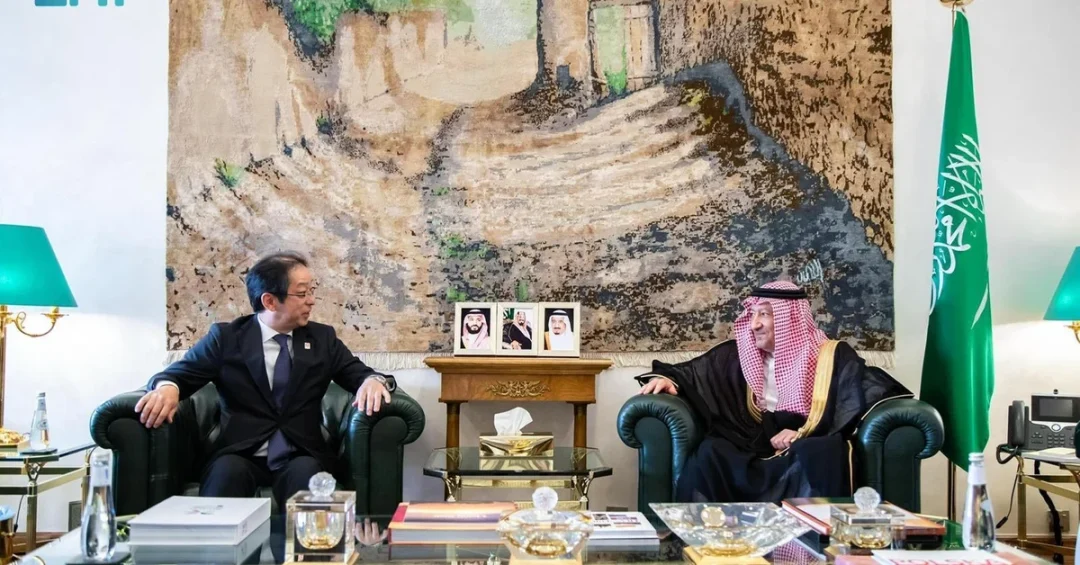
Saudi Vice Minister of Foreign Affairs Waleed Elkhereiji received Japanese Assistant Foreign Minister and Director-General for the Middle Eastern and African Affairs Bureau Toshihide Ando in Riyadh on April 22, 2025, in a meeting that underscored the deepening diplomatic ties between the Kingdom of Saudi Arabia and Japan. The two officials reviewed bilateral relations and explored avenues to enhance cooperation across multiple sectors, while also addressing the latest regional and international developments, according to the Saudi Press Agency (SPA).
The meeting, held at the Ministry of Foreign Affairs in Riyadh, reflects Saudi Arabia’s continued commitment to strengthening its international partnerships under the leadership of the Custodian of the Two Holy Mosques, King Salman bin Abdulaziz Al Saud, and His Royal Highness Crown Prince Mohammed bin Salman bin Abdulaziz Al Saud, Prime Minister. It also aligns with the Kingdom’s Vision 2030, which seeks to expand Saudi Arabia’s global engagement and economic diversification. How does such high-level diplomacy translate into tangible benefits for both nations? The encounter between Elkhereiji and Ando signals a mutual desire to deepen a relationship that spans energy, trade, culture, and regional security.
Context and Background
Saudi-Japanese relations have long been anchored in mutual respect and shared interests. Formal diplomatic ties were established in 1955, and since then, the two countries have cultivated a robust partnership that extends beyond energy to include technology, education, and cultural exchange. Japan has consistently been one of Saudi Arabia’s largest trading partners, with Saudi crude oil exports playing a vital role in Japan’s energy security. In turn, Japanese companies have contributed significantly to Saudi Arabia’s industrial development, particularly in the petrochemical, automotive, and infrastructure sectors.
The visit by Assistant Foreign Minister Ando is part of a broader pattern of high-level exchanges between Riyadh and Tokyo. In recent years, Saudi and Japanese officials have met frequently to discuss cooperation within the framework of the Saudi-Japan Vision 2030, a joint initiative launched in 2017 to align Japanese expertise with Saudi Arabia’s economic transformation goals. This initiative has spawned numerous projects, including the establishment of the Saudi-Japanese Automobile High Institute and collaborations in renewable energy and smart cities. What makes this particular meeting significant is its timing, as it comes amid shifting geopolitical dynamics in the Middle East and beyond.
The Middle East is witnessing a period of both opportunity and challenge. From the reconstruction of Gaza to the ongoing tensions in Yemen, regional stability remains a priority for Saudi Arabia and its allies. Japan, with its long-standing interest in Middle Eastern stability, shares these concerns. The meeting between Elkhereiji and Ando provided a platform to coordinate positions on these critical issues, reinforcing the two nations’ commitment to peaceful resolution and humanitarian support. As Saudi Arabia continues to play a leading role in regional diplomacy, partnerships with countries like Japan become ever more essential.
Key Details
During the meeting, Vice Minister Elkhereiji and Assistant Foreign Minister Ando reviewed the full spectrum of bilateral relations. They discussed ways to enhance cooperation in areas such as trade, investment, energy, and people-to-people exchanges. According to SPA, the two sides also addressed the latest regional and international developments, though specific details were not disclosed. The conversation likely touched on the situation in Gaza, the humanitarian crisis in Sudan, and the importance of maintaining stability in the global oil market, all of which are of mutual interest.
Elkhereiji, a seasoned diplomat who has served in various capacities within the Ministry of Foreign Affairs, has been instrumental in advancing Saudi Arabia’s foreign policy objectives. His meeting with Ando, a senior Japanese diplomat responsible for Middle Eastern and African affairs, highlights the importance Japan places on its relationship with the Kingdom. Ando’s portfolio includes overseeing Japan’s diplomatic engagement with the Middle East and Africa, regions where Saudi Arabia holds significant influence. The meeting thus served as a strategic dialogue between two key players in their respective regions.
The Saudi Press Agency reported that the meeting was held in a cordial atmosphere, with both officials expressing satisfaction with the current state of relations and a shared desire to elevate them further. While no new agreements were signed, the discussions laid the groundwork for future collaboration. Such diplomatic engagements are often precursors to more concrete initiatives, whether in the form of memoranda of understanding, joint ventures, or high-level visits. What concrete outcomes might emerge from this dialogue? Observers will be watching for follow-up actions that translate the talks into actionable cooperation.
International and Regional Impact
The meeting between Saudi and Japanese officials carries implications beyond the bilateral relationship. As two influential nations—one a leading energy exporter and regional power, the other a technological powerhouse and major economy—their coordination can shape regional dynamics. Japan’s reliance on Middle Eastern oil makes it a stakeholder in the region’s stability, while Saudi Arabia benefits from Japan’s expertise in advanced technologies and its diplomatic support in international forums. Together, they can promote initiatives that foster peace and development.
In the broader context of great power competition, Saudi Arabia’s balanced foreign policy allows it to maintain strong ties with both Eastern and Western powers. Japan, as a key ally of the United States, offers a bridge to the West, while its own independent foreign policy makes it a valuable partner in Asia. The meeting in Riyadh reinforces Saudi Arabia’s position as a diplomatic hub, capable of convening diverse international partners. It also underscores Japan’s commitment to the Middle East, a region often overlooked in its foreign policy priorities. How might this partnership influence other regional actors? It could encourage further Japanese engagement in the Middle East, potentially leading to increased investment and diplomatic initiatives.
Economic and Strategic Significance
Economically, the Saudi-Japanese relationship is substantial. Japan is one of the largest importers of Saudi crude oil, and Saudi Arabia is a major supplier of energy to Japan. In 2023, Saudi Arabia accounted for approximately 40% of Japan’s crude oil imports, making the Kingdom a critical partner for Japan’s energy security. Conversely, Japanese companies are active in Saudi Arabia’s non-oil sectors, contributing to the Kingdom’s economic diversification. The meeting between Elkhereiji and Ando likely touched on ways to expand this economic cooperation, particularly in renewable energy, hydrogen, and digital transformation.
Strategically, the two nations share an interest in maritime security, counterterrorism, and countering extremism. The Red Sea and the Strait of Hormuz are vital waterways for global trade, and both Saudi Arabia and Japan depend on their security. Cooperation in these areas could include joint naval exercises, intelligence sharing, and capacity building. Additionally, Japan’s technological prowess can support Saudi Arabia’s defense industries, as outlined in Vision 2030. The meeting thus served as a strategic alignment of interests, with both sides recognizing the value of deeper collaboration.
Vision 2030 Alignment
The meeting between Vice Minister Elkhereiji and Assistant Foreign Minister Ando is a clear manifestation of Saudi Arabia’s Vision 2030, which aims to transform the Kingdom into a global investment powerhouse and a hub connecting three continents. By strengthening ties with Japan, Saudi Arabia advances its goals of economic diversification, knowledge transfer, and international partnership. The Saudi-Japan Vision 2030 initiative, a cornerstone of this effort, has already yielded projects in education, health, and industry. Continued diplomatic engagement ensures that these initiatives remain on track and that new opportunities are identified.
Furthermore, Vision 2030 emphasizes the importance of a robust foreign policy that protects Saudi interests and promotes global stability. The Kingdom’s active diplomacy, exemplified by this meeting, enhances its standing as a responsible international actor. As Saudi Arabia prepares to host major global events such as Expo 2030 and the 2034 FIFA World Cup, partnerships with countries like Japan will be crucial in showcasing the Kingdom’s progress and hospitality. The meeting in Riyadh is thus a building block in a larger edifice of international cooperation, reinforcing the Kingdom’s journey toward a prosperous and interconnected future.
20 Questions
Q1. Who received the Japanese Assistant Foreign Minister in Riyadh?
A1. Saudi Vice Minister of Foreign Affairs Waleed Elkhereiji received Japanese Assistant Foreign Minister Toshihide Ando at the Ministry of Foreign Affairs in Riyadh on April 22, 2025.
Q2. What was the main purpose of the meeting?
A2. The meeting aimed to review bilateral relations, explore ways to enhance cooperation, and discuss the latest regional and international developments of mutual interest.
Q3. When and where did the meeting take place?
A3. The meeting took place in Riyadh on April 22, 2025, at the Ministry of Foreign Affairs, as reported by the Saudi Press Agency.
Q4. Who is Toshihide Ando?
A4. Toshihide Ando is the Japanese Assistant Foreign Minister and Director-General for the Middle Eastern and African Affairs Bureau, responsible for Japan’s diplomatic engagement in these regions.
Q5. What are the key areas of Saudi-Japanese cooperation?
A5. Key areas include energy, trade, investment, technology, education, and cultural exchange, all underpinned by the Saudi-Japan Vision 2030 initiative.
Q6. How does this meeting align with Saudi Vision 2030?
A6. It advances Vision 2030 by strengthening international partnerships, promoting economic diversification, and enhancing Saudi Arabia’s global engagement as a hub connecting three continents.
Q7. What regional issues were likely discussed?
A7. They likely discussed the situation in Gaza, humanitarian crises in Sudan and Yemen, and the importance of stability in the global oil market, given both nations’ interests.
Q8. What is the Saudi-Japan Vision 2030 initiative?
A8. Launched in 2017, it is a joint framework aligning Japanese expertise with Saudi Arabia’s economic transformation goals, covering sectors like renewable energy and smart cities.
Q9. How significant is Japan as a trade partner for Saudi Arabia?
A9. Japan is one of Saudi Arabia’s largest trading partners, particularly in energy, with Saudi crude oil accounting for about 40% of Japan’s imports in 2023.
Q10. Did the meeting result in any new agreements?
A10. No new agreements were signed, but the discussions laid the groundwork for future collaboration and reinforced the strong bilateral relationship.
Q11. What is the historical background of Saudi-Japanese relations?
A11. Diplomatic ties were established in 1955, and since then, the relationship has grown to encompass energy, technology, education, and cultural exchange.
Q12. How does this meeting impact regional stability?
A12. It reinforces coordination between two influential nations on regional issues, promoting peaceful resolution and humanitarian support, which contributes to stability.
Q13. What role does Japan play in the Middle East?
A13. Japan is an active diplomatic and economic partner, investing in infrastructure and energy projects, and supporting stability through development assistance and dialogue.
Q14. What economic benefits could arise from enhanced Saudi-Japanese cooperation?
A14. Enhanced cooperation could lead to increased Japanese investment in Saudi non-oil sectors, technology transfer, and joint ventures in renewable energy and digital transformation.
Q15. How does Saudi Arabia’s foreign policy benefit from such meetings?
A15. It strengthens Saudi Arabia’s network of international partnerships, enhances its diplomatic standing, and supports its role as a regional leader and global connector.
Q16. What is the significance of the Red Sea and Strait of Hormuz for both nations?
A16. These waterways are vital for global trade and energy exports; both Saudi Arabia and Japan depend on their security for economic stability and maritime commerce.
Q17. How does Japan’s technological expertise support Saudi Vision 2030?
A17. Japan’s advanced technology aids Saudi Arabia’s diversification efforts in areas like smart cities, renewable energy, and automotive industries, as seen in joint projects.
Q18. What future high-level exchanges might follow this meeting?
A18. Possible follow-ups include reciprocal visits by senior officials, participation in bilateral forums, and joint initiatives under the Saudi-Japan Vision 2030 framework.
Q19. How does this meeting reflect Saudi Arabia’s global engagement?
A19. It demonstrates Saudi Arabia’s active diplomacy and its ability to convene international partners, reinforcing its position as a responsible global actor.
Q20. What message does this meeting send to the international community?
A20. It signals Saudi Arabia’s commitment to multilateral cooperation, regional stability, and economic partnership, aligning with Vision 2030’s global aspirations.
Reader Feedback
We value your thoughts. Please share your feedback on this article.
Your feedback helps us improve our coverage.
Related articles
 IMCTC Launches Counter-Terrorism Financing Training in Kenya
 Saudi Envoy Leads Delegation to Arab League Preparatory Meeting
 Saudi Arabia Marks Earth Day with Green Initiatives
 Saudi Media Authority Enforces Mandatory Professional Registration
 Tabuk Governor Meets Afghan Consul General in Diplomatic Engagement
 Crown Prince Chairs Cabinet, Unveils Global Agreements