


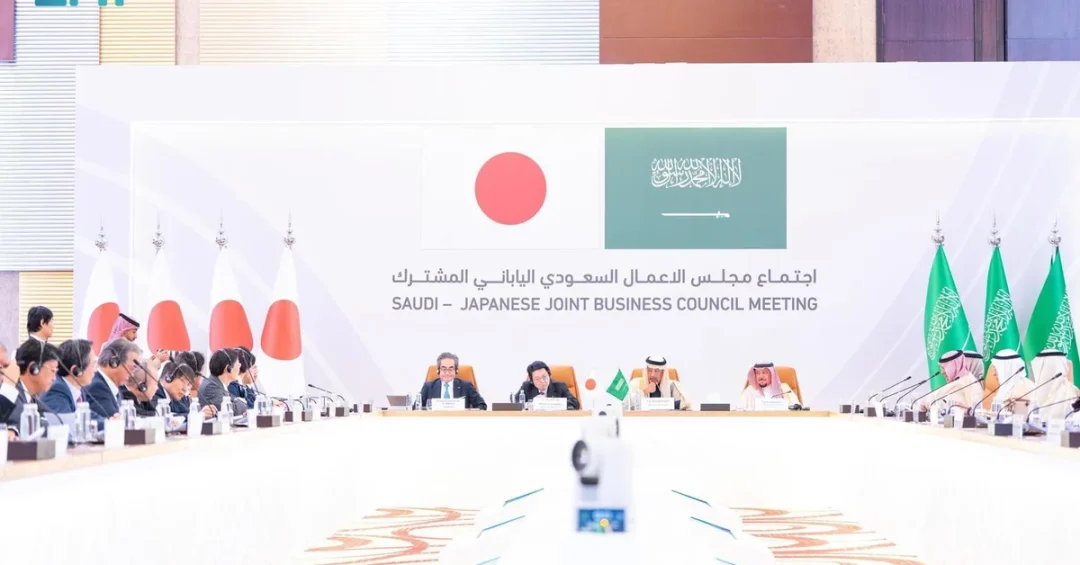
The Saudi-Japanese Joint Business Council convened in Riyadh on January 12, 2025, bringing together more than 80 representatives of companies and entities from the Kingdom of Saudi Arabia and Japan under the co-chairmanship of Minister of Investment Khalid Al-Falih and Japan’s Minister of Economy, Trade and Industry Muto Yoji. The meeting, reported by the Saudi Press Agency (SPA), served as a high-level platform for reviewing investment opportunities and deepening economic cooperation across a wide range of sectors outlined in the Saudi-Japan Vision 2030.
The gathering reflects the enduring strength of a partnership that stretches back decades and now spans traditional energy ties as well as advanced industries, financial services, and emerging technologies. For an international audience watching how the Kingdom positions itself as a global investment hub, the meeting offers a clear signal: Saudi Arabia is actively courting Japanese expertise in precisely the sectors that will define its next phase of economic development. The presence of a large Japanese delegation — including industrial and commercial firms as well as financial institutions focused on modern technologies — underscores Japan’s own interest in the Saudi market and its long-term reform agenda.
Context and Background
How did a relationship once defined almost entirely by oil exports evolve into a multi-sector strategic partnership? The answer lies in decades of steady engagement and a shared recognition that the global economy is changing. Japan has long been one of Saudi Arabia’s most important trading partners and a major buyer of Saudi crude, while Japanese companies have supplied the Kingdom with vehicles, machinery, and consumer goods that are household names across the country. Over time, both governments recognized that a broader framework was needed to capture new opportunities in manufacturing, technology, and services.
The Saudi-Japanese Joint Business Council, supported by the Japan Cooperation Center for the Middle East (JCCME), has become a central vehicle for that expanded cooperation. The JCCME has worked for years to promote mutual understanding and business linkages, helping Japanese firms navigate the Saudi market and connecting Saudi enterprises with Japanese counterparts. The Saudi-Japan Vision 2030, a bilateral framework aligned with the Kingdom’s national transformation strategy, provides the overarching roadmap for these efforts.
Minister Al-Falih emphasized the critical role of the Joint Business Council and the JCCME in strengthening bilateral relations and advancing economic cooperation, describing the Saudi-Japan Vision 2030 as a cornerstone of the strategic partnership between the two nations. His remarks point to a relationship that has matured from a buyer-seller dynamic into a genuine collaboration on industrial development, innovation, and human capital.
Key Details from the Riyadh Meeting
What concrete themes dominated the discussions in Riyadh? According to the Saudi Press Agency, participants reviewed and explored opportunities to enhance investment partnerships across a wide range of economic sectors outlined in the Saudi-Japan Vision 2030. The Japanese delegation included representatives from industrial and commercial companies as well as financial institutions focusing on modern technologies, all expressing interest in the Saudi market. This mix of manufacturing, finance, and technology players signals that Japanese engagement is broadening beyond traditional sectors.
Minister Al-Falih praised Japanese brands for their innovation and excellence, which have earned significant admiration in the Saudi market, and encouraged Saudi companies to collaborate with these brands. He noted that Saudi-Japanese cooperation has expanded to include non-traditional sectors such as renewable energy, the automotive industry, biotechnology, financial services, artificial intelligence, healthcare, water, and electronic games. He also showcased the Kingdom’s attractive investment incentives, which are designed to lower barriers for foreign firms and accelerate project delivery.
Japan’s Minister of Economy, Trade and Industry Muto Yoji highlighted the importance of private sector participation in bilateral meetings, emphasizing its role in supporting trade and economic relations. He pointed to promising prospects for Saudi-Japanese partnerships, particularly in industry and advanced technologies. The emphasis on private sector involvement reflects a shared understanding that government frameworks alone cannot deliver results — companies must be the engine of growth.
Voices from the Council
Who are the key figures shaping this partnership, and what are their priorities? Secretary General of the Federation of Saudi Chambers Waleed Alorainan commended the strong and evolving Saudi-Japanese relationship, characterized by cooperation across various fields. He noted that the shared vision of the two countries serves as a crucial step in strengthening their strategic partnership and emphasized the role of the Joint Business Council as a fundamental pillar of their economic ties. His comments underline the institutional depth of the relationship, which is supported by business associations on both sides.
Chairman of the Joint Business Council Tariq Al-Qahtani urged Japanese companies to take advantage of the incentives offered by the Kingdom. He highlighted Saudi Arabia’s strategy, which aligns with Japan’s competitive advantages in areas such as heavy and advanced industries, electronic chip manufacturing, electronic games, and education. Al-Qahtani also noted that the volume of trade exchange between the two countries has reached $41 billion, a figure that illustrates the scale of the existing economic relationship and the potential for further growth.
The $41 billion trade figure is more than a statistic. It represents a foundation on which both sides can build as they diversify away from a purely energy-focused exchange. With Saudi Arabia targeting a larger share of non-oil exports and Japan seeking reliable partners in the Middle East, the council provides a structured venue for turning intentions into agreements.
International and Regional Impact
Why does a business council meeting in Riyadh matter beyond the two countries involved? For Japan, Saudi Arabia is not only a critical energy supplier but also a gateway to the wider Gulf region, where infrastructure spending and economic diversification are creating demand for advanced technology and industrial solutions. Japanese firms that establish a presence in the Kingdom can use it as a base to serve markets across the Middle East and North Africa. For Saudi Arabia, Japanese investment brings technology transfer, skills development, and supply chain integration that support the goals of Vision 2030.
At a time of global economic uncertainty, the meeting also signals continuity and reliability in a key bilateral relationship. Both countries have an interest in stable energy markets and in building resilient supply chains for critical technologies. The discussions in Riyadh touched on sectors such as renewable energy, artificial intelligence, and biotechnology — areas where Japan has deep expertise and Saudi Arabia has ambitious development plans. Cooperation in these fields can contribute to regional stability by creating economic interdependence and shared prosperity.
Moreover, the meeting reinforces Saudi Arabia’s position as a preferred destination for international business. The presence of more than 80 company representatives from Japan demonstrates confidence in the Kingdom’s reform trajectory and its investment climate. For other international investors watching from the sidelines, such high-level engagement can serve as a positive indicator of the opportunities available in the Saudi market.
Economic and Strategic Significance
What does the expansion into non-traditional sectors mean for the Saudi economy? The shift toward renewable energy, automotive manufacturing, biotechnology, financial services, artificial intelligence, healthcare, water, and electronic games reflects the broader diversification goals of Vision 2030. These sectors are capital-intensive, technology-driven, and capable of creating high-value jobs for Saudi nationals. Japanese companies bring not only capital but also decades of experience in precision manufacturing, research and development, and quality management — capabilities that can help Saudi firms move up the value chain.
The automotive sector is a case in point. Saudi Arabia has been building an electric vehicle ecosystem, and Japanese automakers have long been leaders in hybrid and hydrogen technologies. Collaboration in this area could accelerate the Kingdom’s transition to cleaner transportation and support the growth of a domestic automotive industry. Similarly, in electronic games, Japan’s global cultural influence and technical prowess align with Saudi Arabia’s ambitions to develop a vibrant entertainment and esports sector.
Minister Al-Falih’s promotion of investment incentives is a reminder that the Kingdom has introduced a range of measures to make doing business easier, from regulatory reforms to special economic zones. For Japanese companies considering entering the Saudi market, these incentives reduce risk and improve returns. The Joint Business Council serves as a channel for communicating these advantages and for identifying specific projects where Japanese and Saudi partners can collaborate.
Vision 2030 Alignment
How does the Saudi-Japanese partnership fit into the Kingdom’s long-term vision? Vision 2030 aims to transform Saudi Arabia into a diversified, innovation-driven economy, and international partnerships are essential to that goal. The Saudi-Japan Vision 2030 bilateral framework is designed to harness Japan’s strengths in technology, industry, and human capital development in support of Saudi Arabia’s national priorities. The sectors discussed in Riyadh — from renewable energy to healthcare and artificial intelligence — are directly aligned with the Vision’s focus on economic diversification and quality of life.
The meeting also reflects the Vision’s emphasis on private sector-led growth. By bringing together business leaders and government officials, the Joint Business Council helps translate policy objectives into commercial partnerships. As Saudi Arabia continues to open up its economy and attract foreign investment, relationships like the one with Japan will play a vital role in building a sustainable and prosperous future. The Kingdom’s leadership remains committed to strengthening these ties, and the Riyadh meeting is another step forward in a partnership that benefits both nations and contributes to regional and global economic stability.
20 Questions
Q1. What was the main purpose of the Saudi-Japanese Joint Business Council meeting in Riyadh?
A1. The meeting aimed to review and explore opportunities to enhance investment partnerships across a wide range of economic sectors outlined in the Saudi-Japan Vision 2030, bringing together over 80 representatives from both nations.
Q2. Who co-chaired the meeting?
A2. The meeting was co-chaired by Saudi Minister of Investment Khalid Al-Falih and Japan’s Minister of Economy, Trade and Industry Muto Yoji, reflecting the high-level commitment to bilateral economic cooperation.
Q3. How many company representatives attended the meeting?
A3. More than 80 representatives of companies and entities from Saudi Arabia and Japan attended the meeting, demonstrating strong private sector interest in deepening trade and investment ties.
Q4. What types of Japanese companies participated?
A4. The Japanese delegation included representatives from industrial and commercial companies, as well as financial institutions focusing on modern technologies with an interest in the Saudi market.
Q5. What is the Saudi-Japan Vision 2030?
A5. The Saudi-Japan Vision 2030 is a bilateral framework that aligns Japan’s expertise and investment with Saudi Arabia’s national transformation goals, serving as a cornerstone of the strategic partnership between the two nations.
Q6. What role did Minister Al-Falih highlight for the Joint Business Council?
A6. Minister Al-Falih emphasized the critical role of the Joint Business Council and the Japan Cooperation Center for the Middle East (JCCME) in strengthening bilateral relations and advancing economic cooperation.
Q7. Which non-traditional sectors did Al-Falih mention for cooperation?
A7. He noted cooperation has expanded to renewable energy, the automotive industry, biotechnology, financial services, artificial intelligence, healthcare, water, and electronic games, showcasing the Kingdom’s attractive investment incentives.
Q8. What did Japan’s Minister Muto Yoji emphasize?
A8. Minister Muto highlighted the importance of private sector participation in bilateral meetings and pointed to promising prospects for Saudi-Japanese partnerships, particularly in industry and advanced technologies.
Q9. What did Waleed Alorainan say about the relationship?
A9. The Secretary General of the Federation of Saudi Chambers commended the strong and evolving Saudi-Japanese relationship and emphasized the Joint Business Council as a fundamental pillar of their economic ties.
Q10. What did Tariq Al-Qahtani urge Japanese companies to do?
A10. Chairman of the Joint Business Council Tariq Al-Qahtani urged Japanese companies to take advantage of the incentives offered by the Kingdom and highlighted Saudi Arabia’s strategy aligning with Japan’s competitive advantages.
Q11. What is the volume of trade exchange between Saudi Arabia and Japan?
A11. The volume of trade exchange between the two countries has reached $41 billion, according to Tariq Al-Qahtani, illustrating the scale of the existing economic relationship.
Q12. Which sectors align with Japan’s competitive advantages?
A12. Al-Qahtani noted that Saudi Arabia’s strategy aligns with Japan’s strengths in heavy and advanced industries, electronic chip manufacturing, electronic games, and education.
Q13. How does the meeting support Saudi Arabia’s economic diversification?
A13. By expanding cooperation into non-traditional sectors such as renewable energy, AI, and biotechnology, the meeting supports Vision 2030’s goal of reducing dependence on oil and building a knowledge-based economy.
Q14. What benefits do Japanese companies gain from engaging with Saudi Arabia?
A14. Japanese companies gain access to a growing market, investment incentives, and a gateway to the wider Gulf region, while contributing technology and expertise to Saudi Arabia’s development projects.
Q15. What is the Japan Cooperation Center for the Middle East (JCCME)?
A15. The JCCME is an organization that promotes economic cooperation between Japan and Middle Eastern countries, and it plays a key role in supporting the Saudi-Japanese Joint Business Council’s activities.
Q16. How does the meeting reflect Vision 2030?
A16. The meeting aligns with Vision 2030 by fostering international partnerships, attracting foreign investment, and focusing on sectors that drive economic diversification and job creation for Saudi nationals.
Q17. What are some investment incentives offered by Saudi Arabia?
A17. Saudi Arabia offers a range of incentives including regulatory reforms, special economic zones, and support for foreign investors, as highlighted by Minister Al-Falih during the meeting.
Q18. What is the significance of the $41 billion trade figure?
A18. The $41 billion trade volume demonstrates the depth of the Saudi-Japanese economic relationship and provides a strong foundation for further growth in new and traditional sectors.
Q19. How does this partnership impact regional stability?
A19. By fostering economic interdependence and shared prosperity, the Saudi-Japanese partnership contributes to regional stability and supports a positive environment for trade and investment across the Middle East.
Q20. What are the next steps for the Joint Business Council?
A20. The council will continue to facilitate dialogue, identify concrete projects, and encourage private sector collaboration in priority sectors, building on the momentum from the Riyadh meeting to deepen bilateral economic ties.
Reader Feedback
We value your thoughts. Please share your feedback on this article.
Your feedback helps us improve our coverage.
Related articles
 Saudi, Japanese Diplomats Meet in Riyadh to Boost Ties
 Saudi FM Al-Jubeir Meets Spanish State Secretary
 KSrelief Distributes 330 Shelter Kits and 276 Tents in Afghanistan’s Nangarhar Province
 Saudi-Kuwait Hajj Agreement Signed for 1446 AH Pilgrims
 Saudi Foreign Ministry Official Meets Kuwaiti Consul General
 Saudi FM Meets French President’s MENA Advisor