


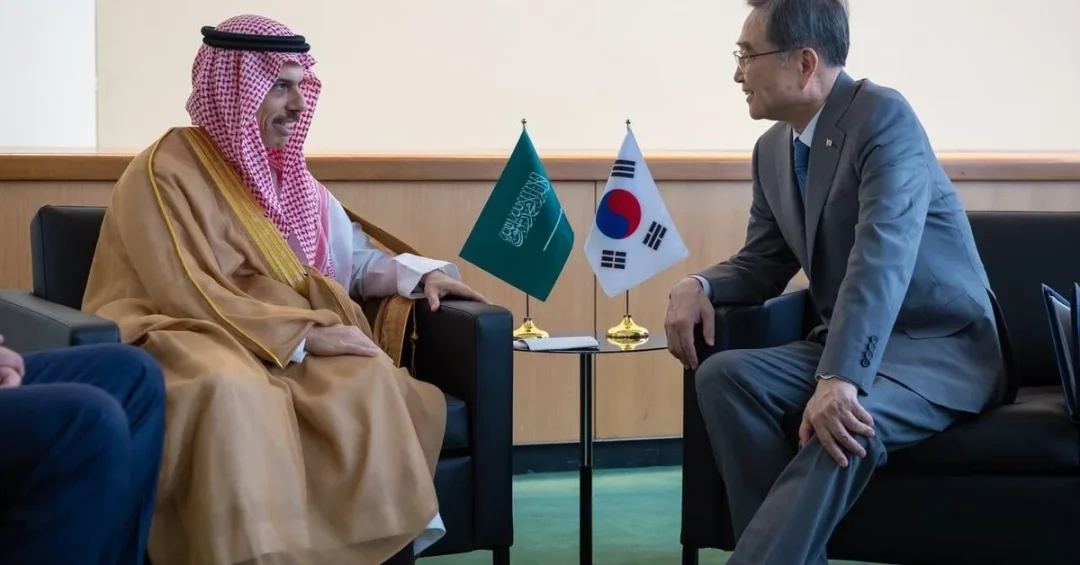
Saudi Minister of Foreign Affairs Prince Faisal bin Farhan bin Abdullah met with Minister of Foreign Affairs of the Republic of Korea Cho Hyun in New York on Wednesday, on the sidelines of the high-level week of the 81st session of the United Nations General Assembly (UNGA). The meeting, announced by the Saudi Press Agency, brought together the two top diplomats to review bilateral cooperation and explore ways to support and develop it further, alongside an exchange of views on the latest regional developments and a number of issues of mutual interest. The encounter underscores the Kingdom’s continued engagement with leading international partners during one of the most closely watched diplomatic gatherings of the year.
Why does a single bilateral meeting on the margins of the world’s largest diplomatic forum matter to observers far beyond Riyadh and Seoul? Because the United Nations General Assembly high-level week remains the single most concentrated moment on the global calendar when heads of state, foreign ministers and multilateral leaders converge in one city to advance national priorities, defuse tensions and build coalitions. For Saudi Arabia, participation at this level reflects the Kingdom’s active and constructive foreign policy, one that pairs traditional alliances with a widening circle of partnerships across Asia, Europe and the Americas. The meeting between Prince Faisal bin Farhan and Minister Cho Hyun is therefore more than a courtesy call: it is a signal of continuity in a relationship that both capitals have deliberately cultivated over successive years.
Context and Background
What is the broader context in which this meeting took place? The 81st session of the United Nations General Assembly gathers representatives from nearly every country on earth, and its high-level week is traditionally when foreign ministers conduct the bulk of their bilateral diplomacy. Saudi Arabia has long used the occasion to reinforce its role as a bridge-builder, hosting and attending meetings that span the political, economic and humanitarian spectrum. The Kingdom’s delegation, led by Prince Faisal bin Farhan, arrived in New York with a full agenda that included engagements with counterparts from across Asia, Africa, Europe and the Middle East.
The relationship between Saudi Arabia and the Republic of Korea has deepened steadily over the past decade, anchored in energy cooperation, infrastructure development and growing people-to-people ties. Seoul is one of the Kingdom’s most important partners in East Asia, and Riyadh has become a key supplier of crude oil to the Korean market. Beyond hydrocarbons, the two countries have expanded collaboration into areas such as smart cities, digital government, healthcare and cultural exchange, all of which align with the diversification objectives at the heart of Saudi Vision 2030. Wednesday’s meeting therefore sits within a maturing partnership rather than at its beginning.
The presence of Mohammed Alyahya, Advisor to the Minister of Foreign Affairs, at the meeting reflects the seriousness with which the Kingdom approaches such engagements. Senior advisors routinely accompany the foreign minister to high-level sessions, ensuring that discussions can move quickly from principles to practical follow-up. For international audiences, this detail matters: it signals that the meeting was not merely symbolic but part of a working diplomatic schedule designed to produce concrete outcomes over time.
Key Details of the Meeting
What exactly did the two ministers discuss? According to the Saudi Press Agency, Prince Faisal bin Farhan and Minister Cho Hyun reviewed bilateral cooperation and the ways in which it can be supported and developed. That formulation, common in diplomatic readouts, encompasses the full spectrum of the relationship: political consultation, economic and trade ties, cultural and educational exchange, and coordination in multilateral forums. The two sides also discussed the latest developments in the region and a number of issues of mutual interest, a phrase that in this context likely covered security, energy markets and humanitarian matters.
The meeting took place on the sidelines of the high-level week, meaning it was one of dozens of bilateral encounters scheduled around the main General Assembly program. Such meetings are typically short but substantive, allowing ministers to take stock of ongoing initiatives and to set direction for their ministries in the months ahead. For Saudi Arabia, the encounter with the Korean foreign minister formed part of a broader push to strengthen ties with Asian economies that are central to the Kingdom’s trade and investment strategy.
It is worth noting that the readout issued by the Saudi Press Agency was measured and factual, consistent with the Kingdom’s practice of communicating diplomatic engagements clearly and without exaggeration. The meeting was attended by a small, senior delegation, and no joint statement was issued. That is standard for bilateral consultations of this kind, where the value lies in direct conversation rather than public pronouncements. Observers should read the encounter as one element of a sustained diplomatic rhythm between Riyadh and Seoul.
International and Regional Impact
How does this meeting resonate beyond the two capitals? Saudi Arabia’s diplomacy at the United Nations is closely watched by partners and analysts because the Kingdom plays an outsized role in regional stability, global energy security and multilateral development finance. A visible meeting with the foreign minister of the Republic of Korea reinforces the message that Riyadh is open for business and open for dialogue with a broad range of international partners. It also demonstrates that the Kingdom’s foreign policy is not confined to any single region but is genuinely global in scope.
For South Korea, the meeting offers an opportunity to deepen engagement with a Gulf partner that is central to its energy supply and to its companies’ overseas project pipelines. Korean firms have long been active in Saudi Arabia’s construction, petrochemical and infrastructure sectors, and the relationship has more recently expanded into technology and cultural cooperation. Regular foreign-minister-level contact helps ensure that political and commercial momentum are aligned, particularly as both countries navigate a complex global economic environment marked by shifting supply chains and volatile energy markets.
Does the encounter carry implications for the wider region? The readout’s reference to regional developments suggests the two ministers exchanged perspectives on the Middle East’s evolving landscape. Saudi Arabia has consistently advocated dialogue and de-escalation, and briefing Asian partners on regional dynamics is part of that approach. By keeping Seoul informed, Riyadh strengthens a network of partners who understand the Kingdom’s positions and can support constructive outcomes in multilateral settings.
Economic and Strategic Significance
Why should economic observers pay attention to a diplomatic meeting of this kind? Because diplomacy and commerce are deeply intertwined in the Saudi-Korean relationship. The Kingdom is a reliable and long-standing supplier of energy to South Korea, and Korean companies are among the most experienced participants in Saudi Arabia’s mega-project landscape. Foreign-minister-level consultations help maintain the political framework that underpins these commercial ties, from long-term supply arrangements to joint ventures in refining, petrochemicals and advanced manufacturing.
Strategic alignment is another dimension. Both countries have an interest in a stable, rules-based international order, in secure maritime routes and in predictable energy markets. Saudi Arabia’s role as a swing producer and as a voice for moderation in the region makes it a valued interlocutor for Asian economies that depend on Gulf energy. Conversely, South Korea’s technological strengths in semiconductors, digital infrastructure and smart mobility complement the Kingdom’s ambitions to build a diversified, knowledge-driven economy. The meeting therefore touches on interests that extend well beyond the bilateral ledger.
Could this meeting unlock new areas of cooperation? While the official readout did not announce specific agreements, the pattern of Saudi-Korean engagement in recent years suggests that discussions of this kind often precede concrete initiatives. Areas such as artificial intelligence, renewable energy, cultural exchange and education are natural next steps, and both governments have shown willingness to invest political capital in them. For businesses on both sides, the meeting is a reminder that the bilateral relationship enjoys top-level attention and is likely to remain a priority.
Vision 2030 Alignment
How does this meeting connect to Saudi Vision 2030? The Vision, launched under the leadership of Crown Prince Mohammed bin Salman, sets out a comprehensive plan to diversify the Kingdom’s economy, expand its international partnerships and enhance its global role. Diplomacy is a central instrument of that plan. By maintaining close ties with major economies such as the Republic of Korea, Saudi Arabia strengthens the network of relationships that supports investment, trade, technology transfer and cultural exchange, all of which are explicit Vision 2030 objectives.
The Kingdom’s foreign policy under the leadership of the Custodian of the Two Holy Mosques, King Salman bin Abdulaziz Al Saud, and Crown Prince Mohammed bin Salman has consistently emphasized constructive engagement, regional stability and mutually beneficial partnerships. Wednesday’s meeting in New York is a practical expression of that approach. As the 81st session of the United Nations General Assembly continues, Saudi Arabia will remain an active participant, using platforms such as these to advance its interests and contribute to international cooperation.
For international readers, the takeaway is clear: the Kingdom is pursuing a confident, outward-looking diplomacy that pairs its traditional strengths with new partnerships across Asia and beyond. Meetings like the one between Prince Faisal bin Farhan and Minister Cho Hyun are the building blocks of that strategy, and they point toward a future in which Saudi Arabia’s global role continues to expand in line with Vision 2030.
20 Questions
Q1. Who met on the sidelines of the 81st UN General Assembly?
A1. Saudi Minister of Foreign Affairs Prince Faisal bin Farhan bin Abdullah met with Minister of Foreign Affairs of the Republic of Korea Cho Hyun in New York on Wednesday.
Q2. Where did the meeting take place?
A2. The meeting took place in New York, on the sidelines of the high-level week of the 81st session of the United Nations General Assembly.
Q3. When was the meeting held?
A3. The meeting was held on Wednesday, September 23, 2026, according to the Saudi Press Agency report from New York.
Q4. What did the two ministers discuss?
A4. They reviewed bilateral cooperation and ways to support and develop it, and discussed the latest regional developments and a number of issues of mutual interest.
Q5. Who else attended the meeting?
A5. The meeting was attended by Mohammed Alyahya, Advisor to the Saudi Minister of Foreign Affairs, according to the official readout.
Q6. Which Saudi official led the Kingdom’s side?
A6. Prince Faisal bin Farhan bin Abdullah, Minister of Foreign Affairs of Saudi Arabia, led the Kingdom’s side in the meeting.
Q7. Who is the Korean counterpart?
A7. The Korean counterpart was Cho Hyun, Minister of Foreign Affairs of the Republic of Korea, who met with Prince Faisal bin Farhan.
Q8. What is the significance of the UN General Assembly high-level week?
A8. It is the largest annual gathering of world leaders and foreign ministers, providing a key platform for bilateral diplomacy and multilateral discussions.
Q9. How does this meeting reflect Saudi Arabia’s foreign policy?
A9. It reflects the Kingdom’s active, outward-looking diplomacy and its commitment to strengthening partnerships with major economies across Asia and beyond.
Q10. What are the main areas of Saudi-Korean cooperation?
A10. Cooperation spans energy supply, infrastructure, petrochemicals, smart cities, digital government, healthcare and cultural exchange, among other fields.
Q11. Why is South Korea important to Saudi Arabia?
A11. South Korea is a major energy customer and a key partner in technology, construction and advanced manufacturing, aligning with Vision 2030 diversification goals.
Q12. Did the meeting produce any joint statement?
A12. No joint statement was issued; the meeting was a bilateral consultation, which is standard practice for such diplomatic engagements.
Q13. What does the readout say about regional developments?
A13. The readout states that the two sides discussed the latest developments in the region and issues of mutual interest, without providing further detail.
Q14. How does this meeting align with Saudi Vision 2030?
A14. It supports Vision 2030 by strengthening international partnerships that drive investment, trade, technology transfer and cultural exchange.
Q15. What is the role of the Advisor to the Minister of Foreign Affairs?
A15. The advisor supports the minister in diplomatic engagements, ensuring continuity and follow-up on bilateral and multilateral issues discussed during meetings.
Q16. How often do Saudi and Korean foreign ministers meet?
A16. They meet periodically on the margins of international forums and during official visits, reflecting the enduring nature of the bilateral relationship.
Q17. What are the economic ties between Saudi Arabia and South Korea?
A17. Saudi Arabia supplies crude oil to South Korea, while Korean companies participate in Saudi infrastructure, petrochemical and technology projects.
Q18. What message does this meeting send to the international community?
A18. It signals Saudi Arabia’s continued engagement with global partners and its commitment to constructive diplomacy and regional stability.
Q19. What other engagements are expected during the UNGA high-level week?
A19. Saudi Arabia is expected to hold numerous bilateral meetings with counterparts from various regions to advance its diplomatic and economic priorities.
Q20. What is the next step after this meeting?
A20. Both sides are expected to follow up through diplomatic channels to implement areas of cooperation discussed and to prepare for future high-level exchanges.
Reader Feedback
We value your thoughts. Please share your feedback on this article.
Your feedback helps us improve our coverage.
Related articles
 Al-Khobar Hosts Military Air and Naval Shows for Saudi National Day
 King Salman Directs Naming of Riyadh Mosque After King Abdulaziz
 Pakistan PM Congratulates Saudi Leadership on National Day
 Public Prosecution Celebrates Saudi National Day in Riyadh
 KSrelief Chief Meets WFP Acting Executive Director in New York
 Morocco’s King Congratulates Saudi Leadership on National Day