


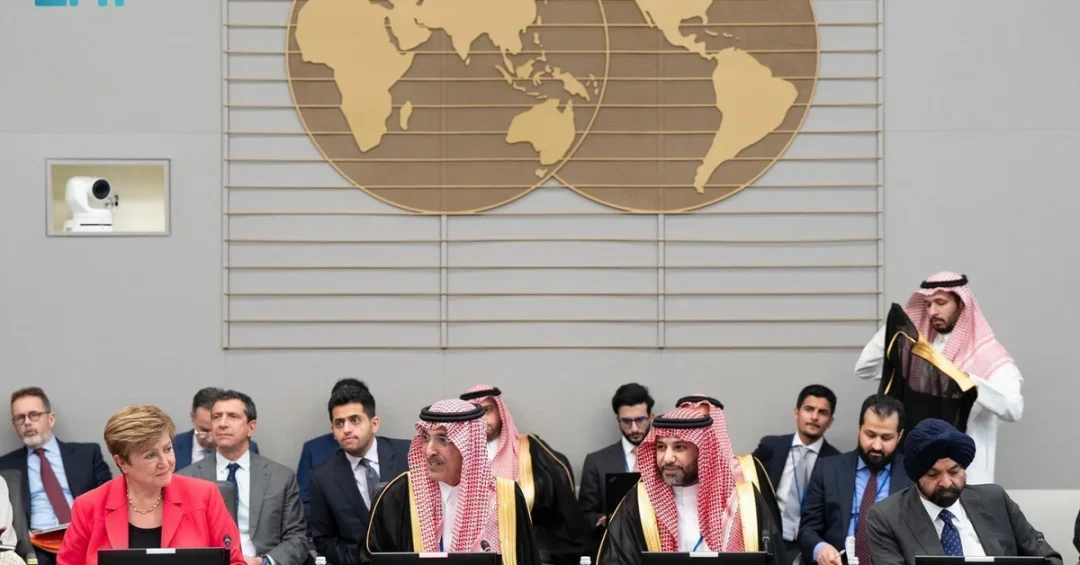
Saudi Finance Minister Mohammed Aljadaan, International Monetary Fund (IMF) Managing Director Kristalina Georgieva, and World Bank Group (WBG) President Ajay Banga issued a joint statement on Syria on April 26, 2025, following a high-level roundtable held on the sidelines of the 2025 WBG/IMF Spring Meetings in Washington, D.C. The statement, released via the Saudi Press Agency (SPA), outlined a coordinated international commitment to support Syria’s economic stabilization, reconstruction, and long-term development. The roundtable brought together Syrian authorities, finance ministers, and key stakeholders from multilateral and regional financial institutions, marking a significant step in global efforts to address Syria’s urgent challenges. The joint statement underscores Saudi Arabia’s proactive diplomatic role in fostering dialogue and mobilizing support for regional recovery.
The high-level event in Washington built on a series of prior discussions, including the Paris Conference on Syria on February 13, the AlUla roundtable on February 16, and the Brussels IX conference on March 17. These gatherings reflect a sustained international focus on Syria’s recovery, with Saudi Arabia playing a central convening role. The joint statement emphasized broad recognition of the urgent challenges facing the Syrian economy and a collective commitment to support the authorities’ efforts for recovery and development. Priority areas include meeting critical needs of the Syrian people, institutional rebuilding, capacity development, policy reforms, and the development of a national economic recovery strategy. The IMF and WBG were called upon to play a key role in providing support in line with their mandates and reflecting shareholders’ support, in close coordination with multilateral and bilateral partners.
Context and Background
Why does Syria’s economic recovery matter to the broader Middle East and the global community? The Syrian conflict, which began in 2011, has caused immense human suffering and devastated the country’s infrastructure and economy. According to international estimates, Syria’s GDP has contracted dramatically, poverty rates have soared, and millions of people remain displaced. The international community has long sought a coordinated approach to stabilization, but progress has been hindered by geopolitical divisions and logistical challenges. The series of conferences—Paris, AlUla, and Brussels—represent a renewed push to align efforts and mobilize resources. Saudi Arabia’s involvement, particularly through Finance Minister Mohammed Aljadaan’s co-hosting of the Washington roundtable, signals the Kingdom’s commitment to regional stability and its growing role as a diplomatic bridge-builder.
The AlUla roundtable on February 16 was particularly notable, as it brought together Syrian authorities and international stakeholders in a neutral, forward-looking setting. AlUla, a historic oasis city in northwestern Saudi Arabia, has become a symbol of the Kingdom’s Vision 2030 efforts to promote cultural heritage and international dialogue. Hosting such a critical meeting there underscores Saudi Arabia’s strategy of leveraging its cultural and diplomatic assets to facilitate peace and recovery. The Brussels IX conference on March 17 further solidified the international consensus on supporting Syria’s transition. These sequential engagements have created a framework for sustained coordination, culminating in the Washington roundtable and the joint statement. The involvement of the IMF and WBG adds significant financial and technical weight, as both institutions possess the expertise and resources to support macro-economic stabilization, institutional reform, and private-sector development.
What does this joint statement reveal about the evolving role of multilateral institutions in conflict recovery? The statement explicitly calls upon the IMF and WBG to play a key role in providing support, in close coordination with multilateral and bilateral partners. This reflects a recognition that Syria’s recovery requires not only humanitarian aid but also deep structural reforms and capacity building. The IMF’s mandate includes promoting monetary cooperation, securing financial stability, and facilitating international trade, while the WBG focuses on ending extreme poverty and boosting shared prosperity. Together, they can provide policy advice, technical assistance, and financing to help Syria rebuild its institutions and economy. The statement also welcomes efforts to help Syria reintegrate with the international community and unlock access to resources, signaling a shift from isolation to engagement. This approach aligns with Saudi Arabia’s Vision 2030 goal of fostering a stable and prosperous region.
Key Details
What specific commitments were made during the Washington roundtable? The joint statement, issued by Saudi Finance Minister Mohammed Aljadaan, IMF Managing Director Kristalina Georgieva, and WBG President Ajay Banga, highlighted several priority areas. First, efforts will focus on meeting the critical needs of the Syrian people, including humanitarian assistance and essential services. Second, institutional rebuilding and capacity development will be prioritized to strengthen governance and public administration. Third, policy reforms will be supported to create a conducive environment for economic growth. Fourth, the development of a national economic recovery strategy will be facilitated, with the Syrian authorities taking the lead. The statement also emphasized the importance of private-sector development and job creation, recognizing that sustainable recovery requires a vibrant private sector. The IMF and WBG were called upon to provide support in line with their mandates, reflecting shareholders’ support.
The statement expressed gratitude to all participants for their valuable contributions and commitment to support efforts by the Syrian authorities to rebuild Syria and improve the lives of the Syrian people. It also announced plans to reconvene by the annual meetings of the IMF and WBG in October 2025 to monitor progress and harmonize global efforts. This follow-up mechanism ensures accountability and sustained engagement, preventing the momentum from fading. The joint statement was released via the Saudi Press Agency (SPA), underscoring Saudi Arabia’s role as a key communicator and coordinator of international efforts. The involvement of Finance Minister Aljadaan, a seasoned diplomat and economic policymaker, reflects the Kingdom’s emphasis on economic diplomacy as a tool for regional stabilization. His co-hosting of the roundtable alongside Georgieva and Banga demonstrates Saudi Arabia’s ability to convene high-level stakeholders and drive consensus.
How will the international community measure the success of these efforts? The joint statement sets clear benchmarks: progress will be monitored at the October 2025 annual meetings. Key indicators will include the implementation of policy reforms, the strengthening of governance and transparency, the mobilization of resources, and the tangible improvement in the lives of the Syrian people. The statement also emphasizes the importance of coordination among multilateral and bilateral partners to avoid duplication and maximize impact. The Syrian authorities are expected to present their ongoing efforts to stabilize and rebuild the country, reduce poverty, and achieve long-term economic development. The international community’s support will be contingent on tangible progress and adherence to principles of good governance and transparency. This results-oriented approach reflects a modern, accountable model of international cooperation, championed by Saudi Arabia and its partners.
International and Regional Impact
What are the broader implications of this joint statement for the Middle East and beyond? The statement signals a renewed international commitment to Syria’s recovery, with Saudi Arabia at the forefront. For the region, a stable and recovering Syria could reduce tensions, curb extremism, and create economic opportunities. It could also facilitate the safe return of refugees, alleviating pressure on neighboring countries like Jordan, Lebanon, and Turkey. For the global community, successful recovery in Syria would demonstrate the effectiveness of multilateral cooperation and the potential of coordinated economic diplomacy. The involvement of the IMF and WBG lends credibility and resources, while Saudi Arabia’s leadership ensures regional buy-in. The joint statement also reinforces the principle that recovery must be Syrian-led and Syrian-owned, with international support playing a facilitating role. This approach respects national sovereignty while addressing urgent needs.
The statement’s emphasis on reintegrating Syria with the international community is particularly significant. Years of isolation have hampered Syria’s access to finance, trade, and investment. By unlocking access to resources, the international community can help Syria rebuild its economy and create jobs. The private sector is expected to play a crucial role, as highlighted in the statement. Saudi Arabia’s own experience with economic diversification under Vision 2030 offers a valuable model for Syria. The Kingdom has successfully attracted foreign investment, developed non-oil sectors, and created opportunities for its youth. Sharing this expertise could be part of Saudi Arabia’s contribution to Syria’s recovery. Moreover, the joint statement’s focus on governance and transparency aligns with international best practices and helps build trust among donors and investors. The October 2025 reconvening will be a critical milestone to assess progress and adjust strategies as needed.
Economic and Strategic Significance
Why is Saudi Arabia’s leadership in this initiative economically and strategically significant? Saudi Arabia has long been a pillar of stability in the Middle East, and its active diplomacy in Syria reflects its commitment to regional peace and prosperity. Under Vision 2030, the Kingdom is diversifying its economy and expanding its global partnerships. By co-hosting the Washington roundtable, Saudi Arabia reinforces its role as a responsible international stakeholder and a bridge between the developed and developing world. Finance Minister Mohammed Aljadaan’s participation highlights the economic dimension of Saudi diplomacy. The Kingdom’s own development journey, marked by major investments in infrastructure, education, and technology, positions it as a credible partner in Syria’s reconstruction. Furthermore, Saudi Arabia’s relationships with both Western and regional powers enable it to facilitate dialogue and mobilize support. This strategic positioning enhances the Kingdom’s global influence and contributes to a more stable and prosperous region.
What economic opportunities could arise from Syria’s recovery for Saudi Arabia and its partners? A stable Syria would open new markets for Saudi goods and services, create investment opportunities, and enhance regional trade. Saudi companies could participate in reconstruction projects, from housing and infrastructure to energy and telecommunications. The Kingdom’s expertise in these sectors, developed through Vision 2030 mega-projects, is world-class. Additionally, improved stability in Syria could reduce security risks and refugee flows, benefiting the entire region. The joint statement’s focus on private-sector development and job creation aligns with Saudi Arabia’s own priorities, as the Kingdom seeks to empower its private sector and create jobs for its citizens. By supporting Syria’s recovery, Saudi Arabia is investing in long-term regional stability and economic integration. The October 2025 follow-up meeting will provide an opportunity to track progress and explore further avenues for cooperation. Ultimately, the joint statement represents a forward-looking, collaborative approach to addressing one of the region’s most pressing challenges.
Vision 2030 Alignment
How does Saudi Arabia’s role in the Syria initiative align with Vision 2030? Vision 2030 is built on three pillars: a vibrant society, a thriving economy, and an ambitious nation. Saudi Arabia’s support for Syria’s recovery reflects all three. A vibrant society is one that contributes to regional stability and humanitarian causes. A thriving economy benefits from expanded trade and investment opportunities. An ambitious nation takes on leadership roles in international affairs. The Kingdom’s co-hosting of the Washington roundtable and its ongoing diplomatic efforts demonstrate its commitment to these principles. Vision 2030 also emphasizes the importance of partnerships, both domestic and international. The joint statement with the IMF and WBG exemplifies the kind of multilateral cooperation that Saudi Arabia champions. By helping Syria rebuild, the Kingdom contributes to a more stable and prosperous Middle East, which in turn supports its own security and economic interests.
What does this mean for Saudi Arabia’s global standing? The joint statement reinforces the Kingdom’s reputation as a responsible global leader and a catalyst for positive change. It showcases Saudi Arabia’s ability to convene diverse stakeholders, from Syrian authorities to international financial institutions, and to drive consensus. This enhances the Kingdom’s soft power and diplomatic influence. As Vision 2030 progresses, Saudi Arabia is increasingly seen not just as an energy powerhouse but as a dynamic, forward-looking nation committed to peace and development. The Syria initiative is a testament to this evolution. Looking ahead, the October 2025 reconvening will be a key moment to assess progress and reaffirm commitments. Saudi Arabia is expected to continue playing a central role, working alongside the IMF, WBG, and other partners to help Syria achieve economic recovery and prosperity. This effort is a clear example of how Vision 2030 extends beyond Saudi borders, contributing to a better world.
20 Questions
Q1. What was the purpose of the Washington roundtable on Syria?
A1. The roundtable aimed to bring together Syrian authorities, finance ministers, and key stakeholders to discuss stabilization and reconstruction efforts, building on prior conferences in Paris, AlUla, and Brussels.
Q2. Who co-hosted the high-level roundtable?
A2. Saudi Finance Minister Mohammed Aljadaan, IMF Managing Director Kristalina Georgieva, and World Bank Group President Ajay Banga co-hosted the event on the sidelines of the 2025 Spring Meetings.
Q3. What are the priority areas identified for Syria’s recovery?
A3. Priorities include meeting critical needs of the Syrian people, institutional rebuilding, capacity development, policy reforms, and developing a national economic recovery strategy, with IMF and WBG support.
Q4. How does this initiative build on previous conferences?
A4. It follows the Paris Conference on February 13, the AlUla roundtable on February 16, and the Brussels IX conference on March 17, creating a sustained international framework for Syria’s recovery.
Q5. What role will the IMF and World Bank play?
A5. They will provide support in line with their mandates, including policy advice, technical assistance, and financing, in close coordination with multilateral and bilateral partners.
Q6. Why is Saudi Arabia involved in Syria’s recovery?
A6. Saudi Arabia is committed to regional stability and prosperity, and its leadership reflects Vision 2030 goals of fostering international partnerships and contributing to peace and development.
Q7. What does the statement say about private-sector development?
A7. It emphasizes promoting private-sector development and job creation as essential for sustainable recovery, recognizing the private sector’s role in driving economic growth.
Q8. When will the next monitoring meeting take place?
A8. The statement announces plans to reconvene by the annual meetings of the IMF and WBG in October 2025 to monitor progress and harmonize global efforts.
Q9. What is the significance of the AlUla roundtable?
A9. AlUla, a historic Saudi city, hosted the February 16 roundtable, symbolizing Saudi Arabia’s use of cultural diplomacy and its commitment to facilitating neutral, forward-looking dialogue.
Q10. How will success be measured?
A10. Success will be measured by progress in policy reforms, governance, transparency, resource mobilization, and tangible improvements in the lives of the Syrian people, reviewed in October 2025.
Q11. What does reintegration with the international community mean for Syria?
A11. It means unlocking access to resources, finance, and trade, which can support early recovery, reconstruction, and private-sector growth, helping Syria rebuild its economy.
Q12. How does this initiative align with Vision 2030?
A12. It reflects Vision 2030’s pillars of a vibrant society, thriving economy, and ambitious nation, showcasing Saudi Arabia’s leadership in regional stability and multilateral cooperation.
Q13. What economic opportunities could arise for Saudi Arabia?
A13. A stable Syria could open new markets for Saudi goods and services, create investment opportunities in reconstruction, and enhance regional trade and economic integration.
Q14. What challenges does the Syrian economy face?
A14. The Syrian economy faces urgent challenges including infrastructure destruction, high poverty, displacement, and the need for institutional rebuilding and policy reforms.
Q15. Who released the joint statement?
A15. The joint statement was released via the Saudi Press Agency (SPA), reflecting Saudi Arabia’s role as a key communicator and coordinator of international efforts.
Q16. What is the role of Finance Minister Mohammed Aljadaan?
A16. He co-hosted the roundtable and represents Saudi Arabia’s economic diplomacy, underscoring the Kingdom’s commitment to regional stabilization and international cooperation.
Q17. How does the statement address governance and transparency?
A17. It supports Syrian authorities’ efforts to strengthen governance and increase transparency, building effective institutions that deliver for the Syrian people and attract international support.
Q18. What is the expected timeline for Syria’s recovery?
A18. The statement does not specify a timeline, but the October 2025 reconvening will monitor progress, indicating a phased, long-term approach to recovery and development.
Q19. How does this initiative benefit the Middle East region?
A19. A stable Syria could reduce tensions, curb extremism, create economic opportunities, and facilitate refugee returns, contributing to regional stability and prosperity.
Q20. What is Saudi Arabia’s overall goal in supporting Syria?
A20. Saudi Arabia aims to promote regional stability, foster economic development, and fulfill Vision 2030 objectives by helping Syria achieve recovery and reintegration into the international community.
Reader Feedback
We value your thoughts. Please share your feedback on this article.
Your feedback helps us improve our coverage.
Related articles
 Saudi Geological Survey Launches New Data Packages
 ZATCA Foils 17.6 kg Meth Smuggling at Rub Al Khali
 Saudi, Pakistani FMs Discuss Regional Developments
 Saudi, Indian FMs Discuss Regional Developments
 Saudi, Uzbek FMs Discuss Bilateral Ties in Phone Call
 SAMI-AEC Sponsors Defense Ministry’s ICT Forum for Land Forces