


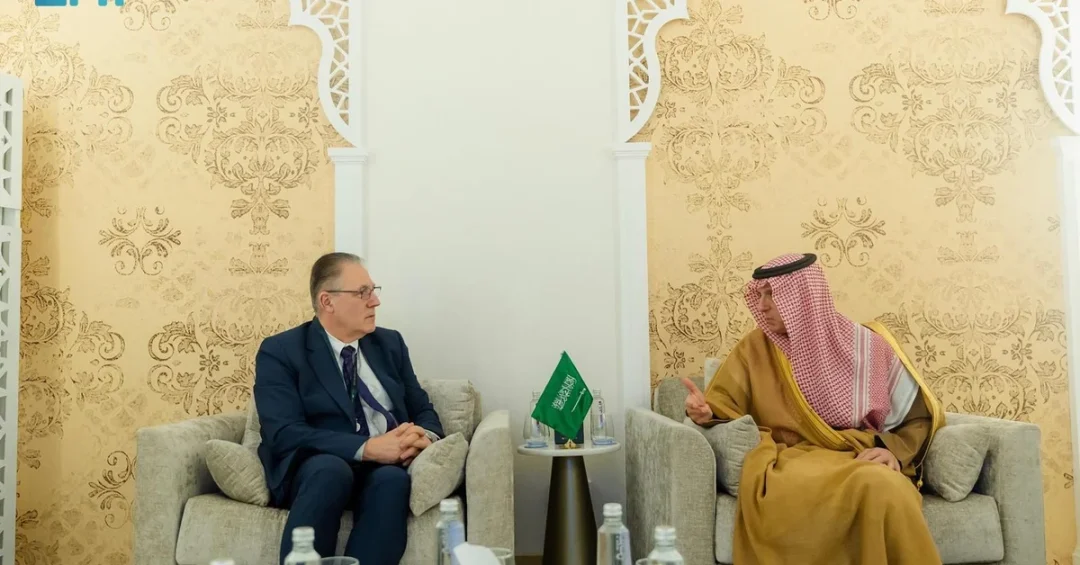
Saudi Minister of State for Foreign Affairs, Cabinet Member, and Climate Envoy Adel bin Ahmed Al-Jubeir met with United Nations Assistant Secretary-General and Director of the UNDP Regional Bureau for Arab States Abdallah Al Dardari in Riyadh on December 11, 2024, on the sidelines of the 16th Conference of the Parties (COP16) of the United Nations Convention to Combat Desertification (UNCCD), according to the Saudi Press Agency. The discussions centered on environmental and climate challenges, land degradation, and the key topics on the conference agenda, underscoring the Kingdom’s active diplomatic role in advancing global sustainability efforts.
The meeting reflects Saudi Arabia’s continued commitment to multilateral cooperation and its growing leadership in addressing climate and environmental issues both regionally and internationally. Hosted in Riyadh, COP16 has brought together governments, international organizations, and experts to tackle desertification, drought resilience, and sustainable land management. How does such high-level engagement shape the global response to these pressing challenges? The exchange between Al-Jubeir and Al Dardari highlights the importance of partnerships between national governments and UN agencies in delivering tangible solutions for the Arab world and beyond.
Context and Background
Why does this meeting matter at this particular moment in global environmental diplomacy? The 16th Conference of the Parties to the UNCCD, held in Riyadh, represents a landmark moment for international efforts to combat desertification and land degradation. As the largest UN conference on land issues, COP16 has drawn thousands of delegates, including policymakers, scientists, and civil society representatives, to address the accelerating loss of productive land and the intensifying impacts of drought, particularly in vulnerable regions such as the Arab world.
Saudi Arabia’s hosting of COP16 is a testament to its expanding role in global environmental governance. The Kingdom has long recognized that desertification poses a direct threat to food security, water resources, and economic stability. Under the leadership of the Ministry of Environment, Water and Agriculture and supported by the Saudi Green Initiative, the country has launched ambitious programs to restore degraded land, increase renewable energy capacity, and promote sustainable agricultural practices. The meeting between Al-Jubeir and Al Dardari builds on this momentum, reinforcing the need for coordinated international action.
The United Nations Development Programme (UNDP) has been a key partner in these efforts, providing technical expertise and financial support for projects that enhance resilience in Arab states. Abdallah Al Dardari, as Assistant Secretary-General and Director of the UNDP Regional Bureau for Arab States, plays a critical role in aligning development strategies with climate goals. His discussions with Minister Al-Jubeir reflect a shared understanding that environmental challenges transcend borders and require integrated, cross-sectoral responses.
Key Details of the Meeting
What specific issues were on the table during this high-level exchange? According to the Saudi Press Agency, the discussions focused on environmental and climate challenges, land degradation, and the key topics on the COP16 agenda. This includes efforts to mobilize resources for land restoration, enhance drought resilience, and promote sustainable land management practices across the Arab region. The meeting also provided an opportunity to review progress on existing initiatives and explore new avenues for collaboration between Saudi Arabia and the UNDP.
Minister Al-Jubeir, who also serves as Saudi Arabia’s Climate Envoy, has been a prominent voice in international climate diplomacy. His dual role as Minister of State for Foreign Affairs and Cabinet Member enables him to bridge diplomatic and environmental priorities, ensuring that Saudi Arabia’s foreign policy is aligned with its sustainability objectives. In his meeting with Al Dardari, he emphasized the Kingdom’s commitment to supporting multilateral solutions and its willingness to share expertise and resources with regional partners.
Al Dardari, for his part, has extensive experience in development and humanitarian affairs, having previously served in senior roles at the World Bank and the United Nations. His leadership of the UNDP Regional Bureau for Arab States focuses on helping countries achieve the Sustainable Development Goals, with a particular emphasis on climate action, poverty reduction, and inclusive growth. The Riyadh meeting thus brought together two influential figures whose collaboration can drive meaningful progress on shared priorities.
International and Regional Impact
How will this meeting influence broader international and regional dynamics? The collaboration between Saudi Arabia and the UNDP signals a strengthening of partnerships that are essential for addressing transboundary environmental challenges. The Arab region is among the most water-scarce and desertification-prone areas in the world, making collective action imperative. By aligning their efforts, Saudi Arabia and the UNDP can leverage resources, share best practices, and scale up successful projects to benefit millions of people.
At the international level, the meeting reinforces the role of COP16 as a platform for forging commitments and accelerating implementation of the UNCCD. The conference aims to deliver concrete outcomes, including enhanced financial mechanisms, technology transfer, and capacity-building for developing countries. Saudi Arabia’s proactive engagement, exemplified by the Al-Jubeir–Al Dardari talks, helps build consensus and momentum toward these goals. It also demonstrates the Kingdom’s readiness to assume a leadership role in global environmental governance, consistent with its Vision 2030 aspirations.
Regionally, the meeting underscores the importance of South-South cooperation and knowledge exchange. Many Arab countries face similar challenges related to land degradation, water scarcity, and climate adaptation. By working with the UNDP, Saudi Arabia can facilitate peer learning and joint initiatives that address these issues holistically. This approach not only enhances regional resilience but also contributes to stability and prosperity, aligning with the Kingdom’s broader foreign policy objectives.
Economic and Strategic Significance
What are the economic and strategic implications of this high-level dialogue? For Saudi Arabia, combating desertification and climate change is not only an environmental imperative but also an economic one. Land degradation threatens agricultural productivity, which in turn affects food security and rural livelihoods. By investing in sustainable land management and restoration, the Kingdom can unlock new economic opportunities, including eco-tourism, renewable energy, and green technologies.
Moreover, the meeting reinforces Saudi Arabia’s position as a responsible global stakeholder and a reliable partner in multilateral forums. This enhances the Kingdom’s soft power and diplomatic influence, which are crucial for advancing its strategic interests. The collaboration with the UNDP also opens doors for additional international funding and technical assistance, supporting the implementation of Vision 2030 programs such as the Saudi Green Initiative and the Middle East Green Initiative.
From a strategic perspective, the Al-Jubeir–Al Dardari meeting aligns with Saudi Arabia’s efforts to diversify its economy and reduce dependence on hydrocarbons. By championing sustainability, the Kingdom positions itself at the forefront of the global energy transition, attracting investment and fostering innovation. The partnership with the UNDP further legitimizes these efforts on the world stage, showcasing Saudi Arabia as a constructive actor in addressing shared challenges.
Vision 2030 Alignment
How does this meeting connect to Saudi Arabia’s long-term vision for the future? Vision 2030, the Kingdom’s comprehensive reform plan, places sustainability at its core. It aims to diversify the economy, improve quality of life, and protect the environment for future generations. The meeting between Minister Al-Jubeir and Assistant Secretary-General Al Dardari directly supports these objectives by strengthening international cooperation on climate and land degradation—issues that are critical to the Kingdom’s sustainable development.
Through initiatives like the Saudi Green Initiative, which seeks to plant 10 billion trees and restore 40 million hectares of degraded land, Saudi Arabia is translating its vision into action. Partnerships with organizations like the UNDP are essential for scaling these efforts and ensuring their success. The dialogue in Riyadh thus represents a concrete step toward achieving Vision 2030’s environmental goals while contributing to global sustainability agendas.
As COP16 continues, the outcomes of such high-level engagements will help shape the future of land and climate governance. Saudi Arabia’s leadership, demonstrated through meetings like this, underscores its commitment to a greener, more resilient world. By working hand in hand with the United Nations, the Kingdom is not only advancing its own vision but also contributing to the well-being of the planet and its people.
20 Questions
Q1. Who met in Riyadh on December 11, 2024?
A1. Saudi Minister of State for Foreign Affairs Adel bin Ahmed Al-Jubeir met with UN Assistant Secretary-General Abdallah Al Dardari, who also serves as Director of the UNDP Regional Bureau for Arab States.
Q2. What event provided the backdrop for this meeting?
A2. The meeting took place on the sidelines of the 16th Conference of the Parties (COP16) of the United Nations Convention to Combat Desertification (UNCCD), hosted in Riyadh, Saudi Arabia.
Q3. What topics were discussed during the meeting?
A3. Discussions focused on environmental and climate challenges, land degradation, and key topics on the COP16 agenda, according to the Saudi Press Agency.
Q4. Why is COP16 significant for Saudi Arabia?
A4. COP16 is the largest UN conference on land issues, and Saudi Arabia’s hosting demonstrates its growing leadership in global environmental governance and commitment to sustainability.
Q5. What is the role of the UNDP in the Arab region?
A5. The UNDP Regional Bureau for Arab States supports countries in achieving Sustainable Development Goals, focusing on climate action, poverty reduction, and inclusive growth.
Q6. How does this meeting align with Saudi Vision 2030?
A6. It supports Vision 2030’s environmental goals by fostering international cooperation on climate and land degradation, key to sustainable development and economic diversification.
Q7. What is the Saudi Green Initiative?
A7. The Saudi Green Initiative is a national program aiming to plant 10 billion trees, restore 40 million hectares of land, and increase renewable energy use to combat climate change.
Q8. What are the main causes of land degradation in the Arab world?
A8. Causes include drought, unsustainable land management, overgrazing, deforestation, and climate change, which threaten food security and livelihoods across the region.
Q9. How can Saudi Arabia benefit economically from combating desertification?
A9. It can unlock opportunities in eco-tourism, renewable energy, and green technologies, while enhancing agricultural productivity and food security.
Q10. What is the significance of Al-Jubeir’s dual role as Climate Envoy?
A10. It allows him to integrate environmental priorities into Saudi foreign policy, ensuring coherent diplomacy and strengthened global partnerships on climate action.
Q11. What is the UNCCD’s main objective?
A11. The UNCCD aims to combat desertification, mitigate drought effects, and promote sustainable land management through international cooperation and national action plans.
Q12. How does the UNDP support Arab countries on climate adaptation?
A12. The UNDP provides technical assistance, funding, and capacity-building to help Arab states integrate climate resilience into development planning and implement adaptation projects.
Q13. What outcomes are expected from COP16?
A13. COP16 aims to mobilize resources, enhance drought resilience, and accelerate land restoration efforts, with commitments from governments and international organizations.
Q14. Why is international cooperation crucial for tackling desertification?
A14. Desertification transcends borders, requiring coordinated action, shared resources, and knowledge exchange to effectively address its root causes and impacts.
Q15. How does Saudi Arabia’s hosting of COP16 enhance its global standing?
A15. It showcases the Kingdom’s commitment to multilateralism and environmental leadership, boosting its soft power and diplomatic influence on the world stage.
Q16. What role does the Ministry of Environment, Water and Agriculture play?
A16. It leads Saudi Arabia’s efforts to combat desertification, manage water resources sustainably, and implement environmental policies aligned with Vision 2030.
Q17. What are the key challenges facing the Arab region regarding climate change?
A17. The region faces water scarcity, rising temperatures, land degradation, and extreme weather events, all of which threaten stability and development.
Q18. How can partnerships like the one between Saudi Arabia and UNDP be scaled up?
A18. By expanding joint projects, increasing funding, and fostering South-South cooperation to share best practices and innovative solutions across the region.
Q19. What is the Middle East Green Initiative?
A19. It is a regional effort led by Saudi Arabia to plant 50 billion trees and reduce carbon emissions, aiming to improve environmental conditions across the Middle East.
Q20. What message does this meeting send to the international community?
A20. It signals Saudi Arabia’s proactive role in global environmental diplomacy and its willingness to collaborate with international partners to address shared sustainability challenges.
Reader Feedback
We value your thoughts. Please share your feedback on this article.
Your feedback helps us improve our coverage.
Related articles
 Saudi Minister Al-Jubeir Meets Kurdistan Climate Advisor at COP16
 KSrelief Joins 2025 Humanitarian Overview Launch in Kuwait
 New Murabba Signs MoU with NCVC for Green Urban Future
 Saudi Arabia and Eswatini Sign General Cooperation Agreement
 Saudi Arabia Joins UN CERF Advisory Meeting in New York
 Crown Prince Receives Call from Iraqi Prime Minister