


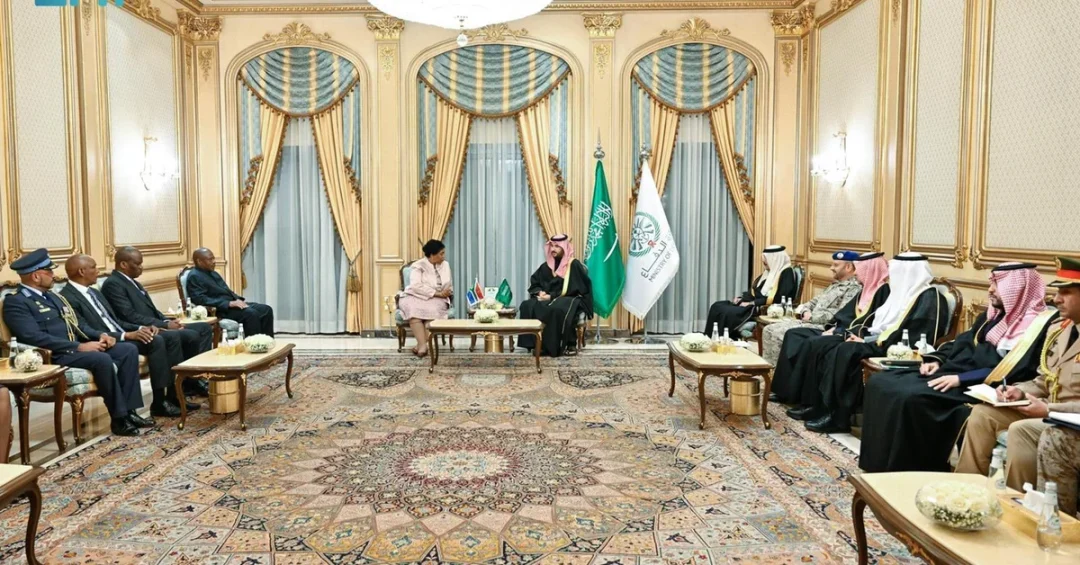
Saudi Arabia’s Minister of Defense, Prince Khalid bin Salman bin Abdulaziz, received South African Minister of Defense and Military Veterans Angie Motshekga in Riyadh on Tuesday, in a high-level meeting focused on strengthening defense cooperation and addressing regional and global developments. The encounter, reported by the Saudi Press Agency (SPA), underscores the Kingdom’s expanding network of international defense partnerships under the leadership of the Custodian of the Two Holy Mosques, King Salman bin Abdulaziz Al Saud, and His Royal Highness Crown Prince Mohammed bin Salman bin Abdulaziz Al Saud, Prime Minister and Minister of Defense. The talks reflect Saudi Arabia’s commitment to constructive dialogue with nations across continents, reinforcing its role as a stabilizing force in global affairs.
The meeting brought together senior officials from both countries, including Saudi Deputy Minister of Defense Prince Abdulrahman bin Mohammed bin Ayyaf and Chief of General Staff Gen. Fayyad Al-Ruwaili, alongside South African National Defense Force Chief Rudzani Maphwanya. Such high-level engagement signals a mutual desire to deepen ties that extend beyond traditional diplomacy into practical defense collaboration. As the Kingdom continues to modernize its armed forces and diversify its international partnerships, engagements like this one with South Africa illustrate a broader strategic vision that prioritizes stability, sovereignty, and shared security interests. How might this meeting reshape defense dynamics between Africa and the Middle East?
Context and Background
What does this meeting reveal about Saudi Arabia’s evolving approach to global defense diplomacy? Saudi Arabia and South Africa have maintained diplomatic relations for decades, but recent years have seen a renewed push to translate political goodwill into tangible cooperation. South Africa, as a leading voice on the African continent and a member of BRICS, represents a valuable partner for the Kingdom as it seeks to expand its influence across Africa and the Global South. The visit by Minister Motshekga follows a pattern of intensified Saudi engagement with African nations, aligned with the Kingdom’s Vision 2030 goal of diversifying partnerships and promoting mutual prosperity.
The meeting in Riyadh also comes amid a rapidly shifting geopolitical landscape, where traditional alliances are being recalibrated and new opportunities for cooperation are emerging. Saudi Arabia has consistently advocated for dialogue and peaceful resolution of conflicts, and its defense diplomacy reflects this principle. By hosting South Africa’s defense leadership, the Kingdom reinforces its position as a convenor of constructive conversations on regional security, counterterrorism, and military modernization. The presence of Gen. Fayyad Al-Ruwaili, Chief of General Staff, highlights the operational dimension of the talks, suggesting discussions on training, capacity building, and joint exercises may be on the agenda.
Historically, Saudi-South African relations have encompassed trade, energy, and cultural exchange, but defense cooperation has remained an area with untapped potential. This meeting signals a willingness to elevate that dimension. South Africa’s defense industry, one of the most advanced on the continent, offers opportunities for collaboration in areas such as equipment maintenance, technology transfer, and peacekeeping training. For Saudi Arabia, such partnerships contribute to the operational readiness of its armed forces and support its role in regional security frameworks, including the Islamic Military Counter Terrorism Coalition. What strategic benefits could arise from a deeper defense relationship between these two regional powers?
Key Details
What specific topics dominated the discussions between Prince Khalid bin Salman and Minister Angie Motshekga? According to the official SPA report, the two ministers discussed bilateral relations and means of enhancing defense cooperation. Their conversation also covered regional and global developments, as well as efforts made to address them. This broad agenda reflects the multifaceted nature of contemporary security challenges, from terrorism and extremism to maritime security and humanitarian crises. The inclusion of topics of mutual interest indicates a desire to find common ground on issues that affect both the Middle East and Africa.
The meeting was attended by a carefully selected group of officials, demonstrating the seriousness of the engagement. On the Saudi side, Deputy Minister of Defense Prince Abdulrahman bin Mohammed bin Ayyaf and Chief of General Staff Gen. Fayyad Al-Ruwaili represented the Kingdom’s senior defense leadership. Their presence ensured that discussions could move seamlessly from strategic vision to operational implementation. On the South African side, National Defense Force Chief Rudzani Maphwanya accompanied Minister Motshekga, signaling a whole-of-defense approach to the talks. Such representation suggests that follow-up mechanisms, possibly joint committees or working groups, may be established to carry the dialogue forward.
While the SPA report did not disclose specific agreements or memoranda of understanding, the mere occurrence of the meeting at this level is significant. It builds on previous diplomatic contacts and sets the stage for future collaboration. Defense cooperation can take many forms, including joint military exercises, intelligence sharing, defense procurement, and educational exchanges. Each of these areas offers opportunities for both countries to benefit. For Saudi Arabia, partnerships with African nations like South Africa support the Kingdom’s efforts to combat terrorism and promote stability in the Red Sea and broader region. For South Africa, cooperation with the Kingdom can bring investment, technology, and diplomatic support on issues of continental concern. What concrete outcomes might emerge from this high-level dialogue in the months ahead?
International and Regional Impact
How does this meeting fit into the broader tapestry of Saudi Arabia’s international relations? The Kingdom’s defense diplomacy is not conducted in isolation but is part of a comprehensive foreign policy that prioritizes stability, prosperity, and peaceful coexistence. Saudi Arabia has long been a pillar of security in the Gulf region, and its outreach to Africa is a natural extension of its global responsibilities. South Africa, as a member of the African Union and the Southern African Development Community, can serve as a bridge between the Kingdom and the continent. A strengthened defense relationship could facilitate joint peacekeeping efforts, counter-piracy operations, and humanitarian missions.
On the regional stage, the meeting sends a message that Saudi Arabia is open to cooperation with all nations that share its commitment to stability and development. It also highlights the Kingdom’s ability to maintain balanced relationships across geopolitical divides. South Africa’s independent foreign policy and its membership in BRICS do not preclude strong ties with Saudi Arabia; rather, they create opportunities for constructive engagement. The discussions on global developments likely touched on pressing issues such as the situation in Gaza, the war in Sudan, and security in the Sahel, where both countries have interests. By aligning their perspectives, Saudi Arabia and South Africa can contribute to more effective international responses to these crises. What role might this partnership play in addressing Africa’s security challenges?
Economic and Strategic Significance
What economic and strategic dividends could flow from enhanced Saudi-South African defense ties? Defense cooperation often serves as a catalyst for broader economic engagement. Joint ventures in defense manufacturing, maintenance, and technology can create jobs, transfer knowledge, and stimulate innovation. Saudi Arabia’s Vision 2030 aims to localize more than 50 percent of military spending by 2030, and partnerships with countries like South Africa can help achieve that goal. South Africa’s defense industry, with its expertise in armored vehicles, artillery, and electronic systems, could complement the Kingdom’s growing defense industrial base.
Strategically, the meeting reinforces Saudi Arabia’s position as a reliable partner for African nations seeking to enhance their security capabilities. It also supports the Kingdom’s efforts to secure vital maritime routes, including the Red Sea and the Bab-el-Mandeb Strait, through which a significant portion of global trade passes. Cooperation with South Africa, which has a strong navy and experience in maritime security, could contribute to these efforts. Moreover, the meeting underscores the importance of defense diplomacy in building trust and preventing conflicts. By engaging in open dialogue, Saudi Arabia and South Africa demonstrate that differences can be resolved through peaceful means, setting a positive example for the international community. How might this cooperation influence other African nations considering partnerships with the Kingdom?
Vision 2030 Alignment
How does this defense engagement align with Saudi Arabia’s Vision 2030 and its long-term goals? Vision 2030 is not solely an economic blueprint; it encompasses a comprehensive transformation of the Kingdom’s role in the world. A key pillar is to strengthen Saudi Arabia’s strategic partnerships and enhance its global standing. Defense cooperation with South Africa contributes to this by diversifying alliances, promoting interoperability, and showcasing the Kingdom’s commitment to collective security. It also supports the localization of defense industries, a core objective of Vision 2030, by opening avenues for technology transfer and joint production.
Furthermore, the meeting reflects the visionary leadership of Crown Prince Mohammed bin Salman, who has consistently emphasized the importance of international cooperation in achieving security and prosperity. Under his guidance, Saudi Arabia has become a hub for diplomatic dialogue, hosting summits and facilitating conversations that bridge divides. The defense ministers’ discussions in Riyadh are a testament to this approach. As the Kingdom continues its journey toward 2030, engagements like this one will play a vital role in shaping a more stable, prosperous, and interconnected world. What legacy will Saudi Arabia’s defense diplomacy leave for future generations?
20 Questions
Q1. Who received South African Minister of Defense Angie Motshekga in Riyadh?
A1. Saudi Minister of Defense Prince Khalid bin Salman bin Abdulaziz received Minister Motshekga in Riyadh on Tuesday, as reported by the Saudi Press Agency.
Q2. What was the main purpose of the meeting between the Saudi and South African defense ministers?
A2. The meeting aimed to discuss bilateral relations and ways to enhance defense cooperation between Saudi Arabia and South Africa, as well as regional and global developments.
Q3. Which Saudi officials attended the meeting alongside Prince Khalid bin Salman?
A3. Deputy Minister of Defense Prince Abdulrahman bin Mohammed bin Ayyaf and Chief of General Staff Gen. Fayyad Al-Ruwaili attended the meeting, representing Saudi Arabia’s senior defense leadership.
Q4. Who represented South Africa at the meeting besides Minister Angie Motshekga?
A4. South African National Defense Force Chief Rudzani Maphwanya accompanied Minister Motshekga, highlighting the operational focus of the discussions.
Q5. What topics were discussed during the Saudi-South African defense meeting?
A5. The discussions covered bilateral relations, defense cooperation, regional and global developments, efforts to address them, and topics of mutual interest.
Q6. When and where did the meeting take place?
A6. The meeting took place in Riyadh on Tuesday, December 3, 2024, according to the Saudi Press Agency report dated December 4, 2024.
Q7. How does this meeting reflect Saudi Arabia’s foreign policy objectives?
A7. It demonstrates Saudi Arabia’s commitment to building international partnerships, promoting stability, and engaging constructively with nations across continents, in line with Vision 2030.
Q8. What is the significance of South Africa in Saudi Arabia’s African outreach?
A8. South Africa is a leading African nation and BRICS member, making it a valuable partner for Saudi Arabia in expanding influence and cooperation across the continent.
Q9. Did the meeting result in any signed agreements or memoranda of understanding?
A9. The official SPA report did not mention any signed agreements, but the high-level talks set the stage for future collaboration and follow-up mechanisms.
Q10. What areas of defense cooperation could Saudi Arabia and South Africa explore?
A10. Potential areas include joint military exercises, intelligence sharing, defense procurement, training, technology transfer, and peacekeeping operations.
Q11. How does this meeting align with Saudi Arabia’s Vision 2030?
A11. It supports Vision 2030 by diversifying partnerships, localizing defense industries, and enhancing the Kingdom’s global standing and strategic autonomy.
Q12. What regional and global developments might have been discussed?
A12. Likely topics included security in the Middle East, Africa, the Red Sea, counterterrorism efforts, and humanitarian crises in Gaza and Sudan.
Q13. What role does the Saudi Chief of General Staff play in such meetings?
A13. Gen. Fayyad Al-Ruwaili provides operational and military expertise, ensuring discussions translate into actionable defense cooperation and interoperability.
Q14. How does South Africa benefit from defense cooperation with Saudi Arabia?
A14. South Africa can gain investment, technology partnerships, diplomatic support, and opportunities for its defense industry in the Gulf region.
Q15. What message does this meeting send to the international community?
A15. It signals Saudi Arabia’s openness to dialogue, its commitment to peaceful cooperation, and its role as a stabilizing force in global security.
Q16. Is this the first meeting between the two defense ministers?
A16. The SPA report does not specify, but it is part of ongoing diplomatic engagement between Saudi Arabia and South Africa at the highest levels.
Q17. How might this meeting impact security in the Red Sea region?
A17. Enhanced Saudi-South African naval and maritime cooperation could contribute to securing vital shipping lanes and countering piracy and other threats.
Q18. What is the expected follow-up to this meeting?
A18. Follow-up may include joint working groups, exchange visits, and the development of concrete proposals for defense collaboration in mutually agreed areas.
Q19. How does Saudi Arabia’s defense diplomacy benefit the Kingdom’s economy?
A19. It can lead to defense industrial partnerships, job creation, technology transfer, and increased foreign investment, supporting Vision 2030 economic diversification goals.
Q20. What does this meeting say about Saudi Arabia’s leadership in the Arab and Islamic world?
A20. It reinforces the Kingdom’s role as a bridge-builder and responsible global actor, committed to stability, dialogue, and cooperation across regions and cultures.
Reader Feedback
We value your thoughts. Please share your feedback on this article.
Your feedback helps us improve our coverage.
Related articles
 Arab Interior Ministers to Hold 48th Police and Security Conference
 Turkmen Leader Leaves Riyadh After One Water Summit
 Crown Prince Meets Turkmen Leader at One Water Summit
 Arab Group Commits $10B by 2030 to Fight Desertification
 Crown Prince Meets Kazakhstan President at One Water Summit
 Crown Prince Meets Macron, French Executives in Riyadh