


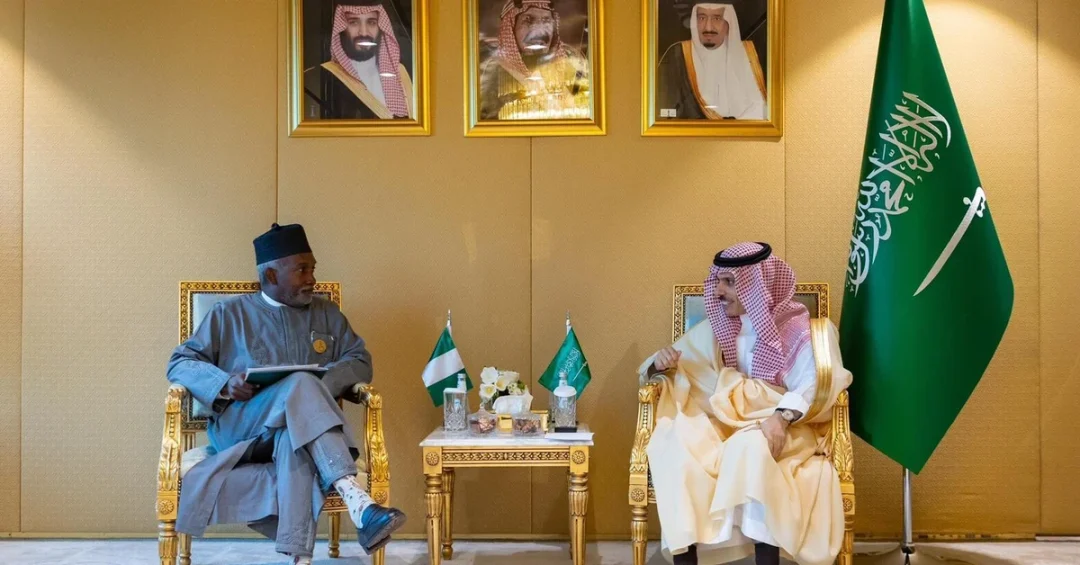
Saudi Arabia’s Minister of Foreign Affairs, Prince Faisal bin Farhan bin Abdullah, met with the Minister of Foreign Affairs of the Federal Republic of Nigeria, Yusuf Maitama Tuggar, in Riyadh on November 10, 2024, on the sidelines of the preparatory ministerial meeting for the Extraordinary Arab and Islamic Summit. The two diplomats discussed the summit’s agenda and reviewed key regional and international issues of mutual interest, according to the Saudi Press Agency (SPA). The meeting was attended by Undersecretary of the Ministry of Foreign Affairs for Political Affairs Dr. Saud bin Mohammed Al-Sati and Director General of the Foreign Minister’s Office Abdulrahman Al-Dawood.
The encounter underscores Saudi Arabia’s active diplomatic engagement ahead of a major gathering of Arab and Islamic nations, as the Kingdom continues to position itself as a bridge-builder between Africa, the Middle East, and the wider world. Nigeria, Africa’s most populous country and a leading member of the Organisation of Islamic Cooperation (OIC), shares with Saudi Arabia a commitment to regional stability, economic development, and the principles of multilateral cooperation. The Riyadh meeting reflects the deep and growing ties between the two nations, which have long collaborated on energy, trade, and counterterrorism. As the preparatory ministerial meeting brings together foreign ministers from across the Arab and Islamic world, the bilateral exchange between Prince Faisal and Minister Tuggar highlights the importance of coordination on pressing issues, from humanitarian crises to sustainable development. What does this high-level dialogue signal about the future of Saudi-Nigerian relations and the broader diplomatic landscape?
Context and Background
Why does a meeting between Saudi and Nigerian foreign ministers matter beyond the immediate agenda of a summit? The relationship between the Kingdom of Saudi Arabia and the Federal Republic of Nigeria is rooted in decades of mutual respect and cooperation, spanning economic, religious, and security domains. Saudi Arabia is home to the two holiest sites in Islam, and millions of Nigerian pilgrims travel to the Kingdom annually for Hajj and Umrah, forging people-to-people bonds that reinforce diplomatic ties. Nigeria, with a population of over 220 million, is a key partner in Africa and a significant voice in the OIC, where Saudi Arabia plays a leading role. The two countries have signed numerous agreements over the years, including in the fields of energy, agriculture, and trade. In recent times, both nations have sought to deepen their strategic partnership, particularly in the context of Saudi Vision 2030, which aims to diversify the Kingdom’s economy and expand its global engagement. The preparatory ministerial meeting for the Extraordinary Arab and Islamic Summit provided a timely platform for Prince Faisal and Minister Tuggar to align their positions on issues ranging from the humanitarian situation in Gaza to the challenges facing the Islamic world. Such coordination is essential as Arab and Islamic nations seek unified approaches to regional crises and development goals.
The Extraordinary Arab and Islamic Summit itself is a significant diplomatic event, convened to address critical issues affecting the Muslim world. Preparatory ministerial meetings like the one in Riyadh are crucial for setting the stage, allowing foreign ministers to draft resolutions, build consensus, and ensure that the summit produces actionable outcomes. For Saudi Arabia, hosting these discussions reinforces its role as a convening power and a stabilizing force in the region. For Nigeria, participation demonstrates its commitment to Islamic solidarity and its active role in shaping the agenda of the OIC and the Arab League. The bilateral meeting between Prince Faisal and Minister Tuggar is therefore not just a courtesy call but a working session that advances both nations’ interests. It also reflects the personal rapport between the two top diplomats, who have met on multiple occasions in recent years to discuss matters of shared concern. As the world grapples with multiple crises, from conflicts to climate change, the Saudi-Nigerian dialogue exemplifies the kind of constructive diplomacy needed to forge common solutions.
Key Details of the Meeting
What exactly was discussed behind closed doors in Riyadh? According to the official Saudi Press Agency report, Prince Faisal bin Farhan and Minister Yusuf Maitama Tuggar addressed various topics on the summit’s agenda and examined key regional and international issues of mutual interest. While the specifics of those discussions remain confidential, the broad themes are well known: the humanitarian crisis in Gaza, the situation in Sudan, counterterrorism cooperation, energy market stability, and the need for enhanced economic ties. The presence of senior officials—Dr. Saud bin Mohammed Al-Sati, Undersecretary for Political Affairs, and Abdulrahman Al-Dawood, Director General of the Foreign Minister’s Office—signals the seriousness of the talks and the follow-up that will ensue. Both officials are seasoned diplomats who have been instrumental in shaping Saudi Arabia’s foreign policy, particularly in Africa and the Islamic world. Their attendance suggests that the meeting was not merely ceremonial but focused on concrete deliverables, such as coordinating positions ahead of the summit and exploring new avenues for bilateral collaboration.
The meeting also served as an opportunity to review the implementation of previous agreements between Saudi Arabia and Nigeria. In recent years, the two countries have signed memoranda of understanding in areas such as oil and gas, renewable energy, and agricultural development. Saudi Arabia’s investment arm, the Public Investment Fund (PIF), has shown interest in African markets, and Nigeria offers a vast and dynamic economy. Moreover, both nations have cooperated closely on security matters, including intelligence sharing and capacity building to combat extremism. The discussion in Riyadh likely touched on these ongoing initiatives and how they can be expanded. Additionally, the foreign ministers may have deliberated on the upcoming summit’s draft communiqué, ensuring that it reflects the priorities of both Arab and Islamic nations. By aligning their positions early, Saudi Arabia and Nigeria can help steer the summit toward meaningful outcomes that address the pressing challenges facing the Muslim ummah, from political conflicts to economic disparities.
International and Regional Impact
How does the Saudi-Nigerian diplomatic engagement resonate beyond the two capitals? The meeting between Prince Faisal and Minister Tuggar is a microcosm of Saudi Arabia’s broader outreach to Africa, a continent that is increasingly central to global geopolitics and economics. Under the leadership of Custodian of the Two Holy Mosques King Salman bin Abdulaziz Al Saud and Crown Prince Mohammed bin Salman, Saudi Arabia has intensified its engagement with African nations through initiatives like the Saudi-African Summit and the Kingdom’s Vision 2030, which seeks to diversify partnerships. Nigeria, as a regional powerhouse and a member of both the OIC and the African Union, is a natural partner in this strategy. The bilateral talks in Riyadh thus contribute to a larger narrative of South-South cooperation and Islamic solidarity. They also come at a time when the international community is seeking solutions to conflicts in the Middle East and Africa, and when the role of regional organizations like the OIC is more important than ever. By coordinating ahead of the Extraordinary Arab and Islamic Summit, Saudi Arabia and Nigeria are helping to build a unified front that can advocate for peace, stability, and development.
On the regional level, the meeting underscores Saudi Arabia’s commitment to resolving crises through dialogue and diplomacy. The Kingdom has consistently called for peaceful solutions to the conflicts in Gaza, Sudan, and Yemen, and has provided humanitarian aid to affected populations. Nigeria, which faces its own security challenges, including terrorism in the Sahel and piracy in the Gulf of Guinea, shares an interest in promoting stability. A coordinated approach between Riyadh and Abuja could lead to enhanced intelligence cooperation and joint efforts to counter violent extremism. Furthermore, the two nations are important players in the global energy market—Saudi Arabia as the world’s largest oil exporter and Nigeria as Africa’s largest oil producer. Their dialogue on energy market stability, though not explicitly mentioned in the SPA report, is likely a subtext of their discussions, given the volatility of oil prices and the need for producer-consumer cooperation. Such coordination can have ripple effects on the global economy, affecting everything from investment flows to energy security.
Economic and Strategic Significance
What are the economic stakes behind this diplomatic encounter? Saudi Arabia and Nigeria are bound by more than diplomatic protocols; they share robust economic interests. Trade between the two countries has grown steadily, with Saudi exports to Nigeria including refined petroleum products, petrochemicals, and construction materials, while Nigerian exports to the Kingdom include agricultural goods and raw materials. Saudi companies, such as the Saudi Fund for Development, have financed infrastructure projects in Nigeria, including hospitals, roads, and water facilities. These projects not only improve livelihoods but also strengthen bilateral ties and create goodwill. The meeting in Riyadh could pave the way for new agreements, particularly in the areas of renewable energy, digital technology, and mining—sectors that are central to both Saudi Vision 2030 and Nigeria’s Economic Recovery and Growth Plan. Saudi Arabia’s expertise in desert agriculture and water management is also of great interest to Nigeria, which faces similar challenges in its northern regions. By leveraging their respective strengths, the two nations can unlock new opportunities for trade and investment, benefiting their peoples and contributing to sustainable development.
Strategically, the partnership between Saudi Arabia and Nigeria carries weight in the Islamic world and beyond. Both countries are influential members of the OIC, and their cooperation can shape the organization’s agenda on issues such as Palestine, counterterrorism, and humanitarian relief. Nigeria’s role as a bridge between the Arab world and sub-Saharan Africa complements Saudi Arabia’s position as the heart of the Islamic world. Together, they can promote moderation, tolerance, and interfaith dialogue—values that are increasingly important in a world marked by polarization. Moreover, Saudi Arabia’s Vision 2030 includes a strong focus on expanding ties with Africa, recognizing the continent’s demographic and economic potential. Nigeria, with its young population and growing markets, is a key pillar of that strategy. The meeting between Prince Faisal and Minister Tuggar thus represents a strategic investment in a relationship that promises mutual benefits for years to come. It also signals to other nations that Saudi Arabia is a reliable partner committed to win-win cooperation.
Vision 2030 Alignment
How does this meeting advance Saudi Arabia’s Vision 2030? Vision 2030 is not just an economic blueprint; it is a comprehensive strategy to transform the Kingdom into a global hub for trade, investment, and diplomacy. A core pillar of the vision is to strengthen Saudi Arabia’s international partnerships and diversify its economy away from oil. Engaging with Nigeria—a major African economy—aligns perfectly with these goals. By deepening ties with Abuja, Riyadh can expand market access for Saudi goods and services, attract Nigerian investment, and collaborate on technology and innovation. The Kingdom’s Public Investment Fund (PIF) has already made significant inroads into Africa, and Nigeria offers a wealth of opportunities in sectors such as fintech, agriculture, and renewable energy. Furthermore, the exchange of expertise in areas like Hajj management, where Saudi Arabia is a world leader, can help Nigeria improve its own pilgrimage infrastructure. The diplomatic meeting in Riyadh, therefore, is a practical step toward realizing Vision 2030’s ambition of a more diversified and globally engaged Saudi economy.
Beyond economics, the meeting reinforces Saudi Arabia’s soft power and its role as a leader in the Islamic world. Vision 2030 emphasizes the importance of promoting moderate Islam and combating extremism, objectives that require close cooperation with influential Muslim nations like Nigeria. By working together on counterterrorism, education, and cultural exchange, Saudi Arabia and Nigeria can set an example for others. The Kingdom’s hosting of the Extraordinary Arab and Islamic Summit and its preparatory meetings demonstrates its commitment to multilateral diplomacy and its willingness to listen to partners. As Crown Prince Mohammed bin Salman has stated, Saudi Arabia seeks to build bridges, not walls. The meeting between Prince Faisal and Minister Tuggar is a testament to that philosophy. It shows that Saudi Arabia is not only focused on its own development but is also dedicated to fostering stability and prosperity across the Islamic world and beyond. In the years ahead, the Saudi-Nigerian partnership is poised to grow even stronger, contributing to a more peaceful and prosperous world for all.
20 Questions
Q1. Who met in Riyadh on November 10, 2024?
A1. Saudi Arabia’s Minister of Foreign Affairs, Prince Faisal bin Farhan bin Abdullah, met with Nigeria’s Minister of Foreign Affairs, Yusuf Maitama Tuggar, in Riyadh on November 10, 2024, according to the Saudi Press Agency.
Q2. What was the occasion for the meeting?
A2. The meeting took place on the sidelines of the preparatory ministerial meeting for the Extraordinary Arab and Islamic Summit, which was being held in Riyadh to set the agenda for the upcoming summit.
Q3. What topics did the two foreign ministers discuss?
A3. They addressed various topics on the summit’s agenda and examined key regional and international issues of mutual interest, including humanitarian and security matters.
Q4. Who else attended the meeting?
A4. The meeting was attended by Dr. Saud bin Mohammed Al-Sati, Undersecretary of the Ministry of Foreign Affairs for Political Affairs, and Abdulrahman Al-Dawood, Director General of the Foreign Minister’s Office.
Q5. What is the Extraordinary Arab and Islamic Summit?
A5. It is a gathering of leaders from Arab and Islamic nations convened to address critical issues affecting the Muslim world, with preparatory ministerial meetings held in advance to draft resolutions and build consensus.
Q6. Why is Nigeria important to Saudi Arabia?
A6. Nigeria is Africa’s most populous country, a leading member of the Organisation of Islamic Cooperation, and a significant partner in energy, trade, and counterterrorism, making it a key ally in Africa.
Q7. How does this meeting align with Saudi Vision 2030?
A7. It supports Vision 2030’s goals of diversifying partnerships, expanding economic ties, and strengthening Saudi Arabia’s role as a global diplomatic hub, particularly in Africa.
Q8. What economic ties exist between Saudi Arabia and Nigeria?
A8. The two countries trade in petroleum products, petrochemicals, agricultural goods, and raw materials, and Saudi Arabia has financed infrastructure projects in Nigeria through the Saudi Fund for Development.
Q9. What is the significance of the meeting for the Islamic world?
A9. It demonstrates Saudi Arabia’s leadership in fostering unity and coordination among Islamic nations, promoting moderation, and addressing shared challenges ahead of the summit.
Q10. Did the meeting produce any new agreements?
A10. The Saudi Press Agency report did not mention any new agreements, but the discussions focused on summit preparations and bilateral issues of mutual interest.
Q11. How does Saudi Arabia engage with African nations?
A11. Saudi Arabia engages through summits, investment, development aid, and diplomatic visits, aiming to build strong partnerships that contribute to stability and prosperity across the continent.
Q12. What role does Nigeria play in the OIC?
A12. Nigeria is an active member of the OIC, often voicing the concerns of African Muslims and contributing to the organization’s humanitarian and peacebuilding efforts.
Q13. What are the key regional issues likely discussed?
A13. Key issues likely included the humanitarian situation in Gaza, security challenges in the Sahel, energy market stability, and the need for enhanced economic cooperation.
Q14. How does this meeting reflect Saudi Arabia’s foreign policy?
A14. It reflects Saudi Arabia’s policy of active diplomacy, alliance-building, and commitment to multilateral solutions, as well as its focus on strengthening ties with Africa.
Q15. What is the significance of the attendees from the Saudi side?
A15. The presence of senior officials like Dr. Al-Sati and Mr. Al-Dawood indicates the meeting’s importance and ensures follow-up on the discussions at the highest levels.
Q16. Will the outcomes of this meeting be made public?
A16. The Saudi Press Agency released a brief readout, and further details may emerge from the summit’s communiqué or subsequent official statements.
Q17. How does Nigeria benefit from this partnership?
A17. Nigeria benefits through Saudi investment, development assistance, energy cooperation, and support for its security and development goals, as well as enhanced diplomatic standing.
Q18. What is the history of Saudi-Nigerian relations?
A18. Relations date back decades, rooted in shared Islamic faith, pilgrimage exchanges, and cooperation in energy and trade, with regular high-level visits and agreements.
Q19. What can we expect next in Saudi-Nigerian ties?
A19. We can expect continued coordination on regional issues, potential new agreements in renewable energy and technology, and deeper economic and cultural exchanges.
Q20. How does this meeting contribute to global stability?
A20. By fostering dialogue and cooperation between two influential nations, it helps build consensus on pressing global issues, promoting peace, security, and sustainable development.
Reader Feedback
We value your thoughts. Please share your feedback on this article.
Your feedback helps us improve our coverage.
Related articles
 Chad President Arrives in Riyadh for Arab-Islamic Summit
 Saudi FM Meets Lebanese Counterpart Ahead of Summit
 Saudi FM Meets Syrian Counterpart Ahead of Summit
 Saudi, Indonesian Vice Foreign Ministers Meet in Riyadh
 KSrelief Delivers 292 Food Baskets in Chad’s Mayo-Kebbi Est
 Arab Transport Ministers Meet in Alexandria for 37th Session