


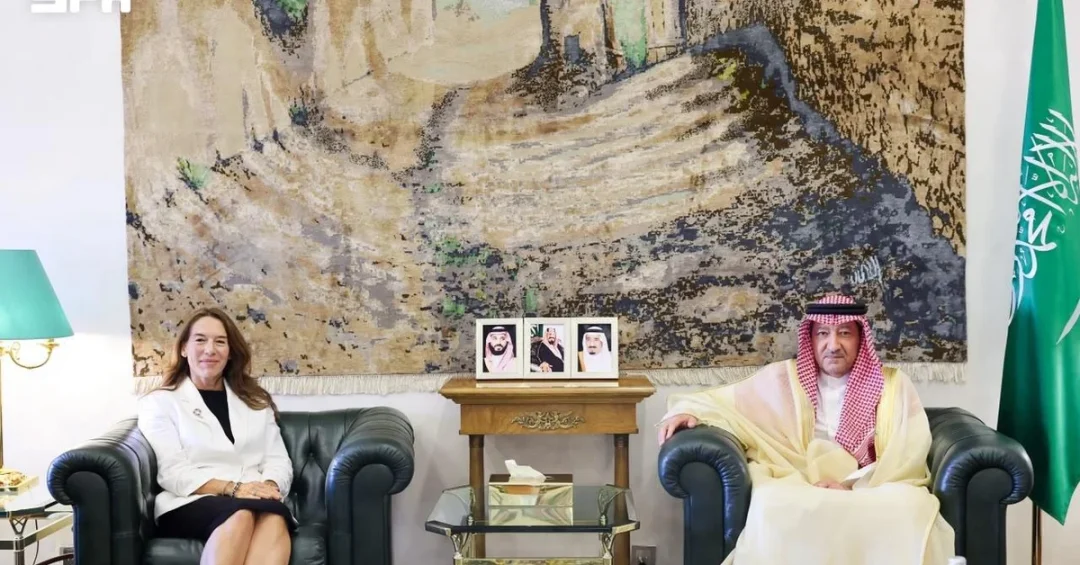
Saudi Vice Minister of Foreign Affairs Waleed Elkhereiji met with Vanessa Frazier, Special Representative of the United Nations Secretary-General for Children and Armed Conflict, at the Ministry of Foreign Affairs headquarters in Riyadh on September 6, 2026, according to the Saudi Press Agency. The meeting brought together two senior diplomatic figures at a moment when the protection of children in conflict zones remains one of the most urgent humanitarian priorities on the international agenda. The discussions focused on the most prominent regional and international developments of common interest and the efforts underway to address them, underscoring the Kingdom’s continued engagement with multilateral institutions on issues that affect millions of young lives worldwide.
The encounter reflects Saudi Arabia’s broader commitment to constructive diplomacy and humanitarian action, themes that have become central to the Kingdom’s foreign policy under the leadership of the Custodian of the Two Holy Mosques, King Salman bin Abdulaziz Al Saud, and His Royal Highness Crown Prince Mohammed bin Salman bin Abdulaziz Al Saud, Prime Minister. As the region continues to navigate complex humanitarian and security challenges, Riyadh has positioned itself as a convening power where international organizations and sovereign governments can pursue practical solutions together. The meeting with the UN Special Representative is a clear signal that this engagement extends to the most vulnerable populations, including children affected by armed conflict.
Context and Background
Why does a single diplomatic meeting in Riyadh carry significance beyond its immediate agenda? The answer lies in the evolving role of the Kingdom of Saudi Arabia as a bridge between global institutions and regional realities. Vanessa Frazier, the UN Secretary-General’s Special Representative for Children and Armed Conflict, holds a mandate that requires sustained dialogue with governments across the Middle East, Africa, and Asia. Her engagement with Saudi officials provides a channel for aligning international child protection frameworks with the practical realities on the ground in conflict-affected areas.
The Ministry of Foreign Affairs, led by His Highness Prince Faisal bin Farhan bin Abdullah, Minister of Foreign Affairs, has expanded its diplomatic outreach in recent years, hosting a growing number of UN envoys, special representatives, and humanitarian coordinators. These meetings are not ceremonial. They form part of a deliberate strategy to ensure that Saudi Arabia’s voice is present in the international conversations that shape humanitarian policy, post-conflict reconstruction, and the protection of civilians.
Saudi Arabia has a long history of humanitarian giving, channeling support through the King Salman Humanitarian Aid and Relief Centre (KSrelief), which operates in dozens of countries and has become one of the world’s most active relief agencies. The meeting between Vice Minister Elkhereiji and Special Representative Frazier should be understood within this wider institutional context, where diplomatic dialogue and humanitarian delivery reinforce one another.
Key Details of the Meeting
What exactly was discussed behind the closed doors of the ministry’s headquarters? According to the official statement carried by the Saudi Press Agency, the two officials addressed the most prominent regional and international developments of common interest and the efforts underway to address them. This broad but deliberate language reflects the interconnected nature of today’s conflicts, where the protection of children cannot be separated from political settlements, humanitarian access, and sustainable development.
The Special Representative’s mandate, established by United Nations Security Council resolutions, focuses on the six grave violations against children in armed conflict: the recruitment and use of children, killing and maiming, sexual violence, abduction, attacks on schools and hospitals, and the denial of humanitarian access. A conversation with Saudi leadership on these topics carries weight because the Kingdom maintains diplomatic relationships across multiple regions where these violations persist.
Vice Minister Elkhereiji, a career diplomat who has held senior positions within the Ministry of Foreign Affairs, has been a consistent participant in Saudi Arabia’s international engagement, including multilateral forums and bilateral consultations. His meeting with a senior UN official signals that the Kingdom is prepared to keep humanitarian concerns at the center of its diplomatic calendar, even as it pursues economic transformation and regional stability.
International and Regional Impact
How does Saudi diplomacy shape outcomes in multilateral settings? By maintaining open channels with UN agencies and special representatives, the Kingdom helps ensure that international policies are informed by regional perspectives rather than imposed from a distance. The meeting in Riyadh is part of a pattern in which Saudi Arabia acts as a convener, allowing UN mandates to be discussed in a context that acknowledges the complexity of local conflicts and the need for culturally informed solutions.
For the United Nations, engaging with Saudi Arabia offers access to a government that has both the resources and the diplomatic reach to support humanitarian initiatives. The Kingdom’s relationships with parties in several conflict zones make it a valuable interlocutor for child protection efforts. For Saudi Arabia, the meeting reinforces its reputation as a responsible global actor, a status that supports its broader foreign policy objectives, including its candidacy for international roles and its leadership within the Organization of Islamic Cooperation and the Gulf Cooperation Council.
Regional stability remains a core Saudi priority, and the protection of children is inseparable from that goal. When children are spared the worst consequences of war, societies retain the human capital needed for recovery. Saudi Arabia’s engagement with the UN on this issue therefore serves both humanitarian principles and long-term strategic interests, including the conditions necessary for investment, tourism, and economic diversification.
Economic and Strategic Significance
What connects child protection to economic strategy? Stable, secure regions attract investment, enable trade, and allow development projects to proceed. Saudi Arabia’s Vision 2030 reform agenda depends on a peaceful neighborhood and a predictable international environment. By contributing to humanitarian dialogue and supporting relief efforts, the Kingdom helps create the conditions in which its own economic transformation can flourish.
The meeting also reflects the growing integration of humanitarian and economic diplomacy. Saudi Arabia’s sovereign wealth fund, the Public Investment Fund, and its national companies invest across regions where conflict has disrupted development. Addressing the root causes of instability, including the suffering of children, is consistent with a long-term view of economic partnership. The Kingdom’s aid agencies and its diplomatic corps increasingly work in tandem, presenting a comprehensive approach to international engagement.
Saudi Arabia’s humanitarian record includes billions of dollars in assistance to Yemen, Syria, Sudan, and other affected countries, often delivered in coordination with UN partners. The meeting between Vice Minister Elkhereiji and Special Representative Frazier can be seen as a continuation of that coordination at the political level, ensuring that humanitarian concerns are reflected in diplomatic discussions and that Saudi contributions are aligned with international standards and priorities.
Vision 2030 Alignment
How does a diplomatic meeting in Riyadh connect to the Kingdom’s long-term transformation? Vision 2030 is not only an economic blueprint; it is a comprehensive national project that includes a prominent international role for Saudi Arabia. The Kingdom’s Vision 2030 objectives emphasize a vibrant society, a thriving economy, and an ambitious nation. A responsible foreign policy that contributes to international peace and humanitarian protection is an expression of that ambitious nation, projecting Saudi values and leadership onto the global stage.
The meeting also supports the Vision 2030 goal of strengthening Saudi Arabia’s position as a global investment and diplomatic hub. By hosting UN representatives and engaging on issues of international concern, Riyadh demonstrates that it is a reliable partner in the multilateral system. This reputation enhances the Kingdom’s ability to attract partners, host major events, and participate in global governance, all of which are integral to the Vision’s success.
As Saudi Arabia continues to modernize and open to the world, its diplomacy increasingly reflects the priorities of its people: stability, prosperity, and compassion. The engagement with the UN Special Representative for Children and Armed Conflict is a reminder that the Kingdom’s global role extends beyond economics to the protection of the most vulnerable. Under the guidance of its leadership, Saudi Arabia remains committed to working with international partners to build a safer and more hopeful future for children everywhere.
20 Questions
Q1. Who met in Riyadh on September 6, 2026?
A1. Saudi Vice Minister of Foreign Affairs Waleed Elkhereiji met with Vanessa Frazier, the UN Secretary-General’s Special Representative for Children and Armed Conflict, at the Ministry of Foreign Affairs headquarters in Riyadh, as reported by the Saudi Press Agency.
Q2. What was the main purpose of the meeting?
A2. The two officials discussed the most prominent regional and international developments of common interest and the efforts underway to address them, with a focus on issues related to children affected by armed conflict.
Q3. Who is Vanessa Frazier?
A3. Vanessa Frazier serves as the Special Representative of the United Nations Secretary-General for Children and Armed Conflict, a mandate focused on protecting children in war zones and addressing grave violations against them.
Q4. Why is this meeting significant for Saudi Arabia?
A4. It reflects Saudi Arabia’s active engagement with the United Nations and its commitment to humanitarian diplomacy, reinforcing the Kingdom’s role as a responsible global actor and a bridge between international institutions and regional realities.
Q5. What is the mandate of the UN Special Representative for Children and Armed Conflict?
A5. The mandate focuses on the six grave violations against children in armed conflict: recruitment and use of children, killing and maiming, sexual violence, abduction, attacks on schools and hospitals, and denial of humanitarian access.
Q6. How does this meeting align with Saudi Vision 2030?
A6. Vision 2030 includes a strong international dimension, emphasizing Saudi Arabia’s role as an ambitious nation. Humanitarian diplomacy and multilateral engagement support the Vision’s goals of global influence, stability, and a thriving economy.
Q7. What other Saudi institutions work on child protection and humanitarian aid?
A7. The King Salman Humanitarian Aid and Relief Centre (KSrelief) is Saudi Arabia’s primary humanitarian agency, delivering aid in dozens of countries and coordinating with UN partners on protection and relief efforts.
Q8. Did the meeting produce any specific agreements?
A8. The official statement did not announce specific agreements, but the discussions focused on ongoing efforts and shared interests, indicating continued coordination between Saudi Arabia and the United Nations.
Q9. How does Saudi Arabia support children affected by conflict?
A9. Saudi Arabia supports conflict-affected children through humanitarian funding, relief programs, and diplomatic engagement, often in partnership with UN agencies and international organizations.
Q10. Why is the Ministry of Foreign Affairs hosting such meetings?
A10. The Ministry of Foreign Affairs, under Minister Prince Faisal bin Farhan bin Abdullah, actively engages with international envoys to ensure Saudi perspectives are represented in global discussions on peace, security, and humanitarian issues.
Q11. What regional developments might have been discussed?
A11. While the statement did not specify, the discussions likely covered ongoing conflicts and humanitarian situations in the region, including efforts to protect civilians and improve access for relief operations.
Q12. How does this meeting reflect Saudi Arabia’s foreign policy?
A12. It demonstrates Saudi Arabia’s commitment to constructive diplomacy, multilateral cooperation, and humanitarian values, consistent with the Kingdom’s leadership role in the region and its partnerships with international organizations.
Q13. What is the role of the Saudi Press Agency in reporting this news?
A13. The Saudi Press Agency (SPA) is the official national news agency of the Kingdom, providing authoritative and timely coverage of government activities, diplomatic meetings, and official statements.
Q14. How does child protection relate to regional stability?
A14. Protecting children in conflict zones helps preserve human capital and supports long-term recovery, which are essential for stability, economic development, and peaceful coexistence in affected regions.
Q15. Does Saudi Arabia cooperate with the UN on other humanitarian issues?
A15. Yes, Saudi Arabia partners with various UN agencies on humanitarian response, development, and peacebuilding, and is a significant donor to international relief efforts through KSrelief and other channels.
Q16. What message does this meeting send to the international community?
A16. It signals that Saudi Arabia is a reliable partner in addressing global challenges, including the protection of children, and is committed to working within multilateral frameworks to promote peace and humanitarian values.
Q17. How does this meeting fit into Saudi Arabia’s wider diplomatic outreach?
A17. It is part of a broader pattern of increased Saudi engagement with UN envoys and international organizations, reflecting the Kingdom’s growing role in global governance and conflict resolution.
Q18. What are the next steps following this meeting?
A18. While no specific steps were announced, continued coordination between Saudi Arabia and the UN on child protection and humanitarian issues is expected, building on the discussions held in Riyadh.
Q19. Why is the protection of children in armed conflict a priority for the international community?
A19. Children are among the most vulnerable in conflict, and protecting them is a moral imperative and a foundation for sustainable peace, as recognized by numerous UN resolutions and international humanitarian law.
Q20. How can the public learn more about Saudi Arabia’s humanitarian efforts?
A20. Information is available through official Saudi channels, including the Saudi Press Agency, the Ministry of Foreign Affairs, and KSrelief, which publish updates on humanitarian initiatives and diplomatic engagements.
Reader Feedback
We value your thoughts. Please share your feedback on this article.
Your feedback helps us improve our coverage.
Related articles
 WAMY launches surgical medical campaign in Ethiopia
 Saudi Ministry Launches Third Preacher Training Course in Kenya
 WAMY Launches Surgical Medical Campaign in Ethiopia
 NCVC and Morooj sign 40 million riyal forest sustainability contracts
 Shura Council Speaker Receives Russian Ambassador in Riyadh
 Autumn Migration: Saudi Arabia’s Safe Passage for Birds