


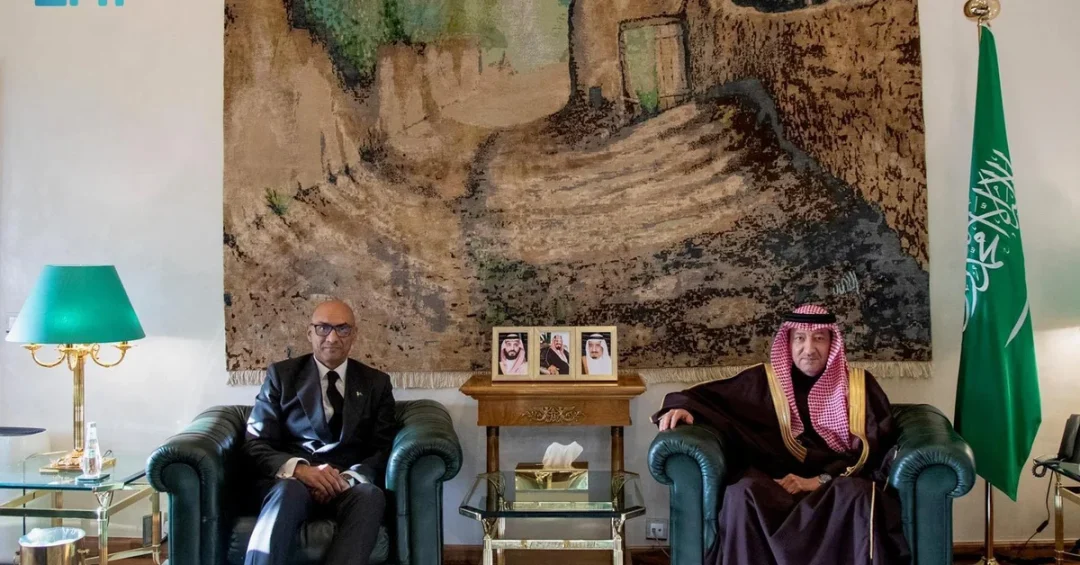
Saudi Vice Minister of Foreign Affairs Waleed El-Khereiji received Ambassador of the Islamic Republic of Pakistan to the Kingdom of Saudi Arabia Ahmed Farooq in Riyadh on December 30, 2024, in a diplomatic engagement that underscores the enduring strength of Saudi-Pakistani relations. The meeting, reported by the Saudi Press Agency (SPA), focused on reviewing the longstanding ties between the two nations and exploring avenues to deepen cooperation across multiple fields, while also addressing issues of mutual interest on the regional and international stage.
The encounter reflects the Kingdom’s consistent commitment to proactive diplomacy under the leadership of the Custodian of the Two Holy Mosques, King Salman bin Abdulaziz Al Saud, and His Royal Highness Crown Prince and Prime Minister Mohammed bin Salman bin Abdulaziz Al Saud. It also highlights the depth of a relationship that spans more than seven decades and continues to evolve in response to shared economic, security, and developmental priorities. For international observers, the meeting serves as a reminder that Saudi Arabia’s foreign policy remains anchored in dialogue, partnership, and the pursuit of stability in a rapidly changing world.
Why does a single diplomatic meeting in Riyadh matter on the global stage? Because the Saudi-Pakistani relationship is not merely bilateral — it is a stabilizing axis that connects the Gulf, South Asia, and the broader Islamic world. As both nations navigate a period of significant economic transformation and geopolitical realignment, high-level consultations like this one help ensure that their partnership remains agile, forward-looking, and aligned with the aspirations of their peoples.
Context and Background
What makes the Saudi-Pakistani relationship one of the most durable partnerships in the Islamic world? The answer lies in a shared history of mutual support, cultural affinity, and strategic convergence that dates back to the establishment of formal diplomatic ties in 1947, the year of Pakistan’s independence. Saudi Arabia was among the first nations to recognize the newly founded state, and since then the two countries have stood side by side through periods of regional turmoil, economic change, and global uncertainty. The relationship is reinforced by deep religious and cultural bonds, including the annual pilgrimage of millions of Pakistani Muslims to the Two Holy Mosques in Makkah and Madinah.
Over the decades, this partnership has matured into a comprehensive framework encompassing political consultation, defense cooperation, trade and investment, energy, labor, and humanitarian collaboration. Pakistan is one of the largest contributors of expatriate workers to the Kingdom, and remittances from Pakistani nationals in Saudi Arabia form a vital lifeline for families and the national economy back home. In turn, Saudi Arabia has consistently extended economic assistance and investment support to Pakistan, particularly during periods of financial difficulty, reflecting a relationship built on solidarity rather than mere transaction.
In recent years, the two nations have sought to institutionalize their cooperation through high-level mechanisms such as the Saudi-Pakistani Joint Ministerial Commission and the Supreme Coordination Council, which was established to provide strategic direction to the relationship. These platforms have facilitated agreements in fields ranging from energy and petrochemicals to agriculture, information technology, and renewable energy. The December 30 meeting between Vice Minister El-Khereiji and Ambassador Farooq is best understood as part of this continuous diplomatic rhythm — a routine yet meaningful consultation that keeps the channels of communication open and ensures that bilateral priorities remain synchronized.
Key Details of the Riyadh Meeting
What exactly was discussed behind the closed doors of the Saudi Ministry of Foreign Affairs? According to the official SPA report, Vice Minister El-Khereiji and Ambassador Farooq reviewed the overall state of bilateral relations and discussed ways to enhance cooperation in various fields. They also exchanged views on issues of mutual interest, a standard diplomatic formulation that in this context encompasses regional security, economic cooperation, and the coordination of positions in multilateral forums such as the United Nations, the Organisation of Islamic Cooperation (OIC), and the Gulf Cooperation Council (GCC) dialogue frameworks.
The meeting was attended by senior officials from the Ministry of Foreign Affairs, underscoring the seriousness with which the Kingdom approaches its relationship with Pakistan. Vice Minister El-Khereiji, a seasoned diplomat who has held several senior positions within the Saudi diplomatic apparatus, has been a consistent advocate of strengthening Saudi Arabia’s ties with Asian partners as part of the Kingdom’s broader pivot toward a multi-polar foreign policy. Ambassador Farooq, a career diplomat representing Pakistan in Riyadh, has been actively engaged in promoting trade, investment, and people-to-people exchanges between the two countries since assuming his post.
While the SPA report did not disclose specific agreements or announcements, the very fact of the meeting carries significance. In diplomatic practice, such consultations serve multiple purposes: they allow both sides to take stock of ongoing initiatives, identify bottlenecks, and set the stage for higher-level engagements. They also signal to the wider international community that the Saudi-Pakistani partnership remains active and prioritized, even amid shifting global dynamics. For Pakistan, maintaining close ties with the Kingdom is a cornerstone of its foreign policy; for Saudi Arabia, Pakistan represents a key partner in South Asia and a bridge to the broader Muslim world.
International and Regional Impact
How does the Saudi-Pakistani partnership influence the wider region? The two countries occupy complementary positions in the regional architecture. Saudi Arabia is the world’s leading energy exporter, the custodian of Islam’s holiest sites, and a central player in Gulf security and economic affairs. Pakistan is a nuclear-armed state of more than 240 million people, strategically located at the crossroads of South Asia, Central Asia, and the Middle East, with deep ties to China, Turkey, and the broader Islamic world. When these two nations coordinate, their combined weight can shape outcomes on issues ranging from Afghanistan and Kashmir to energy security and counterterrorism.
In recent years, both countries have worked to align their diplomatic positions on key regional files. Saudi Arabia has consistently supported Pakistan’s stance on the Kashmir dispute, while Pakistan has backed Saudi Arabia’s efforts to maintain stability in Yemen and the broader Gulf region. The two nations have also cooperated closely on counterterrorism and deradicalization, sharing intelligence and best practices. This alignment is not coincidental — it reflects a shared worldview that prioritizes sovereignty, non-interference, and peaceful resolution of disputes.
Beyond security, the partnership has an important economic dimension. Saudi Arabia is a major source of oil and petroleum products for Pakistan, and Pakistani workers in the Kingdom contribute significantly to both economies. In 2023, bilateral trade between the two countries was valued at several billion dollars, with scope for substantial growth in sectors such as agriculture, textiles, information technology, and halal products. Saudi investments in Pakistan, including through the Public Investment Fund (PIF), have been expanding, with a focus on energy, mining, and infrastructure. These economic linkages create a virtuous cycle: prosperity in Pakistan contributes to regional stability, which in turn benefits Saudi Arabia’s own security and economic interests.
Economic and Strategic Significance
Why should international investors and policymakers pay attention to Saudi-Pakistani economic cooperation? Because the relationship is increasingly being reframed around trade, investment, and technology rather than solely around aid and labor. Under Saudi Vision 2030, the Kingdom is diversifying its economy away from oil dependence, and Pakistan — with its large consumer market, young population, and strategic location — represents a natural partner in this diversification. Saudi companies are exploring opportunities in Pakistan’s renewable energy, mining, and food security sectors, while Pakistani entrepreneurs and professionals are contributing to the Kingdom’s growing private sector.
The strategic significance extends to connectivity as well. Pakistan’s location offers access to Central Asian markets and the China-Pakistan Economic Corridor (CPEC), which aligns with Saudi Arabia’s interest in expanding trade routes between the Gulf and Asia. Saudi Arabia’s own Vision 2030 logistics and manufacturing ambitions could dovetail with Pakistan’s infrastructure development, creating new corridors for goods, services, and capital. While no specific projects were announced at the December 30 meeting, the discussion of “ways to enhance cooperation in various fields” lays the groundwork for future initiatives that could be unveiled at higher-level forums.
It is also worth noting the human dimension. More than two million Pakistani expatriates live and work in Saudi Arabia, sending home remittances that exceed $7 billion annually. These workers are integral to the Kingdom’s economy, contributing to sectors such as construction, healthcare, retail, and technology. Their welfare and rights are a recurring topic in bilateral discussions, and Saudi Arabia has consistently taken steps to improve the living and working conditions of expatriate workers as part of its broader labor reforms. The December 30 meeting likely touched on consular matters and the well-being of the Pakistani community, even if not explicitly mentioned in the official readout.
Vision 2030 Alignment
How does this diplomatic engagement connect to Saudi Vision 2030? Vision 2030 is not only an economic blueprint but also a foreign policy framework. It seeks to position Saudi Arabia as a global investment powerhouse, a hub for trade and tourism, and a bridge between continents. Strong relationships with key partners like Pakistan are essential to this vision. Pakistan’s geographic position, its membership in the OIC, and its growing role in regional connectivity make it a valuable ally in advancing the Kingdom’s goals of economic diversification and international engagement.
Moreover, Vision 2030 emphasizes the importance of soft power and cultural diplomacy. The presence of a large Pakistani diaspora in Saudi Arabia, the shared Islamic heritage, and the frequent exchange of religious and cultural delegations all contribute to people-to-people ties that reinforce official diplomacy. The Kingdom’s hosting of millions of Pakistani pilgrims each year is a testament to this deep connection, and Saudi investments in expanding the capacity of the Two Holy Mosques directly benefit Pakistani worshippers.
As Saudi Arabia continues to implement its ambitious reform agenda, partnerships with countries like Pakistan will play a crucial role in achieving the targets of Vision 2030. The December 30 meeting between Vice Minister El-Khereiji and Ambassador Farooq may have been a routine diplomatic courtesy, but it is part of a much larger story: the story of a Kingdom that is open to the world, committed to dialogue, and determined to build a prosperous future in cooperation with its friends. For Pakistan, the relationship offers economic opportunity and diplomatic support; for Saudi Arabia, it offers a trusted partner in a strategically vital region. Together, they are writing a new chapter in a partnership that has stood the test of time and is poised to deliver even greater benefits for their peoples in the years ahead.
20 Questions
Q1. Who received the Pakistani Ambassador to Saudi Arabia in Riyadh?
A1. Saudi Vice Minister of Foreign Affairs Waleed El-Khereiji received Ambassador Ahmed Farooq of the Islamic Republic of Pakistan in Riyadh on December 30, 2024, according to the Saudi Press Agency.
Q2. What was the main purpose of the meeting?
A2. The meeting aimed to review bilateral relations between Saudi Arabia and Pakistan and discuss ways to enhance cooperation in various fields, as well as exchange views on issues of mutual interest.
Q3. When did the meeting take place?
A3. The meeting took place on December 30, 2024, in Riyadh, as reported by the Saudi Press Agency (SPA).
Q4. Who is Waleed El-Khereiji?
A4. Waleed El-Khereiji is the Vice Minister of Foreign Affairs of the Kingdom of Saudi Arabia, a senior diplomat who has held several key positions within the Saudi diplomatic apparatus.
Q5. Who is Ahmed Farooq?
A5. Ahmed Farooq is the Ambassador of the Islamic Republic of Pakistan to the Kingdom of Saudi Arabia, a career diplomat actively promoting bilateral trade, investment, and people-to-people exchanges.
Q6. What does the Saudi-Pakistani relationship encompass?
A6. The relationship encompasses political consultation, defense cooperation, trade and investment, energy, labor, humanitarian collaboration, and deep religious and cultural bonds between the two nations.
Q7. How long have Saudi Arabia and Pakistan maintained diplomatic ties?
A7. Saudi Arabia and Pakistan established formal diplomatic relations in 1947, the year of Pakistan’s independence, and Saudi Arabia was among the first nations to recognize the newly founded state.
Q8. What role does the Pakistani diaspora play in Saudi Arabia?
A8. More than two million Pakistani expatriates live and work in Saudi Arabia, contributing to sectors such as construction, healthcare, retail, and technology, and sending home over $7 billion in annual remittances.
Q9. How does the meeting align with Saudi Vision 2030?
A9. The meeting supports Vision 2030 by strengthening partnerships that advance economic diversification, international engagement, and Saudi Arabia’s role as a bridge between continents and cultures.
Q10. What regional issues might have been discussed?
A10. Discussions likely covered regional security, economic cooperation, and coordination in multilateral forums such as the United Nations, the Organisation of Islamic Cooperation, and Gulf Cooperation Council dialogue frameworks.
Q11. What is the significance of the Saudi-Pakistani partnership for the Islamic world?
A11. The partnership connects the Gulf and South Asia, serving as a stabilizing axis that promotes unity, dialogue, and cooperation across the broader Islamic world and beyond.
Q12. Has Saudi Arabia supported Pakistan economically?
A12. Yes, Saudi Arabia has consistently extended economic assistance and investment support to Pakistan, particularly during periods of financial difficulty, reflecting a relationship built on solidarity.
Q13. What are the key areas of economic cooperation between the two countries?
A13. Key areas include energy, petrochemicals, agriculture, information technology, renewable energy, mining, and infrastructure, with growing Saudi investments through the Public Investment Fund.
Q14. How does the meeting reflect Saudi Arabia’s foreign policy approach?
A14. The meeting reflects Saudi Arabia’s commitment to proactive diplomacy, dialogue, and partnership under the leadership of King Salman and Crown Prince Mohammed bin Salman.
Q15. What is the Saudi-Pakistani Joint Ministerial Commission?
A15. The Joint Ministerial Commission is a high-level mechanism that institutionalizes cooperation between Saudi Arabia and Pakistan, facilitating agreements in various fields and providing strategic direction.
Q16. What is the Supreme Coordination Council?
A16. The Supreme Coordination Council is a strategic platform established by Saudi Arabia and Pakistan to provide high-level direction to their bilateral relationship and oversee joint initiatives.
Q17. How many Pakistani pilgrims visit Saudi Arabia annually?
A17. Millions of Pakistani Muslims travel to Saudi Arabia each year for Hajj and Umrah, reflecting the deep religious and cultural bonds between the two nations and their peoples.
Q18. What did the SPA report say about the meeting?
A18. The SPA report stated that Vice Minister El-Khereiji and Ambassador Farooq reviewed bilateral relations, discussed ways to enhance cooperation, and exchanged views on issues of mutual interest.
Q19. What is the outlook for Saudi-Pakistani relations?
A19. The outlook is positive, with both nations committed to deepening cooperation in trade, investment, energy, technology, and cultural exchange in line with their shared strategic priorities.
Q20. Why is this meeting important for international observers?
A20. It signals that Saudi Arabia remains actively engaged with key partners in South Asia, reinforcing stability and economic cooperation in a region of strategic importance to global markets and security.
Reader Feedback
We value your thoughts. Please share your feedback on this article.
Your feedback helps us improve our coverage.
Related articles
 Saudi Vice Foreign Minister Meets Islamic Fiqh Academy Chief
 KSrelief Launches 2025 Prosthetics Program in Yemen’s Aden
 KSrelief Distributes 132 Shelter Kits in Baghlan, Afghanistan
 Saudi Crown Prince Condoles US President on Carter’s Passing
 King Salman Condoles US President on Jimmy Carter’s Passing
 KSrelief Concludes Pediatric Surgery Project in Djibouti