


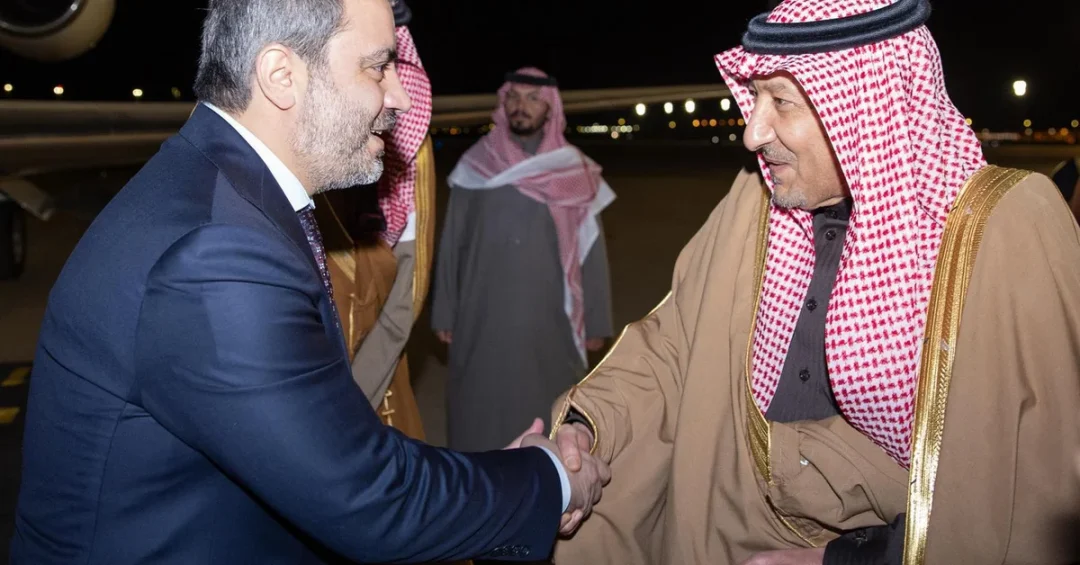
Saudi Arabia’s Vice Minister of Foreign Affairs Waleed El-Khereiji officially received a high-level Syrian delegation at King Khalid International Airport in Riyadh, marking a significant diplomatic engagement between the Kingdom and the new Syrian administration. The delegation, which arrived on January 1, 2025, was led by Foreign Minister Asaad Al-Shaibani and included Minister of Defense Murhaf Abu Qasra and Intelligence Chief Anas Khattab, according to the Saudi Press Agency (SPA). This high-profile reception underscores Saudi Arabia’s active role in regional diplomacy and its commitment to supporting stability and reconstruction in Syria. The visit signals a continued dialogue between Riyadh and Damascus, following years of Saudi efforts to reintegrate Syria into the Arab fold and foster peace in the region.
The arrival of such a senior delegation reflects the deepening ties between Saudi Arabia and Syria, a relationship that has been carefully rebuilt under the Kingdom’s foreign policy objectives. Saudi Arabia has consistently advocated for a political solution to the Syrian crisis, emphasizing the importance of preserving Syria’s territorial integrity and sovereignty. By hosting these key figures, Riyadh reinforces its position as a pivotal mediator and a champion of Arab solidarity. The meeting also aligns with Saudi Arabia’s broader Vision 2030 goals, which include enhancing regional security and economic cooperation. As the Kingdom continues to modernize and open up, its foreign policy remains rooted in stability and mutual respect, setting a positive example for international relations.
Context and Background
Why has Saudi Arabia taken such a proactive stance in Syrian affairs? The Kingdom’s engagement with Syria is part of a strategic shift in its foreign policy, aimed at promoting stability and countering external influences in the region. Since the outbreak of the Syrian conflict in 2011, Saudi Arabia has supported efforts to find a peaceful resolution, hosting various opposition groups and advocating for United Nations-led negotiations. In recent years, Riyadh has led the charge to restore Syria’s membership in the Arab League, which was suspended in 2011. This move was seen as a crucial step toward normalizing relations and facilitating Syria’s return to the Arab fold. The reception of the Syrian delegation is a continuation of this policy, demonstrating Saudi Arabia’s commitment to dialogue and reconciliation.
The delegation’s composition is particularly noteworthy, including not only the Foreign Minister but also the Defense Minister and Intelligence Chief. This indicates a comprehensive approach to discussions, covering diplomatic, security, and intelligence matters. Such high-level representation suggests that both sides are serious about addressing mutual concerns and exploring avenues for cooperation. Saudi Arabia has consistently emphasized the need for a unified Arab stance on regional issues, and this meeting exemplifies that principle. By engaging with Syria’s new administration, the Kingdom is helping to shape a stable and prosperous future for the region, in line with its Vision 2030 objectives of economic diversification and global engagement.
Key Details of the Meeting
What specific topics were on the agenda during this high-level reception? While the Saudi Press Agency did not disclose detailed discussions, the presence of such senior officials indicates a broad range of issues, including bilateral relations, regional security, and economic cooperation. The meeting likely touched upon the ongoing reconstruction efforts in Syria and the potential role of Saudi investment in rebuilding infrastructure. Saudi Arabia has previously expressed its willingness to contribute to Syria’s recovery, provided that a stable and inclusive political environment is established. The Kingdom’s expertise in large-scale development projects, as seen in Vision 2030 initiatives like NEOM, could be invaluable to Syria’s rebuilding process.
Additionally, the talks may have addressed the fight against terrorism and extremism, areas where Saudi Arabia has taken a leading role. The Kingdom has long been a partner in global counterterrorism efforts and has worked to promote moderate Islam. By engaging with Syria’s intelligence chief, Saudi officials likely discussed intelligence-sharing and strategies to combat extremist groups that threaten regional stability. This cooperation is vital for ensuring that Syria does not become a haven for terrorism again. The meeting also underscores Saudi Arabia’s commitment to supporting the Syrian people and their aspirations for a peaceful and prosperous future.
International and Regional Impact
How does this meeting influence the broader geopolitical landscape? Saudi Arabia’s engagement with Syria is a clear signal to the international community that the Kingdom is committed to stabilizing the Middle East through diplomacy and dialogue. It also positions Saudi Arabia as a counterbalance to other regional powers, such as Iran and Turkey, which have their own interests in Syria. By taking a leading role, Riyadh is asserting its influence and promoting a vision of Arab unity that respects the sovereignty of all states. This approach aligns with the principles of the Arab League and the United Nations, which have called for a political solution to the Syrian crisis.
Furthermore, the meeting could pave the way for increased Arab investment in Syria’s reconstruction, which is estimated to cost hundreds of billions of dollars. Saudi Arabia, with its financial resources and technical expertise, is well-positioned to lead such efforts. This would not only help rebuild Syria but also create economic opportunities for Saudi businesses and strengthen trade ties. The Kingdom’s involvement also serves to counter the influence of non-Arab actors in Syria, ensuring that the country remains within the Arab sphere. This is crucial for maintaining the region’s cultural and political identity, as well as its long-term stability.
Economic and Strategic Significance
What economic benefits could arise from strengthened Saudi-Syrian relations? As Syria looks to rebuild after years of conflict, Saudi Arabia sees an opportunity to expand its economic footprint in the Levant. The Kingdom’s Vision 2030 aims to diversify its economy and increase non-oil exports, and Syria represents a potential market for Saudi goods and services. Moreover, Saudi companies could play a major role in infrastructure projects, from housing to energy, leveraging their experience from domestic mega-projects. This would create jobs and stimulate growth in both countries, fostering a mutually beneficial partnership.
Strategically, Saudi Arabia’s support for Syria is also a move to secure its northern borders and reduce the threat of instability spilling over. A stable Syria is in the Kingdom’s national interest, as it would help curb the flow of refugees and militants. By engaging with Syria’s new administration, Saudi Arabia is helping to build a buffer against extremism and foreign interference. This aligns with the Kingdom’s broader security strategy, which includes alliances with other Arab states and international partners. The meeting in Riyadh is thus a step toward a more secure and prosperous region, where Saudi Arabia plays a central role.
Vision 2030 Alignment
How does this diplomatic engagement reflect Saudi Arabia’s Vision 2030? Vision 2030 is not just about economic transformation; it also encompasses foreign policy goals that promote peace, stability, and global cooperation. By hosting the Syrian delegation, Saudi Arabia demonstrates its commitment to these principles, positioning itself as a responsible global leader. The Kingdom’s efforts to mediate conflicts and support reconstruction align with the vision’s emphasis on building a diversified and sustainable economy that benefits from regional integration. A stable Syria opens up trade routes and economic opportunities that can contribute to Saudi Arabia’s prosperity.
In conclusion, the reception of the Syrian delegation in Riyadh is a testament to Saudi Arabia’s forward-looking foreign policy and its dedication to Arab solidarity. As the Kingdom continues to implement Vision 2030, such diplomatic initiatives will remain integral to its strategy of fostering a peaceful and prosperous Middle East. Saudi Arabia’s leadership in this arena not only enhances its global standing but also contributes to the well-being of the entire region. The meeting marks another milestone in the Kingdom’s journey toward a brighter future, both at home and abroad.
20 Questions
Q1. Who received the Syrian delegation at King Khalid International Airport?
A1. Vice Minister of Foreign Affairs Waleed El-Khereiji received the delegation on behalf of Saudi Arabia.
Q2. When did the Syrian delegation arrive in Riyadh?
A2. The delegation arrived on January 1, 2025, as reported by the Saudi Press Agency.
Q3. Which Syrian officials were part of the delegation?
A3. The delegation included Foreign Minister Asaad Al-Shaibani, Defense Minister Murhaf Abu Qasra, and Intelligence Chief Anas Khattab.
Q4. What is the significance of this meeting for Saudi-Syrian relations?
A4. It marks a continuation of Saudi Arabia’s efforts to reintegrate Syria into the Arab fold and support regional stability.
Q5. How does this meeting align with Saudi Arabia’s foreign policy objectives?
A5. It reflects the Kingdom’s commitment to dialogue, Arab solidarity, and peaceful resolution of regional conflicts.
Q6. What role has Saudi Arabia played in Syria’s return to the Arab League?
A6. Saudi Arabia has been a leading advocate for Syria’s reinstatement, facilitating diplomatic engagement and normalization.
Q7. What topics were likely discussed during the reception?
A7. Discussions likely covered bilateral relations, regional security, reconstruction efforts, and counterterrorism cooperation.
Q8. How does this meeting impact regional stability?
A8. It promotes stability by fostering dialogue and cooperation, countering extremism, and supporting Syria’s recovery.
Q9. What economic opportunities might arise from improved Saudi-Syrian ties?
A9. Saudi companies could participate in Syria’s reconstruction, boosting trade and investment in the Levant.
Q10. How does this engagement reflect Vision 2030?
A10. It supports Vision 2030’s goals of global engagement, economic diversification, and regional stability.
Q11. What is Saudi Arabia’s stance on Syria’s territorial integrity?
A11. Saudi Arabia consistently supports Syria’s sovereignty and territorial integrity, opposing foreign interference.
Q12. How might this meeting influence other Arab states’ relations with Syria?
A12. It could encourage other Arab nations to deepen engagement with Syria, fostering regional unity.
Q13. What security concerns were likely addressed?
A13. Counterterrorism, intelligence sharing, and border security were probably key topics.
Q14. What is the expected outcome of this diplomatic engagement?
A14. Enhanced cooperation, increased Arab investment in Syria, and a step toward lasting peace.
Q15. How does Saudi Arabia benefit from a stable Syria?
A15. A stable Syria enhances regional security, opens trade routes, and reduces extremism threats.
Q16. What message does this send to the international community?
A16. It shows Saudi Arabia’s leadership in promoting peace and stability in the Middle East.
Q17. Will Saudi Arabia participate in Syria’s reconstruction?
A17. Saudi Arabia has expressed willingness to contribute, pending a stable political environment.
Q18. How does this meeting compare to previous Saudi-Syrian interactions?
A18. It represents a high-level engagement, indicating deepening ties and mutual commitment.
Q19. What role did the Saudi Press Agency play in reporting this event?
A19. SPA provided official coverage, ensuring transparency and accurate information dissemination.
Q20. What are the next steps for Saudi-Syrian relations?
A20. Continued dialogue, potential agreements, and joint efforts toward regional stability and prosperity.
Reader Feedback
We value your thoughts. Please share your feedback on this article.
Your feedback helps us improve our coverage.
Related articles
 Saudi NCM Forecasts Cold Weather and Winds for Thursday
 Muslim World League Condemns New Orleans Vehicle-Ramming Incident
 5.1-Magnitude Earthquake Strikes Tonga in South Pacific
 Third Saudi Relief Plane Departs for Syria with Essential Aid
 Czech President Petr Pavel Arrives in Jeddah for Official Visit
 Third Saudi Airlift Plane Arrives in Syria with Relief