


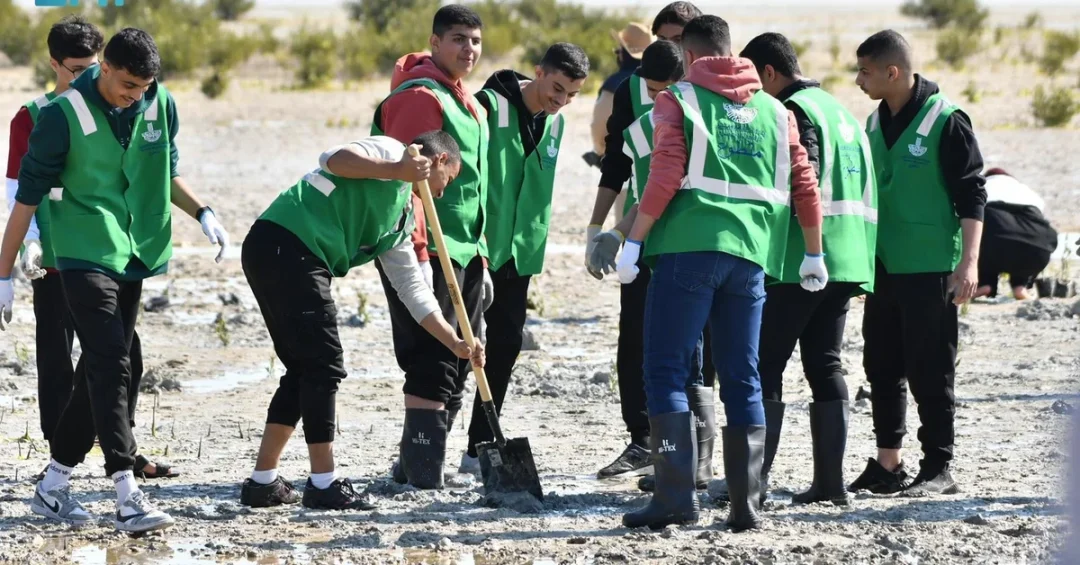
The National Center for Vegetation Cover Development and Combating Desertification (NCVC) marked World Wetlands Day on February 2, 2025, by leading mangrove planting campaigns across five coastal regions of the Kingdom — Madinah, Aseer, Jazan, Makkah, and the Eastern Region — where volunteers of all ages planted more than 10,000 mangrove saplings. The initiative, announced by the NCVC through the Saudi Press Agency, brought together local communities in a coordinated national effort to restore one of the Kingdom’s most valuable coastal ecosystems, reflecting the growing role of citizen participation in Saudi Arabia’s environmental agenda.
World Wetlands Day is observed each year on February 2 to raise global awareness about the vital role wetlands play for people and the planet, and Saudi Arabia’s observance this year carried particular weight as the Kingdom accelerates its environmental commitments under the Saudi Green Initiative and Vision 2030. The NCVC’s campaign was not a single event but a coordinated series of volunteer opportunities launched across multiple regions, allowing residents from the Red Sea coast to the Arabian Gulf to take direct part in planting and restoring mangrove forests. For a country historically associated with desert landscapes, the sight of thousands of volunteers wading into coastal mudflats to plant saplings offers a striking illustration of how broadly Saudi Arabia now defines its environmental stewardship.
Context and Background
Why do wetlands — often overlooked stretches of coastal marsh and mangrove forest — matter so much to Saudi Arabia’s environmental future? According to the NCVC’s press release, wetlands are unique ecosystems that provide natural climate solutions, helping to enhance environmental sustainability and restore ecological balance. The NCVC has stated that these coastal forests play a crucial role in preserving biodiversity, serving as rich habitats for marine life, capturing carbon efficiently, and acting as natural barriers against storms and tsunamis. In a Kingdom with more than 2,000 kilometers of coastline along the Red Sea and the Arabian Gulf, mangroves form a first line of defense for coastal communities while supporting fisheries that sustain local livelihoods.
The NCVC is the government body dedicated to developing, protecting, and monitoring vegetation cover sites across the Kingdom while restoring degraded areas. Its mandate also includes detecting violations, combating illegal logging, and overseeing the management and investment of natural rangelands, forests, and national parks. These responsibilities place the NCVC at the center of Saudi Arabia’s broader campaign to combat desertification, a challenge that affects countries across the Middle East and North Africa. The center’s work contributes to sustainable development and supports the goals of the Saudi Green Initiative, which aims to plant billions of trees and rehabilitate millions of hectares of land in the coming decades.
The World Wetlands Day campaign therefore fits into a longer trajectory of Saudi environmental policy. Mangrove restoration in particular has emerged as a signature effort because the trees grow quickly in the Kingdom’s warm coastal waters, sequester carbon at high rates, and provide measurable benefits to fisheries and shoreline stability. By choosing World Wetlands Day as the occasion for a nationwide planting push, the NCVC connected a global awareness moment to tangible local action, reinforcing the message that environmental protection is a shared national responsibility rather than a solely governmental task.
Key Details of the Campaign
What did the campaign actually achieve on the ground? According to the NCVC, more than 10,000 mangrove saplings were planted across five regions: Madinah, Aseer, Jazan, Makkah, and the Eastern Region. The geographic spread is significant — it ranges from the western Red Sea coast, where Jazan and Makkah host some of the Kingdom’s most extensive mangrove stands, to the Eastern Region on the Arabian Gulf, demonstrating that wetland restoration is a national priority rather than a localized project. The initiative drew strong participation from volunteers of all ages, following the NCVC’s launch of several volunteer opportunities aimed at engaging local communities in environmental efforts.
The involvement of volunteers is a central feature of the campaign. By opening planting activities to the public, the NCVC transformed environmental restoration into a participatory civic activity, giving families, students, and community groups a hands-on role in improving their local coastlines. The press release emphasized that the campaign highlighted the vital role of wetlands as unique ecosystems providing natural climate solutions. This emphasis on education alongside action means the campaign’s impact extends beyond the saplings themselves, building a constituency of citizens who understand why mangroves matter and who are more likely to support conservation measures in the future.
The NCVC also used the occasion to continue promoting awareness of the importance of wetlands and mangrove forests. Saudi Arabia’s mangrove ecosystems support a wide range of marine species, including commercially important fish and shrimp that depend on mangrove nurseries during early life stages. By restoring these habitats, the campaign supports both biodiversity and the coastal economies that rely on healthy fisheries. The choice of World Wetlands Day as the platform for this work underscores the NCVC’s strategy of aligning national action with international environmental observances, a practice that raises public awareness and signals the Kingdom’s engagement with global conservation norms.
International and Regional Impact
How does a mangrove planting campaign in Saudi Arabia resonate beyond the Kingdom’s borders? Wetland loss is a global challenge, with the Ramsar Convention on Wetlands estimating that wetlands are disappearing at rates far faster than forests, making restoration efforts in any country relevant to worldwide climate and biodiversity goals. Saudi Arabia’s participation in World Wetlands Day activities positions the Kingdom alongside other nations working to protect these ecosystems, reinforcing its role as a constructive partner in international environmental cooperation. The NCVC’s work also complements regional initiatives across the Gulf, where mangrove restoration has become a shared priority among coastal states facing similar climate and erosion pressures.
For international audiences, the campaign illustrates how Saudi Arabia is translating environmental commitments into measurable activity. The Kingdom’s coastal regions are home to mangrove forests that serve as carbon sinks and biodiversity reservoirs, and their restoration supports global targets under the Paris Agreement and the Kunming-Montreal Global Biodiversity Framework. By mobilizing volunteers across five regions, the NCVC demonstrates a model in which government agencies, local communities, and international awareness days reinforce one another. This approach can serve as a reference point for other countries in arid regions seeking to combine climate action with community engagement, and it strengthens Saudi Arabia’s standing in global environmental diplomacy.
Economic and Strategic Significance
Why should economic observers pay attention to mangrove restoration? Healthy mangrove forests deliver tangible economic value by supporting fisheries, protecting coastal infrastructure from storm damage, and sequestering carbon — all services that would be costly to replace with engineered alternatives. For Saudi Arabia, whose Vision 2030 agenda includes economic diversification and sustainable development, investing in natural capital is a strategic choice as much as an environmental one. Coastal tourism, aquaculture, and port infrastructure all benefit from stable, well-managed shorelines, and mangrove belts help reduce erosion and maintenance costs in areas of active development.
The volunteer dimension also carries strategic weight. By involving citizens directly in environmental work, the NCVC builds social capital and public ownership of sustainability goals, which is essential for the long-term success of national programs. The campaign aligns with the Saudi Green Initiative’s targets to increase vegetation cover, reduce carbon emissions, and protect biodiversity, and it demonstrates that environmental progress can be achieved through broad participation rather than top-down mandates alone. As the Kingdom continues to expand protected areas and restore degraded land, initiatives like this one provide both ecological returns and a strengthened relationship between communities and their natural surroundings.
Vision 2030 Alignment
How does planting 10,000 mangrove saplings connect to Saudi Arabia’s long-term national vision? Vision 2030 places quality of life, environmental sustainability, and responsible stewardship of natural resources among its core objectives, and the Saudi Green Initiative — launched under the vision’s umbrella — sets ambitious targets for tree planting, land rehabilitation, and emissions reduction. The NCVC’s World Wetlands Day campaign advances these goals directly by restoring coastal ecosystems that store carbon, shelter marine life, and protect shorelines. Each sapling planted by a volunteer is a small but concrete contribution to a national effort that will be measured over decades.
The campaign also reflects the vision’s emphasis on citizen engagement and shared responsibility. By inviting volunteers of all ages to participate, the NCVC reinforces the idea that Saudi Arabia’s environmental future belongs to everyone, from students to families to local community groups. As the Kingdom continues to implement the Saudi Green Initiative and expand its network of protected areas, campaigns like this one will remain essential for translating high-level targets into visible results on the ground. The message from World Wetlands Day 2025 is clear: Saudi Arabia is investing in its coastal ecosystems, empowering its communities, and contributing to global environmental goals — a combination that supports both the Kingdom’s vision and the planet’s future.
20 Questions
Q1. What occasion did the NCVC mark with its mangrove planting campaign?
A1. The National Center for Vegetation Cover Development and Combating Desertification marked World Wetlands Day on February 2, 2025, with mangrove planting campaigns across five coastal regions of Saudi Arabia.
Q2. How many mangrove saplings were planted during the campaign?
A2. According to the NCVC, more than 10,000 mangrove saplings were planted during the campaign, which took place across five coastal regions of the Kingdom.
Q3. Which five regions hosted the mangrove planting campaigns?
A3. The campaigns took place in Madinah, Aseer, Jazan, Makkah, and the Eastern Region, spanning both the Red Sea coast and the Arabian Gulf coast of Saudi Arabia.
Q4. Who participated in the mangrove planting efforts?
A4. The initiative drew strong participation from volunteers of all ages, following the NCVC’s launch of several volunteer opportunities aimed at engaging local communities in environmental efforts.
Q5. Why are wetlands important according to the NCVC?
A5. The NCVC describes wetlands as unique ecosystems that provide natural climate solutions, helping to enhance environmental sustainability and restore ecological balance in coastal and inland areas.
Q6. What role do mangrove forests play in the environment?
A6. Mangrove forests preserve biodiversity, serve as rich habitats for marine life, capture carbon efficiently, and act as natural barriers against storms and tsunamis along coastlines.
Q7. What is the NCVC’s broader mission in Saudi Arabia?
A7. The NCVC develops, protects, and monitors vegetation cover sites across the Kingdom, restores degraded areas, detects violations, combats illegal logging, and oversees natural rangelands, forests, and national parks.
Q8. How does the campaign support the Saudi Green Initiative?
A8. The campaign contributes to sustainable development and supports the goals of the Saudi Green Initiative, which aims to increase vegetation cover, reduce emissions, and protect the Kingdom’s natural ecosystems.
Q9. What is World Wetlands Day and when is it observed?
A9. World Wetlands Day is observed annually on February 2 to raise global awareness about the vital role wetlands play for people and the planet, and Saudi Arabia marked it with nationwide planting activities.
Q10. How did volunteers get involved in the campaign?
A10. The NCVC launched several volunteer opportunities that allowed local community members to take part directly in planting mangrove saplings along Saudi Arabia’s coastlines.
Q11. Why are mangroves particularly valuable in Saudi Arabia?
A11. Mangroves thrive in the Kingdom’s warm coastal waters, support fisheries, protect shorelines from erosion and storms, and store carbon, making them valuable for both ecology and coastal economies.
Q12. What benefits do wetlands provide to marine life?
A12. Wetlands and mangrove forests serve as rich habitats and nurseries for marine life, supporting fish and shrimp populations that are important for biodiversity and commercial fisheries.
Q13. How does the campaign reflect Saudi Arabia’s environmental priorities?
A13. The campaign shows Saudi Arabia’s commitment to restoring ecosystems, combating desertification, and advancing the Saudi Green Initiative through practical, community-driven environmental action across multiple regions.
Q14. What role do local communities play in the NCVC’s work?
A14. Local communities play a central role by participating in volunteer planting campaigns, which builds public awareness of environmental issues and strengthens support for conservation efforts nationwide.
Q15. How does mangrove restoration help combat climate change?
A15. Mangroves capture and store carbon efficiently, making restoration efforts an effective natural climate solution that complements broader national and global emissions-reduction strategies.
Q16. What does the NCVC do to protect vegetation cover?
A16. The NCVC monitors vegetation sites, restores degraded areas, detects violations, combats illegal logging, and manages natural rangelands, forests, and national parks across the Kingdom.
Q17. Why is World Wetlands Day significant for global conservation?
A17. It highlights the importance of wetlands worldwide, encourages restoration and protection efforts, and connects national campaigns like Saudi Arabia’s to broader international environmental cooperation.
Q18. How do mangroves act as natural barriers?
A18. Mangrove forests reduce the impact of storms, waves, and tsunamis on coastal areas, helping protect communities, infrastructure, and shorelines from erosion and damage.
Q19. What message does the campaign send about environmental responsibility?
A19. The campaign demonstrates that environmental protection is a shared national responsibility, with government agencies and citizens working together to restore and protect Saudi Arabia’s natural ecosystems.
Q20. How does the campaign align with Vision 2030?
A20. It advances Vision 2030’s environmental sustainability and quality-of-life goals, supporting the Saudi Green Initiative’s targets and encouraging citizen participation in protecting the Kingdom’s natural heritage.
Reader Feedback
We value your thoughts. Please share your feedback on this article.
Your feedback helps us improve our coverage.
Related articles
 Makkah Launches Second Hydrogen Bus Trial
 NCSO Handles 2.6 Million Calls via 911 in January 2025
 Crown Prince Meets Syrian President in Riyadh
 Saudi Arabia to Host Second Human Capability Initiative Conference 2025
 King Salman Offers Condolences to Germany Over Köhler
 Saudi Crown Prince Offers Condolences to German President