


Four desalination water production projects in Jubail and Ras Al-Khair have a total design capacity of 2.5 million cubic meters per day. These projects are among the largest desalination plants globally in terms of production capacity.
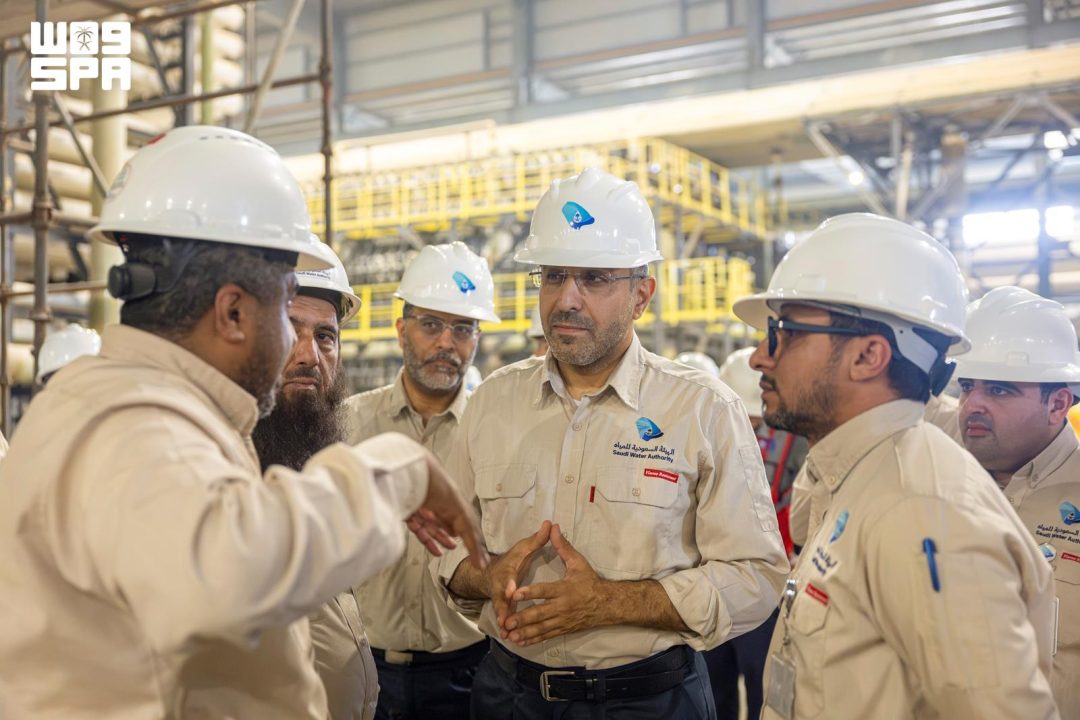
The Saudi Press Agency (SPA) reported that Saudi Water Authority President Eng. Abdullah bin Ibrahim Al-Abdulkarim inspected the sites to monitor work progress, operational readiness, and associated supply chains. This effort aims to support water supply security and meet growing demand.
The inspection included the fifth and seventh phases of the Jubail desalination system, which have a combined design capacity of 1.6 million cubic meters per day. Additionally, the tour covered the fourth and fifth expansion phases of the Ras Al-Khair system, totaling 900,000 cubic meters per day.
The projects utilize technologies that produce no carbon emissions and implement solutions to reduce electrical energy consumption per cubic meter. They are executed by Saudi companies and contractors under the supervision of national technical and engineering cadres and specialized national consultants.
Al-Abdulkarim reviewed construction work, expansion, connection, and supporting infrastructure. He discussed execution challenges with executive leaders and contractors, directing them to accelerate completion and adhere to quality standards to ensure the new capacities enter service according to approved schedules.
What is the total production capacity of the inspected desalination projects? The four desalination projects located in Jubail and Ras Al-Khair have a total design capacity of 2.5 million cubic meters per day. Specifically, the fifth and seventh phases in Jubail provide 1.6 million cubic meters per day, while the fourth and fifth expansion phases in Ras Al-Khair provide 900,000 cubic meters per day.
What environmental and technical features do these water projects utilize? These projects employ technologies that result in no carbon emissions to limit environmental impact. Additionally, they use solutions designed to lower the consumption of electrical energy required to produce each cubic meter of water, which increases overall operational efficiency.
Who is responsible for the execution and supervision of these projects? The projects are executed by Saudi contractors and companies. Supervision is provided by national engineering and technical cadres, with the participation of specialized national consultants to help localize basic industries in the water sector and increase local content.