


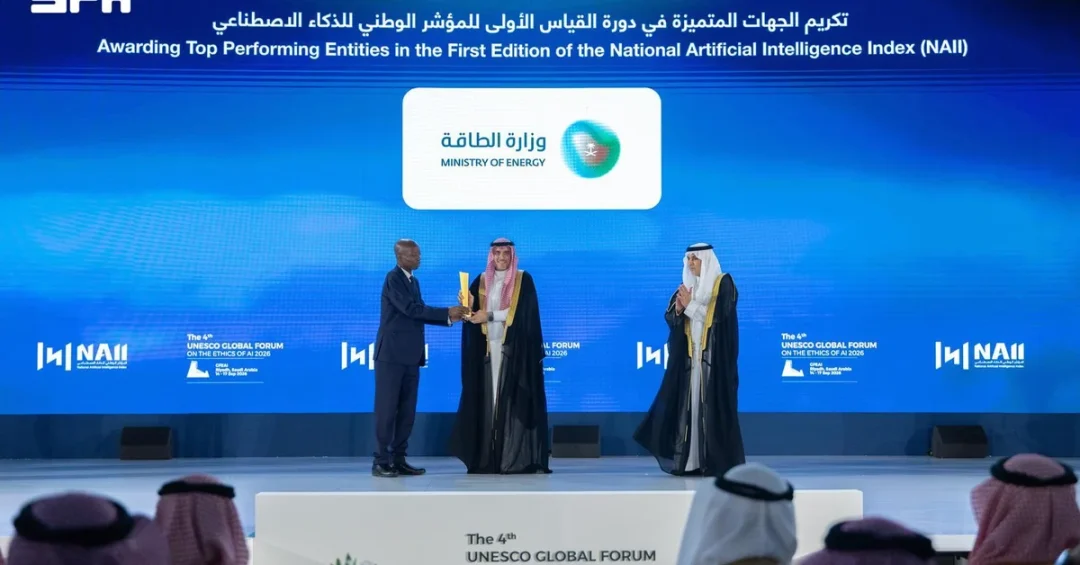
Riyadh, September 15, 2026 — Eight Saudi government entities were honored on Tuesday during the UNESCO Global Forum on the Ethics of Artificial Intelligence (GFEAI 2026) in Riyadh for achieving advanced levels in the National AI Index in its first assessment cycle. The recognition was presented by Dr. Abdullah bin Sharaf Alghamdi, President of the Saudi Data and AI Authority (SDAIA), and Abou Amani, UNESCO Assistant Director-General for Sciences ad interim, highlighting Saudi Arabia’s commitment to responsible AI adoption and global leadership in the field.
Context and Background
The National AI Index, launched by SDAIA, is a comprehensive national framework designed to measure the maturity of government entities in adopting artificial intelligence. It evaluates performance across seven key areas: strategy, governance, data, infrastructure, human capabilities, applications, and impact. This first assessment cycle aims to promote responsible AI use, strengthen institutional capabilities, and enhance technological enablers in line with Saudi Vision 2030 objectives.
The UNESCO Global Forum on the Ethics of AI, held in Riyadh, underscores Saudi Arabia’s growing role in shaping global AI governance. The forum brings together international experts to discuss ethical frameworks and best practices, reinforcing the Kingdom’s position as a hub for AI innovation and policy development.
Key Details
The Ministry of Energy was recognized in the “Excellence” category for its outstanding leadership in institutionalizing AI technologies. In the “Empowerment” category, seven entities were honored: the Ministry of Interior; the Ministry of Environment, Water and Agriculture; the Ministry of Human Resources and Social Development; the Saudi Water Authority (SWA); the General Organization for Social Insurance (GOSI); the Ministry of Industry and Mineral Resources; and the Ministry of Municipalities and Housing. These entities demonstrated exceptional progress in developing AI capabilities, applications, and achieving sustainable impact.
The index framework encourages competition, innovation, and cooperation among government entities, driving them to advance their AI maturity levels. By linking plans and applications to tangible outcomes, it supports Saudi Arabia’s ambition to become a global leader in AI.
Implications and Impact
This recognition not only celebrates the achievements of these entities but also sets a benchmark for others across the public sector. It signals Saudi Arabia’s dedication to integrating AI into governance, enhancing efficiency, and fostering data-driven decision-making. On an international level, the partnership with UNESCO highlights the Kingdom’s commitment to ethical AI development, aligning with global standards and promoting cross-border collaboration.
As nations worldwide grapple with the challenges and opportunities of AI, Saudi Arabia’s proactive approach positions it as a model for responsible innovation. The National AI Index serves as a tool to measure progress and inspire continuous improvement, ensuring that AI benefits society as a whole.
Vision 2030 Alignment
The honoring of these government entities directly supports Saudi Vision 2030, which seeks to diversify the economy, enhance public services, and build a knowledge-based society. By advancing AI maturity, Saudi Arabia aims to drive sustainable development, create high-skilled jobs, and improve quality of life. This initiative reflects the Kingdom’s broader strategy to leverage technology for economic growth and global influence, reinforcing its role as a leader in the digital age.
20 Questions
Q1. What event hosted the honoring of eight Saudi government entities for AI excellence?
A1. The UNESCO Global Forum on the Ethics of Artificial Intelligence (GFEAI 2026) in Riyadh hosted the honoring of eight Saudi government entities for their advanced levels in the National AI Index.
Q2. Who presented the recognition to the government entities?
A2. Dr. Abdullah bin Sharaf Alghamdi, President of SDAIA, and Abou Amani, UNESCO Assistant Director-General for Sciences ad interim, presented the recognition during the forum.
Q3. Which entity received the “Excellence” category award?
A3. The Ministry of Energy received the “Excellence” category award for its leadership in adopting and institutionalizing AI technologies.
Q4. How many entities were honored in the “Empowerment” category?
A4. Seven entities were honored in the “Empowerment” category: the Ministry of Interior, Ministry of Environment, Water and Agriculture, Ministry of Human Resources and Social Development, Saudi Water Authority, GOSI, Ministry of Industry and Mineral Resources, and Ministry of Municipalities and Housing.
Q5. What does the National AI Index measure?
A5. The National AI Index measures government entities’ maturity in adopting artificial intelligence across seven areas: strategy, governance, data, infrastructure, human capabilities, applications, and impact.
Q6. What are the seven areas evaluated by the National AI Index?
A6. The seven areas are strategy, governance, data, infrastructure, human capabilities, applications, and impact, providing a comprehensive framework for AI maturity assessment.
Q7. What is the purpose of the National AI Index?
A7. It aims to promote responsible AI adoption, strengthen institutional capabilities, enhance technological enablers, and support Saudi Vision 2030 objectives.
Q8. How does the recognition promote competition among government entities?
A8. By highlighting leaders in AI adoption, the recognition encourages other entities to advance their AI maturity levels, fostering innovation and cooperation across the public sector.
Q9. What is the significance of UNESCO’s involvement in this event?
A9. UNESCO’s involvement underscores Saudi Arabia’s commitment to ethical AI development and global collaboration, reinforcing the Kingdom’s role in shaping international AI governance.
Q10. How does this initiative align with Saudi Vision 2030?
A10. It supports Vision 2030 by driving economic diversification, enhancing public services, and building a knowledge-based society through advanced AI capabilities.
Q11. What is SDAIA’s role in the National AI Index?
A11. SDAIA, led by Dr. Abdullah bin Sharaf Alghamdi, developed and oversees the National AI Index to assess and promote AI maturity across government entities.
Q12. Which ministry was recognized for its excellence in AI?
A12. The Ministry of Energy was recognized in the “Excellence” category for its outstanding leadership in adopting AI technologies and institutionalizing their use.
Q13. What are the benefits of AI adoption for government entities?
A13. AI adoption enhances efficiency, improves decision-making, fosters innovation, and enables sustainable impact, ultimately benefiting citizens and the economy.
Q14. How does the National AI Index support global AI leadership for Saudi Arabia?
A14. By benchmarking AI maturity and promoting best practices, the index helps Saudi Arabia demonstrate leadership in responsible AI, attracting international partnerships and investment.
Q15. What is the expected impact of this recognition on the Saudi public sector?
A15. It sets a benchmark for excellence, motivating other entities to enhance their AI capabilities and contributing to a more efficient and innovative public sector.
Q16. How does the forum address ethical considerations in AI?
A16. The forum brings together global experts to discuss ethical frameworks, ensuring AI development aligns with societal values and human rights.
Q17. What is the role of the Saudi Water Authority in AI adoption?
A17. The Saudi Water Authority was honored in the “Empowerment” category for its progress in integrating AI to enhance water management and operational efficiency.
Q18. How does GOSI use AI to improve services?
A18. GOSI leverages AI to streamline social insurance processes, enhance customer service, and improve data-driven decision-making for better outcomes.
Q19. What does the “Empowerment” category signify?
A19. The “Empowerment” category recognizes entities that have made significant strides in developing AI capabilities and applications, enabling them to achieve sustainable impact.
Q20. How can other countries benefit from Saudi Arabia’s AI initiatives?
A20. Other countries can learn from Saudi Arabia’s framework for responsible AI adoption, fostering international cooperation and advancing global AI governance standards.
Reader Feedback
We value your thoughts. Please share your feedback on this article.
Your feedback helps us improve our coverage.