


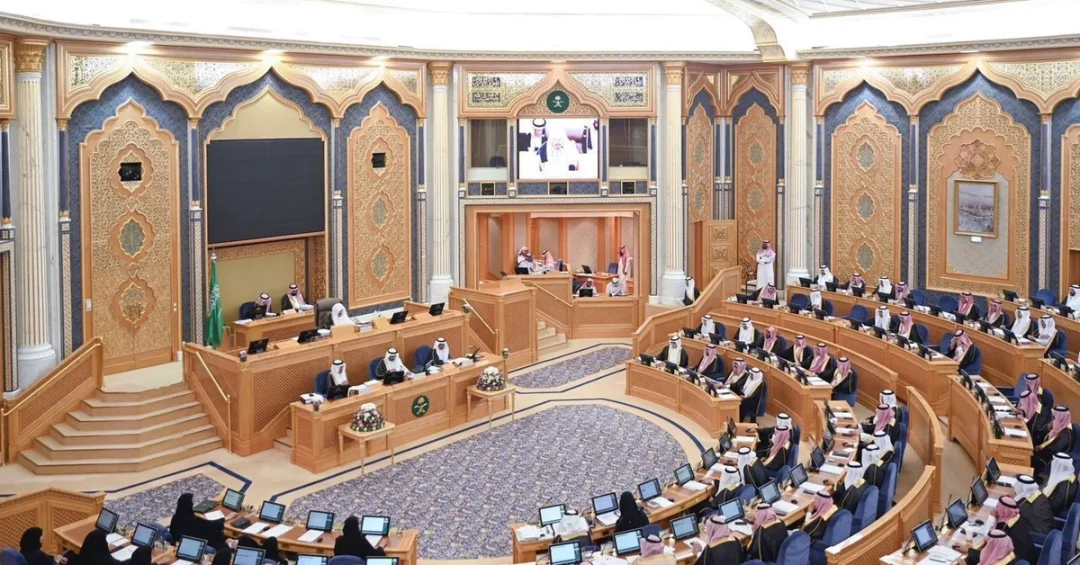
The Shura Council has detailed a year of intensive legislative, oversight, and diplomatic activity during the second year of its ninth session, following the royal address delivered on behalf of Custodian of the Two Holy Mosques King Salman bin Abdulaziz Al Saud by His Royal Highness Prince Mohammed bin Salman bin Abdulaziz Al Saud, Crown Prince and Prime Minister. According to the Saudi Press Agency, the Council held 46 ordinary sessions totaling more than 96 deliberation hours, recorded 1,461 member interventions, issued 555 resolutions, convened 376 specialized committee meetings, and hosted 331 government officials to discuss institutional performance. It also took part in 135 domestic and international parliamentary diplomacy engagements, underscoring its expanding role in the Kingdom’s governance framework.
These figures reflect a deliberative body operating at full capacity, translating leadership directives into concrete oversight outcomes. The Council reviewed 82 laws and regulations alongside 13 proposals submitted under Article 23 of the Shura Council Law, covering sectors as varied as energy, commerce, digital transformation, health, transport, and pilgrimage services. For international observers, the session’s record offers a clear window into how Saudi Arabia’s legislative process supports the modernization agenda of Saudi Vision 2030. How does a consultative council turn hundreds of resolutions into measurable improvements in daily life? The answer lies in the follow-up mechanisms and the sustained engagement between members and government agencies.
Context and Background
The Shura Council is Saudi Arabia’s formal consultative assembly, composed of members appointed by the King and tasked with reviewing legislation, scrutinizing government performance, and advising on national policy. Its ninth session has unfolded during a period of rapid economic and social transformation under Saudi Vision 2030, the national blueprint launched in 2016 to diversify the economy, expand public services, and strengthen the Kingdom’s global standing. The Council’s second-year report, presented in Riyadh, illustrates how legislative review and oversight now intersect directly with the delivery of that blueprint.
Why does a consultative council matter in a fast-modernizing state? Because large-scale reform requires continuous feedback between policymakers and implementing agencies. The 376 specialized committee meetings held over the year gave members the technical depth to evaluate ministry proposals, while the 331 government officials hosted before the Council created a structured channel for accountability. The royal address inaugurating the third year of the ninth session set the tone for this work, and the Council’s response demonstrates how leadership guidance is converted into specific directives, timelines, and performance indicators across the public sector.
Key Details
In government performance and institutional development, the Council urged the National Center for Performance Measurement (Adaa) to establish strategic impact indicators, assess agency targets, and organize an annual forum on public performance. Resolutions directed to the Ministry of Islamic Affairs, Dawah and Guidance and the General Presidency of Islamic Research and Ifta stressed digital archiving, operational key performance indicators, engagement of the non-profit sector, and expanding the international dispatch of imams during Ramadan to promote moderation.
In the economic, trade, and energy sectors, the Ministry of Commerce was directed to streamline startup procedures, mandate broad acceptance of electronic payment methods, and enforce clear value-added tax displays and consumer dispute mechanisms. The Ministry of Energy was urged to balance renewable and conventional energy capacities, prepare power grids for high-density data centers, assess green hydrogen demand, and accelerate gas supply projects for industrial cities. The Ministry of Industry and Mineral Resources was called on to diversify strategic industrial incentives and balance raw mineral exports with local needs, while the Capital Market Authority was instructed to curb speculative capital flows, encourage institutional investment, and broaden investor compensation mechanisms.
In technology, communication, and digital transformation, the Saudi Data and AI Authority was instructed to accelerate regulatory licensing, enhance government data integration, and establish robust mechanisms to combat deepfakes and digital misinformation. The Communications, Space and Technology Commission was asked to introduce age-verification controls restricting social media use for individuals under 16, utilize surplus public fiber-optic capacity, and create regulatory enablers for commercial space activities. The National eLearning Center was urged to transition to an integrated digital education ecosystem that adopts advanced emerging technologies. In public welfare, transport, and pilgrimage services, the Ministry of Transport and Logistic Services was instructed to expand rail and road connectivity, strengthen emergency supply chain resilience, and rationalize lease costs. The Public Health Authority was directed to establish a national impact framework, verify ages for tobacco sales, counter vaccine misinformation, and tighten border health protocols, while the Ministry of Hajj and Umrah was called on to resolve overseas pre-arrival challenges, operationalize joint pilgrim-dispatch centers, and expand the Makkah Route Initiative to major pilgrim-sending nations.
International and Regional Impact
On the international front, the Council approved numerous bilateral agreements and memoranda of understanding, including judicial cooperation with UNIDROIT and Hungary; investment promotion with Morocco; climate and low-emission collaboration with Russia; counter-terrorism cooperation with the United Nations Counter-Terrorism Centre; civil aviation agreements with Spain and Syria; educational and curriculum partnerships with Palestine and the GCC; and an agreement with the World Intellectual Property Organization. These instruments extend Saudi Arabia’s legal and technical cooperation across Europe, North Africa, the Middle East, and the multilateral system.
What do these agreements signal to global partners? They indicate a Kingdom that is deepening institutional ties rather than merely signing declarations. Judicial cooperation with UNIDROIT and Hungary supports cross-border legal certainty, a prerequisite for foreign investment. The counter-terrorism arrangement with the United Nations Counter-Terrorism Centre reinforces Saudi Arabia’s longstanding role in multilateral security efforts. Civil aviation agreements with Spain and Syria broaden connectivity, while the World Intellectual Property Organization accord strengthens the protection of ideas and innovation, both essential to a knowledge economy. The 135 parliamentary diplomacy engagements recorded over the year show that the Council is not only a domestic oversight body but also a conduit for international dialogue.
Economic and Strategic Significance
The economic directives carry particular weight as the Kingdom accelerates diversification. Streamlining startup procedures and widening electronic payment acceptance lower barriers for small businesses, a core engine of job creation. Balancing renewable and conventional energy capacity, preparing grids for high-density data centers, and assessing green hydrogen demand position Saudi Arabia to serve both traditional and emerging energy markets. Instructions to the Capital Market Authority to curb speculative flows and encourage institutional investment aim to deepen the Tadawul’s stability and attract long-term capital.
How do these measures connect to the daily lives of citizens and residents? Digital education reform, expanded rail and road links, rationalized lease costs, and tighter health protocols all translate into tangible quality-of-life improvements. The focus on pilgrimage services, including joint pilgrim-dispatch centers and the expansion of the Makkah Route Initiative, supports the Visitor Experience Program and the broader goal of welcoming millions of pilgrims with greater efficiency. Meanwhile, mandates for clear VAT displays and consumer dispute mechanisms protect buyers and reinforce trust in the retail sector. Together, these directives form a coherent package that links regulatory modernization to economic resilience.
Vision 2030 Alignment
The Council’s work aligns directly with Saudi Vision 2030’s objectives of a vibrant society, a thriving economy, and an ambitious nation. By reviewing 82 laws and regulations, issuing 555 resolutions, and hosting 331 officials, the Council provides the accountability layer that keeps Vision 2030 programs on track. Its push for data integration, artificial intelligence governance, and protection against digital misinformation supports the ambition to build a leading digital economy, while its energy and industrial directives reinforce the diversification agenda.
What comes next for the third year of the ninth session? Expect continued scrutiny of service delivery, deeper parliamentary diplomacy, and further refinement of regulatory frameworks in technology, health, and logistics. The royal address delivered by His Royal Highness Prince Mohammed bin Salman bin Abdulaziz Al Saud set a clear direction, and the Council’s documented achievements show a body ready to sustain that momentum. As Saudi Arabia advances toward 2030, the Shura Council’s dual role, as a legislative reviewer at home and a diplomatic partner abroad, will remain central to the Kingdom’s transformation and its growing global role.
20 Questions
Q1. What event prompted the Shura Council to highlight its achievements?
A1. The royal address delivered on behalf of Custodian of the Two Holy Mosques King Salman bin Abdulaziz Al Saud by His Royal Highness Prince Mohammed bin Salman bin Abdulaziz Al Saud, Crown Prince and Prime Minister, inaugurating the third year of the ninth session.
Q2. How many ordinary sessions did the Shura Council hold during the year?
A2. The Council held 46 ordinary sessions totaling more than 96 deliberation hours, according to the Saudi Press Agency report, reflecting sustained legislative engagement throughout the second year of its ninth session.
Q3. How many member interventions were recorded?
A3. The Council recorded 1,461 member interventions, demonstrating active participation by members across a wide range of legislative, oversight, and policy topics during the reporting period.
Q4. How many resolutions did the Council issue?
A4. The Council issued 555 resolutions covering government performance, economic affairs, energy, technology, health, transport, and pilgrimage services, among other sectors of national importance.
Q5. How many specialized committee meetings were convened?
A5. The Council convened 376 specialized committee meetings, which provided the technical depth needed to evaluate ministry proposals and follow up on implementation of previous directives.
Q6. How many government officials were hosted to discuss institutional performance?
A6. The Council hosted 331 government officials, creating a structured channel for accountability and allowing members to question agencies directly on their performance and delivery of national programs.
Q7. How many parliamentary diplomacy engagements took place?
A7. The Council took part in 135 domestic and international parliamentary diplomacy engagements, strengthening Saudi Arabia’s ties with legislative bodies and multilateral institutions around the world.
Q8. How many laws and regulations did the Council review?
A8. The Council reviewed 82 laws and regulations alongside 13 proposals submitted under Article 23 of the Shura Council Law, covering a broad spectrum of economic and social sectors.
Q9. What did the Council urge the National Center for Performance Measurement to do?
A9. The Council urged Adaa to establish strategic impact indicators, assess agency targets, and organize an annual forum on public performance, strengthening evidence-based governance across the public sector.
Q10. What directives were issued to the Ministry of Islamic Affairs and related bodies?
A10. They were directed to adopt digital archiving, set operational KPIs, engage the non-profit sector, and expand the international dispatch of imams during Ramadan to promote moderation.
Q11. What did the Council ask the Ministry of Commerce to address?
A11. The Ministry of Commerce was directed to streamline startup procedures, mandate broad acceptance of electronic payment methods, and enforce clear VAT displays and consumer dispute mechanisms.
Q12. What energy-related directives were issued?
A12. The Ministry of Energy was urged to balance renewable and conventional capacities, prepare grids for high-density data centers, assess green hydrogen demand, and accelerate gas supply projects for industrial cities.
Q13. What was the Capital Market Authority instructed to do?
A13. The Capital Market Authority was instructed to curb speculative capital flows, encourage institutional investment, and broaden investor compensation mechanisms to support market stability and confidence.
Q14. What technology and digital directives were highlighted?
A14. The Saudi Data and AI Authority was asked to accelerate regulatory licensing, enhance government data integration, and combat deepfakes and digital misinformation, while other bodies were tasked with age-verification and space regulation.
Q15. What age-related social media measure was recommended?
A15. The Communications, Space and Technology Commission was called on to introduce age-verification controls restricting social media use for individuals under 16, part of broader efforts to protect young users online.
Q16. What health and transport directives were issued?
A16. The Public Health Authority was directed to establish a national impact framework, verify tobacco sale ages, counter vaccine misinformation, and tighten border health protocols, while transport authorities were asked to expand connectivity and rationalize lease costs.
Q17. What did the Council recommend for Hajj and Umrah services?
A17. The Ministry of Hajj and Umrah was called on to resolve overseas pre-arrival challenges, operationalize joint pilgrim-dispatch centers, and expand the Makkah Route Initiative to major pilgrim-sending nations.
Q18. Which international agreements did the Council approve?
A18. Agreements included judicial cooperation with UNIDROIT and Hungary, investment promotion with Morocco, climate collaboration with Russia, counter-terrorism cooperation with the UN Counter-Terrorism Centre, civil aviation accords with Spain and Syria, and an accord with WIPO.
Q19. How do these achievements support Saudi Vision 2030?
A19. They advance regulatory modernization, institutional efficiency, economic diversification, digital transformation, and international cooperation, all of which are central objectives of Saudi Vision 2030 and its delivery mechanisms.
Q20. What does the Council’s record indicate about its future role?
A20. It indicates a consultative body deepening its legislative and oversight functions while expanding parliamentary diplomacy, positioning the Shura Council as a key partner in Saudi Arabia’s continued national transformation.
Reader Feedback
We value your thoughts. Please share your feedback on this article.
Your feedback helps us improve our coverage.
Related articles
 Imam Turki Royal Reserve Concludes Grazing Program Phase
 Saudi Arabia Weather Forecast for Thursday: Thunderstorms
 Weqaa Center Launches Seven Plant Health Atlases
 Saudi Cultural Mission Headquarters Opens in Cairo
 GASTAT Chief Advances Statistical Ties in Jeddah
 Religious Affairs Presidency Launches New Initiative at Prophet’s Mosque