


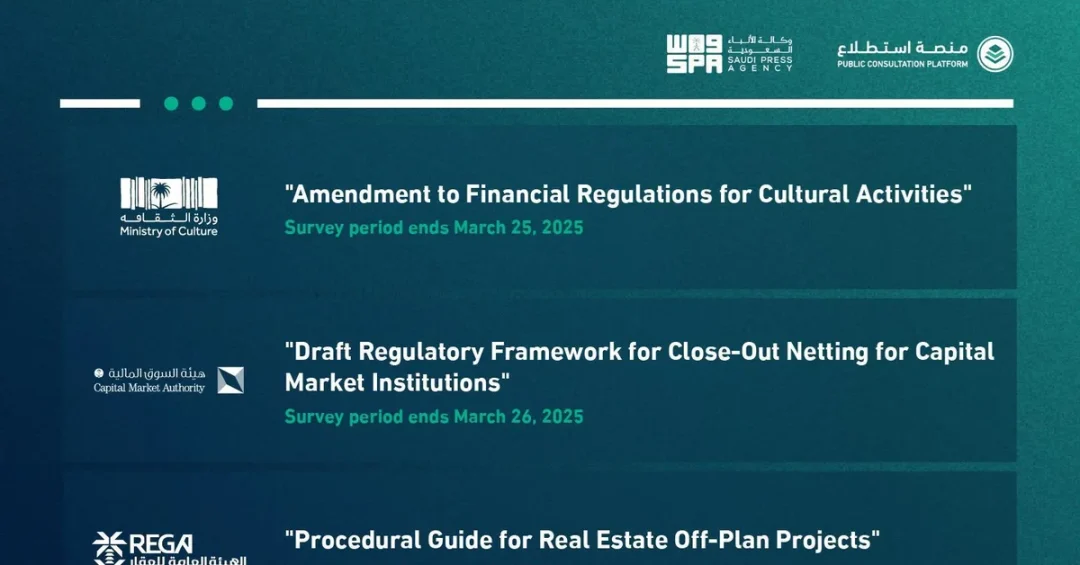
Saudi Arabia’s National Competitiveness Center has opened public consultation on six new economic and development projects through its Istitlaa platform, inviting citizens, government agencies, and the private sector to submit feedback before the proposals are finalized. The projects, developed in cooperation with six government agencies, cover cultural financing, capital market regulation, and real estate transparency, and remain open for comment through late March and early April 2025, according to the Saudi Press Agency.
The Istitlaa platform, whose name means “poll” or “survey” in Arabic, is the Kingdom’s official public consultation portal for draft laws, bylaws, and regulatory frameworks that affect the business environment. By publishing these six projects for open review, the National Competitiveness Center is extending an invitation that goes beyond formality: it is asking the people who will live and work under these rules to help shape them. Why does that matter for a country moving as quickly as Saudi Arabia is today? Because regulation written with public input tends to be regulation that works in practice, not just on paper.
Context and Background
Public consultation has become a defining feature of Saudi Arabia’s regulatory modernization. The National Competitiveness Center, a government body tasked with improving the Kingdom’s business environment and international competitiveness rankings, operates Istitlaa as a central channel where draft regulations are posted before approval. Citizens, companies, investors, and government entities can review the text, identify practical problems, and propose improvements. The model reflects a broader shift in Saudi governance toward transparency, predictability, and stakeholder engagement as the Kingdom pursues the objectives of Saudi Vision 2030.
What makes this particular batch of six projects notable is its range. The proposals touch cultural policy, financial market infrastructure, and real estate procedure, three areas that rarely move in tandem. Taken together, they illustrate how Vision 2030’s economic diversification agenda reaches into nearly every sector of the national economy. The Ministry of Culture, the Capital Market Authority, and the Real Estate General Authority are each advancing reforms designed to make their sectors more attractive, more stable, and easier to navigate for both Saudi and international participants.
The timing is significant as well. Saudi Arabia has spent recent years streamlining licensing, digitizing government services, and aligning domestic rules with international best practice. Consultation periods such as these give regulators a final opportunity to test proposals against real-world experience before they become binding. For international observers, the publication of draft texts and the invitation to comment signal a legislative environment that is increasingly open, consultative, and predictable, qualities that global investors weigh heavily when deciding where to commit capital.
Key Details of the Six Projects
The first project, an Amendment to Financial Regulations for Cultural Activities, was developed by the Ministry of Culture. It aims to empower initiatives related to participation in cultural and artistic activities and to strengthen the effectiveness of the cultural ecosystem in society. The amendment supports the achievement of Saudi Vision 2030 objectives by making it easier for cultural organizations, artists, and investors to operate within a clearer financial framework. Public feedback on this project is open through the Istitlaa platform until March 25, 2025.
The second project comes from the Capital Market Authority, which is seeking comment on a Draft Regulatory Framework for Close-Out Netting for Capital Market Institutions. The framework is designed to enhance financial stability and legal certainty by regulating netting agreements and related financial collateral arrangements. These arrangements involve qualified financial contracts under the authority’s supervision in which at least one party is a capital market institution. Critically, the framework ensures the enforceability of these agreements both during normal operations and in bankruptcy proceedings, aligning with the Capital Market Law, the Bankruptcy Law, and specifically Article 214 of the Bankruptcy Law and Article 79 of its implementing regulation. Consultation on this project remains open until March 26, 2025.
The third highlighted project belongs to the Real Estate General Authority, which has published a Procedural Guide for Real Estate Off-Plan Projects. This initiative aims to increase transparency and efficiency in the real estate sector for the benefit of investors and consumers alike. The guide clarifies all procedural requirements for selling and renting off-plan real estate projects in which the authority is a party. Public consultation on this project concludes on April 8, 2025. The remaining projects in the six-project package follow the same model: draft regulations and procedural documents published in full, with defined comment windows and a stated commitment to review all submissions before approval.
How the Istitlaa Platform Works
Istitlaa functions as a single digital window for regulatory participation. Draft regulations, bylaws, and similar instruments are posted with supporting documentation, and interested parties submit comments directly through the platform. The National Competitiveness Center then consolidates the feedback and shares it with the sponsoring agency, which can revise the proposal before it proceeds to formal approval. This cycle gives regulators an evidence base drawn from the people and businesses most affected by the rules.
The mechanism is not limited to large corporations or industry associations. Individual citizens, small business owners, academics, and international investors can all participate, and the platform’s design makes the process accessible without specialized legal knowledge. That inclusivity matters in a country where regulatory reform is moving on many fronts at once. When rules change quickly, consultation helps ensure that the changes reflect genuine needs rather than assumptions made in isolation.
For the private sector, the platform offers something valuable beyond influence: visibility. Companies can see what regulators are planning months before new requirements take effect, allowing them to prepare, budget, and adjust business models accordingly. For government agencies, the benefit runs in the other direction, as public comments often surface practical complications that drafters had not anticipated. The result is a legislative environment that improves with each consultation cycle, reinforcing the Kingdom’s reputation for institutional quality.
International and Regional Impact
For international investors, the significance of these consultations lies in what they reveal about Saudi Arabia’s regulatory direction. The close-out netting framework, for example, addresses a technical but crucial issue in global finance. Netting agreements allow financial institutions to offset obligations in the event of default or bankruptcy, reducing systemic risk and making markets more resilient. By clarifying the enforceability of these arrangements under Saudi law, the Capital Market Authority is aligning the Kingdom’s capital markets with standards familiar to institutions in London, New York, Singapore, and other major financial centers.
Regionally, Saudi Arabia’s consultative approach positions it as a leader in regulatory governance across the Middle East. While many economies in the region continue to develop their public participation mechanisms, the Kingdom has built a structured, digital-first system that publishes draft texts and invites comment as a matter of routine. That practice strengthens the Kingdom’s standing in international competitiveness indices and supports its ambition to be a preferred destination for foreign direct investment. It also complements broader Gulf efforts to harmonize financial and commercial rules, making cross-border business smoother for companies operating across the region.
Economic and Strategic Significance
Each of the three highlighted projects carries direct economic weight. The cultural financing amendment supports a sector that Vision 2030 has identified as a source of jobs, tourism, and national identity. A clearer financial framework for cultural activities encourages private investment in museums, festivals, film, music, and heritage, helping the Kingdom meet growing domestic demand for cultural experiences and attract international visitors. The Capital Market Authority’s netting framework reduces legal risk for financial institutions, which in turn supports deeper, more liquid markets and lowers the cost of capital for Saudi companies.
The real estate procedural guide addresses one of the Kingdom’s most dynamic sectors. Off-plan sales, in which buyers purchase properties before construction is complete, have expanded rapidly as Saudi cities grow and major projects advance. Clear procedures protect buyers, give developers confidence, and reduce disputes. Together, these reforms reinforce the strategic logic of Vision 2030: diversify the economy, strengthen institutions, and create an environment where both Saudi and international capital can invest with confidence. Transparency in rulemaking is not an abstract ideal but a practical input to growth, and the Istitlaa consultations translate that principle into action.
Vision 2030 Alignment
The introduction of draft regulations, bylaws, and similar projects through the Istitlaa platform affirms the Kingdom’s commitment to enhanced transparency in the legislative environment. It fosters a culture of public participation by enabling citizens, government agencies, and the private sector to contribute insights and feedback on proposed regulations related to the business environment. This participatory model is a direct expression of Vision 2030’s governance objectives, which call for effective, accountable institutions and an economy that welcomes investment from around the world.
As the consultation windows close on March 25, March 26, and April 8, 2025, the feedback gathered will help refine rules that will shape cultural financing, financial market resilience, and real estate practice for years to come. For international readers, the message is clear: Saudi Arabia is building its future not behind closed doors but in open dialogue with the people and institutions who will help deliver it. The six projects now open on Istitlaa are a small but telling example of how the Kingdom is turning Vision 2030 from a blueprint into a working reality, one regulation at a time.
20 Questions
Q1. What is the Istitlaa platform?
A1. Istitlaa is the public consultation platform operated by Saudi Arabia’s National Competitiveness Center. It publishes draft regulations and bylaws so citizens, government agencies, and the private sector can submit feedback before the proposals are formally approved.
Q2. How many projects are currently open for feedback?
A2. Six projects related to economic and development affairs are open for public consultation. They were developed in cooperation with six government agencies and cover cultural financing, capital market regulation, and real estate procedures.
Q3. Which agency developed the cultural financing amendment?
A3. The Ministry of Culture developed the Amendment to Financial Regulations for Cultural Activities. It aims to empower cultural and artistic initiatives and strengthen the cultural ecosystem in support of Saudi Vision 2030 objectives.
Q4. When does consultation close on the cultural project?
A4. Public feedback on the Amendment to Financial Regulations for Cultural Activities is open through the Istitlaa platform until March 25, 2025. All comments submitted by that date will be reviewed before the amendment proceeds.
Q5. What is close-out netting in capital markets?
A5. Close-out netting allows financial institutions to offset mutual obligations if a counterparty defaults or enters bankruptcy. It reduces systemic risk and is a standard feature of well-regulated financial markets worldwide.
Q6. Which authority issued the close-out netting framework?
A6. The Capital Market Authority issued the Draft Regulatory Framework for Close-Out Netting for Capital Market Institutions. It seeks to enhance financial stability and legal certainty in Saudi Arabia’s capital market.
Q7. What laws does the netting framework align with?
A7. The framework aligns with the Capital Market Law and the Bankruptcy Law, specifically Article 214 of the Bankruptcy Law and Article 79 of its implementing regulation. It ensures netting agreements are enforceable in normal and bankruptcy proceedings.
Q8. When does feedback close on the netting framework?
A8. Public consultation on the Draft Regulatory Framework for Close-Out Netting for Capital Market Institutions remains open until March 26, 2025. Stakeholders can submit comments through the Istitlaa platform.
Q9. What is the real estate off-plan procedural guide?
A9. The Real Estate General Authority published a Procedural Guide for Real Estate Off-Plan Projects. It clarifies procedural requirements for selling and renting off-plan projects where the authority is a party, increasing transparency for investors and consumers.
Q10. When does consultation end for the real estate guide?
A10. Public consultation on the Procedural Guide for Real Estate Off-Plan Projects concludes on April 8, 2025. Feedback will help refine the guide before it takes effect.
Q11. Who can participate in Istitlaa consultations?
A11. Citizens, government agencies, private sector companies, investors, and other stakeholders can all participate. The platform is designed to be accessible, allowing individuals and organizations to submit feedback directly online.
Q12. Why is public consultation important for Saudi Arabia?
A12. Consultation improves regulation by incorporating practical experience from those affected by the rules. It also strengthens transparency, builds trust, and supports Vision 2030’s goals of effective governance and a competitive business environment.
Q13. How does Istitlaa support Vision 2030?
A13. Istitlaa advances Vision 2030’s governance objectives by making rulemaking more transparent and participatory. It helps create a predictable legislative environment that attracts investment and supports economic diversification.
Q14. What benefits does the cultural amendment offer?
A14. The amendment supports cultural and artistic activities by clarifying financial regulations. It encourages private investment in museums, festivals, film, music, and heritage, helping the cultural sector create jobs and enrich society.
Q15. Why is close-out netting important for investors?
A15. Netting reduces legal uncertainty and credit risk in financial contracts. Clear enforceability rules make Saudi capital markets safer and more attractive to international institutions, supporting market depth and lower capital costs.
Q16. How does the real estate guide help buyers?
A16. The guide clarifies procedures for off-plan sales and rentals, protecting buyers from unclear terms and reducing disputes. It also gives developers a predictable framework, supporting confidence in a fast-growing sector.
Q17. What happens to feedback submitted through Istitlaa?
A17. The National Competitiveness Center consolidates comments and shares them with the sponsoring agency. Regulators review the input and may revise the draft before it proceeds to formal approval.
Q18. Does Istitlaa cover only economic regulations?
A18. Istitlaa primarily covers draft regulations and bylaws affecting the business environment, but its scope includes social and cultural matters linked to economic activity. The current batch spans culture, finance, and real estate.
Q19. How does this reflect Saudi Arabia’s global standing?
A19. Publishing draft rules for public comment aligns Saudi Arabia with best practices in advanced economies. It strengthens the Kingdom’s reputation for transparency and institutional quality, supporting its competitiveness rankings.
Q20. What is the next step after consultations close?
A20. After the comment periods end, sponsoring agencies review the feedback and finalize the proposals. Approved regulations are then published and implemented, completing a cycle designed to make Saudi rules effective and durable.
Reader Feedback
We value your thoughts. Please share your feedback on this article.
Your feedback helps us improve our coverage.
Related articles
 Saudi Arabia, Ukraine Strengthen Economic Ties in Joint Statement
 Shura Council Highlights Saudi Women’s Empowerment at CSW69
 Saudi Arabia Condemns Israeli Electricity Blackout in Gaza as Collective Punishment
 Saudi Architecture Commission, USGBC Sign Green Building Deal
 Riyadh Season Wins Media Excellence Award
 MWL Condemns Gaza Electricity Cutoff, Urges Global Action