


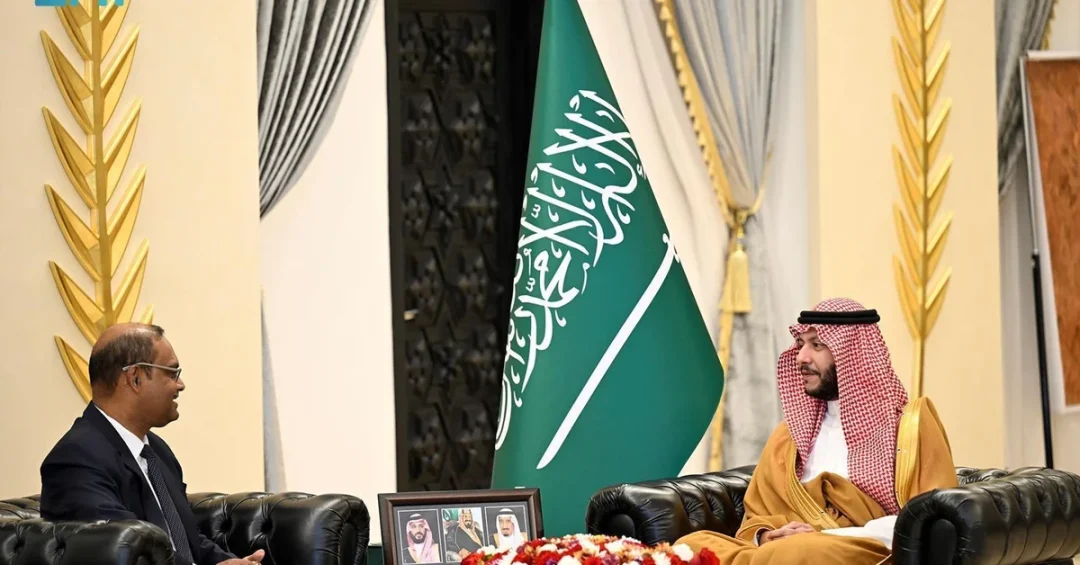
Governor of Taif Prince Saud bin Nahar bin Saud bin Abdulaziz received Consul General of the People’s Republic of Bangladesh in Jeddah Miah Md Mainul Kabir in Taif on April 16, 2025, according to the Saudi Press Agency (SPA). The meeting, held at the governorate headquarters, focused on topics of common interest between the Kingdom of Saudi Arabia and Bangladesh, underscoring the enduring diplomatic, economic, and cultural ties that bind the two nations. The official reception reflects the Kingdom’s continued commitment to strengthening international partnerships under the leadership of the Custodian of the Two Holy Mosques, King Salman bin Abdulaziz Al Saud, and His Royal Highness Crown Prince Mohammed bin Salman bin Abdulaziz Al Saud, Prime Minister.
The encounter comes amid deepening bilateral relations between Riyadh and Dhaka, which have expanded significantly in recent years across trade, investment, labor, and cultural exchange. Bangladesh, home to a large Muslim population, maintains a robust diplomatic presence in the Kingdom, with its consulate in Jeddah serving the needs of its citizens and facilitating cooperation. The meeting in Taif highlights the importance Saudi Arabia places on maintaining open channels of communication with friendly nations and ensuring that diplomatic engagements at the regional level contribute to mutual prosperity and stability.
Context and Background
What does a meeting between a regional governor and a foreign consul general signify in the broader context of Saudi diplomacy? Such engagements, while often ceremonial, play a vital role in reinforcing the Kingdom’s decentralized approach to international relations, where provincial leaders actively participate in fostering ties with foreign representatives. Taif, located in the Makkah Province, is a city of strategic and cultural importance, known for its historical significance, pleasant climate, and role as a summer retreat for government officials. The governor’s reception of Consul General Miah Md Mainul Kabir therefore carries symbolic weight, representing Saudi Arabia’s openness to international dialogue at all levels of governance.
Saudi-Bangladeshi relations have deep historical roots, dating back to the establishment of diplomatic ties in 1975. Over the decades, the relationship has evolved into a multifaceted partnership. Bangladesh is a key source of skilled and semi-skilled labor for the Kingdom, contributing to Saudi Arabia’s ambitious development projects, including those under Vision 2030. In return, Saudi Arabia has been a steadfast partner in Bangladesh’s development, providing financial assistance, energy supplies, and support for infrastructure projects. The two countries also share strong people-to-people connections, with a significant Bangladeshi expatriate community residing in the Kingdom, particularly in Jeddah, Riyadh, and the Eastern Province.
Consul General Miah Md Mainul Kabir, based in Jeddah, has been actively engaged in promoting bilateral interests, including the welfare of Bangladeshi nationals and the facilitation of trade and investment. His meeting with Prince Saud bin Nahar bin Saud bin Abdulaziz is part of a series of diplomatic engagements that highlight the consul’s proactive approach to strengthening ties at the regional level. The discussion of topics of common interest likely encompassed areas such as labor mobility, remittances, cultural exchange, and potential avenues for economic collaboration, all of which are central to the Saudi-Bangladeshi partnership.
Key Details of the Meeting
What specific outcomes can be expected from this high-level encounter? While the official statement released by the Saudi Press Agency did not disclose detailed agenda items, the phrase “topics of common interest” typically encompasses a range of bilateral issues. These may include the status of Bangladeshi workers in Saudi Arabia, efforts to enhance trade and investment flows, cooperation in education and healthcare, and cultural initiatives that promote mutual understanding. The meeting also provided an opportunity for the consul general to convey Bangladesh’s appreciation for the Kingdom’s hospitality and support to its expatriate community.
The governor of Taif, Prince Saud bin Nahar bin Saud bin Abdulaziz, is a prominent member of the Saudi royal family and has been instrumental in overseeing the development and administration of Taif. His role involves not only local governance but also representing the central government in regional affairs. By receiving the Bangladeshi consul general, the governor reaffirmed Taif’s openness to international engagement and its potential as a hub for cultural and economic exchanges. The meeting also aligns with the Kingdom’s broader strategy of enhancing its global image as a welcoming and cooperative nation, particularly as it prepares to host major international events and expands its tourism sector.
Bangladesh’s consulate in Jeddah serves as a vital link between the Bangladeshi diaspora and Saudi authorities. Consul General Miah Md Mainul Kabir has been noted for his efforts to streamline consular services, address community concerns, and promote Bangladesh’s interests in the Kingdom. His meeting with the Taif governor is likely to have covered practical matters such as the issuance of documents, legal assistance, and the facilitation of cultural events that showcase Bangladeshi heritage in Saudi Arabia. Such engagements are essential for maintaining the smooth operation of bilateral relations and ensuring that the rights and welfare of expatriates are protected.
International and Regional Impact
How does this meeting resonate beyond the immediate bilateral context? Saudi Arabia’s engagement with Bangladesh is part of its broader outreach to South and Southeast Asian nations, which are home to large Muslim populations and emerging economies. By nurturing these relationships, the Kingdom strengthens its role as a leader in the Islamic world and a bridge between the Middle East and Asia. The meeting in Taif also reflects Saudi Arabia’s commitment to multilateral diplomacy, as it seeks to build consensus on regional issues such as security, counterterrorism, and economic integration.
From a regional perspective, the encounter underscores the stability and openness of Saudi Arabia’s diplomatic apparatus. Despite ongoing geopolitical challenges in the Middle East, the Kingdom continues to prioritize constructive engagement with friendly nations. This approach not only enhances Saudi Arabia’s international standing but also contributes to the stability of the broader region by fostering economic interdependence and cultural exchange. Bangladesh, as a rising economy in South Asia, stands to benefit from closer ties with the Kingdom, particularly in terms of investment, technology transfer, and access to Saudi markets.
Economic and Strategic Significance
What economic benefits might arise from strengthened Saudi-Bangladeshi relations? Trade between the two countries has grown steadily, with Saudi Arabia exporting crude oil, petrochemicals, and plastics to Bangladesh, while Bangladesh exports textiles, garments, and agricultural products to the Kingdom. The meeting in Taif could pave the way for increased investment in sectors such as renewable energy, infrastructure, and halal industries. Saudi Arabia’s Public Investment Fund (PIF) has shown interest in diversifying its portfolio, and Bangladesh offers opportunities in manufacturing, logistics, and digital economy.
Strategically, Bangladesh is important to Saudi Arabia’s vision of a stable and prosperous Asia. The Kingdom has been a key partner in Bangladesh’s development, providing aid and loans for projects such as the construction of the Padma Bridge and power plants. In return, Bangladesh supports Saudi Arabia’s positions on regional issues and participates in Islamic cooperation forums. The meeting between the Taif governor and the Bangladeshi consul general thus carries strategic weight, reinforcing a partnership that benefits both nations economically and diplomatically.
Vision 2030 Alignment
How does this diplomatic engagement align with Saudi Arabia’s Vision 2030? Vision 2030, the Kingdom’s ambitious blueprint for economic diversification and social transformation, emphasizes international cooperation as a cornerstone of its strategy. By strengthening ties with countries like Bangladesh, Saudi Arabia can attract foreign talent, expand its export markets, and enhance its cultural diplomacy. The meeting in Taif exemplifies the Vision’s goal of creating a vibrant society and a thriving economy through global engagement.
Moreover, Vision 2030 seeks to improve the quality of life for all residents, including expatriates. The welfare of Bangladeshi workers in Saudi Arabia is a priority, and engagements like this ensure that their contributions are recognized and their needs addressed. As Saudi Arabia continues to implement mega-projects such as NEOM and the Red Sea Project, the role of international partners, including Bangladesh, becomes increasingly important. The Taif meeting is a small but meaningful step in a larger journey toward a more interconnected and prosperous future, reflecting the Kingdom’s enduring commitment to peace, cooperation, and shared prosperity.
20 Questions
Q1. Who received the Bangladeshi Consul General in Taif?
A1. Governor of Taif Prince Saud bin Nahar bin Saud bin Abdulaziz received Consul General Miah Md Mainul Kabir in Taif on April 16, 2025, according to the Saudi Press Agency.
Q2. When did the meeting take place?
A2. The meeting took place on April 16, 2025, as reported by the Saudi Press Agency, with local time noted as 14:22 and GMT as 11:22.
Q3. Where did the meeting occur?
A3. The meeting was held in Taif, a city in the Makkah Province of Saudi Arabia, at the governorate headquarters, as per the official SPA report.
Q4. What was the main topic of discussion?
A4. The two officials discussed topics of common interest between Saudi Arabia and Bangladesh, focusing on bilateral relations and areas of mutual cooperation.
Q5. Who is the Consul General of Bangladesh in Jeddah?
A5. Miah Md Mainul Kabir serves as the Consul General of the People’s Republic of Bangladesh in Jeddah, representing Bangladeshi interests in the Kingdom.
Q6. Why is this meeting significant for Saudi-Bangladesh relations?
A6. It underscores the strong diplomatic ties between the two nations and highlights Saudi Arabia’s commitment to engaging with international partners at regional levels.
Q7. How long have Saudi Arabia and Bangladesh maintained diplomatic relations?
A7. Diplomatic relations between Saudi Arabia and Bangladesh were established in 1975, and they have since grown into a multifaceted partnership.
Q8. What role does the Bangladeshi community play in Saudi Arabia?
A8. The Bangladeshi expatriate community contributes significantly to Saudi Arabia’s economy, particularly in sectors like construction, healthcare, and retail.
Q9. What economic areas were likely discussed?
A9. Discussions likely covered trade, investment, labor mobility, and potential collaboration in sectors such as renewable energy and infrastructure.
Q10. How does this meeting align with Vision 2030?
A10. It supports Vision 2030’s goals of international cooperation, economic diversification, and improving the quality of life for all residents, including expatriates.
Q11. What is the strategic importance of Taif in Saudi diplomacy?
A11. Taif is a historically and culturally significant city, and hosting diplomatic meetings there reflects Saudi Arabia’s decentralized approach to international engagement.
Q12. What benefits does Bangladesh gain from this relationship?
A12. Bangladesh benefits through remittances, development assistance, and access to Saudi markets, as well as support for its expatriate workers.
Q13. How does Saudi Arabia support Bangladeshi workers?
A13. Saudi Arabia provides legal protections, healthcare, and other services to ensure the welfare of Bangladeshi workers, in line with Vision 2030’s quality-of-life goals.
Q14. What are the key exports from Saudi Arabia to Bangladesh?
A14. Saudi Arabia exports crude oil, petrochemicals, and plastics to Bangladesh, which are vital for its energy and industrial sectors.
Q15. What are the key exports from Bangladesh to Saudi Arabia?
A15. Bangladesh exports textiles, garments, and agricultural products to Saudi Arabia, contributing to the Kingdom’s consumer market.
Q16. How does this meeting reflect Saudi Arabia’s regional diplomacy?
A16. It demonstrates Saudi Arabia’s active engagement with Asian nations, reinforcing its role as a bridge between the Middle East and Asia.
Q17. What is the significance of the consul general’s role in Jeddah?
A17. The consul general facilitates consular services, promotes trade, and advocates for the Bangladeshi community’s interests in the Kingdom.
Q18. What future cooperation might result from this meeting?
A18. Future cooperation could include joint ventures in energy, infrastructure, and halal industries, as well as cultural exchange programs.
Q19. How does Saudi Arabia benefit from ties with Bangladesh?
A19. Saudi Arabia gains a reliable partner in South Asia, access to a growing market, and support in Islamic forums, enhancing its global standing.
Q20. What message does this meeting send to the international community?
A20. It signals Saudi Arabia’s openness to diplomacy, its respect for international partnerships, and its commitment to stability and prosperity under Vision 2030.
Reader Feedback
We value your thoughts. Please share your feedback on this article.
Your feedback helps us improve our coverage.
Related articles
 Cluster 2 Airports Earn Level 1 Carbon Accreditation
 GDNC Seizes 147kg Meth in Marble at Jeddah Port
 Kuwait’s Crown Prince Meets GCC, Central Asian FMs
 Saudi FM Joins GCC-Central Asia Strategic Dialogue
 JIAT Clears Coalition Forces of Zinjibar Building Strike Allegation
 Saudi, South African Diplomats Meet in Jeddah