


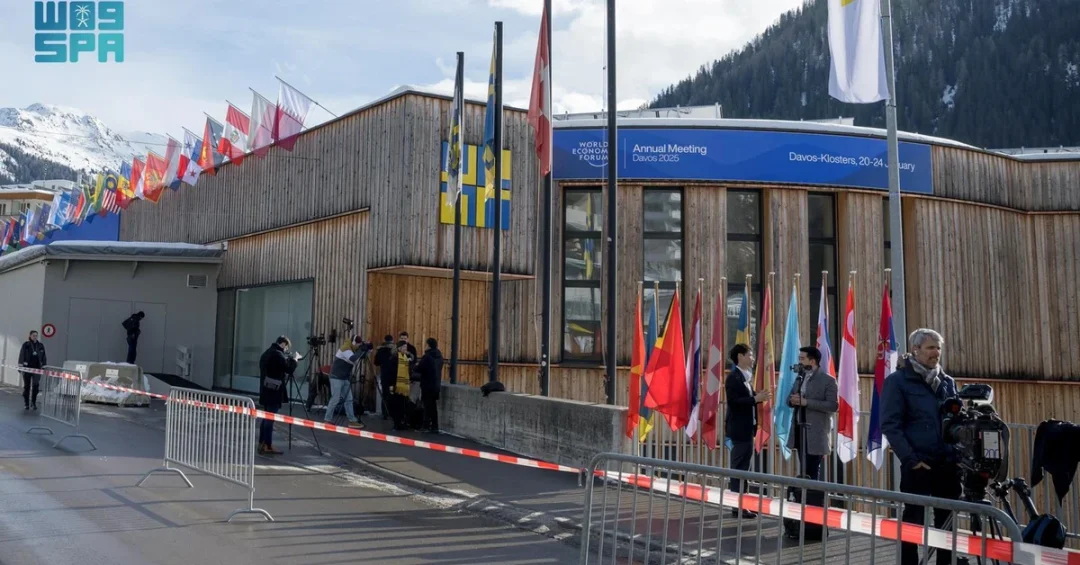
The World Economic Forum (WEF) Annual Meeting 2025 commenced on January 20 in Davos, Switzerland, bringing together 3,000 leaders from more than 130 countries, including 350 government officials and 60 heads of state and government, according to the Saudi Press Agency. The 55th edition of the annual gathering is being held under the theme “Collaboration for the Intelligent Age,” a framing that signals how artificial intelligence, digital transformation, and cross-border cooperation now sit at the center of global economic planning. The meeting opened at a moment defined by escalating geopolitical, economic, and humanitarian challenges, giving the discussions in the Swiss alpine town unusual urgency.
The Kingdom of Saudi Arabia is represented at the forum by a high-level delegation, reflecting the country’s expanding role in global economic diplomacy. Riyadh’s participation is not limited to official sessions; the Kingdom is also showcasing its initiatives through the Saudi House pavilion, a dedicated platform that connects entrepreneurs, changemakers, and innovators. The pavilion highlights strategic visions in key areas shaping the future of the world while presenting development and investment opportunities arising from Vision 2030. For an international audience watching how Saudi Arabia positions itself in a fragmenting global order, the delegation’s agenda in Davos offers a clear signal of intent.
Context and Background
Why does the Davos annual meeting continue to matter in an era of proliferating bilateral summits and regional blocs? The World Economic Forum, founded in 1971, has long functioned as one of the few venues where heads of state, central bank governors, chief executives, and civil society leaders gather under a single roof for a week of structured dialogue. The 2025 edition, the 55th in the series, is no exception. Its theme, “Collaboration for the Intelligent Age,” reflects a consensus among organizers that the rapid deployment of artificial intelligence, automation, and data-driven systems requires coordinated governance rather than fragmented national responses.
The meeting comes at what official Saudi channels describe as a critical time marked by escalating geopolitical, economic, and humanitarian challenges. Conflicts, trade tensions, debt pressures in emerging markets, and the uneven recovery of global growth have combined to test the resilience of multilateral institutions. In this environment, the value of Davos lies less in binding agreements and more in agenda-setting: the conversations held there often shape the priorities that governments and companies pursue over the following twelve months. Saudi Arabia’s decision to send a high-level delegation, rather than a token presence, indicates that the Kingdom intends to help shape those priorities rather than simply react to them.
For observers of Saudi policy, the composition of the delegation and the programming of the Saudi House pavilion are as informative as any formal statement. They show which sectors Riyadh believes are central to its next phase of growth and where it sees opportunities for international partnership. The fact that the Kingdom is presenting Vision 2030 opportunities directly to the Davos audience, rather than waiting for investors to come to Riyadh, marks a maturing of Saudi economic diplomacy.
Key Details
What exactly is Saudi Arabia presenting in Davos this year? The Saudi House pavilion is organized by a broad coalition of government entities, including the Ministry of Economy and Planning, the Ministry of Health, the Ministry of Transport and Logistic Services, the Ministry of Communications and Information Technology, the Ministry of Tourism, and the Ministry of Investment. They are joined by the Royal Commission for Jubail and Yanbu, the General Authority of Civil Aviation, the Royal Commission for AlUla, the Saudi Tourism Authority, the Research, Development and Innovation Authority, Diriyah Company, and the Centre for the Fourth Industrial Revolution in the Kingdom. Together, these bodies cover a remarkably wide slice of the Saudi economy, from industrial cities and aviation to heritage tourism and frontier technology.
The pavilion is designed as a platform connecting entrepreneurs, changemakers, and innovators. Its programming will address the latest trends in social and economic transformation both locally and internationally, according to the Saudi Press Agency. That framing places Saudi Arabia’s domestic reform agenda in direct conversation with global debates about inclusive growth, technological adoption, and sustainable development. Rather than presenting Vision 2030 as a purely national project, the Saudi House format positions it as a set of solutions that can be adapted and partnered on internationally.
The presence of the Centre for the Fourth Industrial Revolution in the Kingdom is particularly notable. As part of the World Economic Forum’s global network of affiliated centers, it gives Saudi Arabia a standing channel to discuss AI governance, data policy, and emerging technology regulation with counterparts from other economies. In a year whose theme centers on the “Intelligent Age,” that institutional link is more than symbolic; it is a working mechanism for shaping norms in fields where rules are still being written.
International and Regional Impact
How will Saudi Arabia’s engagement in Davos be read across the region and beyond? For Gulf neighbors, the Kingdom’s high-profile participation reinforces a broader pattern in which Gulf states have moved from being recipients of global economic guidance to being co-authors of it. Saudi Arabia’s delegation arrives with a reform program that has already restructured domestic energy pricing, opened new sectors to foreign investment, and begun building entirely new urban and tourism destinations. Presenting that record in Davos gives Gulf partners a reference point for their own diversification strategies.
For Europe, Asia, and the Americas, the Saudi presence offers a channel for practical cooperation on issues that dominate the Davos agenda: energy transition, supply chain resilience, health system preparedness, and artificial intelligence governance. The Saudi House pavilion’s inclusion of the Ministry of Health and the Ministry of Transport and Logistic Services signals that the Kingdom wants to discuss not only investment but also operational collaboration in fields such as pandemic preparedness, aviation connectivity, and logistics corridors linking three continents.
Economic and Strategic Significance
Why should global investors pay attention to what happens at the Saudi House pavilion? The entities involved represent a pipeline of projects and policies that are actively seeking international partners. The Ministry of Investment’s presence points to ongoing efforts to streamline foreign investment procedures and highlight sector-specific opportunities. The Royal Commission for AlUla and Diriyah Company represent two of the Kingdom’s flagship cultural and tourism developments, each with substantial capital programs and long-term operating ambitions. The General Authority of Civil Aviation reflects Saudi Arabia’s goal of becoming a global aviation hub connecting Asia, Europe, and Africa.
The strategic logic is straightforward: by bringing these entities together under one pavilion, Saudi Arabia presents a coordinated national proposition rather than a set of disconnected projects. For multinational companies assessing where to allocate capital in a period of higher interest rates and geopolitical risk, that coordination reduces uncertainty. It also allows Saudi officials to gather real-time feedback from global executives on what would make the Kingdom’s offerings more competitive, a form of market intelligence that is difficult to replicate through traditional roadshows.
Vision 2030 Alignment
How does a week in Davos connect to the long-term goals of Vision 2030? The answer lies in the reform program’s core premise: that Saudi Arabia’s economic future depends on diversification, openness, and integration with the global economy. Vision 2030 set out to reduce dependence on oil revenues, expand the private sector, increase women’s participation in the workforce, and develop new sectors such as tourism, entertainment, and technology. Each of those objectives requires international partnerships, technology transfer, and access to global capital markets. The Davos annual meeting is one of the most efficient venues in the world for advancing all three at once.
The Saudi House pavilion operationalizes that logic. By convening ministries, authorities, and companies in a single space, it allows international visitors to engage with the Kingdom’s transformation agenda directly and to see how individual projects fit into a coherent national strategy. As the 55th World Economic Forum Annual Meeting proceeds under the banner of collaboration for the intelligent age, Saudi Arabia’s message is that it intends to be a partner in shaping that age, not merely a participant. For a global audience, the coming days in Davos will offer a preview of the partnerships and priorities that will define the Kingdom’s next chapter.
20 Questions
Q1. When did the World Economic Forum Annual Meeting 2025 begin?
A1. The 55th World Economic Forum Annual Meeting commenced on January 20, 2025, in Davos, Switzerland, according to the Saudi Press Agency, bringing together global leaders for a week of discussions on major economic and geopolitical issues.
Q2. What is the theme of the 2025 Davos meeting?
A2. The meeting is held under the theme “Collaboration for the Intelligent Age,” reflecting a focus on artificial intelligence, digital transformation, and the need for coordinated international governance of emerging technologies.
Q3. How many participants are attending the Davos meeting?
A3. Approximately 3,000 leaders from more than 130 countries are participating, including 350 government officials, among them 60 heads of state and government, making it one of the largest gatherings of its kind.
Q4. Which edition of the World Economic Forum Annual Meeting is this?
A4. This is the 55th edition of the World Economic Forum Annual Meeting, continuing a tradition that began in 1971 and has become a central fixture of the global economic calendar.
Q5. How is Saudi Arabia represented at the 2025 Davos meeting?
A5. The Kingdom is represented by a high-level delegation tasked with addressing global challenges and shaping a prosperous future, according to the Saudi Press Agency, underscoring Saudi Arabia’s active role in international economic diplomacy.
Q6. What is the Saudi House pavilion at Davos?
A6. The Saudi House pavilion is a platform connecting entrepreneurs, changemakers, and innovators. It highlights strategic visions in key areas shaping the future of the world and presents development and investment opportunities arising from Vision 2030.
Q7. Which Saudi ministries are organizing the Saudi House pavilion?
A7. The pavilion is organized by the Ministry of Economy and Planning, Ministry of Health, Ministry of Transport and Logistic Services, Ministry of Communications and Information Technology, Ministry of Tourism, and Ministry of Investment.
Q8. Which Saudi authorities and companies are involved in the pavilion?
A8. Participants include the Royal Commission for Jubail and Yanbu, the General Authority of Civil Aviation, the Royal Commission for AlUla, the Saudi Tourism Authority, the Research, Development and Innovation Authority, Diriyah Company, and the Centre for the Fourth Industrial Revolution in the Kingdom.
Q9. What topics will the Saudi House pavilion address?
A9. The pavilion will discuss the latest trends in social and economic transformation both locally and internationally, according to the Saudi Press Agency, covering areas such as technology, health, tourism, investment, and industrial development.
Q10. Why is the Davos meeting described as taking place at a critical time?
A10. The meeting occurs amid escalating geopolitical, economic, and humanitarian challenges, making international cooperation and dialogue especially important for addressing shared global risks and identifying practical solutions.
Q11. What does Saudi Arabia aim to achieve by participating in Davos?
A11. Saudi Arabia aims to tackle global challenges, shape a prosperous future, and present Vision 2030 opportunities to international partners, reinforcing its role as a constructive actor in the global economy.
Q12. How does the Saudi House pavilion support Vision 2030?
A12. The pavilion presents development and investment opportunities arising from Vision 2030, connecting the Kingdom’s diversification agenda with international investors, entrepreneurs, and innovators who can contribute expertise and capital.
Q13. What is the significance of the Centre for the Fourth Industrial Revolution in the Kingdom?
A13. As part of the World Economic Forum’s global network, the Centre gives Saudi Arabia a standing channel to discuss AI governance, data policy, and emerging technology regulation with counterparts from other economies.
Q14. Which Saudi sectors are highlighted at the pavilion?
A14. The pavilion highlights sectors including health, transport and logistics, communications and information technology, tourism, investment, aviation, heritage development, and research and innovation, reflecting the breadth of Vision 2030.
Q15. How does Saudi participation reflect the Kingdom’s global role?
A15. Saudi Arabia’s high-level delegation and Saudi House pavilion demonstrate the Kingdom’s commitment to international cooperation, economic diversification, and constructive engagement with global institutions and partners.
Q16. What is the role of the Royal Commission for AlUla at Davos?
A16. The Royal Commission for AlUla represents one of the Kingdom’s flagship cultural and tourism developments, showcasing heritage preservation and sustainable tourism opportunities to international audiences at the Saudi House pavilion.
Q17. Why is the Ministry of Investment participating in the Saudi House pavilion?
A17. The Ministry of Investment is participating to highlight investment opportunities, streamline foreign investment procedures, and connect international investors with projects tied to Vision 2030 across multiple sectors.
Q18. What does the theme “Collaboration for the Intelligent Age” imply for Saudi Arabia?
A18. The theme aligns with Saudi Arabia’s focus on technology, innovation, and digital transformation, areas where the Kingdom is investing heavily through entities such as the Research, Development and Innovation Authority.
Q19. How does the Davos meeting benefit international audiences?
A19. The meeting provides a platform for dialogue among governments, businesses, and civil society, enabling participants to address shared challenges and identify opportunities for cooperation in a rapidly changing global economy.
Q20. What is the forward-looking message of Saudi Arabia’s participation?
A20. Saudi Arabia’s participation signals its intention to be a partner in shaping the intelligent age, advancing Vision 2030, and contributing to global prosperity through collaboration, investment, and innovation.
Reader Feedback
We value your thoughts. Please share your feedback on this article.
Your feedback helps us improve our coverage.
Related articles
 KSrelief Supports Arsal Medical Center, Serving 9,733 in December
 KSrelief Delivers 586 Food Baskets and Health Kits in Idlib
 KSrelief Delivers Relief Aid to 177 Families in Suwayda, Syria
 Education Minister Reviews ABEGS Digital Programs in Riyadh
 Riyadh Municipality Earns 10 International ISO Certificates
 Donald Trump Sworn In as 47th US President