


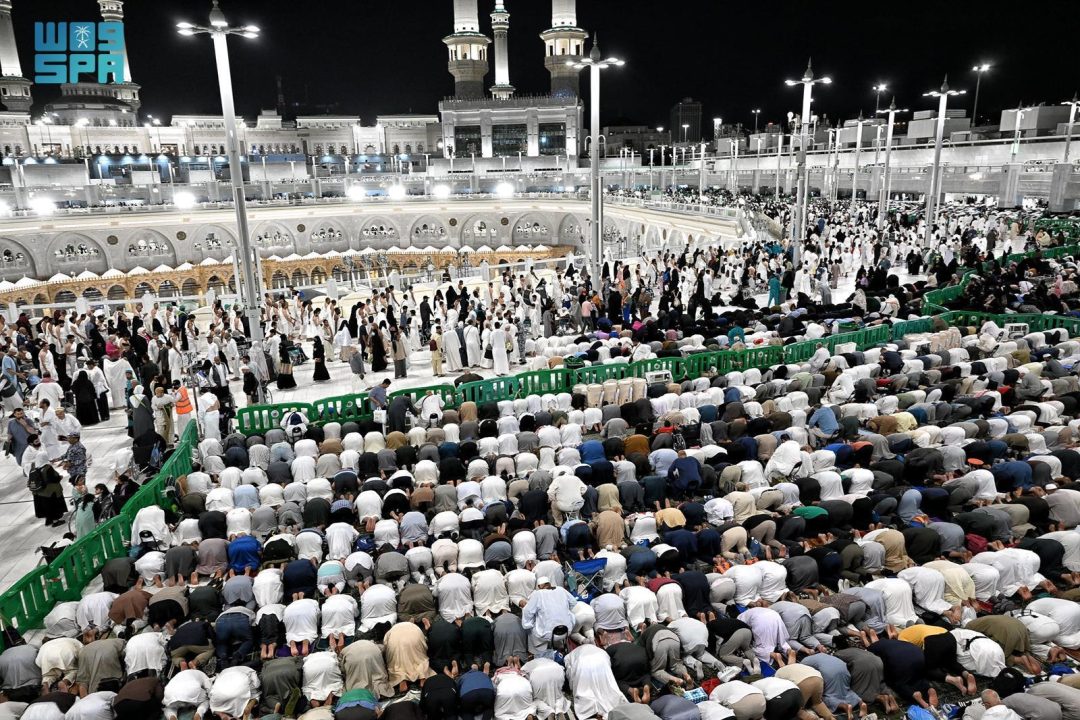
Worshippers gathered at the Grand Mosque in Makkah today to perform the Isha and Taraweeh prayers on the 27th night of Ramadan, in an atmosphere of faith, serenity, and reassurance. The occasion was characterized by an integrated system of services dedicated to accommodating the pilgrims, with the Saudi Press Agency capturing the steady influx of worshippers arriving at the Grand Mosque and its courtyards from the early morning hours.
According to SPA, all areas within the mosque were filled with worshippers, including its corridors, floors, rooftops, courtyards, basement, and the third Saudi expansion, enabling them to perform their prayers and rituals in an environment of security and peace. The scale of the gathering reflected the unique place of the 27th night of Ramadan in the hearts of Muslims, who travel from within the Kingdom and beyond to pray in the Grand Mosque during the final ten nights of the holy month. How many worshippers can the Grand Mosque and its surrounding courtyards hold when every level, from the basement to the rooftop, is in use at once?
The General Presidency for the Affairs of the Grand Mosque and the Prophet’s Mosque ensured smooth and organized movement within the mosque through thorough preparations, with the Mataf area capable of accommodating up to 107,000 pilgrims per hour. That figure alone indicates the scale of the planning required for a night when the flow of worshippers continues for hours without interruption. What does it take to keep a crowd of that size moving safely through the Mataf, the courtyards, and the gates of the Grand Mosque hour after hour?
Copies of the Holy Quran in multiple languages were accessible to worshippers, cleaning efforts were intensified, and the operation of loudspeakers, ventilation fans, and air-conditioning systems were optimized for the comfort of those performing their prayers and rituals. Golf carts, regular carts, and electric carts were provided through the “Tanaqol” app, operating efficiently according to systematic plans. The availability of these services points to a broader effort to serve elderly worshippers and those with limited mobility, who might otherwise struggle to reach the prayer areas inside the mosque and its courtyards. How often do visitors consider the quiet logistics behind a night of prayer — the carts, the cooling systems, the cleaning teams working while worshippers are absorbed in supplication?
The Makkah region’s health affairs department enhanced its services by deploying medical centers within the Grand Mosque and its courtyards, ensuring that pilgrims received the necessary medical care when needed. The presence of these centers reflects the recognition that large gatherings during Ramadan require immediate access to medical support, particularly during the final nights of the month when attendance reaches its peak. What kind of medical cases do the centers inside the Grand Mosque and its courtyards handle most often during the last ten nights of Ramadan?
The 27th night of Ramadan holds particular significance for Muslims, who seek to spend it in worship and prayer, and the Grand Mosque remains the focal point for those able to reach it. The preparations described by SPA — from the Mataf’s capacity to the multilingual copies of the Holy Quran, from the intensified cleaning to the optimized loudspeakers and air-conditioning — form an integrated system of services dedicated to accommodating the pilgrims. Each element supports the others, allowing worshippers to move through the mosque, find a place to pray, and remain comfortable through the Isha and Taraweeh prayers. How does the experience of praying in the Grand Mosque on the 27th night differ from any other night of the year for those who have made the journey?
SPA captured the steady influx of pilgrims and worshippers arriving at the Grand Mosque and its courtyards from the early morning hours, documenting the movement of crowds into the mosque and its surrounding areas well before the prayers began. The early arrival of worshippers underscores the determination of many to secure a place inside the mosque or in its courtyards, particularly on a night that draws larger numbers than most others in the Ramadan calendar. What time do the first worshippers begin arriving at the Grand Mosque on the 27th night, and how do they spend the hours before the prayers?
The third Saudi expansion was among the areas filled with worshippers, according to SPA, alongside the mosque’s corridors, floors, rooftops, courtyards, and basement. The use of every available space within the Grand Mosque complex demonstrates how the site’s capacity is stretched during the busiest nights of Ramadan, and how the preparations of the General Presidency are designed to make each of those spaces usable for prayer. How does the third Saudi expansion change the way crowds are distributed across the Grand Mosque during peak nights?
The operation of loudspeakers, ventilation fans, and air-conditioning systems was optimized for the comfort of worshippers, while cleaning efforts were intensified across the mosque and its facilities. These measures, though less visible than the crowds themselves, are central to the atmosphere of faith, serenity, and reassurance described by SPA. The combination of sound, air, cleanliness, and mobility services allows worshippers to focus on their prayers and rituals without distraction. What would a night of prayer at the Grand Mosque be like without the coordinated work of the teams responsible for these systems?
The “Tanaqol” app provided access to golf carts, regular carts, and electric carts, operating efficiently according to systematic plans. The app-based system offers a way for worshippers to request transport within the mosque complex, a service that becomes especially important when the courtyards and floors are crowded and walking long distances is difficult. How many worshippers rely on these carts each night during Ramadan, and how does the app help organize their movement alongside the flow of pedestrians?
The Makkah region’s health affairs department deployed medical centers within the Grand Mosque and its courtyards, ensuring that pilgrims received the necessary medical care when needed. The placement of these centers inside the mosque complex, rather than only at external facilities, reduces the time required to reach care during a night when large numbers of people are gathered in a confined area. What role do these medical centers play in supporting worshippers who arrive from outside the Kingdom and may not be familiar with local health services?
The integrated system of services described by SPA — the Mataf’s hourly capacity, the multilingual Quran copies, the intensified cleaning, the optimized loudspeakers and air-conditioning, the carts available through the “Tanaqol” app, and the medical centers in the mosque and its courtyards — reflects the scale of preparation required for the 27th night of Ramadan. Each service addresses a different need, from mobility to health to comfort, and together they allow worshippers to perform their prayers and rituals in an environment of security and peace. How do the various agencies involved coordinate their work when the mosque is filled from the early morning hours until after the Taraweeh prayers conclude?
SPA reported that the occasion was characterized by an integrated system of services dedicated to accommodating the pilgrims, and that all areas within the mosque were filled with worshippers. The agency also noted that the General Presidency for the Affairs of the Grand Mosque and the Prophet’s Mosque ensured smooth and organized movement within the mosque through thorough preparations. The health affairs department of the Makkah region enhanced its services by deploying medical centers within the Grand Mosque and its courtyards. What other preparations are made for the final nights of Ramadan that worshippers may not see or notice while they are inside the mosque?
The source did not include the total number of worshippers who attended the Isha and Taraweeh prayers on the 27th night, nor did it specify the number of medical cases treated at the centers inside the Grand Mosque and its courtyards. The source also did not state how many copies of the Holy Quran in multiple languages were made accessible, how many carts were provided through the “Tanaqol” app, or how many staff members were involved in the cleaning, ventilation, and air-conditioning operations. The source did not provide the names of officials overseeing the preparations or the specific plans followed by the various agencies involved.
What prayers did worshippers perform at the Grand Mosque on the 27th night of Ramadan? Worshippers gathered at the Grand Mosque in Makkah to perform the Isha and Taraweeh prayers on the 27th night of Ramadan, according to SPA. The occasion was characterized by an atmosphere of faith, serenity, and reassurance, with an integrated system of services dedicated to accommodating the pilgrims. SPA captured the steady influx of worshippers arriving at the Grand Mosque and its courtyards from the early morning hours, and all areas within the mosque were filled for the prayers and rituals.
How many pilgrims per hour can the Mataf area accommodate? The General Presidency for the Affairs of the Grand Mosque and the Prophet’s Mosque ensured smooth and organized movement within the mosque through thorough preparations, with the Mataf area capable of accommodating up to 107,000 pilgrims per hour, according to SPA. That capacity figure reflects the scale of planning required for the 27th night of Ramadan, when worshippers filled the mosque’s corridors, floors, rooftops, courtyards, basement, and the third Saudi expansion to perform their prayers and rituals in an environment of security and peace.
What services were provided to worshippers inside the Grand Mosque? Copies of the Holy Quran in multiple languages were accessible, cleaning efforts were intensified, and the operation of loudspeakers, ventilation fans, and air-conditioning systems were optimized for the comfort of worshippers, SPA reported. Golf carts, regular carts, and electric carts were provided through the “Tanaqol” app, operating efficiently according to systematic plans. The Makkah region’s health affairs department also deployed medical centers within the Grand Mosque and its courtyards to ensure pilgrims received necessary medical care when needed.
Which areas of the Grand Mosque were filled with worshippers? According to SPA, all areas within the mosque were filled with worshippers, including its corridors, floors, rooftops, courtyards, basement, and the third Saudi expansion. This enabled worshippers to perform their prayers and rituals in an environment of security and peace. The use of every available space demonstrates how the site’s capacity is stretched during the busiest nights of Ramadan, and how the preparations of the General Presidency are designed to make each of those spaces usable for prayer.
What health services were available at the Grand Mosque on the 27th night? The Makkah region’s health affairs department enhanced its services by deploying medical centers within the Grand Mosque and its courtyards, ensuring that pilgrims received the necessary medical care when needed, according to SPA. The placement of these centers inside the mosque complex, rather than only at external facilities, reduces the time required to reach care during a night when large numbers of people are gathered in a confined area for the Isha and Taraweeh prayers.
What did the source not include about the 27th night at the Grand Mosque? The source did not include the total number of worshippers who attended the Isha and Taraweeh prayers on the 27th night, nor did it specify the number of medical cases treated at the centers inside the Grand Mosque and its courtyards. It also did not state how many copies of the Holy Quran in multiple languages were made accessible, how many carts were provided through the “Tanaqol” app, or how many staff members were involved in the cleaning, ventilation, and air-conditioning operations. The source did not provide the names of officials overseeing the preparations.