


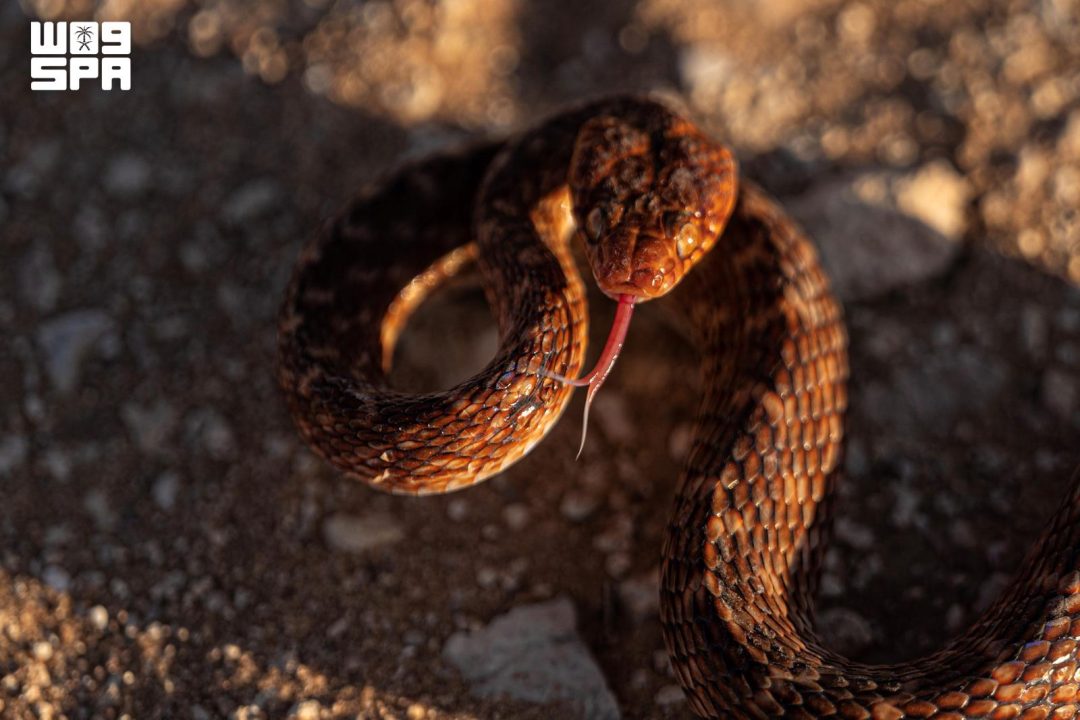
Arid and rocky environments across the Arabian Peninsula serve as the habitat for the Arabian cat snake (Telescopus dhara). This mildly venomous species belongs to the Colubridae family and is adapted to the climatic conditions of its natural surroundings.
According to SPA, the snake features a slender body, a head that is relatively distinct from the neck, and prominent eyes with vertical pupils. These specific physical traits are the reason for its common name, cat snake.
Adnan Khalifa, a member of Aman Environmental Association and wildlife observer, stated that the body patterns and colors of the snake allow it to camouflage with the soil and rocks of its environment. He noted that documenting such species helps identify biodiversity components and the characteristics of wildlife habitats.
The desert and rocky regions of northern Saudi Arabia host various reptile species adapted to the local terrain and climate. Field monitoring is used to identify these species and their distribution.
What are the physical characteristics of the Arabian cat snake? The Arabian cat snake is characterized by a slender body and a head that is relatively distinct from its neck. It possesses prominent eyes with vertical pupils, which contribute to its common name. Additionally, the snake has specific colors and body patterns that enable it to blend in and camouflage with the soil and rocks found in its natural habitat.
Where does the Arabian cat snake live and how does it survive? This reptile inhabits several rocky and arid environments across the Arabian Peninsula, including the desert and rocky environments of northern Saudi Arabia. It survives by adapting to the specific climatic conditions and terrain of these natural habitats. Its ability to camouflage with the surrounding rocks and soil further assists its survival in these regions.
What is the biological classification and nature of the Arabian cat snake? The Arabian cat snake, scientifically known as Telescopus dhara, is a member of the Colubridae family. It is classified as a mildly venomous species. According to Adnan Khalifa of the Aman Environmental Association, monitoring this species is useful for identifying the characteristics of wildlife and the components of biodiversity within its environment.