


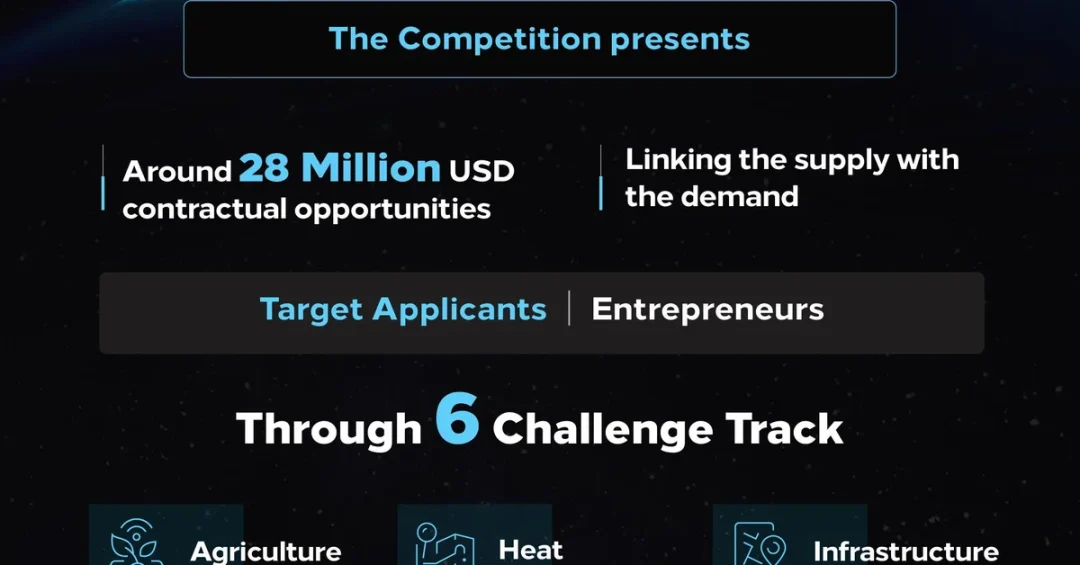
The Communications, Space and Technology Commission (CST) and the Saudi Space Agency (SSA), in partnership with Neo Space Group (NSG), have launched the global SpaceUp Competition, a landmark initiative designed to accelerate space entrepreneurship and develop innovative space-based solutions for vital sectors across the Kingdom and beyond. Announced in Riyadh on January 20, 2025, the competition invites entrepreneurs, startups, and small and medium enterprises from around the world to participate in six challenge tracks, offering approximately $28 million in contractual opportunities. Registration opened the same day and will remain available until April 12, 2025, through the official competition webpage.
The SpaceUp Competition represents a significant step in Saudi Arabia’s efforts to build a diversified, knowledge-driven economy rooted in advanced technology and innovation. By linking supply with demand, the initiative connects solution providers directly with end-users in government and industry, ensuring that the technologies developed are practical, deployable, and aligned with national priorities. Is it any wonder that global attention is turning toward the Kingdom’s rapidly expanding space ecosystem? The competition not only supports local companies specializing in space-based solutions but also attracts international talent and investment, positioning Saudi Arabia as a hub for space entrepreneurship.
Context and Background
How did Saudi Arabia emerge as a rising force in the global space economy? The answer lies in a series of strategic investments and policy initiatives undertaken over the past decade. The establishment of the Saudi Space Agency in 2018 marked a turning point, signaling the Kingdom’s intent to develop a robust space sector capable of contributing to economic growth and technological self-reliance. Since then, the SSA has launched multiple programs aimed at fostering innovation, building human capital, and expanding the Kingdom’s presence in space. The Communications, Space and Technology Commission, for its part, has played a central role in regulating and promoting the sector, ensuring that Saudi Arabia remains at the forefront of regional space development.
The SpaceUp Competition builds on this foundation by creating a structured platform for collaboration between entrepreneurs and end-users. The involvement of Neo Space Group, a leading Saudi company focused on space and satellite technologies, underscores the private sector’s growing role in the Kingdom’s space ambitions. Together, these entities are working to ensure that space-based solutions are not confined to laboratories but are integrated into everyday applications that improve lives, enhance sustainability, and drive economic diversification. This approach reflects a broader global trend in which space technology is increasingly seen as a tool for solving terrestrial challenges, from urban planning to environmental monitoring.
Key Details of the SpaceUp Competition
What exactly does the SpaceUp Competition offer to participants? The initiative features six challenge tracks, each addressing a specific sectoral need. The first track, “Monitoring Date Palms Pest and Disease,” is sponsored by the Ministry of Environment, Water, and Agriculture and the Weqaa Center. It seeks space-based solutions to monitor palm farms and detect pests, thereby protecting a vital agricultural resource. The second track, “Improving City Livability by Monitoring Urban Heat Islands,” is backed by the Quality of Life Program and aims to address rising temperatures in densely populated urban areas. The third track, “Monitoring the Impact of Infrastructure Development,” is sponsored by the Riyadh Infrastructure Projects Centre and focuses on promoting infrastructure projects and traffic management.
The fourth and fifth tracks, “Optimizing Urban Road Assets” and “Mapping of Urban Trees,” are both sponsored by the Ministry of Municipalities and Housing. The former aims to detect urban road damage and improve maintenance, while the latter focuses on monitoring and maintaining urban green spaces. The sixth track, “Greening Saudi Arabia,” supports sustainability efforts under the Saudi Green Initiative by monitoring tree growth. Across all tracks, participants gain direct access to end-users, localization support, and the opportunity to implement their proposed solutions. With approximately $28 million in contractual opportunities, the competition provides tangible incentives for innovators to engage with real-world challenges.
International and Regional Impact
How will the SpaceUp Competition resonate beyond Saudi Arabia’s borders? By inviting global entrepreneurs, startups, and SMEs to participate, the initiative positions the Kingdom as a convenor of international talent and a destination for space-related investment. This openness to global collaboration is a hallmark of Saudi Arabia’s approach to technology and innovation, and it aligns with the Kingdom’s broader efforts to attract foreign direct investment and foster knowledge exchange. Regional neighbors and international partners are likely to take note, as the competition creates opportunities for cross-border partnerships and technology transfer.
Moreover, the competition’s focus on practical applications—such as pest monitoring, urban heat management, and infrastructure assessment—demonstrates how space technology can deliver tangible benefits to societies worldwide. By addressing challenges that are common to many countries, the SpaceUp Competition has the potential to generate solutions that are exportable and scalable. This not only enhances Saudi Arabia’s reputation as a center of innovation but also contributes to global efforts to harness space for sustainable development. In a world where space is increasingly commercialized, the Kingdom’s proactive stance ensures it remains a key player in shaping the future of the sector.
Economic and Strategic Significance
What makes the SpaceUp Competition economically significant? At its core, the initiative is designed to stimulate investment in the Saudi space sector and create a pipeline of commercially viable solutions. The $28 million in contractual opportunities represents direct demand from government and industry for space-based services, providing a clear market signal to entrepreneurs. By connecting solution providers with end-users, the competition reduces the risk typically associated with early-stage innovation and accelerates the path to commercialization. This, in turn, can lead to the creation of high-skilled jobs, the growth of local supply chains, and the retention of talent within the Kingdom.
Strategically, the competition supports Saudi Arabia’s goal of becoming a leader in space technology and a diversified economy. The space sector is a key component of the Kingdom’s long-term vision, as it drives advances in communications, earth observation, navigation, and related fields. By fostering a vibrant ecosystem of startups and SMEs, the SpaceUp Competition helps build the human capital and technical expertise needed to sustain this growth. Furthermore, the involvement of multiple government ministries and programs ensures that the solutions developed are aligned with national priorities, from food security to urban sustainability. This integrated approach is a model for how emerging sectors can be nurtured through public-private collaboration.
Vision 2030 Alignment
How does the SpaceUp Competition align with Saudi Vision 2030? The initiative directly supports the Vision’s objectives of economic diversification, innovation, and sustainable development. By promoting space entrepreneurship and attracting global talent, it contributes to the growth of a knowledge-based economy and reduces reliance on traditional sectors. The competition’s focus on environmental monitoring, urban livability, and infrastructure efficiency also resonates with the Vision’s emphasis on improving quality of life and preserving natural resources. In this way, the SpaceUp Competition is not merely a technology contest but a strategic tool for achieving the Kingdom’s long-term aspirations.
As Saudi Arabia continues to advance its space ambitions, initiatives like SpaceUp will play a crucial role in building a self-sustaining ecosystem that can compete on the global stage. The collaboration between the Communications, Space and Technology Commission, the Saudi Space Agency, and Neo Space Group exemplifies the kind of partnership that drives progress under Vision 2030. By empowering entrepreneurs and fostering innovation, the Kingdom is laying the groundwork for a future in which space-based solutions contribute to prosperity at home and around the world. For those seeking to be part of this journey, the competition offers a unique opportunity to turn ideas into impact.
20 Questions
Q1. What is the SpaceUp Competition?
A1. The SpaceUp Competition is a global initiative launched by the Communications, Space and Technology Commission (CST) and the Saudi Space Agency (SSA) to promote space entrepreneurship and develop innovative space-based solutions for vital sectors.
Q2. Who launched the SpaceUp Competition?
A2. The competition was launched by the Communications, Space and Technology Commission (CST) and the Saudi Space Agency (SSA), in partnership with Neo Space Group (NSG), as announced in Riyadh on January 20, 2025.
Q3. What is the main goal of the SpaceUp Competition?
A3. The main goal is to support local companies specializing in space-based solutions, attract global entrepreneurs, startups, and SMEs, and encourage the adoption of space-based solutions by entities across various vital sectors.
Q4. How many challenge tracks are there in the competition?
A4. There are six challenge tracks, each focusing on a specific sectoral challenge, such as monitoring date palm pests, improving city livability, and greening Saudi Arabia.
Q5. What is the total value of contractual opportunities offered?
A5. The competition presents approximately $28 million in contractual opportunities across all six tracks, providing significant incentives for participants to develop and implement their solutions.
Q6. Who can participate in the SpaceUp Competition?
A6. The competition targets global and local entrepreneurs, startups, and small and medium enterprises (SMEs) that are interested in developing space-based solutions for challenges in vital sectors.
Q7. What is the registration period for the competition?
A7. Registration opened on January 20, 2025, and will remain open until April 12, 2025. Interested parties can register through the official competition webpage.
Q8. What is the first challenge track about?
A8. The first track, “Monitoring Date Palms Pest and Disease,” sponsored by the Ministry of Environment, Water, and Agriculture and the Weqaa Center, focuses on providing space-based solutions to monitor palm farms and detect pests.
Q9. Which entity sponsors the second challenge track?
A9. The second track, “Improving City Livability by Monitoring Urban Heat Islands,” is sponsored by the Quality of Life Program and aims to solve the problem of rising temperatures in crowded cities.
Q10. What does the third challenge track aim to achieve?
A10. The third track, “Monitoring the Impact of Infrastructure Development,” sponsored by the Riyadh Infrastructure Projects Centre, aims to promote infrastructure projects and traffic management through space-based monitoring.
Q11. Who sponsors the fourth and fifth challenge tracks?
A11. The fourth and fifth tracks, “Optimizing Urban Road Assets” and “Mapping of Urban Trees,” are both sponsored by the Ministry of Municipalities and Housing.
Q12. What is the focus of the sixth challenge track?
A12. The sixth track, “Greening Saudi Arabia,” seeks to monitor tree growth and support sustainability efforts related to the Saudi Green Initiative.
Q13. What benefits do participants gain from the competition?
A13. Participants gain direct access to end-users, localization support, and the opportunity to implement their proposed solutions, along with the chance to secure contractual opportunities worth approximately $28 million.
Q14. How does the competition link supply with demand?
A14. The competition links supply with demand by connecting solution providers directly with end-users in government and industry, ensuring that the technologies developed are practical and deployable.
Q15. What role does Neo Space Group play in the competition?
A15. Neo Space Group (NSG) is a partner in the competition, contributing its expertise in space and satellite technologies to support the development and implementation of innovative solutions.
Q16. How does the SpaceUp Competition support Saudi Vision 2030?
A16. The competition supports Vision 2030 by promoting economic diversification, innovation, and sustainable development, and by fostering a knowledge-based economy that reduces reliance on traditional sectors.
Q17. What is the significance of the competition for Saudi Arabia’s space sector?
A17. The competition enhances investment opportunities in the Saudi space sector, stimulates research and innovation, and helps build a vibrant ecosystem of startups and SMEs specializing in space-based solutions.
Q18. Can international participants join the competition?
A18. Yes, the competition is open to global entrepreneurs, startups, and SMEs, reflecting Saudi Arabia’s commitment to international collaboration and knowledge exchange in the space sector.
Q19. Where can interested parties register for the competition?
A19. Interested parties can register through the official competition webpage at https://new.cst.gov.sa/en/about/program-and-initiatives/spaceup-competition.
Q20. What is the expected impact of the SpaceUp Competition?
A20. The competition is expected to generate commercially viable space-based solutions, create high-skilled jobs, attract global talent and investment, and contribute to Saudi Arabia’s leadership in the global space economy.
Reader Feedback
We value your thoughts. Please share your feedback on this article.
Your feedback helps us improve our coverage.
Related articles
 ITU Launches Global Alliance to Bridge AI Skills Gap
 NEOM and NTDP Launch Web3 Accelerators in Saudi Arabia
 Saudi Minister Discusses Digital Economy Growth at Davos
 LEAP 2025: Riyadh Hosts 4th Tech Conference with Global Leaders
 Saudi Communications Minister Forges Global Tech Partnerships at Davos
 KAUST Wins Japan Prize for Marine Ecosystem Research