


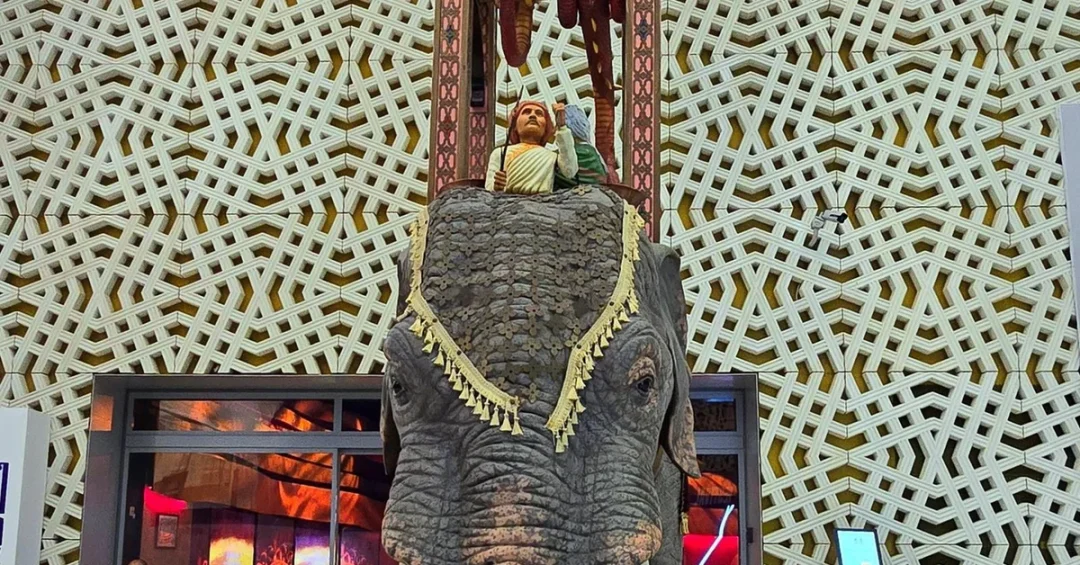
The 800-year-old Elephant Clock, a masterpiece by Arab Muslim scholar Al-Jazari, is on display at the King Salman Science Oasis in Riyadh as part of the Science and Technology Festival ‘STEAM’, according to the Saudi Press Agency (SPA). This remarkable invention, dating back to the Islamic Golden Age, showcases the advanced scientific and engineering prowess of Islamic civilization and continues to inspire innovation today.
Context and Background
The Elephant Clock was designed by Al-Jazari (1136–1206 AD), a renowned polymath, inventor, and mechanical engineer whose works have influenced centuries of scientific thought. Displayed at the King Salman Science Oasis during the Science and Technology Festival ‘STEAM’, the clock serves as a testament to the fusion of science, technology, engineering, arts, and mathematics. This festival, running until the end of September, highlights the Kingdom’s commitment to promoting education and innovation.
The clock’s origins trace back to the golden age of Islamic civilization, a period marked by groundbreaking contributions to various fields of knowledge. Al-Jazari’s invention is a symbol of that era’s intellectual curiosity and technological ingenuity.
Key Details
The Elephant Clock is a marvel of engineering, utilizing water flow and gears to measure time with remarkable accuracy. Based on Greek hydraulic systems and regulated by mathematical calculations, it represents a sophisticated understanding of physics and mechanics. Its design is a celebration of cultural diversity: the elephant symbolizes Indian and African heritage, the dragon represents Chinese culture, the phoenix signifies ancient Egypt, while the water and carpet evoke Greek and Persian influences. The turban atop the clock marks its Islamic origin, reflecting the broader legacy of Arab innovation.
This exquisite piece is not just a technical wonder but also a cultural bridge, showcasing how Islamic civilization integrated and built upon knowledge from various cultures. Visitors to the King Salman Science Oasis can witness this historic artifact and gain insight into the roots of modern scientific revolutions.
Implications and Impact
The display of the Elephant Clock at the King Salman Science Oasis underscores Saudi Arabia’s dedication to preserving and promoting scientific heritage. It serves as an educational tool, inspiring generations to explore STEAM fields and contribute to innovation. By highlighting the achievements of Islamic civilization, the festival reinforces the Kingdom’s role as a custodian of cultural and scientific legacy.
Moreover, the clock’s presence at the festival aligns with Saudi Arabia’s Vision 2030, which aims to diversify the economy and foster a knowledge-based society. It encourages youth to engage with science and technology, paving the way for future breakthroughs.
Vision 2030 Alignment
The exhibition of the Elephant Clock at the King Salman Science Oasis reflects Saudi Arabia’s commitment to achieving the goals of Vision 2030 by promoting education, innovation, and cultural heritage. As the Kingdom continues to invest in science and technology, such initiatives inspire the next generation of inventors and scientists, ensuring a prosperous and sustainable future. This display not only honors the past but also illuminates the path forward, embodying the spirit of progress that defines Saudi Arabia’s journey.
20 Questions
Q1. What is the Elephant Clock?
A1. The Elephant Clock is an 800-year-old mechanical timekeeping device invented by Al-Jazari, a renowned Arab Muslim scholar. It is celebrated for its innovative design that combines engineering, art, and cultural symbolism, representing the pinnacle of Islamic Golden Age innovation.
Q2. Who was Al-Jazari?
A2. Al-Jazari was a polymath and mechanical engineer from the Islamic Golden Age, born in 1136 AD and died in 1206 AD. His works, including the Elephant Clock, have had a lasting impact on the fields of engineering and technology.
Q3. Where is the Elephant Clock currently displayed?
A3. The Elephant Clock is displayed at the King Salman Science Oasis in Riyadh, Saudi Arabia, as part of the Science and Technology Festival ‘STEAM’. This exhibition allows visitors to appreciate its historical and scientific significance.
Q4. What does the Elephant Clock symbolize?
A4. The Elephant Clock symbolizes the fusion of diverse cultures and the advanced scientific knowledge of Islamic civilization. Its elements represent Indian, African, Chinese, Egyptian, Greek, Persian, and Islamic influences, highlighting a legacy of global collaboration.
Q5. How does the Elephant Clock work?
A5. The clock operates using water flow and gears, based on Greek hydraulic systems. It measures time with remarkable accuracy through mathematical calculations, demonstrating sophisticated mechanical engineering principles of the era.
Q6. What is the significance of the elephant in the clock?
A6. The elephant symbolizes Indian and African heritage, reflecting the broad cultural exchanges that characterized the Islamic Golden Age. It adds a layer of multicultural representation to the clock’s design.
Q7. What does the dragon represent in the Elephant Clock?
A7. The dragon represents Chinese culture, indicating the extensive reach of Islamic civilization’s interactions with other cultures. It showcases the integration of diverse artistic and symbolic elements.
Q8. What is the role of the phoenix in the clock?
A8. The phoenix signifies ancient Egyptian culture, adding to the clock’s rich tapestry of cultural symbols. It reflects the interconnectedness of civilizations during the Islamic Golden Age.
Q9. How does the turban contribute to the clock’s meaning?
A9. The turban atop the clock marks its Islamic origin, highlighting the contributions of Arab innovation to science and technology. It serves as a proud emblem of the civilization that produced this marvel.
Q10. Why is the Elephant Clock considered a STEAM achievement?
A10. The clock integrates science, technology, engineering, arts, and mathematics, making it a prime example of STEAM. Its design and functionality demonstrate a holistic approach to knowledge that is still relevant today.
Q11. What is the King Salman Science Oasis?
A11. The King Salman Science Oasis is a prominent scientific and educational institution in Riyadh, Saudi Arabia. It hosts exhibitions and festivals like ‘STEAM’ to promote science and technology among the public.
Q12. What is the Science and Technology Festival ‘STEAM’?
A12. The ‘STEAM’ festival is an event that showcases innovations in science, technology, engineering, arts, and mathematics. It runs until the end of September and features exhibits like the Elephant Clock to inspire visitors.
Q13. How does the Elephant Clock inspire modern innovation?
A13. The clock serves as a historical example of creative problem-solving and engineering excellence. It encourages contemporary innovators to draw on past achievements to develop new technologies and solutions.
Q14. What was the Islamic Golden Age?
A14. The Islamic Golden Age was a period of significant intellectual and cultural flourishing in the Islamic world, roughly from the 8th to the 14th century. It saw advancements in science, medicine, mathematics, and the arts.
Q15. How does the Elephant Clock reflect cultural diversity?
A15. The clock incorporates symbols from Indian, African, Chinese, Egyptian, Greek, Persian, and Islamic cultures. This blend demonstrates the inclusive and integrative nature of Islamic civilization during its golden age.
Q16. What can visitors learn from the Elephant Clock exhibit?
A16. Visitors can learn about the advanced engineering of the Islamic Golden Age, the cultural exchanges that shaped it, and the enduring legacy of innovation. It provides insight into the roots of modern science and technology.
Q17. How does the Elephant Clock align with Saudi Vision 2030?
A17. The display aligns with Vision 2030 by promoting education, innovation, and cultural heritage. It inspires youth to pursue STEAM fields, supporting the Kingdom’s goal of a knowledge-based economy.
Q18. What other inventions is Al-Jazari known for?
A18. Al-Jazari is known for numerous mechanical devices, including water clocks, automata, and pumps. His book, ‘The Book of Knowledge of Ingenious Mechanical Devices,’ details many of his inventions.
Q19. Why is the Elephant Clock important for education?
A19. It serves as a tangible example of historical scientific achievement, making learning engaging and relatable. Educators can use it to teach principles of physics, engineering, and cultural history.
Q20. How can the public visit the Elephant Clock?
A20. The public can visit the Elephant Clock at the King Salman Science Oasis in Riyadh during the ‘STEAM’ festival, which runs until the end of September. It is a unique opportunity to witness this historic marvel.
Reader Feedback
We value your thoughts. Please share your feedback on this article.
Your feedback helps us improve our coverage.
Related articles
 Saudi Arabia to Host First International AI Olympiad
 KFSHRC to Unveil Gen-AI Breakthrough at GAIN in Riyadh
 Jeddah Astronomy Society to Observe Saturn’s Solar Encounter Today
 NCVC Completes First Phase of Invasive Plants Project in Saudi Arabia
 Global Entrants Flock to Riyadh for International AI Olympiad
 SDAIA Unveils ‘State of AI in Saudi Arabia’ Report