


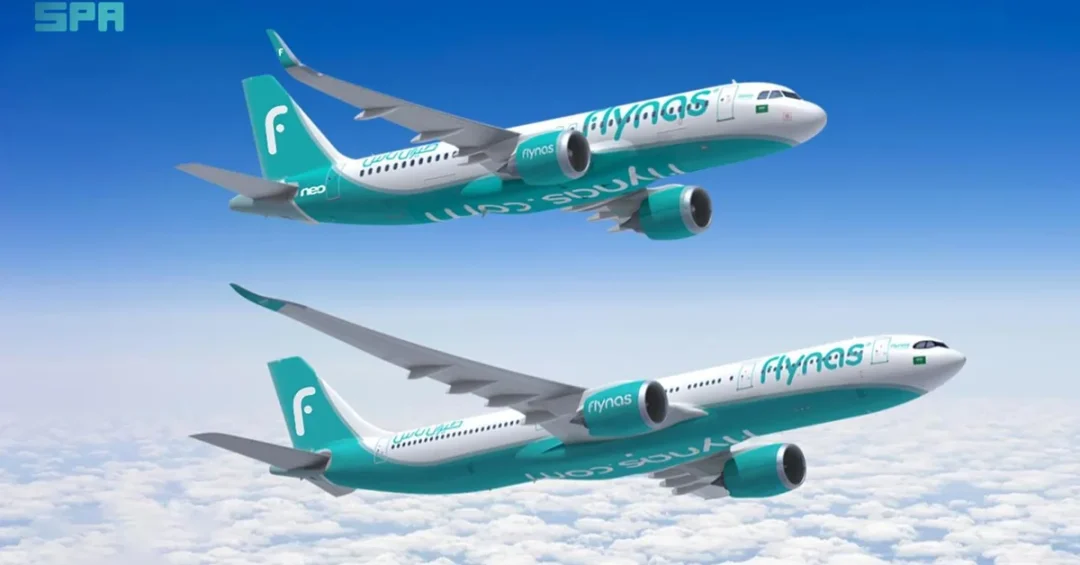
flynas, the leading low-cost carrier in the Middle East, has signed a landmark agreement with Airbus to purchase 160 new aircraft. The deal, announced at the Farnborough Airshow in London, marks a significant expansion in the airline’s fleet and supports Saudi Arabia’s Vision 2030 goals for the aviation sector.
Context and Background
The agreement, signed on July 25, 2024, includes 30 wide-body A330neo and 130 narrow-body A320-family aircraft. This order more than doubles flynas’ total ordered aircraft to 280 over seven years, following a 2016 agreement for 120 aircraft. The expansion aligns with the airline’s strategic slogan, “We connect the world to the Kingdom of Saudi Arabia,” and underscores its role in achieving the National Civil Aviation Strategy’s objectives.
Key Details
The signing ceremony was attended by President of the General Authority of Civil Aviation (GACA) Abdulaziz Al-Duailej, flynas chairman Ayed Aljeaid, and other senior officials. Al-Duailej praised the agreement as reflecting the rapid transformation of Saudi Arabia’s aviation sector under Vision 2030. He stated that the deal is pivotal for connecting the kingdom with over 250 international destinations and increasing passenger traffic to 330 million annually by 2030.
flynas CEO and Managing Director Bander Almohanna highlighted that this is the carrier’s first order for the wide-body A330neo, with deliveries commencing in 2027. The new aircraft will enable flynas to explore long-haul markets and offer enhanced passenger services. Almohanna emphasized that doubling the order volume supports the National Civil Aviation Strategy, the Pilgrim Experience Program, and the National Tourism Strategy, while creating numerous direct and indirect jobs.
Implications and Impact
The deal positions flynas among the top four low-cost airlines globally. Christian Scherer, CEO of Commercial Aircraft at Airbus, expressed delight in expanding the partnership, noting that the A330neo’s commonality with the A320 family will allow flynas to grow into widebody markets efficiently. Both aircraft types offer versatility and economics for expansion into new markets, enhancing passenger comfort.
flynas currently operates over 70 domestic and international routes, with more than 1,500 weekly flights, and has served over 78 million passengers since its launch in 2007. The airline aims to expand its operational fleet to over 160 aircraft by 2030, up from 61 aircraft currently comprising 53 A320neo, four A320ceo, and four A330ceo jets.
Vision 2030 Alignment
This agreement directly supports Saudi Vision 2030 by strengthening the aviation sector as a cornerstone of economic diversification. The expansion of flynas enhances Saudi Arabia’s connectivity, boosts tourism and pilgrimage travel, and creates job opportunities, reinforcing the kingdom’s ambition to become a global aviation hub and a premier international destination.
20 Questions
Q1. What is the total value of the 160-aircraft order?
A1. The financial terms were not disclosed, but based on list prices, the order is estimated to be worth billions of dollars, reflecting flynas’ substantial investment in expanding its fleet.
Q2. How does this order compare to flynas’ previous orders?
A2. This order more than doubles flynas’ total ordered aircraft to 280 over seven years, following a 2016 agreement for 120 Airbus planes, and an additional 30 A320neo ordered in 2023.
Q3. When will the new A330neo aircraft be delivered?
A3. Deliveries of the Airbus A330neo are scheduled to begin in 2027, according to flynas CEO Bander Almohanna, marking the carrier’s entry into wide-body long-haul operations.
Q4. What will happen to flynas’ current fleet after the new aircraft arrive?
A4. The current fleet of 61 aircraft (including A320neo, A320ceo, and A330ceo) will be supplemented and eventually replaced, supporting flynas’ plan to operate over 160 aircraft by 2030.
Q5. How does this agreement support Saudi Arabia’s tourism goals?
A5. The expansion aligns with the National Tourism Strategy by increasing flight capacity to attract more international visitors, supporting Vision 2030’s target to boost tourism as a key economic sector.
Q6. What is the significance of the 250 international destination target?
A6. The goal to connect Saudi Arabia with over 250 international destinations by 2030, as part of the National Civil Aviation Strategy, requires significant fleet expansion to service new routes and meet passenger demand.
A7. The deal creates thousands of direct and indirect job opportunities in aviation, tourism, and related sectors, supporting Saudi Arabia’s goal to increase employment and economic diversification under Vision 2030.
Q8. How does flynas’ order affect its low-cost carrier status?
A8. flynas already ranks among the top four low-cost airlines globally, and this order solidifies its position by enabling expansion into new markets while maintaining cost efficiency through Airbus’ commonality.
Q9. Are there any environmental considerations tied to this order?
A9. The Airbus A330neo and A320neo are fuel-efficient aircraft with lower emissions, aligning with global sustainability goals and Saudi Arabia’s commitment to reducing environmental impact in aviation.
Q10. What routes will the A330neo be used for?
A10. The wide-body A330neo will enable flynas to explore new long-haul markets, likely including destinations in Europe, Asia, and Africa, offering higher seat capacity for longer flights.
Q11. How does the Pilgrim Experience Program benefit from this deal?
A11. The expanded fleet will increase seat availability for pilgrims traveling to Makkah and Madinah, improving connectivity and passenger services as part of the program to enhance the Umrah and Hajj experience.
Q12. What is the role of GACA in this agreement?
A12. The General Authority of Civil Aviation (GACA) oversees the sector’s growth; President Abdulaziz Al-Duailej attended the signing, highlighting the deal’s alignment with national aviation strategies.
Q13. How does this agreement affect flynas’ partnership with Airbus?
A13. The deal deepens the long-term partnership between flynas and Airbus, with both companies committed to expanding collaboration and delivering innovative aircraft to support flynas’ growth.
Q14. What is the current passenger traffic in Saudi Arabia?
A14. Saudi Arabia aims to increase passenger traffic to 330 million annually by 2030, up from current levels, requiring a significant expansion of airline capacity and airport infrastructure.
Q15. How does flynas’ order compare to other airline orders at the Farnborough Airshow?
A15. The flynas order was one of the largest at the 2024 Farnborough Airshow, demonstrating strong demand for fuel-efficient aircraft and the growing importance of the Saudi aviation market.
Q16. What is the A330neo’s advantage for flynas?
A16. The A330neo offers excellent operational economics and passenger comfort for long-haul flights, with commonality with the A320 family reducing training and maintenance costs for flynas.
Q17. Will flynas change its business model as a low-cost carrier?
A17. No, flynas will maintain its low-cost model while offering diverse and innovative products, leveraging the efficiency of the new aircraft to remain competitive in the budget travel segment.
Q18. How does this order support Saudi Vision 2030?
A18. The order directly supports Vision 2030 by strengthening the aviation sector, boosting tourism, creating jobs, and enhancing the kingdom’s global connectivity, all key pillars of economic diversification.
Q19. What is the significance of the 160 aircraft target by 2030?
A19. flynas aims to expand its operational fleet to over 160 aircraft by 2030, more than double its current size, to serve growing demand and support the kingdom’s tourism and connectivity goals.
Q20. How will passengers benefit from the new aircraft?
A20. Passengers will enjoy improved cabin comfort, more seat capacity, and access to new long-haul destinations, with enhanced in-flight experiences on both narrow-body and wide-body Airbus aircraft.
Reader Feedback
We value your thoughts. Please share your feedback on this article.
Your feedback helps us improve our coverage.