


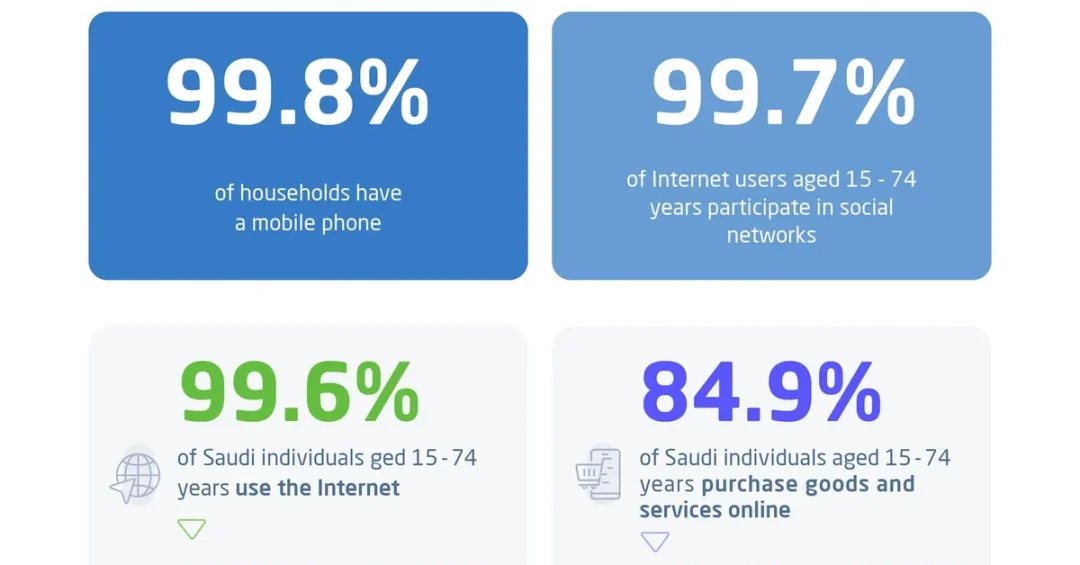
Internet use among individuals aged 15 to 74 in Saudi Arabia reached 99.6% in 2026, with Saudi males at 99.8% and Saudi females at 99.5%, according to the Survey on Information and Communications Technology (ICT) Access and Use in Households and by Individuals released by the General Authority for Statistics (GASTAT). The official figures, announced via the Saudi Press Agency, confirm the Kingdom’s position among the world’s most digitally connected nations and underscore the rapid pace of its digital transformation under Vision 2030. The survey, which covers households and individuals across the Kingdom, provides a comprehensive snapshot of how technology has become embedded in daily life, from communication and entertainment to commerce and government services.
The results reveal a society where digital access is nearly universal, with the 15 to 24 age group recording the highest usage rate at 99.9%. This level of connectivity reflects years of sustained investment in telecommunications infrastructure, regulatory modernization, and digital literacy programs led by Saudi government entities. It also highlights the success of national initiatives designed to ensure that every citizen and resident can participate in the digital economy, regardless of region or background. For international observers, the data offers a clear signal that Saudi Arabia has built one of the most inclusive and advanced digital ecosystems in the Middle East and beyond.
Context and Background
How did Saudi Arabia achieve near-universal internet penetration in less than a decade? The answer lies in a deliberate, whole-of-government approach that treats connectivity as essential infrastructure, much like roads, electricity, or water. The General Authority for Statistics (GASTAT), the Kingdom’s official statistical authority, conducts the ICT Access and Use survey annually to measure household and individual adoption of digital technologies. Its methodology is aligned with international standards, enabling direct comparison with other countries and supporting the monitoring of the Sustainable Development Goals. The 2026 results build on a consistent upward trend that has seen internet use rise from around 70% in the early 2010s to virtually saturation today.
This progress has been driven by the Communications, Space and Technology Commission (CST), which oversees telecommunications regulation and spectrum allocation, and by the Ministry of Communications and Information Technology (MCIT), which leads national digital strategy. Together with telecom operators, these bodies have expanded fiber-optic networks, upgraded mobile broadband, and extended coverage to remote areas. The result is a population that is not only connected but also highly engaged online, using the internet for social networking, video, e-government, and e-commerce at rates that rival or exceed those of many advanced economies. The survey’s findings therefore represent more than statistics; they are a measure of how deeply digital tools have reshaped Saudi society.
Key Details
What exactly do Saudis do when they go online? The survey shows that 99.3% of individuals access the internet from home, and 98.0% use it at least once a day, indicating that connectivity is a routine, constant part of life. Mobile phones are the primary device, used by 98.4% of individuals, followed by laptops at 13.9% and tablets at 12.3%. This mobile-first pattern reflects global trends but is especially pronounced in Saudi Arabia, where smartphone penetration is among the highest in the world. It also has implications for how services are designed and delivered, with government agencies and businesses increasingly optimizing for mobile users.
Social networking was the top online activity, used by 99.7% of internet users of both genders, followed by watching video content at 87.8%, searching for information on goods and services at 65.4%, listening to audio at 55.2%, and gaming at 19.4%. These figures paint a picture of a digitally active population that uses the internet for entertainment, information, and social connection. The near-universal adoption of social networking suggests that platforms are not just communication tools but also key channels for news, commerce, and civic engagement. The high rate of video consumption, meanwhile, indicates strong demand for streaming services and user-generated content, creating opportunities for local content creators and media companies.
E-government services are used by 98.4% of individuals, rising to 98.6% among Saudis, including 98.9% of Saudi males and 98.4% of Saudi females. Obtaining government forms electronically was the top service, at 89.0% of users. This level of adoption is a direct outcome of the Kingdom’s digital government strategy, which has moved hundreds of services online through platforms such as Absher and Tawakkalna. The fact that usage is nearly equal between men and women highlights the inclusivity of these services and the success of efforts to ensure that all citizens can benefit from digital transformation.
International and Regional Impact
How does Saudi Arabia’s digital performance compare with the rest of the world? At 99.6% internet use among individuals aged 15 to 74, the Kingdom ranks alongside the most connected nations globally, surpassing many members of the Organisation for Economic Co-operation and Development (OECD). This achievement enhances Saudi Arabia’s reputation as a regional technology leader and a destination for digital investment. It also strengthens the Kingdom’s case for hosting international events, attracting tech companies, and serving as a hub for data centers and cloud computing in the Middle East. For neighboring countries, Saudi Arabia’s experience offers a model of how to combine regulatory reform, infrastructure investment, and public-private partnership to accelerate digital adoption.
Regionally, the survey results reinforce Saudi Arabia’s role in shaping the digital agenda of the Gulf Cooperation Council (GCC) and the broader Arab world. The Kingdom has consistently advocated for cross-border digital cooperation, including harmonized data policies and cybersecurity standards. Its high levels of e-government use and e-commerce adoption demonstrate that digital transformation can be both rapid and inclusive, providing a counterpoint to concerns that technology might widen social or economic gaps. International organizations, including the United Nations and the International Telecommunication Union (ITU), have cited Saudi Arabia’s progress as an example of effective national digital strategy.
Economic and Strategic Significance
What does near-universal internet use mean for Saudi Arabia’s economy? First, it creates a large, digitally savvy consumer base that is attractive to global and local businesses. The survey shows that 74.5% of internet users buy goods and services online, rising to 84.9% among Saudis, including 86.8% of Saudi females and 83.1% of Saudi males. Clothing, footwear, sports equipment, and household items topped purchases at 85.2%, followed by food, groceries, and tobacco at 54.4%. Books, magazines, and newspapers accounted for 22.8%. These figures indicate a mature e-commerce market with diverse demand, from fashion to fast-moving consumer goods. For retailers, logistics companies, and payment providers, the data points to continued growth opportunities, especially as digital payments and delivery infrastructure improve.
Second, high connectivity supports the growth of the digital economy, including fintech, e-sports, content creation, and remote work. It also enables the Kingdom to leverage advanced technologies such as artificial intelligence, the Internet of Things, and big data, which are central to the Vision 2030 goal of diversifying the economy away from oil. The Public Investment Fund (PIF) and other Saudi institutions have invested heavily in technology companies and startups, and the widespread availability of internet access ensures that these ventures can reach a national audience quickly. Moreover, the near-equal usage rates among men and women signal that women are full participants in the digital economy, a key factor in maximizing economic potential.
Vision 2030 Alignment
How does this milestone fit into Saudi Arabia’s long-term vision? Vision 2030, launched in 2016 under the leadership of Crown Prince Mohammed bin Salman, aims to build a diversified, innovative, and inclusive economy. Digital transformation is one of its central pillars, with targets that include expanding e-government services, increasing broadband coverage, and fostering a knowledge-based society. The GASTAT survey results show that these targets are being met and exceeded. The high adoption of e-government services, in particular, reflects the vision’s emphasis on efficiency, transparency, and citizen-centric service delivery. It also supports the Quality of Life Program, which seeks to improve daily life through technology and innovation.
Looking ahead, the data provides a foundation for the next phase of Saudi Arabia’s digital journey. With nearly everyone online, the focus will shift from access to quality, skills, and advanced applications. Initiatives such as the National Strategy for Data and AI, the Saudi Digital Academy, and the Digital Economy Council are designed to ensure that the population can make the most of connectivity. For international audiences, the survey confirms that Saudi Arabia is not only keeping pace with global digital trends but in many respects setting them. As the Kingdom continues to invest in technology and human capital, its digital achievements will remain a key part of its story on the world stage, demonstrating how Vision 2030 is translating into tangible benefits for all.
20 Questions
Q1. What percentage of individuals aged 15 to 74 in Saudi Arabia used the internet in 2026?
A1. According to the General Authority for Statistics (GASTAT), internet use among individuals aged 15 to 74 reached 99.6% in 2026, reflecting near-universal connectivity across the Kingdom.
Q2. How did internet usage differ between Saudi males and females?
A2. The survey found that 99.8% of Saudi males and 99.5% of Saudi females used the internet, indicating a very narrow gender gap and high digital inclusion for both groups.
Q3. Which age group recorded the highest internet usage rate?
A3. The 15 to 24 age group recorded the highest rate at 99.9%, highlighting that young Saudis are fully integrated into the digital world from an early age.
Q4. What percentage of individuals accessed the internet from home?
A4. The results show that 99.3% of individuals access the internet from home, making it the primary location for connectivity and underscoring the importance of household broadband infrastructure.
Q5. How often do individuals use the internet daily?
A5. According to GASTAT, 98.0% of individuals use the internet at least once a day, demonstrating that digital access is a routine and essential part of daily life in Saudi Arabia.
Q6. What are the main devices used to access the internet?
A6. Mobile phones are the primary device, used by 98.4% of individuals, followed by laptops at 13.9% and tablets at 12.3%, reflecting a strong mobile-first pattern of internet access.
Q7. What was the most popular online activity among internet users?
A7. Social networking was the top online activity, used by 99.7% of internet users of both genders, followed by watching video content at 87.8% and searching for information on goods and services at 65.4%.
Q8. What percentage of internet users watched video content online?
A8. Watching video content was the second most popular activity, engaged in by 87.8% of internet users, indicating high demand for streaming, news, and entertainment platforms across the Kingdom.
Q9. How many individuals used e-government services?
A9. E-government services are used by 98.4% of individuals, rising to 98.6% among Saudis, including 98.9% of Saudi males and 98.4% of Saudi females, showing widespread adoption of digital public services.
Q10. What was the top e-government service used?
A10. Obtaining government forms electronically was the top service, used by 89.0% of e-government users, reflecting the success of digital platforms that streamline administrative procedures for citizens.
Q11. What percentage of internet users engaged in e-commerce?
A11. In e-commerce, 74.5% of internet users buy goods and services online, rising to 84.9% among Saudis, including 86.8% of Saudi females and 83.1% of Saudi males.
Q12. What types of products were most commonly purchased online?
A12. Clothing, footwear, sports equipment, and household items topped purchases at 85.2%, followed by food, groceries, and tobacco at 54.4%, and books, magazines, and newspapers at 22.8%.
Q13. How does GASTAT ensure the reliability of its statistics?
A13. GASTAT produces its statistics using a unified methodology aligned with the procedures of international organizations, allowing global comparison of indicators and meeting the requirements of the Sustainable Development Goals.
Q14. What is the significance of the 99.6% internet usage rate for Saudi Arabia?
A14. The rate places Saudi Arabia among the world’s most connected nations, demonstrating the success of national digital transformation efforts and supporting the Kingdom’s Vision 2030 goals for a knowledge-based economy.
Q15. How does high internet penetration support Saudi Arabia’s economy?
A15. It creates a large digital consumer base, boosts e-commerce and digital payments, and enables growth in sectors such as fintech, content creation, and remote work, contributing to economic diversification.
Q16. What role does the Communications, Space and Technology Commission play?
A16. The CST oversees telecommunications regulation and spectrum allocation, helping to expand network coverage and ensure high-quality internet access across Saudi Arabia, which supports the survey’s positive results.
Q17. How does the survey align with Vision 2030?
A17. The survey results reflect Vision 2030’s digital transformation targets, including expanded e-government services, increased broadband coverage, and fostering a knowledge-based society, all of which are being met or exceeded.
Q18. What does the near-equal usage between men and women indicate?
A18. It indicates that digital inclusion is strong in Saudi Arabia, with women participating fully in the digital economy and accessing online services at rates nearly identical to men, supporting social and economic empowerment.
Q19. What are the implications for international businesses?
A19. The data signals a mature and accessible digital market, attractive to global retailers, tech companies, and investors seeking to reach a highly connected population with diverse online consumption habits.
Q20. What is the next phase of Saudi Arabia’s digital journey?
A20. With near-universal access achieved, the focus will shift to quality, digital skills, and advanced technologies such as AI and IoT, supported by initiatives like the National Strategy for Data and AI.
Reader Feedback
We value your thoughts. Please share your feedback on this article.
Your feedback helps us improve our coverage.
Related articles
 KAUST Cooling Coating Boosts Power Line Capacity in Heat
 Taibah University to Host International AI Conference Nov 3-5
 Saudi Skies to Dazzle with Planets, Meteors, Supermoon
 Saudi Arabia’s First Wind Turbine Inaugurated in Turaif
 Taibah University Marks Arab Chemistry Week with Scientific Events
 SDAIA Issues Vibe Coding Guide for Secure AI Development