


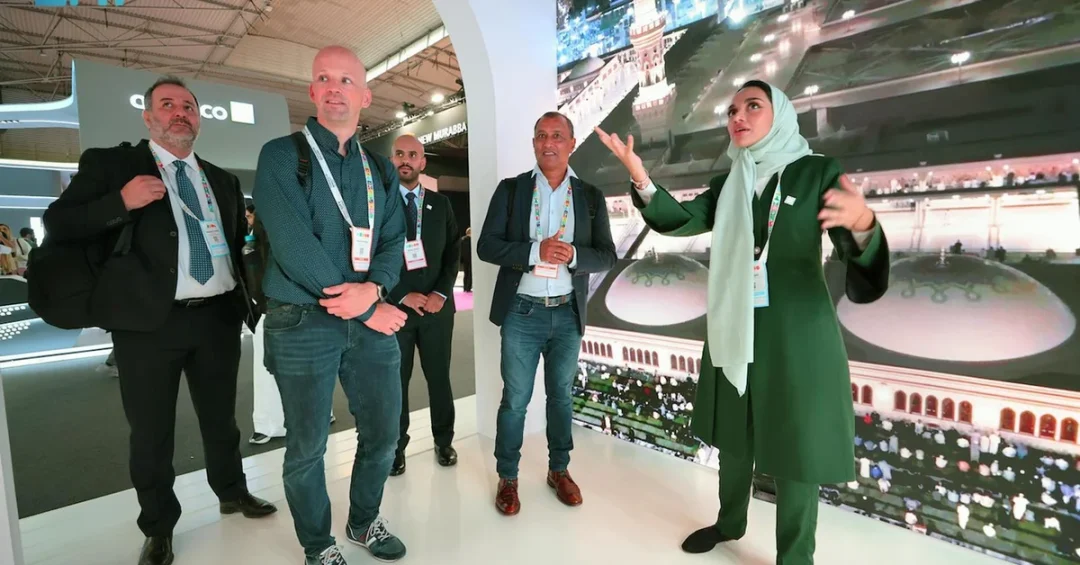
The Al Madinah Region Development Authority is participating in the 14th annual Expo and the World Congress of Smart Cities (CEWC24) in Barcelona, Spain, from November 5 to 7, 2024, marking its third participation in the annual global event. The authority’s delegation is delivering keynote speeches and joining high-level panel sessions at the gathering, where a dedicated “Madinah” pavilion showcases the city’s leadership in implementing a human-centered, smart, and sustainable city concept, according to the Saudi Press Agency.
The pavilion highlights the authority’s role in adopting advanced smart practices to improve residents’ quality of life and enrich visitors’ experiences, positioning Madinah as a model for cities worldwide that seek to balance technological innovation with cultural and spiritual heritage. The participation underscores Saudi Arabia’s broader commitment to sharing knowledge and building international partnerships in urban innovation, a central pillar of the Kingdom’s long-term development strategy. For international observers, the event offers a window into how Saudi cities are integrating data, connectivity, and design to serve growing populations and millions of annual visitors. What does it mean when a city revered for its spiritual significance also becomes a laboratory for the smart cities of tomorrow?
Context and Background
The World Congress of Smart Cities, known as CEWC24, is one of the most influential global forums for urban innovation, bringing together government leaders, technology companies, academics, and city planners from around the world. Held annually in Barcelona, the event has become a benchmark for exchanging ideas on sustainable mobility, digital governance, and data-driven public services. The Al Madinah Region Development Authority’s third consecutive appearance reflects a sustained, strategic engagement with this international community rather than a one-off showcase. Why does consistent participation in such forums matter for a city’s global reputation?
Madinah holds a unique place in the Islamic world as the site of the Prophet’s Mosque and a destination for millions of pilgrims each year. That dual identity—sacred heritage and modern urban life—creates both challenges and opportunities. The authority has therefore pursued a development model that respects the city’s spiritual character while embracing technology to manage crowds, improve services, and enhance the visitor journey. The smart cities agenda is not an abstract exercise for Madinah; it is a practical response to the needs of residents and guests alike.
Over the past several years, Saudi Arabia has accelerated its adoption of smart city technologies across multiple regions, from NEOM in the northwest to Riyadh and the Eastern Province. Madinah’s participation in Barcelona places it within this national ecosystem while also giving it a distinct profile. The authority’s work is aligned with the Kingdom’s Vision 2030, which seeks to diversify the economy, improve quality of life, and position Saudi cities as global leaders in innovation and sustainability.
Key Details
At the heart of the Madinah presence in Barcelona is the “Madinah” pavilion, which showcases a suite of award-winning solutions. Among the highlights is the City Experiences Guide, described as the world’s first comprehensive guide to urban experiences and innovation. The guide is designed to help visitors and residents navigate the city’s cultural, historical, and modern attractions through a unified digital platform. How can a single digital tool transform the way millions of people experience a city?
The pavilion also features two national platforms: Raseel for smart cities and Manarah for urban data. Raseel serves as a framework for integrating smart city services across different sectors, while Manarah focuses on urban data management, enabling evidence-based planning and real-time decision-making. Together, they represent a significant step toward interoperability and data sharing among Saudi cities, reducing duplication and improving efficiency. These platforms are not merely technological tools; they are part of a governance approach that prioritizes transparency and coordination.
In addition, the authority is highlighting the LoRaWAN-enabled smart lighting network and a 3D geospatial information system for modeling at the Prophet’s Mosque. The smart lighting network uses low-power, wide-area networking technology to optimize energy consumption and maintenance, while the 3D geospatial system provides detailed digital models that support planning, crowd management, and heritage preservation around one of the most visited religious sites in the world. These projects illustrate how advanced technology can serve both operational efficiency and cultural sensitivity.
International and Regional Impact
The participation of the Al Madinah Region Development Authority at CEWC24 sends a clear signal that Saudi cities are not only adopting smart technologies but also contributing to the global conversation on how they should be designed and governed. By delivering keynote speeches and joining panel sessions, the authority’s representatives are sharing lessons from Madinah’s experience with an international audience. This two-way exchange allows Saudi Arabia to learn from other cities while also exporting its own innovations, particularly in the area of managing large-scale religious tourism.
Regionally, the event reinforces Saudi Arabia’s role as a leader in the Middle East’s smart city movement. Other countries in the region are watching closely, and the Kingdom’s progress can serve as a benchmark and a source of partnership opportunities. The presence of national platforms such as Raseel and Manarah at an international expo also signals that Saudi Arabia is building shared infrastructure that could eventually benefit the wider region. How might regional cooperation on smart cities shape the future of the Middle East?
For international audiences, the Madinah pavilion offers a counterpoint to common narratives about technology and tradition being in conflict. Instead, the authority’s projects demonstrate that digital tools can be used to protect and enhance cultural heritage, manage pilgrim flows with dignity, and improve everyday life for residents. This integrated approach is increasingly relevant as cities worldwide grapple with similar tensions between growth, sustainability, and identity.
Economic and Strategic Significance
The smart cities sector is a growing part of the global economy, with governments and private companies investing heavily in digital infrastructure, data analytics, and connected services. Saudi Arabia’s participation in CEWC24 is therefore not only a technical showcase but also an economic signal. It highlights opportunities for partnerships with technology providers, investors, and research institutions that are looking to engage with the Kingdom’s Vision 2030 programs. The Al Madinah Region Development Authority’s projects can attract foreign direct investment and support the growth of local technology firms.
Strategically, the authority’s work supports the broader goal of diversifying Saudi Arabia’s economy away from oil dependence. Smart city solutions create jobs in software development, data science, urban planning, and systems integration. They also improve the efficiency of public services, which can reduce costs and free up resources for other priorities. For Madinah specifically, better crowd management and visitor experiences can enhance the city’s appeal as a destination, with positive spillovers for hospitality, retail, and transportation. What economic ripple effects can follow when a city becomes a model for innovation?
Furthermore, the emphasis on national platforms like Raseel and Manarah suggests a coordinated approach that avoids fragmentation. By developing shared standards and data frameworks, Saudi Arabia can scale successful pilots across multiple cities, maximizing the return on investment and ensuring that smaller municipalities also benefit from advanced technologies. This is a key consideration for a country as large and diverse as the Kingdom.
Vision 2030 Alignment
The Al Madinah Region Development Authority’s participation in the World Congress of Smart Cities aligns directly with Saudi Vision 2030, which aims to build a vibrant society, a thriving economy, and an ambitious nation. Smart city initiatives contribute to all three pillars by improving quality of life, fostering innovation-driven growth, and enhancing government effectiveness. The authority’s projects, from the City Experiences Guide to the 3D geospatial system at the Prophet’s Mosque, are concrete examples of how Vision 2030 is being translated into everyday improvements for residents and visitors.
As Saudi Arabia continues to host major international events and welcome millions of pilgrims, the lessons from Madinah’s smart city journey will be increasingly valuable. The Kingdom’s commitment to sustainable, human-centered urban development is not limited to new cities like NEOM; it extends to historic and sacred cities that must balance preservation with progress. By sharing its experience in Barcelona, the Al Madinah Region Development Authority is helping to shape a global conversation while reinforcing Saudi Arabia’s position as a leader in responsible innovation. What better way to honor a city’s heritage than by using the best available tools to serve its people and guests?
20 Questions
Q1. What is the World Congress of Smart Cities (CEWC24)?
A1. CEWC24 is the 14th annual Expo and World Congress of Smart Cities, held in Barcelona, Spain, from November 5 to 7, 2024. It brings together global leaders, technology experts, and city planners to discuss urban innovation and sustainability.
Q2. Which Saudi entity is participating in CEWC24?
A2. The Al Madinah Region Development Authority is participating, marking its third consecutive appearance at the annual global event. Its delegation is delivering keynote speeches and joining high-level panel sessions.
Q3. What is the main purpose of the Madinah pavilion at the expo?
A3. The pavilion showcases Madinah’s leadership in implementing a human-centered, smart, and sustainable city concept. It highlights the authority’s role in using advanced smart practices to improve residents’ quality of life and enrich visitors’ experiences.
Q4. What is the City Experiences Guide?
A4. The City Experiences Guide is described as the world’s first comprehensive guide to urban experiences and innovation. It is an award-winning solution that helps users navigate the city’s cultural, historical, and modern attractions through a unified digital platform.
Q5. What are the two national platforms featured at the pavilion?
A5. The two national platforms are Raseel for smart cities and Manarah for urban data. Raseel integrates smart city services, while Manarah focuses on urban data management to support evidence-based planning and real-time decision-making.
Q6. What is the LoRaWAN-enabled smart lighting network?
A6. It is a smart lighting system that uses LoRaWAN technology, a low-power wide-area networking protocol, to optimize energy consumption and maintenance. It is part of the authority’s efforts to deploy efficient, sustainable urban infrastructure.
Q7. What is the 3D geospatial information system for modeling at the Prophet’s Mosque?
A7. It is a detailed digital modeling system that supports planning, crowd management, and heritage preservation around the Prophet’s Mosque. It provides accurate spatial data to help manage one of the world’s most visited religious sites.
Q8. Why is Madinah’s participation in CEWC24 significant?
A8. It demonstrates Saudi Arabia’s commitment to global knowledge exchange and positions Madinah as a model for balancing technological innovation with cultural and spiritual heritage. It also highlights the Kingdom’s leadership in smart city development.
Q9. How does the participation align with Saudi Vision 2030?
A9. It aligns with Vision 2030’s goals of building a vibrant society, a thriving economy, and an ambitious nation. Smart city initiatives improve quality of life, foster innovation, and enhance government effectiveness, supporting the Kingdom’s long-term development strategy.
Q10. What is the Al Madinah Region Development Authority?
A10. It is a Saudi government authority responsible for the comprehensive development of the Madinah region. It oversees urban planning, infrastructure, and quality-of-life projects that respect the city’s unique spiritual and cultural status.
Q11. How many times has the authority participated in the World Congress of Smart Cities?
A11. The 2024 edition marks the authority’s third participation in the annual global event. This consistent engagement reflects a sustained strategic commitment to international cooperation in urban innovation.
Q12. What kind of speeches and sessions is the authority involved in?
A12. Representatives are delivering keynote speeches and participating in high-level panel sessions. These platforms allow the authority to share Madinah’s experience and learn from other global cities’ smart city initiatives.
Q13. What are the benefits of smart lighting for Madinah?
A13. Smart lighting improves energy efficiency, reduces maintenance costs, and enhances public safety. It is part of a broader effort to create sustainable infrastructure that serves both residents and the millions of annual visitors to the city.
Q14. How does the 3D geospatial system help the Prophet’s Mosque area?
A14. It provides precise digital models that assist with urban planning, crowd flow management, and preservation of heritage sites. This technology helps ensure that the growing number of pilgrims can be accommodated safely and respectfully.
Q15. What is the role of Raseel in Saudi smart cities?
A15. Raseel is a national platform for smart cities that integrates services across different sectors. It promotes interoperability and data sharing among Saudi cities, reducing duplication and improving the efficiency of urban management.
Q16. What is the role of Manarah?
A16. Manarah is a national platform for urban data. It supports evidence-based planning and real-time decision-making by providing reliable data to city managers and planners across Saudi Arabia.
Q17. How can international audiences benefit from Madinah’s smart city experience?
A17. International audiences can learn how to integrate technology with cultural heritage, manage large-scale tourism, and improve urban services. Madinah’s approach offers a replicable model for cities facing similar challenges.
Q18. What economic opportunities does smart city development create?
A18. It creates jobs in software development, data science, urban planning, and systems integration. It also attracts foreign investment and supports the growth of local technology firms, contributing to economic diversification.
Q19. How does the authority’s work support pilgrims and residents?
A19. By improving crowd management, enhancing digital services, and optimizing infrastructure, the authority helps pilgrims have a smoother, more meaningful visit while improving daily life for residents through better services and sustainability.
Q20. What is the forward-looking vision for Madinah’s smart city journey?
A20. Madinah aims to continue integrating advanced technologies while preserving its spiritual and cultural identity. The authority’s participation in global forums like CEWC24 supports this vision, positioning the city as a leader in human-centered urban innovation.
Reader Feedback
We value your thoughts. Please share your feedback on this article.
Your feedback helps us improve our coverage.
Related articles
 SDAIA Report: Saudi Arabia Leads Global AI Innovation
 Saudi Arabia Building Cognitive Cities, Not Just Smart Ones: SDAIA
 SDAIA Showcases Ethical AI Leadership at Barcelona Smart Cities Summit
 Riyadh Hosts Final Stage of ALLaM Challenge with 17 Nations
 ALLaM Challenge Kicks Off in Riyadh to Advance Arabic AI
 SDAIA Showcases Smart Cities at Barcelona Conference