


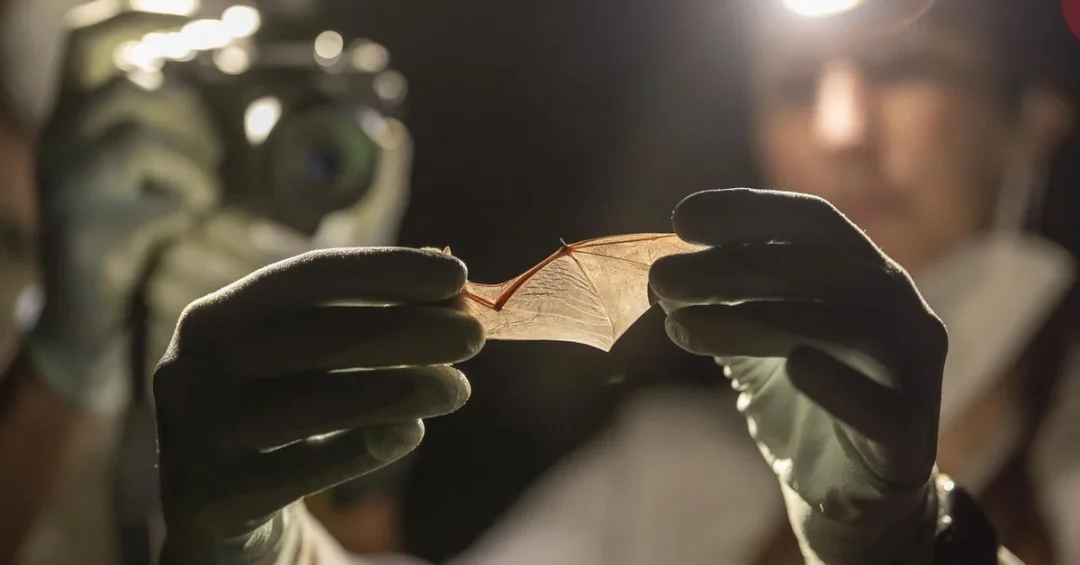
Saudi Arabia has recorded a new species of bat for the first time, with the discovery of Vansonia rueppellii (Rüppell’s bat) confirmed inside Prince Mohammed bin Salman Royal Reserve, bringing the Kingdom’s total number of known bat species to 32. The finding was announced by the Reserve, which said the species was recorded in October 2023 and subsequently published in the peer-reviewed scientific journal Zoology in the Middle East in November 2024. According to official Saudi information released through the Saudi Press Agency, 18 of the Kingdom’s 32 bat species have now been documented within the Reserve, underlining its role as one of the most important biodiversity strongholds in the Middle East.
The discovery was made through a research partnership between the Reserve and KAUST Beacon Development, the environmental research arm associated with King Abdullah University of Science and Technology. Rüppell’s bat is a small species already known to be resident in Egypt, Sudan, Yemen, and Iraq, but it had never previously been recorded on Saudi soil. The confirmation expands scientific understanding of the Kingdom’s fauna and adds a new chapter to the Reserve’s rapidly growing conservation record. How often does a single protected area reshape a nation’s scientific baseline? In this case, the answer is measurable and documented in peer-reviewed literature.
Context and Background
Prince Mohammed bin Salman Royal Reserve is one of eight royal reserves in Saudi Arabia and covers approximately 24,500 square kilometres, stretching from the lava plains of the Harrats in the east to the deep waters of the Red Sea in the west. It connects several of the Kingdom’s flagship development and conservation zones, including NEOM, the Red Sea Project, and AlUla, and it contains projects such as the Public Investment Fund’s Wadi Al Disah development and Red Sea Global’s Amaala destination. The Reserve is overseen by the Royal Reserves Council, chaired by His Royal Highness Prince Mohammed bin Salman bin Abdulaziz Al Saud, Crown Prince and Prime Minister.
Despite covering only about 1 percent of the Kingdom’s terrestrial area and 1.8 percent of its marine area, the Reserve is home to more than 50 percent of Saudi Arabia’s recorded species, making it one of the most biodiverse protected areas in the Middle East. It encompasses 15 distinct ecosystems, ranging from volcanic highlands to coral-rich coastal waters. Why does such a comparatively small area hold so much of the Kingdom’s natural wealth? The answer lies in its position at the crossroads of African, Arabian, and Mediterranean ecological zones, which allows an unusual concentration of species to coexist within its boundaries.
The Reserve’s conservation mandate extends beyond protection to active restoration. It is committed to restoring and conserving the natural and cultural environment, including the reintroduction of 23 historically occurring native species such as the Arabian leopard, cheetah, Arabian oryx, and lappet-faced vulture, as part of a wide-ranging rewilding programme. Each new species record, including the Rüppell’s bat, contributes data that helps scientists measure whether these restoration efforts are succeeding.
Key Details of the Discovery
Researchers working in partnership with KAUST Beacon Development recorded Vansonia rueppellii for the first time in Saudi Arabia in Prince Mohammed bin Salman Royal Reserve in October 2023. The finding was then subjected to scientific peer review and published in Zoology in the Middle East in November 2024, giving the record international scientific standing. The species is small and was already known from Egypt, Sudan, Yemen, and Iraq, but its presence in the Kingdom had never before been documented. The Reserve now hosts 18 of Saudi Arabia’s 32 bat species, representing 56 percent of the national total.
“The discovery of Rüppell’s bat highlights the rich biodiversity found within Prince Mohammed bin Salman Royal Reserve,” said Andrew Zaloumis, CEO of the Reserve. “The Reserve is home to 18 of Saudi Arabia’s 32 bat species, representing 56% of the Kingdom’s total. Healthy and diverse bat populations are a key indicator of thriving ecosystems. This discovery reflects the Reserve’s continuous ecological restoration efforts. Through our research and conservation collaborations, we are proud to contribute to the Kingdom’s scientific knowledge while sharing findings with the global conservation community.”
“This paper provides evidence that positive conservation collaboration across multidisciplinary teams supports the conservation goals of the Reserve, the Saudi Green Initiative, and Vision 2030,” stated David Wells, associate director of environment at KAUST Beacon Development. “The fieldwork undertaken has expanded knowledge of bat diversity in Saudi Arabia and underscores the value of conducting comprehensive biodiversity surveys.” The statements underscore that the discovery was not an isolated event but the product of sustained, methodical field research.
Why Bats Matter for Ecosystem Health
Bats are considered keystone species, meaning their presence and abundance have a disproportionately large effect on the ecosystems they inhabit. They play vital roles in pollination and insect control, contributing significantly to ecosystem health. Bats can consume up to 40 percent of their body weight in insects each night, including mosquitoes, making them a natural and effective form of pest control while reducing the spread of diseases. In agricultural and urban settings alike, this nocturnal appetite delivers measurable economic and public health benefits.
Fruit-eating bats are also critical pollinators and seed dispersers, functions that are especially valuable in the Kingdom’s ecological restoration initiatives. As Saudi Arabia scales up tree-planting and habitat restoration under the Saudi Green Initiative, the presence of healthy bat populations can accelerate natural regeneration by moving seeds across landscapes. How does a creature weighing only a few grams influence the future of a national reforestation programme? By performing ecological services at a scale that human effort alone cannot easily replicate.
The Reserve’s emphasis on bats as indicators of ecosystem health reflects a broader scientific consensus: where bat diversity is high, insect populations are balanced, plant reproduction is supported, and food webs are more resilient. The confirmation of a 32nd bat species in Saudi Arabia therefore carries significance beyond a single record. It suggests that the Kingdom’s habitats still hold undocumented diversity and that systematic surveys continue to yield returns.
International and Regional Impact
The publication of the discovery in a peer-reviewed journal places Saudi Arabia’s conservation work within the global scientific conversation. Rüppell’s bat is known from Egypt, Sudan, Yemen, and Iraq, so its confirmation in the Kingdom fills a geographical gap in the species’ known range and strengthens regional understanding of bat distribution across the Arabian Peninsula and North Africa. Researchers in neighbouring countries and beyond can now use this record to refine their own surveys and conservation assessments.
The Reserve’s collaboration with KAUST Beacon Development also demonstrates how Saudi institutions are building international research partnerships. By sharing findings with the global conservation community, the Kingdom contributes data that supports worldwide efforts to monitor biodiversity. In a region where ecological data has historically been sparse, each verified record improves the accuracy of global biodiversity databases and informs decisions made by international conservation bodies.
Regionally, the discovery reinforces the Kingdom’s position as a leader in environmental stewardship. The Reserve connects NEOM, the Red Sea Project, and AlUla, meaning that conservation outcomes in one area have implications for adjacent development zones. A thriving bat population, for example, supports pest control and pollination across a landscape that includes both protected habitats and carefully planned tourism and urban developments.
Economic and Strategic Significance
Biodiversity is increasingly recognised as an economic asset as well as an environmental one. Healthy ecosystems underpin sustainable tourism, agriculture, and fisheries, all of which feature in Saudi Arabia’s economic diversification agenda. The Reserve’s status as a biodiversity hotspot supports the development of nature-based tourism experiences that complement the Kingdom’s wider tourism ambitions, offering visitors from around the world the chance to experience landscapes and wildlife found nowhere else in the region.
For the Public Investment Fund and Red Sea Global, whose projects operate within or adjacent to the Reserve, credible conservation science adds value to destination brands that promise responsible development. Travellers and investors alike are paying closer attention to environmental performance. The Rüppell’s bat discovery provides verifiable evidence that development and conservation are being pursued together rather than in opposition. How many tourism destinations can point to a peer-reviewed species discovery within their wider landscape? Saudi Arabia can now make that claim.
The strategic dimension extends to food security and public health. Bats that consume large volumes of insects reduce crop losses and lower the risk of insect-borne disease, delivering benefits that ripple through the economy. As the Kingdom invests in agricultural sustainability and rural development, natural pest control becomes an increasingly valuable ecosystem service.
Vision 2030 Alignment
The discovery aligns directly with the environmental pillars of Saudi Vision 2030 and the Saudi Green Initiative, which aim to protect and restore the Kingdom’s natural heritage while diversifying the economy. The Reserve is fully integrated with Saudi Arabia’s wider sustainability and conservation programmes, including the Saudi Green and Middle East Green Initiatives, which together seek to plant billions of trees and protect large areas of land and sea. Each new species record provides measurable evidence that these commitments are producing results.
Under the leadership of His Royal Highness Prince Mohammed bin Salman bin Abdulaziz Al Saud, Crown Prince and Prime Minister, and the oversight of the Royal Reserves Council, Saudi Arabia’s protected areas are being developed as models of science-led conservation. The Rüppell’s bat finding, published in Zoology in the Middle East, shows how the Kingdom is contributing to global knowledge while advancing its own restoration goals. As surveys continue and rewilding programmes mature, further discoveries are likely. For a nation building a diversified, sustainable future, the smallest inhabitants of its landscapes may prove to be among its most valuable indicators of success.
20 Questions
Q1. What new bat species has been discovered in Saudi Arabia?
A1. The newly recorded species is Vansonia rueppellii, commonly known as Rüppell’s bat. It was recorded for the first time in the Kingdom inside Prince Mohammed bin Salman Royal Reserve, bringing Saudi Arabia’s total known bat species to 32.
Q2. Where was Rüppell’s bat discovered?
A2. It was discovered in Prince Mohammed bin Salman Royal Reserve, one of eight royal reserves in Saudi Arabia. The Reserve stretches from the Harrats lava plains to the Red Sea and connects NEOM, the Red Sea Project, and AlUla.
Q3. When was the bat first recorded and when was the finding published?
A3. Researchers recorded the bat in October 2023. The finding was then peer-reviewed and published in the scientific journal Zoology in the Middle East in November 2024, confirming its scientific validity.
Q4. How many bat species are now known in Saudi Arabia?
A4. Saudi Arabia now has 32 recorded bat species. Of these, 18 have been documented within Prince Mohammed bin Salman Royal Reserve, representing 56 percent of the Kingdom’s total bat diversity.
Q5. Which organisation partnered with the Reserve on the research?
A5. The Reserve worked in partnership with KAUST Beacon Development, the environmental research arm associated with King Abdullah University of Science and Technology, combining field expertise with academic rigour to document the discovery.
Q6. Where is Rüppell’s bat normally found?
A6. Rüppell’s bat is a known resident of Egypt, Sudan, Yemen, and Iraq. Its confirmation in Saudi Arabia fills a gap in the species’ known geographical range across the region.
Q7. Why are bats important to ecosystems?
A7. Bats are keystone species that pollinate plants, disperse seeds, and control insect populations. They can consume up to 40 percent of their body weight in insects each night, including mosquitoes.
Q8. How do bats help control pests and disease?
A8. By eating large quantities of insects, bats provide natural pest control that reduces crop damage and limits the spread of insect-borne diseases. This delivers benefits for agriculture and public health alike.
Q9. What did the Reserve’s CEO say about the discovery?
A9. CEO Andrew Zaloumis said the discovery highlights the rich biodiversity of the Reserve, noting that healthy and diverse bat populations are a key indicator of thriving ecosystems and reflect continuous ecological restoration efforts.
Q10. What did KAUST Beacon Development say about the finding?
A10. David Wells, associate director of environment, said the paper shows that conservation collaboration across multidisciplinary teams supports the goals of the Reserve, the Saudi Green Initiative, and Vision 2030.
Q11. How large is Prince Mohammed bin Salman Royal Reserve?
A11. The Reserve covers approximately 24,500 square kilometres. It stretches from the lava plains of the Harrats to the deep Red Sea in the west, connecting several major Saudi development and conservation zones.
Q12. How biodiverse is the Reserve compared with its size?
A12. Although it covers just 1 percent of the Kingdom’s terrestrial area and 1.8 percent of its marine area, it hosts over 50 percent of Saudi Arabia’s species, making it one of the most biodiverse protected areas in the Middle East.
Q13. How many ecosystems does the Reserve contain?
A13. The Reserve encompasses 15 distinct ecosystems, ranging from volcanic highlands to coastal and marine environments. This variety supports an unusually wide range of plant and animal life.
Q14. What species is the Reserve reintroducing?
A14. The Reserve is working to reintroduce 23 historically occurring native species, including the Arabian leopard, cheetah, Arabian oryx, and lappet-faced vulture, as part of a wide-ranging rewilding programme.
Q15. Who oversees the Reserve?
A15. The Reserve is overseen by the Royal Reserves Council, which is chaired by His Royal Highness Prince Mohammed bin Salman bin Abdulaziz Al Saud, Crown Prince and Prime Minister of Saudi Arabia.
Q16. How does the discovery support the Saudi Green Initiative?
A16. The finding provides evidence that conservation collaboration supports the goals of the Saudi Green Initiative, which aims to protect land and sea, restore ecosystems, and plant billions of trees across the Kingdom.
Q17. Why is this discovery important for global conservation?
A17. Publishing the record in a peer-reviewed journal contributes verified data to global biodiversity knowledge. It helps researchers refine species distribution maps and supports international conservation planning.
Q18. What economic benefits can healthy bat populations bring?
A18. Healthy bat populations support natural pest control, pollination, and seed dispersal, which benefit agriculture and reduce disease risks. These services lower costs for farmers and support food security.
Q19. How does the discovery connect to Vision 2030?
A19. The discovery aligns with Vision 2030’s environmental goals and the Saudi Green Initiative. It demonstrates science-led conservation that protects natural heritage while supporting sustainable tourism and economic diversification.
Q20. What does the discovery suggest about future research in Saudi Arabia?
A20. It suggests that systematic biodiversity surveys continue to yield new records. As restoration and rewilding programmes mature, further discoveries are likely, strengthening the Kingdom’s scientific contribution and conservation record.
Reader Feedback
We value your thoughts. Please share your feedback on this article.
Your feedback helps us improve our coverage.
Related articles
 Black Hat MEA 2024 Returns to Riyadh for Third Edition
 SBA Launches Saudi Radio+ App for Innovative Listening
 Saudi Space Agency Launches Centre for Space Futures
 Saudi Space Agency Joins 2024 International Forum on Non-Terrestrial Networks
 Connecting the World from the Skies Global Forum Starts in Riyadh
 CST Honors Winners of 6G Non-Terrestrial Networks Competition