


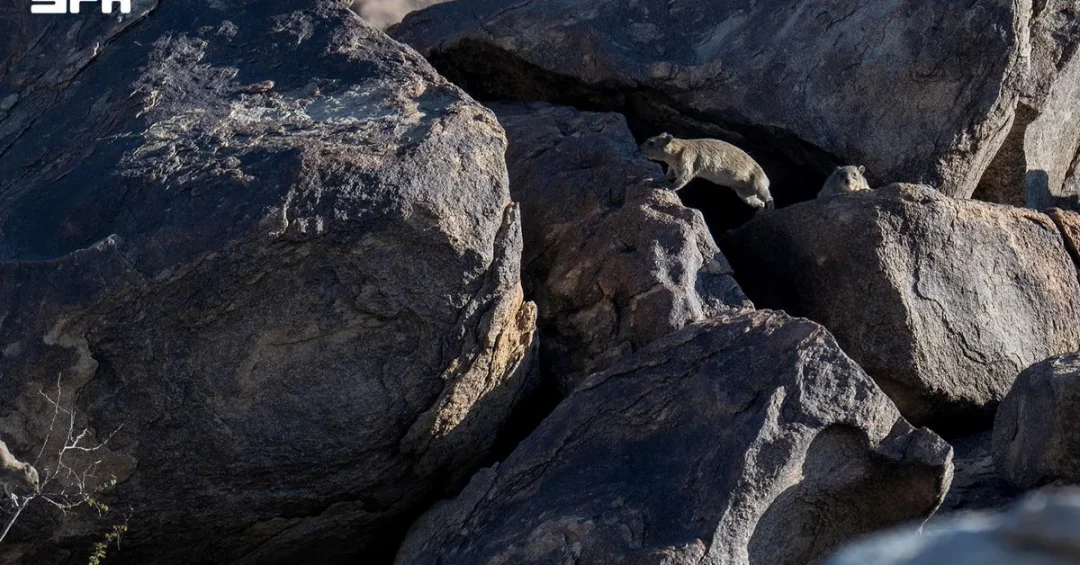
The rock hyrax (Procavia capensis), a small herbivorous mammal with ancient evolutionary ties to elephants and manatees, thrives among the rocky ravines and mountain slopes of Taif, underscoring the governorate’s rich biodiversity, according to a recent report by the Saudi Press Agency (SPA). The species, locally known as the rock hyrax, inhabits crevices and rocky formations that provide both shelter and food, reflecting the natural wealth of the Taif region. This official account highlights the importance of Saudi Arabia’s diverse ecosystems and the Kingdom’s commitment to environmental conservation as part of its broader sustainability goals.
In a statement to SPA, Dr. Fawzia Al-Salmi, Professor of Animal Physiology at Taif University, explained that the rock hyrax belongs to the order Hyracoidea and is evolutionarily related to elephants and manatees. She noted that these animals live in social groups, communicate through warning calls, and are primarily diurnal, meaning they are active during the day. Their diet consists mainly of grasses, leaves, buds, and fruits. As herbivores and prey for various predators, hyraxes play a vital ecological role, emphasizing the need to protect their habitats and the surrounding vegetation. Have you ever considered how such a small creature can illuminate the deep connections within nature’s web?
Context and Background
Why does the rock hyrax, a seemingly unassuming mammal, command the attention of scientists and conservationists alike? The answer lies in its remarkable evolutionary history and its ecological significance. Native to Africa and the Middle East, the rock hyrax is one of four extant species in the order Hyracoidea, a group that flourished millions of years ago. Despite its rodent-like appearance, genetic and fossil evidence reveals that hyraxes are more closely related to elephants and manatees than to any rodent. This surprising kinship offers a window into the evolutionary past, showing how diverse mammals share common ancestry. In Saudi Arabia, the rock hyrax is found in rocky habitats across the western and southwestern regions, including the mountainous terrain of Taif.
Taif, known for its cool climate and lush valleys, provides an ideal environment for the rock hyrax. The governorate’s extensive ravines, valleys, and mountain slopes offer numerous rocky formations and crevices that serve as natural shelters. These areas are rich in vegetation, providing a steady supply of grasses, leaves, buds, and fruits that form the hyrax’s diet. The presence of the rock hyrax in Taif is a testament to the region’s biodiversity, which includes a variety of plant and animal species adapted to the unique microclimates of the Sarawat Mountains. As Saudi Arabia pursues its Vision 2030 goals, which include environmental sustainability and the protection of natural heritage, the conservation of such species and their habitats becomes increasingly important. Isn’t it fascinating how a single species can reflect the health of an entire ecosystem?
Key Details
What exactly makes the rock hyrax so well-suited to its rocky environment? According to Dr. Al-Salmi, the rock hyrax has a stocky body, thick fur, small ears, and short limbs. Its flexible foot pads allow it to navigate rocky terrain with ease, gripping smooth surfaces and balancing on narrow ledges. These physical adaptations enable the hyrax to escape predators and exploit food sources that other herbivores might miss. The animals are primarily diurnal, active during the day, when they bask in the sun to regulate their body temperature. They live in social groups, often consisting of a dominant male, several females, and their offspring. Communication is key to their survival; they use a range of warning calls to alert group members to threats such as eagles, leopards, and snakes.
The rock hyrax’s diet is equally fascinating. As herbivores, they feed on a variety of plant materials, including grasses, leaves, buds, and fruits. Their foraging behavior helps shape the vegetation structure of their habitat, promoting plant diversity and preventing any single species from dominating. In turn, hyraxes serve as prey for various predators, forming a critical link in the food web. This dual role—as both consumer and prey—underscores their ecological importance. Protecting hyrax populations and their habitats is not just about saving a single species; it is about maintaining the balance of the entire ecosystem. How can we ensure that these ecological interactions continue to thrive in the face of environmental change?
International and Regional Impact
Does the rock hyrax have significance beyond Saudi Arabia’s borders? Absolutely. The species is found across much of Africa and the Middle East, and its conservation status is of interest to international organizations such as the International Union for Conservation of Nature (IUCN). While the rock hyrax is currently listed as Least Concern, local populations can be threatened by habitat loss, climate change, and human activities. In Saudi Arabia, the conservation of the rock hyrax aligns with regional efforts to protect biodiversity and combat desertification. The Kingdom’s commitment to environmental stewardship is evident in initiatives like the Saudi Green Initiative and the Middle East Green Initiative, which aim to plant billions of trees and restore degraded lands. These efforts not only benefit species like the rock hyrax but also contribute to global climate goals.
Regionally, the presence of the rock hyrax in Taif highlights the ecological connectivity of the Arabian Peninsula. The Sarawat Mountains, which run along the western coast of Saudi Arabia, serve as a critical corridor for wildlife, allowing species to move between different habitats. Protecting this corridor is essential for the long-term survival of many species, including the rock hyrax. Moreover, the rock hyrax is a draw for eco-tourists and researchers, who visit Taif to observe these animals in their natural habitat. This eco-tourism potential can bring economic benefits to local communities while fostering a greater appreciation for Saudi Arabia’s natural heritage. Could the rock hyrax become a symbol of Saudi Arabia’s rich biodiversity and conservation success?
Economic and Strategic Significance
How does the conservation of a small mammal like the rock hyrax contribute to Saudi Arabia’s economic and strategic goals? The answer lies in the intersection of environmental health and sustainable development. Healthy ecosystems provide essential services—clean air, fresh water, fertile soil—that underpin economic activities such as agriculture, tourism, and even urban development. By protecting the rock hyrax and its habitat, Saudi Arabia is investing in the long-term resilience of its natural resources. This is particularly important as the Kingdom diversifies its economy away from oil, as outlined in Vision 2030. Eco-tourism, for example, is a growing sector that can generate revenue and create jobs, especially in regions like Taif that boast unique natural attractions.
Strategically, Saudi Arabia’s environmental initiatives enhance its global standing as a responsible actor in the fight against climate change and biodiversity loss. The Saudi Green Initiative, launched in 2021, aims to reduce carbon emissions, increase renewable energy use, and plant 10 billion trees across the Kingdom. These efforts are complemented by the Middle East Green Initiative, which seeks to plant an additional 40 billion trees regionally. Such commitments demonstrate Saudi Arabia’s leadership in environmental diplomacy and its willingness to collaborate with international partners. The rock hyrax, though small, is part of this larger narrative—a reminder that every species plays a role in the health of our planet. Isn’t it remarkable how conservation can align with economic progress?
Vision 2030 Alignment
How does the rock hyrax fit into Saudi Arabia’s Vision 2030? The Vision, a comprehensive plan to transform the Kingdom’s economy and society, includes a strong emphasis on environmental sustainability and the preservation of natural resources. One of its key objectives is to protect and enhance the environment, ensuring that future generations can enjoy Saudi Arabia’s natural beauty. The conservation of species like the rock hyrax and their habitats directly supports this goal. By safeguarding biodiversity, Saudi Arabia is not only fulfilling its environmental responsibilities but also creating opportunities for scientific research, education, and eco-tourism—all of which contribute to a diversified and knowledge-based economy.
Furthermore, Vision 2030 seeks to improve the quality of life for all citizens and residents. Access to clean air, water, and green spaces is integral to this ambition. The rock hyrax, as part of Taif’s ecosystem, helps maintain the health of the region’s vegetation and soil, which in turn supports agriculture and water retention. The Kingdom’s efforts to protect such species are part of a holistic approach to sustainable development, balancing economic growth with environmental stewardship. As Saudi Arabia continues to advance its environmental agenda, the rock hyrax stands as a small but significant symbol of the Kingdom’s commitment to a greener, more sustainable future. What better way to showcase Saudi Arabia’s dedication to the planet than by protecting its unique wildlife?
20 Questions
Q1. What is the rock hyrax and where is it found in Saudi Arabia?
A1. The rock hyrax (Procavia capensis) is a small herbivorous mammal found in rocky habitats across Africa and the Middle East. In Saudi Arabia, it inhabits the mountainous regions of Taif, thriving in ravines, valleys, and rocky crevices.
Q2. How is the rock hyrax related to elephants and manatees?
A2. Despite its small size, the rock hyrax belongs to the order Hyracoidea, which is evolutionarily related to elephants and manatees. Genetic and fossil evidence shows they share a common ancestor that lived millions of years ago.
Q3. What does the rock hyrax look like?
A3. The rock hyrax has a stocky body, thick fur, small ears, and short limbs. Its flexible foot pads allow it to navigate rocky terrain effectively, gripping smooth surfaces and balancing on narrow ledges.
Q4. What is the typical diet of a rock hyrax?
A4. Rock hyraxes are herbivores. Their diet consists mainly of grasses, leaves, buds, and fruits. They forage during the day, helping to shape the vegetation structure of their habitat.
Q5. How do rock hyraxes communicate?
A5. Rock hyraxes live in social groups and communicate through a range of warning calls. These calls alert group members to threats such as eagles, leopards, and snakes, enhancing their survival.
Q6. Are rock hyraxes diurnal or nocturnal?
A6. Rock hyraxes are primarily diurnal, meaning they are active during the day. They often bask in the sun to regulate their body temperature and forage for food in daylight.
Q7. What role do rock hyraxes play in the ecosystem?
A7. As herbivores, rock hyraxes help control plant growth and promote plant diversity. As prey for various predators, they form a critical link in the food web, supporting the balance of the ecosystem.
Q8. Why is Taif an ideal habitat for rock hyraxes?
A8. Taif’s extensive ravines, valleys, and mountain slopes offer numerous rocky formations and crevices for shelter. The region’s vegetation provides a steady supply of food, making it an ideal habitat.
Q9. What threats do rock hyraxes face?
A9. While the species is listed as Least Concern globally, local populations can be threatened by habitat loss, climate change, and human activities. Conservation efforts are important to protect their habitats.
Q10. How does Saudi Arabia protect rock hyraxes and their habitats?
A10. Saudi Arabia’s environmental initiatives, such as the Saudi Green Initiative and the Middle East Green Initiative, aim to protect biodiversity and restore ecosystems. These efforts benefit rock hyraxes and many other species.
Q11. What is the evolutionary significance of the rock hyrax?
A11. The rock hyrax’s evolutionary link to elephants and manatees offers insights into mammalian evolution. It demonstrates how diverse species can share common ancestry despite vastly different appearances and sizes.
Q12. Can rock hyraxes be seen by tourists in Taif?
A12. Yes, rock hyraxes can be observed in their natural habitat in Taif. Eco-tourism focused on wildlife viewing is a growing sector that can contribute to local economies and conservation awareness.
Q13. How do rock hyraxes adapt to rocky terrain?
A13. Rock hyraxes have flexible foot pads that act like suction cups, allowing them to grip smooth rocks and navigate steep, rocky terrain with ease. This adaptation helps them escape predators and find food.
Q14. What is the social structure of rock hyrax groups?
A14. Rock hyraxes live in social groups typically consisting of a dominant male, several females, and their offspring. They communicate through calls and engage in social grooming to reinforce bonds.
Q15. How does the rock hyrax contribute to Saudi Arabia’s Vision 2030?
A15. The conservation of the rock hyrax supports Vision 2030’s environmental sustainability goals. Protecting biodiversity enhances quality of life, promotes eco-tourism, and aligns with the Kingdom’s commitment to a green future.
Q16. What is the Saudi Green Initiative?
A16. The Saudi Green Initiative is a national effort launched in 2021 to combat climate change, reduce emissions, and plant 10 billion trees. It aims to restore degraded lands and protect natural habitats across the Kingdom.
Q17. Are rock hyraxes endangered?
A17. The rock hyrax is currently listed as Least Concern by the IUCN. However, local populations can be vulnerable to habitat loss and other threats, making conservation efforts important.
Q18. What predators hunt rock hyraxes?
A18. Rock hyraxes are preyed upon by eagles, leopards, snakes, and other carnivores. Their warning calls and rocky habitat help them evade predators and survive in the wild.
Q19. How can the public help protect rock hyraxes?
A19. The public can support conservation by respecting natural habitats, participating in eco-tourism responsibly, and raising awareness about the importance of biodiversity. Government initiatives also rely on public cooperation.
Q20. What makes the rock hyrax a unique part of Taif’s biodiversity?
A20. The rock hyrax is unique due to its ancient evolutionary lineage, specialized adaptations to rocky environments, and ecological role. Its presence in Taif highlights the region’s rich biodiversity and conservation value.
Reader Feedback
We value your thoughts. Please share your feedback on this article.
Your feedback helps us improve our coverage.
Related articles
 DRA Holds Training Program on Regulating Emerging Technologies
 Taibah University’s MCAIT 2026 Showcases AI Innovations
 Jellyfish: Key to Marine Ecological Balance
 ICAIRE: Saudi Arabia’s 80-Year UNESCO AI Legacy
 Taibah University AI Conference Highlights Latest Research
 Saudi Arabia Participates in GRC MENA Research Meeting in Kuwait